
Embroidery Machines for Garment Decoration

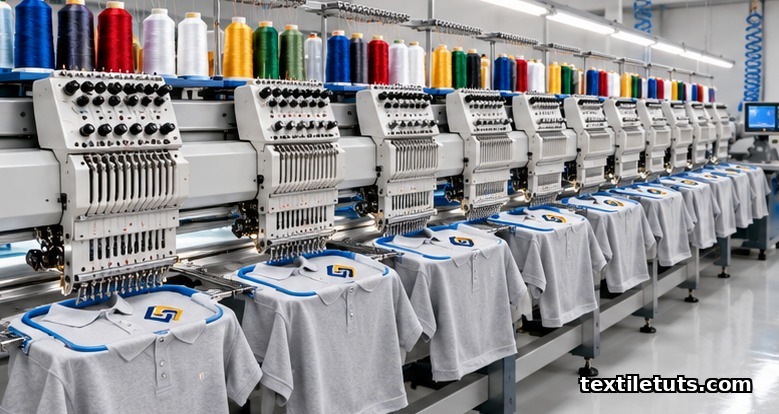
Industrial embroidery machines for garment decoration typically operate at 400 to 1,500 stitches per minute (SPM), with single-needle home machines running 400 to 650 SPM and multi-head production machines reaching 850 to 1,500 SPM across 4 to 24 heads.
The right embroidery machine for a garment decoration shop depends on three measurable factors: stitches per minute, hoop (frame) size, and the number of needles per head. Each of these maps directly to throughput, design size, and the variety of threads a shop can run without re-threading.
This article walks through the machine classes (home, commercial single-head, industrial multi-head), the standards that govern stitch and seam quality (ISO 8230, ASTM D1683, AATCC TM-110), and the spec sheet a textile engineer uses to compare models side by side.
What Is an Embroidery Machine?
An embroidery machine is a sewing machine variant that carries a programmable X-Y frame instead of a free-arm fabric feed. Thread is fed through a needle that moves along two axes driven by stepper or servo motors, building a stitch pattern from digitized artwork rather than from operator-guided sewing. The stitch formation is lockstitch in most machines, conforming to ISO 4918 stitch type 301.
The key difference from a standard sewing machine is automation: stitch direction, density, and color changes are dictated by a digitized file (commonly DST, PES, or TAP format), and a pantograph moves the hoop under the needle to execute the design. The needle itself remains largely stationary while the frame translates, allowing exact reproduction of the same design across hundreds of garments.
Modern embroidery machines also include automatic thread trimming, color-change sequencing, and bobbin-winding monitors. These features reduce operator intervention and increase effective machine utilization, which is the real productivity metric a textile engineer tracks, since raw SPM is rarely the bottleneck.
Machine Classes for Garment Decoration
Embroidery machines for garment decoration fall into three operational classes:
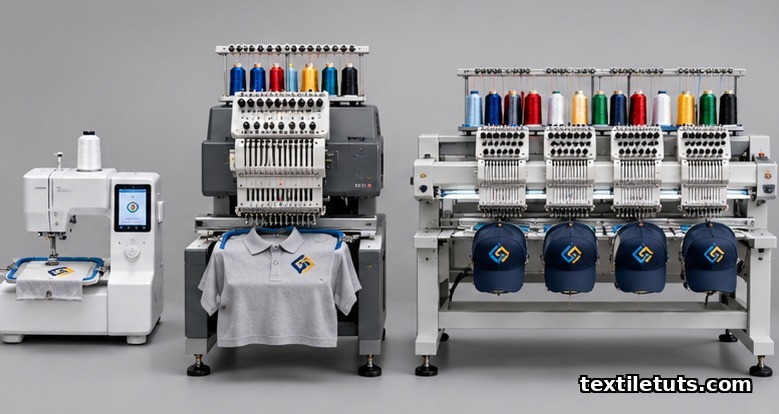
- Home/hobby embroidery machines: 1 to 2 needles, single head, 4″x4″ to 8″x12″ hoop field, 400 to 650 SPM. Suitable for monogramming, patches, and small designs on a single garment at a time.
- Commercial single-head machines: 10 to 15 needles, single head, 14″x14″ to 14″x18″ hoop field, 800 to 1,000 SPM. Used by small decoration shops, custom apparel brands, and on-demand production.
- Industrial multi-head machines: 4 to 24 heads, 6 to 15 needles per head, 14″x20″ to 24″x36″ hoop field, 850 to 1,500 SPM per head. Used by contract embroiderers producing 500 to 50,000+ identical pieces per run.
Major industrial manufacturers include Tajima (Japan), Barudan (Japan), SWF (South Korea), ZSK (Germany), and HappyJapan (Japan). For commercial single-head machines, Brother, Janome, and Melco dominate the North American and European markets. Pricing scales roughly with head count and SPM: a hobby machine runs $300 to $3,000, a commercial single-head runs $5,000 to $25,000, and an industrial 12-head production machine runs $80,000 to $300,000+.
Key Specifications to Compare
When evaluating embroidery machines for garment decoration, the textile engineer’s comparison sheet typically tracks the following parameters. Throughput scales most strongly with head count and SPM, while design size is limited by the largest hoop the machine can fit.
| Spec | Home/Hobby | Commercial Single-Head | Industrial Multi-Head |
|---|---|---|---|
| Stitches per minute (max) | 400 to 650 | 800 to 1,000 | 850 to 1,500 |
| Needles per head | 1 to 2 | 10 to 15 | 6 to 15 |
| Number of heads | 1 | 1 | 4 to 24 |
| Max hoop field (inches) | 8×12 | 14×18 | 24×36 |
| Bobbin type | Plastic, drop-in | Plastic or metal | Metal, auto-thread |
| File formats | PES, JEF, DST | PES, DST, EXP | DST, TAP, DSB |
| Price range (USD) | $300 to $3,000 | $5,000 to $25,000 | $40,000 to $300,000+ |
| Typical monthly output | 50 to 200 pcs | 300 to 2,000 pcs | 5,000 to 50,000+ pcs |
Stitch and Seam Quality Standards
Garment decoration embroidery is governed by several ISO, ASTM, and AATCC standards that define minimum quality thresholds. A shop that ignores these standards risks producing garments that fail wash testing, tear at seams, or fail customer inspection.
- ISO 8230: Safety requirements for textile machinery, including embroidery machines. Covers electrical, mechanical, and ergonomic hazards. CE-marked machines sold in the EU conform to this standard.
- ISO 4918: Stitch types and seam classifications used in embroidery. Most embroidery uses lockstitch (Type 301) or chainstitch (Type 101).
- ASTM D1683: Standard test method for failure in sewn seams of woven fabrics. Used to evaluate the seam strength of embroidered garments.
- AATCC TM-110: Colorfastness to washing at 40 °C. Critical for embroidered textiles that will be laundered commercially or domestically.
- AATCC TM-61: Colorfastness to laundering, accelerated. Most embroidered apparel is tested to TM-61 Grade 3A or higher.
A properly embroidered logo on a polo shirt should retain at least 80% of its thread color after 5 wash cycles per AATCC TM-61, with no visible thread breakage at seams per ASTM D1683. Shops that fail these tests typically have either incorrect thread tension (the most common cause), wrong needle size, or inadequate stabilizer for the substrate.
Threads, Needles, and Stabilizers
The embroidery machine is only as good as its consumables. The textile engineer’s checklist for garment decoration consumables:
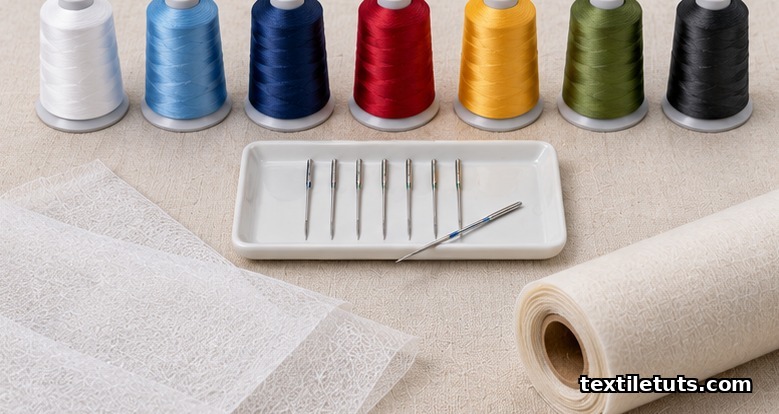
- Thread: Polyester 40-weight (Tex 27, ~75 denier) is the industry standard for embroidered apparel due to its wash durability and colorfastness. Rayon 40-weight is used for decorative sheen but has lower wash durability under AATCC TM-61 testing. Polyester trilobal is a middle-ground option for high-sheen logos on performance wear.
- Needles: Size 65/9 to 80/12 for general garment work. Ballpoint needles for knit fabrics, sharp (setpoint) needles for woven fabrics and caps. A 75/11 ballpoint is the default for polo-shirt embroidery on 200 to 220 GSM piqué knits.
- Stabilizer: Cut-away for knits, tear-away for wovens, water-soluble for freestanding lace. Weight should match the fabric weight; under-stabilization causes puckering, over-stabilization makes the garment feel stiff and scratchy against the skin.
- Bobbin thread: Pre-wound polyester 60-weight bobbins (Tex 18) reduce bobbin-change frequency and produce consistent stitch formation. Pre-wound bobbins also reduce lint buildup compared to shop-wound bobbins.
Maintenance and Daily Care
Industrial embroidery machines require daily and weekly maintenance to keep stitch quality consistent. A maintenance log is a common requirement for shops certified to ISO 9001 quality management.
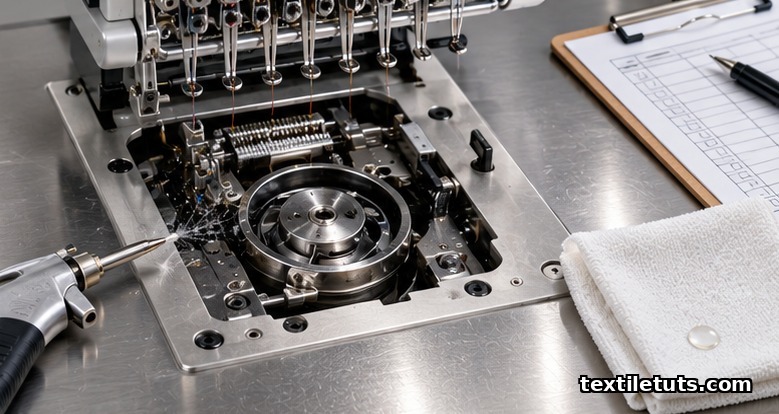
- Daily: Blow out lint from the bobbin area and needle bar with compressed air (max 30 psi). Wipe the hook race with a lint-free cloth and a drop of sewing-machine oil. Check thread tension springs for wear.
- Weekly: Remove the needle plate and clean the feed dog area. Inspect the rotary hook for burrs. Test stitch formation on scrap fabric at the start of each shift.
- Monthly: Replace needles after 8 hours of running time, or sooner if sewing abrasive fabrics like denim or canvas. Calibrate thread tension using a tension meter on at least one needle per head.
- Annually: Have a service technician verify servo motor alignment, pantograph backlash (typically held under 0.05 mm), and rotary hook timing. Replace belts and bearings as preventive maintenance.
Choosing the Right Machine for Your Shop
The decision tree for selecting an embroidery machine for garment decoration starts with monthly volume, then design size, then substrate mix.
- Under 200 garments per month: A commercial single-head with 10 to 15 needles is the right starting point. Most startup apparel brands and small Etsy shops fall here.
- 200 to 5,000 garments per month: A 4-head to 6-head industrial machine is the next step. Expect throughput around 200 to 400 garments per shift per head depending on design complexity.
- Over 5,000 garments per month: A 12-head to 24-head production line is required. At this volume, design loading time and operator efficiency become the bottleneck, not raw SPM.
Cap embroidery, jacket-back embroidery, and 3D puff embroidery all require specific hoop types and needle bar configurations that may not be available on every machine. Verify machine compatibility before committing to a model, especially for puff embroidery, which requires a special needle bar that can lift the thread above the fabric surface.
Frequently Asked Questions
How many stitches per minute do I need for a small garment decoration shop?
For a small shop running 50 to 100 garments per day, 800 SPM is the practical minimum. Below 650 SPM, hoop loading and design changes dominate cycle time, making stitch rate less important than uptime and design complexity. Many successful shops run at 1,000 SPM on commercial single-head machines and never push higher.
What is the difference between a single-head and a multi-head embroidery machine?
A single-head machine has one needle bar and one set of needles, producing one garment per cycle. A multi-head machine duplicates the needle bar 4 to 24 times in parallel, producing 4 to 24 identical garments per cycle. Throughput scales linearly with head count up to about 12 heads; beyond that, design loading and bobbin changes become the bottleneck.
What hoop size do I need for a left-chest logo?
A standard 4″x4″ hoop covers a left-chest logo up to about 3.5″x3.5″ finished size. For full-front designs on a t-shirt or jacket back, a 14″x18″ or larger hoop is needed. Most commercial shops standardize on a 14″x14″ tubular hoop, which covers around 90% of decoration jobs and can be rotated for non-square designs.
Why does my embroidered logo pucker on knit fabrics?
Puckering on knits is caused by insufficient stabilizer, incorrect thread tension, or sewing too tightly. Use a cut-away stabilizer matched to the knit weight (typically 2.5 oz/sq yd for polo-weight knits), reduce upper thread tension by 10 to 15%, and verify the needle is a 75/11 ballpoint rather than a sharp needle, which can pierce knit fibers and cause runs.
How do I verify that an embroidery machine meets safety standards?
Industrial embroidery machines sold in major markets carry CE marking (EU), UL listing (US/Canada), or equivalent national certifications, indicating conformity with ISO 8230 textile-machinery safety requirements. Verify the certification mark on the machine nameplate before purchase; uncertified machines are typically not covered by standard shop insurance policies.
References
- ISO. ISO 8230: Safety requirements for textile machinery. iso.org — covers electrical, mechanical, and ergonomic safety for embroidery machines.
- ISO. ISO 4918: Textiles — Stitch types and seam classifications. iso.org — defines lockstitch (Type 301) and chainstitch (Type 101) used in embroidery.
- ASTM International. ASTM D1683: Standard Test Method for Failure in Sewn Seams of Woven Fabrics. astm.org — method to evaluate seam strength after embroidery.
- AATCC. AATCC TM-110: Colorfastness to Washing at 40 °C. aatcc.org — wash-fastness test for embroidered apparel.
- AATCC. AATCC TM-61: Colorfastness to Laundering: Accelerated. aatcc.org — accelerated laundering test for embroidered textiles.
- ResearchGate. Effect of Embroidery Parameters on Seam Performance of Knitted Fabrics. researchgate.net — peer-reviewed study on stitch density and seam strength in embroidered knit garments.
- MDPI. Influence of Stitch Density on the Mechanical Properties of Embroidered Fabrics. mdpi.com — open-access study on how stitch density affects tensile strength and elasticity.
This article is the working reference for embroidery machine selection in garment decoration. Editorial by Mohammad Yousuf (Anik), TextileTuts. Sources: ISO 8230, ISO 4918, ASTM D1683, AATCC TM-110, AATCC TM-61, ResearchGate, MDPI as cited.


