
Why Indigo Blue Defines Denim

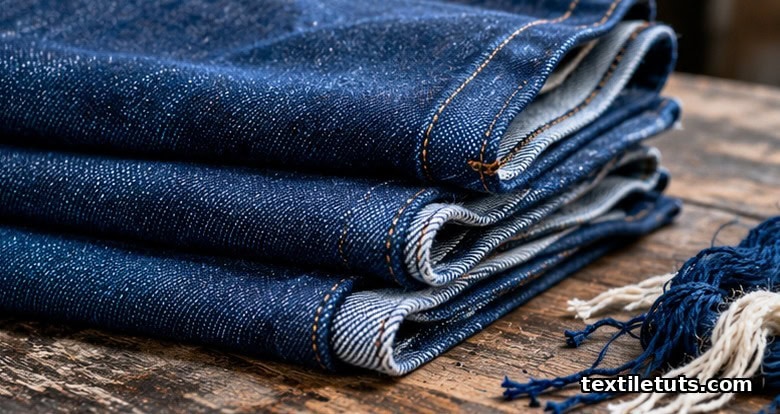
The blue jean as Americans know it is, chemically, a single dye applied to a single type of yarn. Indigo, a vat dye first isolated from plants of the genus Indigofera and now produced almost entirely by synthetic routes, is responsible for the color that defines denim. Understanding how indigo is reduced, applied, oxidized, and fixed on cotton warp yarn explains the fades, the crocking, the ring-dye patterns, and the way a pair of jeans changes color over years of wear.
Indigo is a pigment when dry, a dye only when reduced. That single fact controls the entire industrial process. The dye molecule itself, indigotin (C16H10N2O2) – has been characterized in detail since the late 19th century and is now reproduced at scale by BASF, DyStar, and other manufacturers through routes first developed by Karl Heumann in 1890. Its low aqueous solubility and high affinity for cotton under reducing conditions are what make the warp-only dyeing of denim possible.
Natural vs Synthetic Indigo: Indigo Carmine and Indigotin
Two molecules dominate the discussion: indigo carmine and indigotin. Indigo carmine (C16H8N2Na2O8S2) is the water-soluble sulfonate derivative used as a food colorant and pH indicator; it is not what dyes denim. Indigotin is the actual chromophore in denim. Synthetic indigo, manufactured by the Heumann process starting from aniline, is chemically identical to plant-derived indigo, the absorption maxima, the X-ray crystal structure, and the reduction behavior all match (Venkataraman, The Chemistry of Synthetic Dyes, Vol. 2, 1952). The “natural vs synthetic” distinction is largely about trace impurities, batch consistency, and price, not about the color itself.
Modern denim mills use synthetic indigo almost exclusively. Global production of synthetic indigo exceeds 50,000 tonnes per year, and the dye is supplied in granular or 20% pre-reduced liquid forms. Pre-reduced indigo is the industry default because it removes the prereduction step at the mill and ships as a stable, oxygen-free liquid that reoxidizes predictably in the dye bath.
The Reduction–Oxidation Chemistry of Vat Dyeing
Indigo is a vat dye: it is applied in its reduced (leuco) form and then reoxidized inside the fiber to its insoluble blue form. The reduction step is performed with sodium hydrosulfite (sodium dithionite, Na2S2O4) in a strongly alkaline bath, typically with sodium hydroxide to keep the pH above 11. The reduced form, leuco-indigo, is a yellow-green solution of the disodium salt of the dihydro compound:
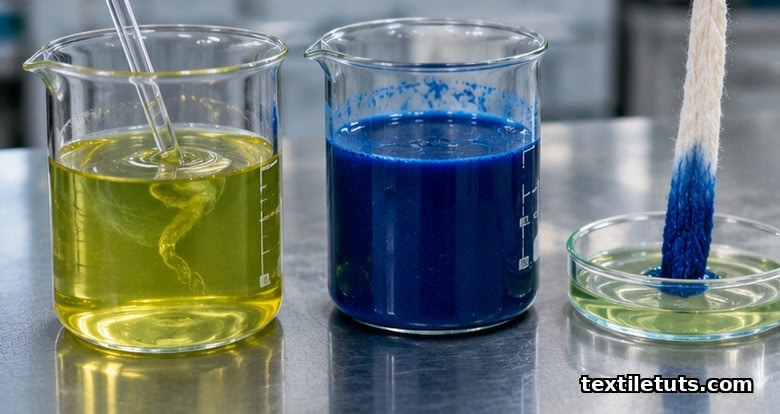
indigo (blue, insoluble) + Na2S2O4 + 2 NaOH → leuco-indigo (yellow, soluble)
When cotton yarn is dipped into this bath, the leuco form diffuses into the outer layers of the fiber. Upon withdrawal into air, the dissolved oxygen reoxidizes leuco-indigo back to the insoluble blue pigment, trapping it mechanically inside the fiber:
leuco-indigo + ½ O2 → indigo + H2O
This reduction–oxidation cycle is the heart of every indigo dyeing recipe. Mills control shade depth by controlling the number of “dips and nips” – each immersion followed by air exposure deposits another thin layer of pigment. Color fastness depends on how completely each layer has reoxidized before the next dip; insufficient air exposure between dips leaves residual leuco form that rubs off as crocking.
Ring Dyeing vs Surface Dyeing
Indigo does not penetrate to the core of a cotton fiber during normal rope dyeing. Because the leuco form has only moderate substantivity and the dip time is short (typically 15–30 seconds), the dye deposits as a thin shell on the outer circumference of each fiber. This phenomenon is called ring dyeing and is the physical basis for denim’s characteristic fade behavior.
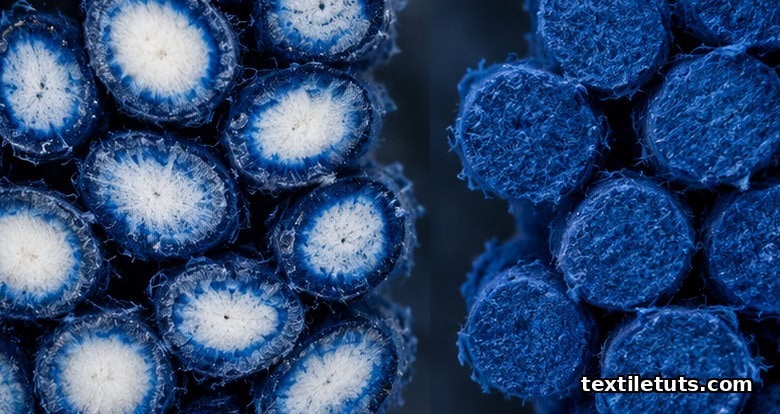
The ring-dyed cross-section leaves the center of each cotton fiber white. As the jeans are worn and washed, the surface pigment erodes and exposes the undyed core, producing the high-contrast fades prized in raw denim. Surface dyeing, by contrast, would color the fiber uniformly and produce flatter, slower-fading jeans.
This behavior has been documented quantitatively. Textile Research Journal studies using fiber cross-section microscopy consistently show that indigo penetration depth in rope-dyed yarn is typically 20–40% of the fiber radius, depending on yarn count, dye bath temperature (typically 20–30 °C), and number of dips (Paul, R., “Denim: Manufacture, Finishing and Applications”, Woodhead Publishing, 2015).
Dye Penetration and Color Yield
Several factors control how deeply indigo penetrates and how much dye is fixed per unit of cotton weight:
Yarn count. Coarser yarns (Ne 6 to Ne 10) show shallower ring-dye penetration than finer yarns, because the dip time relative to fiber circumference is shorter.
Number of dips. Modern indigo ranges run 6 to 12 dips. Each dip deposits a thin layer of pigment; the total K/S (color strength) value rises roughly linearly with dip count until the saturation point.
Bath temperature. Lower temperatures (20–25 °C) favor ring dyeing and sharper fades; higher temperatures (40–50 °C) drive more uniform penetration and duller final color.
Reducing agent concentration. Excess hydrosulfite produces a more fully reduced bath and marginally deeper shade, but excessive reducing power also strips previously deposited layers during subsequent dips, a phenomenon that limits how deep a single-pass indigo range can go.
For deep “indigo black” effects, mills often top the indigo with a sulfur bottom that does penetrate the fiber more uniformly, then finish with an indigo face. This is a hybrid ring/surface-dyed construction and is one of the workarounds used to achieve visually darker, fast-fading denim.
Color Fastness: Crocking, Washing, and Light
Color fastness is the practical measure of how indigo holds up to wear. Three tests dominate denim specification:
Crocking fastness – measured by AATCC TM-8 (or ISO 105-X12), the test rubs a dry and wet crock cloth against the dyed fabric under controlled pressure. Crocking grade 3 or higher is typical for well-oxidized, well-washed indigo denim. Crocking grade 1–2 is the classic complaint with poorly reoxidized raw denim, where excess surface pigment transfers onto everything the wearer touches.
Wash fastness – measured by AATCC TM-61 (or ISO 105-C06), this evaluates how much indigo bleeds out during laundering. Because indigo is not chemically bonded to the cotton (it is trapped mechanically as a pigment), wash fastness is inherently limited. Indigo denim in a wash test will always lose color; the question is how much. Typical wash-fastness ratings for indigo denim range from 2 to 4 on the gray scale.
Light fastness – measured by AATCC TM-16 (or ISO 105-B02), light fastness is one of indigo’s strengths. Indigotin is rated Blue Wool 7–8, meaning moderate lightfastness for apparel use. This is why vintage denim can retain visible blue decades later while other dyes in the same garment have faded.
Industrial Indigo Dyeing: The Rope Range
Continuous indigo dyeing is performed on a rope range. Hundreds of cotton warp ends are gathered into a rope, passed through the dye box for 15–30 seconds, squeezed through padder rolls, and exposed to air for 60–120 seconds before re-entering the bath. A typical six-dip range runs 60 meters of rope path with six separate dye boxes and air-oxidation sections. Modern ranges from Morrison Textile Machinery, Kusters, and Benninger operate at speeds up to 40 meters per minute.
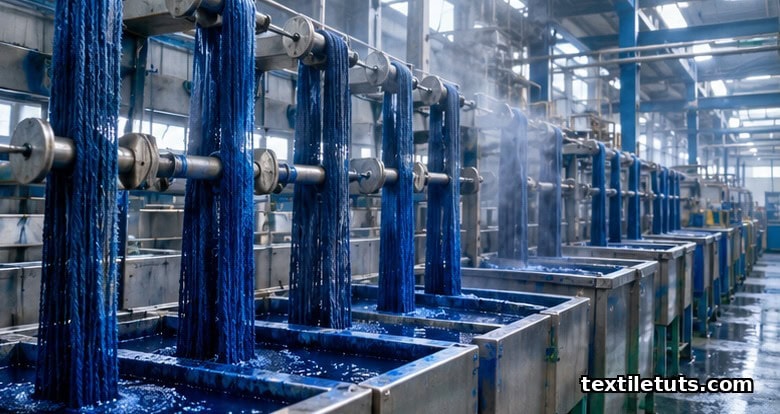
Slashing follows dyeing: the dyed warp is passed through a size bath (typically starch or modified starch) and dried on cylinders to protect the warp during weaving. The dye liquor chemistry, oxidation time, and squeeze-roll pressure are all controlled centrally. Shade depth is monitored on-line with color sensors, and the liquor is replenished automatically to keep K/S within tolerance.
FAQ: Indigo Dyeing on Denim
What is the difference between indigo and indigo carmine?
Indigo carmine is the water-soluble sodium sulfonate derivative of indigo, used as a food colorant (FD&C Blue #2) and a histological stain. It is not used to dye denim. Denim is dyed with indigotin, the parent vat dye molecule that must be reduced to a soluble leuco form before application.
Why does indigo dye only the surface of cotton yarn?
The short dip time, low substantivity of the leuco form, and air oxidation together deposit pigment only in the outer 20–40% of each fiber’s radius. This ring-dye structure is responsible for denim’s signature fade pattern, in which the undyed core becomes visible as the surface pigment abrades.
What reducing agent is used in commercial indigo dyeing?
Sodium hydrosulfite (sodium dithionite, Na2S2O4) in a strongly alkaline (NaOH) bath. The reduction step converts insoluble blue indigo into soluble yellow leuco-indigo, which has affinity for cotton. After impregnation, atmospheric oxygen reoxidizes the leuco form back to blue indigo inside the fiber.
How is indigo color fastness measured?
Color fastness is tested under AATCC TM-8 (crocking), AATCC TM-61 (laundering), and AATCC TM-16 (light). Indigo typically scores 3–4 on crocking, 2–4 on washing (limited by mechanical rather than chemical bonding), and 7–8 on light fastness, one of the strengths of indigotin as a textile colorant.
Can indigo be applied without a reduction bath?
No. Indigo is insoluble in water and has no affinity for cotton in its oxidized (blue) form. Only the chemically reduced leuco-indigo is water-soluble and substantive to cellulose. This is why every indigo dyeing process, historical or modern, includes a reduction step and an oxidation step.
References
- Venkataraman, K. The Chemistry of Synthetic Dyes, Vol. 2. Academic Press, 1952.
- Paul, R. (ed.). Denim: Manufacture, Finishing and Applications. Woodhead Publishing, 2015.
- AATCC Technical Manual, Test Methods 8, 16, and 61. American Association of Textile Chemists and Colorists, 2023.
- ISO 105 series: Textiles, Tests for Colour Fastness. International Organization for Standardization.
- Chakraborty, J.N. Fundamentals and Practices in Colouration of Textiles. Woodhead Publishing India, 2014.
- Needles, H.L. Textile Fibers, Dyes, Finishes, and Processes. Noyes Publications, 1986.
- Burgess, G. “Indigo Dyeing of Cotton Warp Yarns: Process Control and Quality.” Textile Chemist and Colorist, Vol. 28, No. 4, 1996.
Editorial by Shahrukh Islam, TextileTuts


