
Selvedge Denim Identification

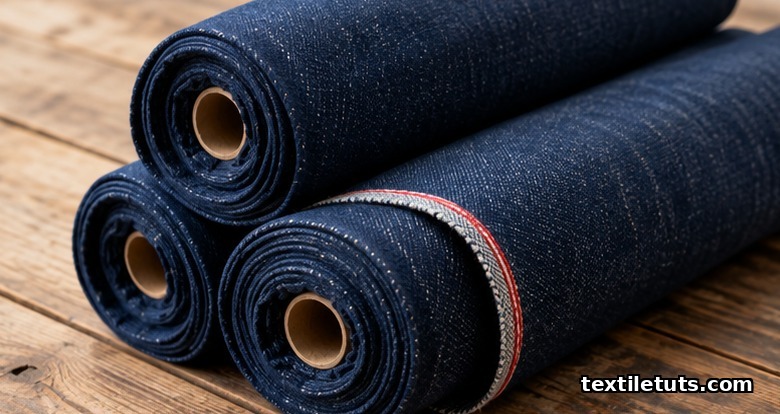
Selvedge denim is woven on shuttle looms at 75-83 cm (29-32 inch) fabric widths with a self-finished edge marked by a 2-3 mm colored yarn stripe running along the lengthwise border, distinguishing it from the cut-and-overlocked edges of 150-165 cm wide projectile-loom denim. The selvedge itself cannot fray because the weft yarn turns back at each end of the loom pass, locking the warp yarns in place. This construction is the single most reliable identifier when the edge of a garment is visible.
This guide covers how to read the selvedge ID at the cuff, what fabric width tells you about the loom, which yarn and weave characteristics confirm the construction, and how selvedge compares to modern non-selvedge denim on measurable textile properties.
What “Selvedge” Actually Means
The word “selvedge” comes from “self-edge.” On a shuttle loom, a single weft yarn is carried back and forth across the warp by a wooden shuttle, turning at each edge to begin the next row. That turning motion loops the weft back into the warp, producing a tight, finished edge that does not need hemming or overlocking to remain stable. On a modern projectile, rapier, or air-jet loom, the weft is cut at each edge and tucked back by a needle, leaving a soft, fraying-prone edge that mills must finish before cutting patterns.
Selvedge denim therefore identifies itself by the physical edge of the fabric. When you turn up a cuff or open an outseam on a well-made pair of jeans, the selvedge line should appear as a narrow, woven stripe running parallel to the seam. It is structural, not printed or sewn-on, and cannot be removed without destroying the fabric.
How to Identify Selvedge Denim at the Cuff
The fastest field check is the cuff test. Turn the bottom of a jeans leg upward 3-5 cm to expose the inside of the outseam. On selvedge denim you will see:
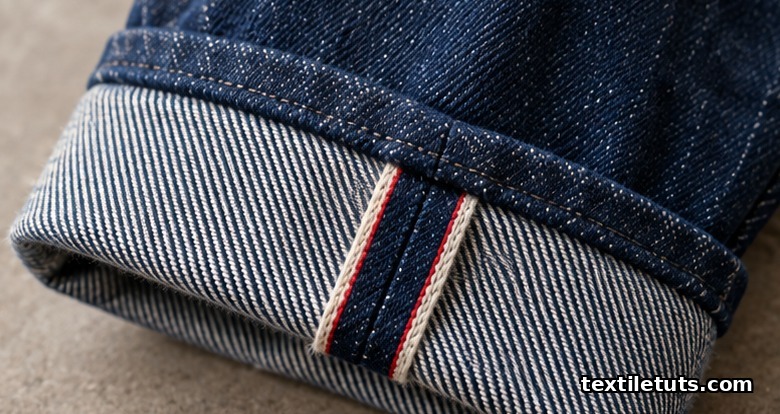
- A narrow woven band, typically 1.5-2 cm wide, running along the lengthwise edge of the fabric.
- A distinct colored line (red, gold, orange, white, or alternating combinations) embedded as one or two warp yarns within that band.
- A noticeably tighter weave at the edge compared with the body of the fabric, with no loose weft tails or serged thread.
If the inside of the cuff shows a serged or overlocked edge, a folded-and-stitched hem, or a printed tape, the denim is almost certainly not selvedge. Modern manufacturing can mimic the look by attaching decorative selvedge tape to the outseam, so always verify that the stripe is woven into the fabric itself rather than applied as a strip.
Reading the Selvedge ID Color Code
Mills traditionally used the selvedge color to identify their fabric to garment factories. Several of these color codes became semi-standard through 20th-century workwear manufacturing:
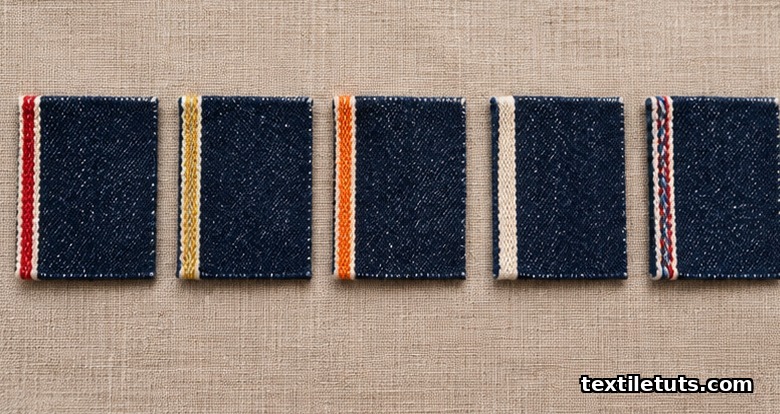
- Red: Most commonly associated with Cone Mills (White Oak, USA) and with Levi’s 501 through much of the 20th century.
- Gold or yellow: Used by several Japanese mills and historically by Lee.
- Orange: Wrangler’s heritage identification.
- White or natural: Common on Japanese selvedge mills producing undyed or natural indigo.
- Multiple alternating colors: Often indicates a specific mill, run number, or designer collaboration.
The color itself is not a guarantee of authenticity. Japanese selvedge denim from mills such as Kuroki, Kaihara, and Nihon Menpu each use their own ID colors, and the same shade of red can come from very different yarn sources. Treat the color as a mill hint rather than a certification mark.
Fabric Width and Loom Type Clues
Fabric width is the strongest indirect indicator of selvedge construction. Shuttle looms can only weave narrow fabric, typically 75-83 cm (29-32 inches) in the warp direction. Projectile and rapier looms can weave 150-165 cm (59-65 inches) or wider, which is why the modern denim industry standardized on wide fabric. If a garment is cut from fabric wider than approximately 90 cm, it almost certainly did not come off a shuttle loom.
You can usually detect width by looking at how the fabric is cut. A pair of jeans sized for a 32-inch waist needs roughly 80 cm of usable fabric across the body if cut from selvedge, leaving only narrow trim pieces offcut from the selvedge roll. Non-selvedge production can cut the same jeans from a 150 cm roll with much higher yield. The pattern of waste fabric at a denim mill is itself an identifier of the loom type that produced it.
Yarn and Weave Characteristics
Selvedge denim is typically woven from ring-spun yarn rather than open-end (rotor-spun) yarn. Ring spinning drafts and twists the fibers through a rotating spindle, producing a stronger, more irregular yarn with visible slubs and a softer hand. Open-end spinning breaks the fiber staple into smaller segments and twists them in a rotor, producing a more uniform but weaker yarn with a coarser hand. The yarn character affects fading: ring-spun indigo yarns fade into higher-contrast vertical patterns, while open-end yarns fade into a flatter, more uniform blue.
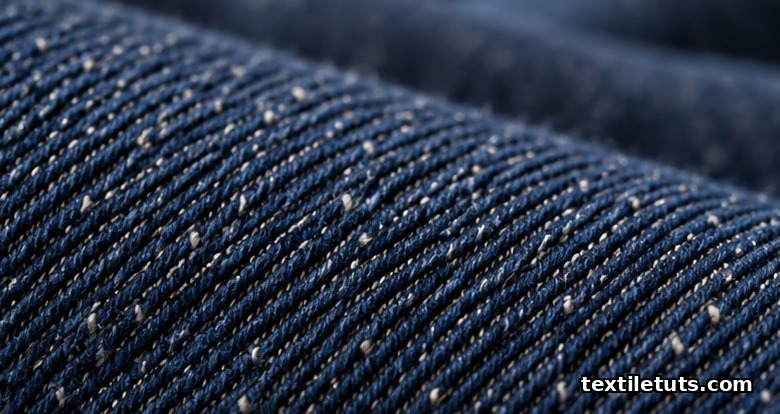
Most heritage and Japanese selvedge denim uses a 3×1 right-hand twill (warp-faced twill where the warp covers three-quarters of the fabric face), though left-hand twill and broken twill variants exist. Twill direction affects how the denim fades: right-hand twill typically fades with sharp vertical lines, while left-hand twill softens into a smoother diagonal wear pattern. Standard test methods for mass per unit area (ASTM D3776/D3776M and ISO 3801) confirm that heritage selvedge denim usually falls in the 12-16 oz/yd² (407-543 g/m²) range, though weights from 9 oz/yd² to over 20 oz/yd² are produced by specialist mills.
Selvedge vs Non-Selvedge Denim at a Glance
| Property | Selvedge Denim | Non-Selvedge Denim |
|---|---|---|
| Loom type | Shuttle | Projectile, rapier, or air-jet |
| Typical fabric width | 75-83 cm (29-32 in) | 150-165 cm (59-65 in) |
| Edge finish | Self-finished (selvedge) | Cut, often overlocked or hemmed |
| Common yarn type | Ring-spun, slubby | Open-end or ring-spun, more uniform |
| Typical weight | 12-16 oz/yd² (407-543 g/m²), wider range possible | 10-14 oz/yd² (340-475 g/m²) |
| Visible ID | Colored stripe at outseam when cuffed | None; cut edge or overlock only |
Common Misidentifications
Three things are routinely mistaken for selvedge:
- Decorative selvedge tape sewn into an outseam on a non-selvedge garment, which imitates the look without the construction.
- Chino or workwear fabrics that share a similar narrow loom heritage (such as US Army sateen) but use different fibers and dyes.
- Reissue denim that is selvedge in construction but has had the edge bleached, sanded, or hidden in the pattern layout.
A truly selvedge garment should let you turn a cuff at the outseam and see the colored stripe continuously, without tape, printed markings, or finishing that obscures the woven edge.
Frequently Asked Questions
Is all selvedge denim Japanese?
No. Selvedge denim was woven in the United States (most famously at Cone Mills White Oak until its closure in the late 2010s) and across Europe before Japanese mills became the dominant supply in the 2000s. Japanese mills such as Kuroki, Kaihara, and Nihon Menpu produce the majority of new selvedge today, but the construction itself originated in shuttle-loom weaving traditions worldwide.
Does heavier selvedge denim mean better quality?
Not necessarily. Mass per unit area (measured by ASTM D3776/D3776M or ISO 3801) above 16 oz/yd² (543 g/m²) requires denser yarn packing, which can reduce tear strength (ASTM D5034 grab test) and increase break-in time. Many high-quality selvedge denims are woven at 12-14 oz/yd² (407-475 g/m²) for balanced wear. Quality comes from yarn selection, dye depth, and finishing control, not from weight alone.
Can you wash selvedge denim?
Yes, but indigo crocking and dye loss are normal. Cold water washing inside-out with a neutral detergent (pH 6-8), reduced agitation, and air drying preserves both the dye and the weave. ISO 105-C06 wash-fastness ratings and AATCC TM 16 colorfastness to light data on the specific fabric are the proper reference points for care decisions, not the selvedge label alone.
Why does selvedge denim cost more?
Shuttle looms run roughly 5-10 times slower than modern projectile looms at 75-83 cm width, so the same meter of fabric costs more to weave. Narrow fabric also produces more mill waste per garment. The premium reflects weaving time and lower throughput, not necessarily better fiber chemistry.
Is “selvedge” the same as “raw”?
No. “Selvedge” describes the loom construction. “Raw” (or “dry”) describes the finishing: raw denim has not been washed, sanforized, or pre-shrunk at the mill. A garment can be selvedge and washed, selvedge and raw, or non-selvedge and raw. The two properties are independent.
References
- ASTM D3776/D3776M-20. Standard Test Methods for Mass per Unit Area (Weight) of Fabric. ASTM International. Mass per unit area determination protocol.
- ISO 3801:1977. Textiles: Determination of mass per unit length and mass per unit area. International Organization for Standardization. Basis weight method.
- ASTM D5034-21. Standard Test Method for Breaking Strength and Elongation of Textile Fabrics (Grab Test). ASTM International. Tensile strength of woven fabric.
- AATCC TM 16.3-2020. Colorfastness to Light: Xenon-Arc. American Association of Textile Chemists and Colorists. Lightfastness testing protocol.
- ISO 105-C06:2010. Textiles: Tests for colour fastness, Part C06: Colour fastness to domestic and commercial laundering. International Organization for Standardization. Wash-fastness rating method.
This article is the working reference for identifying selvedge denim by construction. Editorial by Shahrukh Islam, TextileTuts. Sources: ASTM D3776, ISO 3801, ASTM D5034, AATCC TM 16.3, and ISO 105-C06 as cited.


