
Denim Manufacturing: From Cotton to Finished Jeans

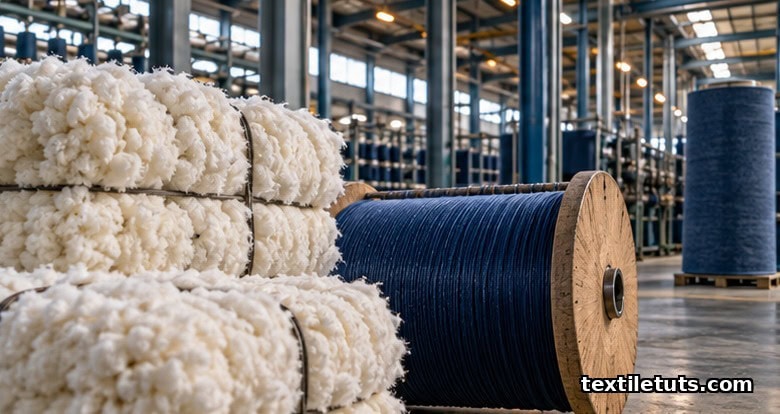
Denim manufacturing is the end-to-end process of turning raw cotton fiber into finished denim fabric ready for garment cut-and-sew. The process has five main stages: yarn formation (ring or rotor spinning of indigo-dyed warp yarn and undyed weft yarn), dyeing (the warp is dyed with indigo or sulfur dye, the weft is left undyed), weaving (typically a 3/1 right-hand twill on a projectile or rapier loom), finishing (singeing, desizing, mercerizing, sanforizing, and optionally various wash effects), and quality control. Modern denim mills run as integrated operations, with all five stages under one roof, and produce 20–80 million meters of denim per year from a single plant.
The defining feature of denim, its 3/1 twill weave with indigo-dyed warp and undyed weft, is what gives the fabric its iconic fade behavior. As the garment is worn and washed, the indigo dye slowly abrades off the warp surface, revealing the white core of the yarn and creating the high-contrast fades that denim is prized for. The rest of the manufacturing process is engineered to support this end use: yarn count and twist for strength, dye penetration for controlled fade, weave density for hand and durability, finishing for shrinkage control and surface texture.
Stage 1: Yarn formation
Denim warp and weft use different yarns. The warp is typically a ring-spun cotton yarn (often Ne 6 to Ne 12 for apparel denim, finer for shirting) with a relatively high twist multiplier to give strength and abrasion resistance. The weft is typically a coarser, lower-twist yarn (often Ne 5 to Ne 8) for body and softness. Both are made from carded or combed cotton, depending on the quality target.
For stretch denim (the dominant fabric in women’s jeans and most fashion denim), the weft contains 2–4% elastane (Lycra or equivalent) wrapped in cotton. The elastane is fed as a core-spun yarn: the elastane filament is drafted and the cotton fibers are spun around it, so the elastane is fully encapsulated and protected from the indigo dye (which would degrade elastane if it were exposed). The weft’s stretch is what makes stretch denim comfortable to wear; without it, denim is rigid and uncomfortable for fitted garments.
Recycled cotton is increasingly used in denim, especially by brands with sustainability commitments. The recycled content is typically in the weft, where the fiber-length loss from recycling is less critical than in the warp. Recycled-cotton weft yarns are blended with virgin cotton or polyester for spinnability and strength.
Stage 2: Indigo dyeing (warp only)
The warp yarn is dyed with indigo (or sulfur black, for black denim) before weaving. The weft is left undyed (its natural cotton color is the “white” that the warp fades to). Indigo is applied to the warp as a rope or sheet in a continuous dye range, then oxidixed in air to convert the leuco-indigo back to its insoluble blue form.
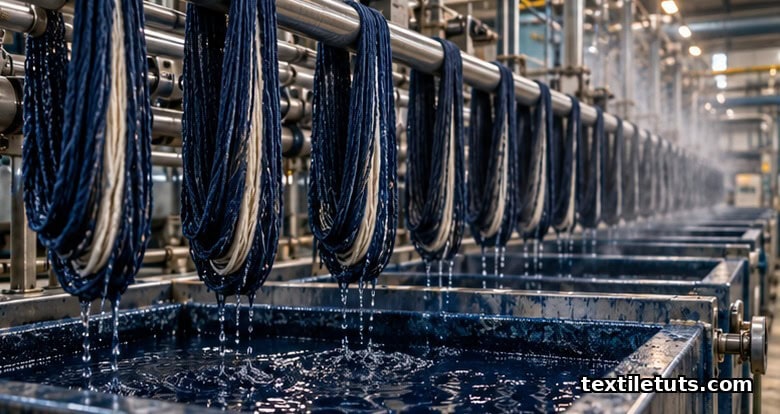
Two dye methods dominate:
Rope dyeing (the standard for premium denim)
Multiple warp yarns (typically 300–400 ends) are bundled into a rope, which passes through a series of dye boxes (typically 6–10 boxes) and oxidation skyers (the ropes hang in loops between boxes to air-oxidize). Each box dips the rope in indigo solution; each sky oxidizes the dye. The process is repeated 6–10 times to build the depth of shade.
Rope dyeing produces yarn with a high-contrast fade: the dye only penetrates the outer surface of each fiber, leaving a white core. As the fabric is worn and washed, the surface dye abrades off, revealing the white core and creating the sharp vertical fades that rope-dyed denim is prized for.
Slasher dyeing (sheet dyeing, the standard for mid-market denim)
The warp is spread out as a flat sheet and passed through a single dye box and oxidation chamber. The process is faster and cheaper than rope dyeing, but the dye penetration is shallower (because the sheet is exposed to dye only briefly) and the fade behavior is more even and less sharp. Slasher-dyed denim is the workhorse for mass-market jeans.
After dyeing, the warp is sized (coated with starch or PVA size) to protect it from the abrasion of weaving. The size is later removed in finishing.
Stage 3: Weaving
Denim is woven almost exclusively as a 3/1 right-hand twill: the weft passes under three warp ends and over one, and the diagonal of the twill runs from lower-left to upper-right on the face of the fabric. This is the iconic denim weave; left-hand twill denim (the diagonal runs the other way) is a niche variant used by some Japanese mills and a few heritage US mills.
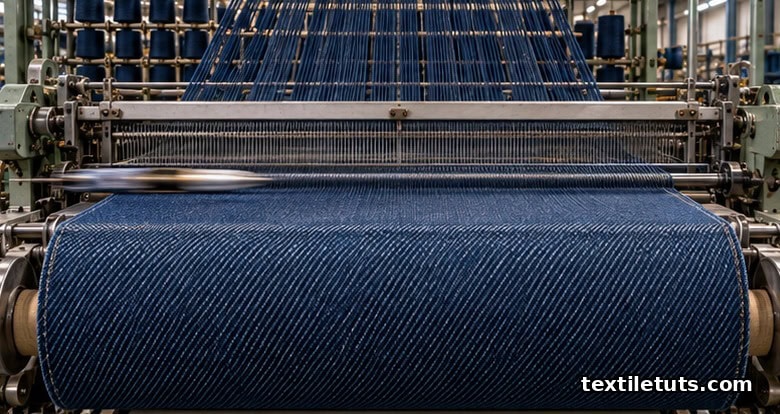
The loom is typically a projectile or rapier loom. Shuttle looms are now rare (they were the original denim loom, famous for the “shuttle marks” or “selvedge” of shuttle-woven denim). Modern high-speed projectile or rapier looms produce denim at 600–1,000 picks per minute, with fabric widths up to 90 inches for apparel and 120 inches for furnishing.
Selvedge denim, denim woven on a shuttle loom so the fabric has a self-finished edge (the “selvedge”) – is a heritage product. Shuttle looms are slower than modern looms (typically 150–200 ppm) and produce narrower fabric (30–34 inches vs. 60–90 inches for modern looms), but the selvedge is prized by heritage denim brands and the slow-loom weave gives the fabric a distinctive hand and visual texture. Production volumes are a small fraction of total denim output but a meaningful premium segment.
Stage 4: Finishing
Greige denim from the loom is dark blue, stiff, heavily sized, and full of fabric impurities. The finishing steps turn it into the soft, dimensionally stable, ready-to-cut fabric the garment maker needs.
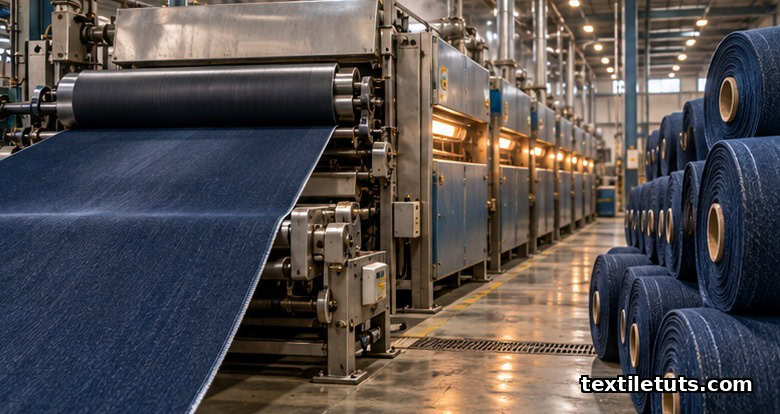
- Desizing – removes the warp size with enzyme (amylase) or oxidative treatment, exposing the cotton for further wet processing.
- Singeing – burns off the surface fuzz from the fabric face, giving a cleaner appearance and reducing pilling in wear.
- Mercerizing – treatment with concentrated caustic soda, applied under tension, to increase luster, dye affinity, and tensile strength. Most apparel denim is mercerized; some heritage denim is not (for a more matte, vintage look).
- Sanforizing (pre-shrinking) – mechanical compression in a rubber-belt compactor that compresses the fabric in the warp direction, removing most of the residual shrinkage. Most apparel denim is sanforized to ≤3% residual shrinkage. Unsanforized denim (“shrink-to-fit”) is a heritage product.
- Skewing correction – straightens the fabric’s weft so it lies perpendicular to the warp. Without this, the fabric’s twill diagonal would shift after washing.
- Final inspection – fabric is inspected on a frame with backlighting, defects are marked with chalk, and 4-point or 10-point grading is applied to determine the roll quality and price.
Some denim receives additional finishing for specific end uses. Stretch denim is heat-set on a stenter to lock in the elastane’s stretch and recovery. Coated denim (wax, resin) is run through a coating range to apply the surface treatment. Pre-washed denim (used for garments that don’t want post-wash shrinkage) is given a hot wash and tumble-dry before shipping.
Stage 5: Quality control
Denim is a high-volume, technically demanding fabric, and QC is rigorous. The standard tests include:
- Weight (oz/yd²) – measured by cutting a known area and weighing (ISO 3801 method). Denim weight ranges from 4 oz (lightweight shirting denim) to 16 oz (heavy jacket denim) to 24+ oz (very heavy heritage denim).
- Tensile strength – warp and weft, by the grab method (ASTM D5034) or strip method (ASTM D5035). Minimum 200 N warp, 150 N weft for apparel denim.
- Tear strength – by the Elmendorf method (ASTM D1424) or tongue method (ASTM D2261). Minimum 25 N warp, 20 N weft for apparel denim.
- Dimensional stability (shrinkage) – measured after a standardized hot wash, typically 3× at 60 °C. Sanforized denim should shrink ≤3% warp and ≤3% weft.
- Colorfastness to washing – graded on a 1–5 gray scale after a standardized wash cycle (ISO 105-C06). The indigo crocking and bleeding behavior is the key quality issue; ratings of 3–4 are typical, 4–5 is premium.
- Crocking fastness – resistance to dye transfer by rubbing, on a 1–5 gray scale (ISO 105-X12). Indigo crocking is a chronic issue; ≥3.5 is the typical minimum.
- Abrasion resistance – Martindale or Wyzenbeek method, often paired with the tensile and tear tests.
Each roll of finished denim is graded (typically 4-point system: total defect points per 100 yd²; 0–20 points is first quality, 21–40 is second quality, >40 is rejected) and assigned a final price based on grade, weight, color, and any special finishes.
Specialty denim variants
Beyond the standard 3/1 indigo twill, several specialty denim variants are produced for specific markets:
- Selvedge denim – woven on a shuttle loom, with the self-finished selvedge. Prized by heritage denim brands; slower and more expensive to produce.
- Stretch denim – contains elastane in the weft. Now the dominant fabric in women’s jeans and most fashion denim.
- Slub denim – yarn with intentionally irregular thickness, creating a textured, vintage-look surface.
- Printed or coated denim – printed with patterns (floral, geometric) or coated with wax, resin, or pigment for surface effects.
- Sulfur-dyed black denim – black dyed with sulfur dye instead of indigo, producing a matte black with a different fade behavior (less sharp, more even).
- Ecru or natural denim – undyed warp, used for the natural or “raw” denim look.
- Recycled-content denim – contains 20–50% recycled cotton (from pre-consumer waste) in the weft, with sustainability claims certified to GRS or RCS.
Frequently Asked Questions
What is the difference between ring-spun and rotor-spun denim?
Ring-spun yarn is made by drafting the fiber roving and twisting it around itself as it winds onto a ring-and-traveler bobbin. The process is slower but produces a stronger, more uniform yarn with a tighter twist structure. Rotor-spun (open-end) yarn is made by drafting the fiber into a rotor cup and using the rotor’s centrifugal force to twist the fiber into yarn. Rotor spinning is faster and cheaper but produces a slightly weaker, more hairy yarn. Premium denim uses ring-spun warp; mid-market denim often uses rotor-spun warp. The difference shows up in the fabric’s hand, strength, and surface texture.
Why is denim usually 3/1 twill and not plain weave?
The 3/1 twill weave produces the characteristic diagonal pattern on the face of the fabric, with the warp dominating the surface. The warp floats over three weft threads, which gives the fabric a smooth, lustrous face and a slightly textured back. Plain weave denim (1/1) is possible but is rare because it has a more rigid hand and a less distinctive look. 3/1 twill also allows the warp to dominate the surface, which is what creates the iconic indigo fade as the warp floats abrade off during wear.
Is denim always indigo-dyed?
Traditional denim is indigo-dyed (in various shades from pale blue to deep navy), but the warp can be dyed with other colors. Sulfur black is the second most common denim dye and produces a matte black that fades to gray. Brown, green, and other “novelty” denims use sulfur or reactive dyes. The defining feature of denim is the 3/1 twill weave with a dyed warp and undyed weft; the warp dye color is what makes the fabric “denim” in the consumer sense.
What is the difference between sanforized and unsanforized denim?
Sanforized denim has been mechanically pre-shrunk at the mill, typically to ≤3% residual shrinkage. The garment made from sanforized denim will not shrink significantly in the wash. Unsanforized (“shrink-to-fit”) denim is sold without pre-shrinking; the garment will shrink 7–10% on the first wash, and the wearer is expected to size up to account for the shrink. Unsanforized denim is a heritage product (Levi’s 501 STF, most Japanese selvedge denim) prized for the way it molds to the wearer’s body over time, but it is a small share of the market.
How much water does denim manufacturing use?
A modern denim mill uses 50–100 L of water per kg of fabric, mostly in the indigo dye range and the finishing washes. Closed-loop systems with counter-current washing and indigo recovery can bring this down to 20–40 L/kg. Water and energy (for heating the dye and wash baths) are the largest operating costs after labor in a denim mill. Sustainability-focused mills (e.g., Saitex in Vietnam, Candiani in Italy) operate at the lower end of this range.
References
- Wikipedia (2002, last revised 2025). Denim. https://en.wikipedia.org/wiki/Denim, historical and process overview of denim manufacturing, including the development of the 3/1 twill weave, indigo dyeing, and the modern synthetic indigo process.
- ISO 3801:1977, Textiles, Woven fabrics, Determination of mass per unit length and mass per unit area – standard method for denim weight measurement.
- ASTM D5034-21, Standard Test Method for Breaking Strength and Elongation of Textile Fabrics (Grab Test) – tensile testing method for denim.
- ASTM D1424-21, Standard Test Method for Tearing Strength of Fabrics by Falling-Pendulum (Elmendorf) Apparatus – tear strength test for denim.
- ISO 105-C06:2010, Textiles, Tests for colour fastness, Part C06: Colour fastness to domestic and commercial laundering – wash-fastness test, the standard for denim crocking and bleeding assessment.
- ISO 105-X12:2016, Textiles, Tests for colour fastness, Part X12: Colour fastness to rubbing – crocking test.
This article is the working reference for denim manufacturing. Editorial by Shahrukh Islam, TextileTuts. Sources: Wikipedia (Denim), ISO 3801, ASTM D5034, ASTM D1424, ISO 105-C06, ISO 105-X12 as cited.


