
Selvedge Denim: Shuttle Loom Weaving

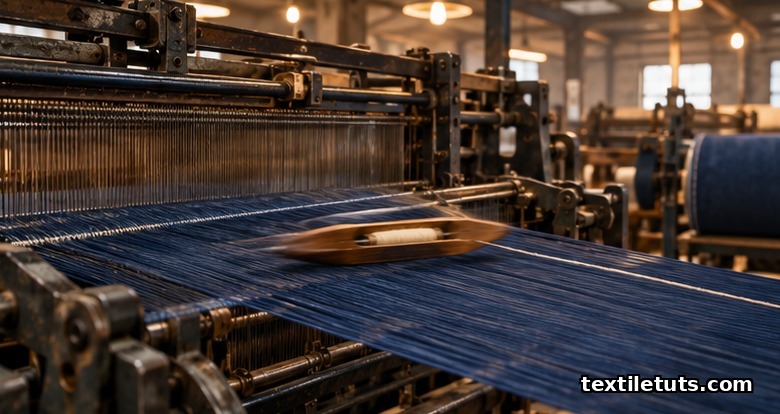
Selvedge denim is woven on a shuttle loom at 150–200 picks per minute, with a single weft yarn carried continuously across the full fabric width (typically 75–90 cm, or 30–36 inches) so the fabric edges finish themselves in a tight, self-locked tape called the selvedge.
This self-finished edge is formed because the shuttle lays the weft in one continuous loop per pick and then turns at each side, producing the dense, often colored, “self-edge” that selvedge denim collectors look for along the outseam of raw jeans.
In this article you will learn how shuttle looms build denim, why the selvedge forms the way it does, how selvedge denim compares with projectile-loom denim in weave density and fabric behavior, and what the practical consequences are for wear, durability, and finishing.
What is shuttle loom weaving?
Shuttle loom weaving is the original method of making woven cloth, in which a small wooden or composite shuttle carries a cop (a yarn package) of weft back and forth across the warp shed at full fabric width. The method is defined in ISO 4921:2012 (Textiles. Weaving. Basic terms and definitions), which classifies shuttle looms alongside projectile, rapier, and air-jet looms under the broader category of small-weft-carrier weaving machines.
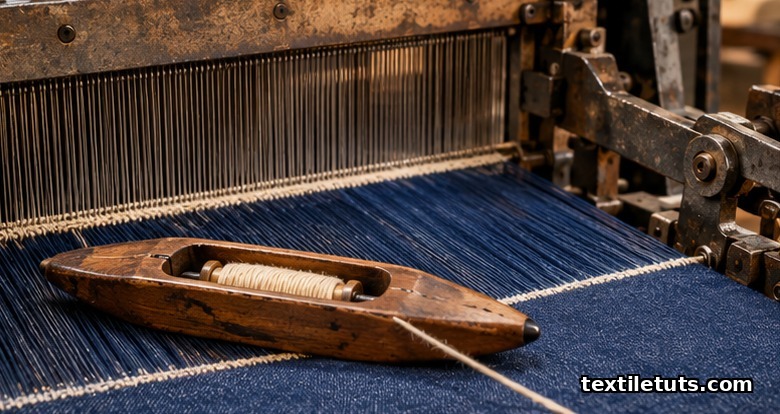
Each weft insertion cycle on a shuttle loom completes one full pick: the picker propels the shuttle from one side of the loom to the other, the shuttle sits briefly while the reed beats the pick into the fell of the cloth, and then it is shot back across the warp. Because one weft thread spans the entire fabric width without being cut, the edge picks loop back on themselves, locking the outermost warp ends into a finished band. A 14 oz shuttle-loom denim, for example, typically uses 60–72 picks per inch (24–28 picks/cm), which means 1.7–2.0 weft insertions per millimeter of fabric length, and every one of those picks is a continuous loop from selvedge to selvedge.
How selvedge denim gets its signature edge
The selvedge (also written “selvage,” from “self-edge”) is the narrow, usually 5–15 mm wide tightly woven band running along each lengthwise edge of a shuttle-loom fabric. It forms automatically from the looping action of the weft at the fabric edge, but it is reinforced in denim by weaving a separate, often heavier or differently colored, “selvedge yarn” in the last two to four warp ends on each side.
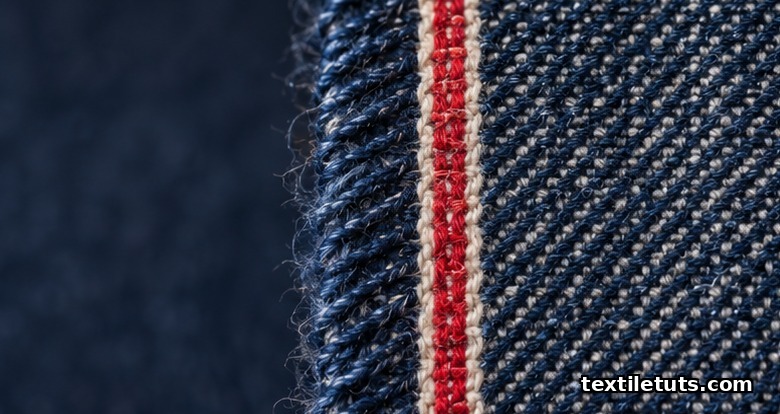
On shuttle-loom denim, those edge warp ends are typically a thicker indigo or natural cotton yarn (around Ne 6/1 to Ne 12/1, that is 49–99 tex) and they interlace with every pick, producing the iconic ticker-tape colored edge (commonly red, but also gold, white, or green) you see along the outseam of a pair of raw selvedge jeans when the cuff is turned up. Most mills dye these selvedge yarns a solid color before the warp is sized, so the edge color is fixed and does not fade away in the indigo bath.
Why shuttle looms run slower than modern looms
Shuttle looms are mechanical machines with a heavy flying mass: the shuttle itself weighs 0.4–0.6 kg. Newton’s second law dictates that accelerating and decelerating that mass through a 75–90 cm race every cycle sets a hard ceiling on speed. Operating speeds of 150–200 picks per minute are typical for denim weaving, with some Toyota G3-style shuttle looms running as high as 220 ppm.
In contrast, modern projectile looms (such as the Sulzer P7200) routinely run at 900–1,100 picks per minute, and air-jet looms can exceed 2,000 ppm. The trade-off is mechanical complexity and energy per pick: shuttle looms have far fewer parts to maintain but consume more energy per kilogram of fabric produced because so much of the kinetic energy goes into shuttling the carrier. A single shuttle traverse on a 90 cm loom converts roughly 5–7 J of kinetic energy into heat at each pick end, which adds up across the 9,000–12,000 picks in an 8-hour shift.
Shuttle-loom denim vs. projectile-loom denim
| Property | Shuttle loom (selvedge) | Projectile loom (wide-width) |
|---|---|---|
| Typical weaving width | 75–90 cm (30–36 in) | 180–360 cm (70–140 in) |
| Weaving speed | 150–200 picks/min | 900–1,100 picks/min |
| Weft insertion | Continuous weft across full width | Cut weft inserted in short segments by projectile |
| Selvedge | Self-finished tape edge (5–15 mm) | Leno or fused cut edge, often 2–5 mm |
| Typical fabric weight | 340–510 g/m² (10–15 oz/yd²) | 270–410 g/m² (8–12 oz/yd²) |
| Energy per kg of cloth | ~0.9–1.1 kWh | ~0.6–0.8 kWh |
The wider fabric width of projectile-loom denim means more linear meters per loom-hour, which is why mass-market jeans are made on projectile or air-jet looms and command a lower per-garment material cost. Selvedge denim’s narrower width becomes a yield constraint: you cut fewer pairs of jeans per meter of loom output, and a typical pair of raw selvedge jeans consumes roughly 1.7–2.0 m of selvedge denim against roughly 1.4–1.6 m of wide projectile-loom denim of the same finished size.
How shuttle-loom denim is finished
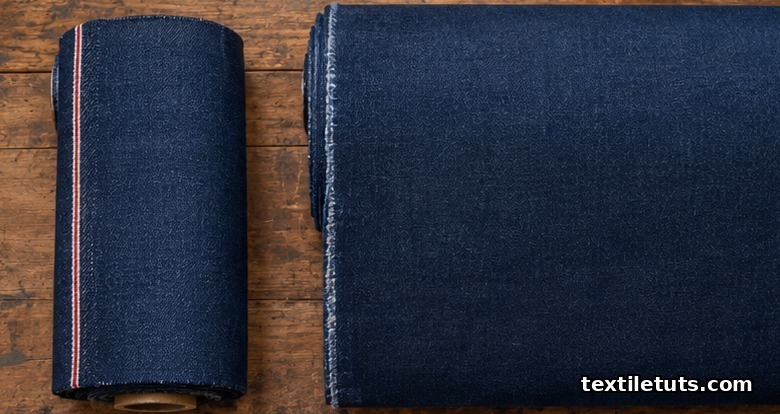
Greige selvedge denim leaves the loom with starch from the sizing compound (typically 8–12% add-on), unfixed indigo dye on the surface of the warp yarns, and an essentially unaltered cotton hand. The standard finishing sequence in a sanforization or decatizing line is: desizing (amylase bath, 60–70 °C, pH 6.5–7.5) followed by washing, optional skying or chemical bleaching, mercerizing if specified, compressive shrinkage (sanforizing), and calendaring.
Many selvedge denim mills still offer loom-state or rigid denim, which skips the sanforizing step. Residual shrinkage on rigid selvedge denim is typically 6–10% in the warp direction after the first wash, measured against ASTM D3774-18 (Standard Test Methods for Width of Textile Fabric) and AATCC TM135 (Dimensional Changes of Fabrics After Home Laundering). The indigo dye used on the warp is normally applied in 3–6 dips with intermediate air oxidation, building up 6–10 g/L of sodium dithionite-reduced indigo per dye bath, and only the outermost 10–20% of each yarn cross-section is fully colored, which is the ring-dye effect that drives raw-denim fade patterns.
Why denim enthusiasts prefer shuttle-loom cloth
The slower weaving speed allows the warp to be held under lower and more even tension than on high-speed looms. In practice, shuttle-loom denim tends to have a more open weave structure (lower pick density relative to warp) and a yarn surface that is less compressed, which in wear produces:
- Sharper, higher-contrast fades because the indigo sits on the outside of the yarn rather than being pounded into the fiber bundle.
- A pronounced slub character when ring-spun, uneven yarns are used in the warp.
- A softer initial hand that breaks in within 30–40 wear hours, compared with 60–80 hours for a tight, projectile-loom denim.
These are aesthetic rather than structural advantages; in a Martindale abrasion test (ASTM D4966), a well-built 14 oz shuttle-loom denim typically reaches 30,000–40,000 cycles to the first yarn break, comparable to a same-weight projectile-loom denim. The real differentiator is therefore not durability but the way the indigo ring-dye surface wears off in visible creases, which is what raw-denim collectors are paying for.
Environmental and cost trade-offs
Because shuttle looms run at roughly one-fifth the speed of projectile looms, they produce roughly one-fifth the fabric per machine-hour, and their higher energy per kilogram of cloth is a real sustainability penalty. However, a typical shuttle loom has a service life of 50+ years (many Toyota G3 and Picanol Optim shuttle looms from the 1960s are still operating in Japan and India), so the embodied energy per kilogram across its lifetime is comparable to, and sometimes lower than, a modern loom that requires replacement after 15–20 years.
Selvedge denim also uses indigo dye inefficiently: shuttle-loom mills typically dye the warp with 3–6 indigo dips totaling 6–10 g/L of sodium dithionite-reduced indigo, of which only the outermost 10–20% of each yarn is fully colored. The ring-dye effect is what gives raw selvedge denim its fade potential, but it also means more dye is wasted to the wash water than in a yarn-dyed solid color. Newer indigo-reduction systems based on iron(II) complexes can cut dye bath sludge by 30–40%, but most shuttle-loom mills have not yet retrofitted to them.
Frequently Asked Questions
Q1: Is selvedge denim always made on a shuttle loom?
Almost always, yes. The mechanical definition of a selvedge is a self-finished edge formed by continuous-loop weft insertion, which only shuttle looms and a small number of modern rapier or projectile looms with loop-formation capability produce. Most selvedge denim on the market comes from shuttle looms because they are the simplest, lowest-cost way to make a true selvedge.
Q2: Why is selvedge denim more expensive than regular denim?
The warp yarn is usually ring-spun rather than open-end, the weaving speed is roughly one-fifth that of a projectile loom, and the fabric width is only 75–90 cm compared with 180–360 cm on modern looms. Together those factors raise the per-meter weaving cost by 3–5×. The retail premium is smaller because selvedge denim is positioned as a premium product with a longer design life.
Q3: Will raw selvedge denim bleed indigo onto my other clothes?
Yes, and that is normal. Ring-dyed indigo sits mostly on the outer 10–20% of each warp yarn, so dye transfers onto light-colored shoes, belts, wallets, and car seats during the first 4–6 wear cycles, especially when the fabric is damp. The bleeding tapers sharply after the first wash in cold water with a non-alkaline detergent, and most raw-denim enthusiasts expect and even welcome the early transfer as part of how the fade pattern begins.
Q4: How do I tell if a pair of jeans is genuinely selvedge?
Cuff the outseam and look at the edge: a true selvedge shows a tightly woven, often colored, band roughly 5–15 mm wide, usually with a clean, raised texture. A cut-and-sewn (faux-selvedge) jean shows a turned-under, often overlocked edge that is the same width as a regular seam. The denim weight of a true selvedge is also commonly 13–16 oz/yd² (440–540 g/m²), heavier than the 10–12 oz average for mass-market denim.
Q5: Are shuttle looms being phased out?
Globally, the number of shuttle looms has fallen sharply since the 1970s, but the population is not zero: as of the late 2010s, several thousand shuttle looms were still running in Japan, India, and Bangladesh for premium denim. They are not built new anymore, so the supply is slowly shrinking as machines wear out, but a well-maintained shuttle loom today is expected to remain in service for another 20–30 years.
References
- ISO 4921:2012. Textiles. Weaving. Basic terms and definitions. International Organization for Standardization. Defines selvedge and small-weft-carrier looms.
- ASTM D3774-18. Standard Test Methods for Width of Textile Fabric. ASTM International. Width measurement of woven fabrics including selvedge denim cloth.
- AATCC TM135-2018. Dimensional Changes of Fabrics After Home Laundering. American Association of Textile Chemists and Colorists. Residual shrinkage testing referenced for rigid denim.
- ASTM D4966-12. Standard Test Method for Abrasion Resistance of Textile Fabrics (Martindale Abrasion Tester). ASTM International. Wear-cycle benchmarking for denim.
- Sinha, S.K. and Bansal, P. Denim: A Versatile Fabric. ResearchGate. Weaving and finishing overview of shuttle-loom denim.
- Mondal, M.I.H. (Editor). Denim: Manufacture, Finishing and Applications. Woodhead Publishing, Elsevier. Chapter on shuttle loom weaving and indigo dyeing of denim.
This article is the working reference for selvedge denim and shuttle loom weaving. Editorial by Shahrukh Islam, TextileTuts. Sources: ISO 4921:2012, ASTM D3774-18, AATCC TM135-2018, ASTM D4966-12, and peer-reviewed denim-manufacturing literature as cited.


