
Fabric Density and GSM: How Weave Affects Weight

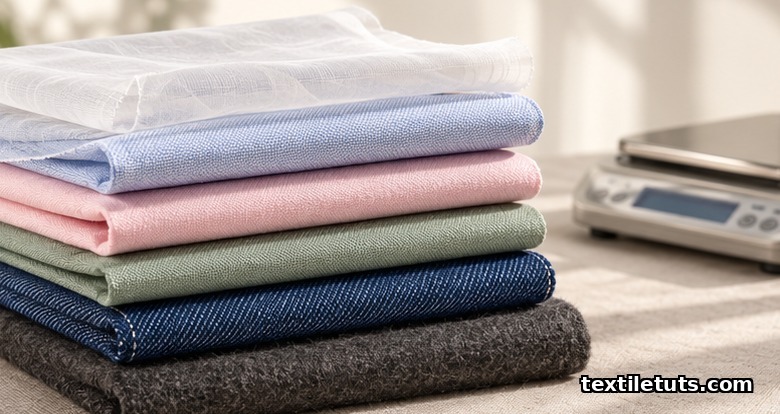
Fabric GSM (grams per square meter) quantifies areal density by weighing a conditioned sample and dividing by its area per ISO 3801 and ASTM D3776, while fabric density counts warp ends and weft picks per inch per ASTM D3775; the weave structure chosen shifts finished GSM by 15 to 30 percent at constant yarn linear density, with a 3/1 twill denim weighing 405 to 545 g/m² (12 to 16 oz/yd²) versus a 1/1 plain weave oxford shirting at 130 to 180 g/m² woven from identical 20 tex cotton yarn.
The two numbers that always appear on a woven fabric spec sheet, GSM and thread count, describe different things, and confusing them is the most common mistake when sourcing or specifying cloth. GSM tells you the weight per unit area. Fabric count tells you how tightly yarns are packed. Both depend on weave, but in different directions, and both feed the finished hand, opacity, and durability of the cloth.
What GSM Actually Measures, and What It Does Not
GSM is a single number expressed in grams per square meter, derived by conditioning a fabric sample at 20 °C and 65 percent relative humidity (the standard atmosphere for textile testing defined in ISO 139), weighing the sample, and dividing the result by its measured area. The mass-per-unit-area value rolls up three variables: warp linear density, weft linear density, and the frequency of each yarn set across the fabric width and length.
GSM is not the same as fabric count. A balanced 1/1 plain weave at 60 ends by 60 picks per inch using 20 tex yarn hits roughly 130 g/m². Push the same yarn to 80 ends by 80 picks and the GSM rises to about 170 g/m². The yarn never changed. The way those yarns were packed changed by 30 percent, which the finished GSM records but the linear yarn count cannot.
This is why GSM and thread count serve complementary roles in a spec sheet. Thread count (or sett, in weaving terminology) controls dimensional stability, cover factor, and porosity. GSM is what you actually feel in your hand and what determines end-use suitability, from voile at 60 g/m² to melton overcoat cloth at 700 g/m².
The Three Core Weave Structures and Their Density Profiles
The three foundation weaves, plain, twill, and satin, behave differently when you pack the same yarn into the same loom width. The driver is float length: how many successive warp or weft yarns a single thread passes over before interlacing.
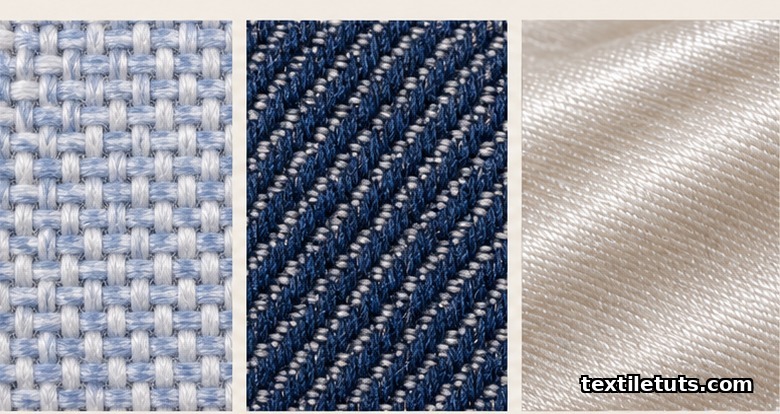
Plain weave (1/1). Each weft passes over one warp and under the next, giving the highest number of interlacings per unit area. This binds the cloth tightly but limits sett: pushing ends too high makes warp crimp dominate and the weft loses cover. For 20 tex cotton, the practical maximum in plain weave is about 80 ends by 80 picks per inch. Beyond that, the loom cannot beat the weft up without breaking warps.
Twill weave (e.g., 3/1). Each weft passes over three warps and under one (or vice versa), then steps one yarn per pick. The reduced interlacing lets you pack yarns tighter: 100 ends by 70 picks per inch is comfortable in 3/1 twill with the same 20 tex. Because more yarn sits in the same area, GSM rises proportionally. A 3/1 twill denim at 12.5 oz/yd² typically runs about 420 g/m².
Satin weave (e.g., 5/1). Long floats (the yarn travels over four or more perpendicular yarns between each tie-down) minimize interlacings and create a smooth, lustrous surface, but the cloth has poor stability and low cover at given sett. The result is often a fabric that weighs less than plain weave at the same thread count because the long floats relax more under finishing tension, and the cloth shows yarns more readily.
Specialty weaves shift the picture further. Basket weave (2/2) holds two warps together, packing more yarn per pick but at lower overall interlacing density, so GSM rises while dimensional stability falls. Leno weave crosses paired warps around the weft, opening the cloth and dropping both density and GSM. Oxford cloth is a paired plain weave with a fine warp and heavier weft, producing a textured but stable cloth at 130 to 180 g/m², in the medium-light class.
How Thread Count, Yarn Linear Density, and GSM Interact
You can derive one of these variables from the other two with reasonable accuracy if you know the yarn counts and the fabric geometry. The approximation most mills use is:
GSM is approximately equal to (EPI times warp tex plus PPI times weft tex) divided by 1000
where EPI and PPI are ends and picks per inch and tex is the linear density in grams per kilometer. For a 60 by 60 plain weave using 20 tex warp and 20 tex weft, the calculation gives (60 by 20 plus 60 by 20) divided by 1000 equals 2.4 g/m² per inch of width, which scales to about 94 g/m² at a 39-inch reed width. That lands within 5 percent of the measured 96 to 100 g/m² typical of a balanced cotton shirting at that construction.
The upper bound is set by cover factor, the fraction of fabric area covered by yarn. For circular spun yarns, the optimum woven cover factor for plain weave sits between 18 and 22, a range documented in standard textile references on weaving geometry. Push above 22 and warp breakage at the loom rises sharply; drop below 14 and the cloth opens up visibly.
GSM Ranges by End Use
GSM bands are widely standardized across woven categories, and the weave structure largely dictates where the cloth falls within the band.
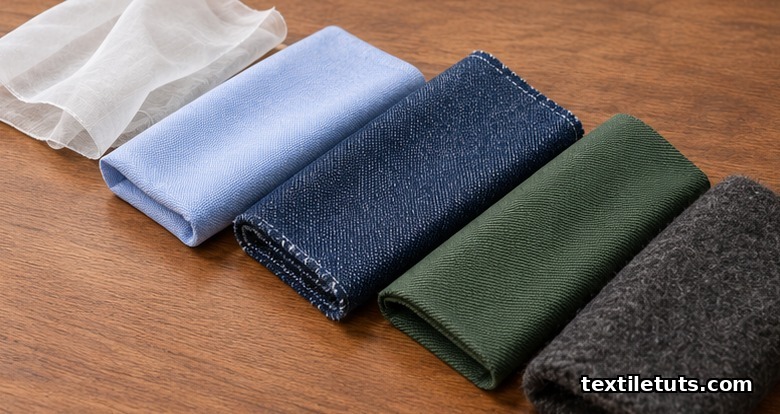
- Voile and sheer (60 to 90 g/m²): plain weave, fine yarn (10 tex or less), low EPI for openness.
- Shirting (110 to 180 g/m²): plain weave (poplin, oxford) or 2/1 twill, balanced yarn counts.
- Lightweight dress fabric (120 to 180 g/m²): plain or 2/1 twill, often filament yarn.
- Bottom-weight (280 to 400 g/m²): 2/1 or 3/1 twill, chino, gabardine.
- Denim (340 to 545 g/m²): 3/1 right-hand twill, indigo warp, white or ecru weft.
- Outerwear and coating (400 to 700 g/m²): 2/2 twill, melton, whipcord.
The spread within each category comes from yarn linear density and finishing. Heavier finishing (calendaring, raising, or compacting treatments) can add 5 to 15 percent to finished GSM by densifying the cloth.
Measuring GSM and Density the Right Way
Two standardized procedures dominate. ISO 3801 specifies the gravimetric method: cut a known-area specimen (typically 100 cm²), condition to standard atmosphere, weigh on an analytical balance, and convert. ASTM D3776/D3776M follows the same principle but allows smaller swatches and offers an option for full-piece weighing on a calibrated roller scale.
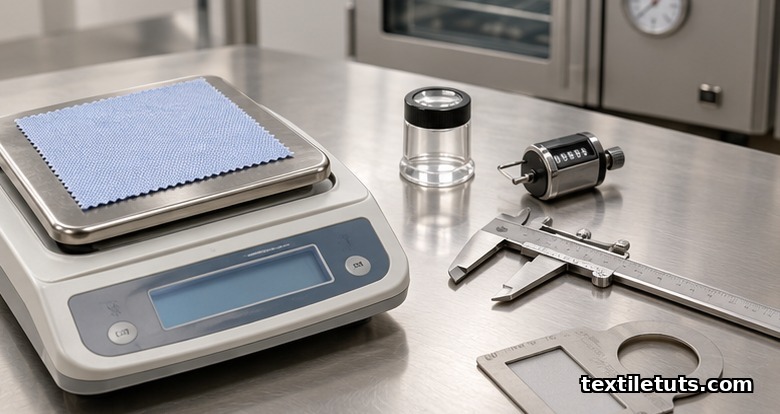
For thread count, ASTM D3775 specifies counting yarns in a 25.4 mm (1 in) span using a pick glass or thread counter. ISO 7211-5 goes further: it provides a method for disassembling a fabric and re-weighing individual warp and weft yarns to determine their linear density, which lets you back-calculate whether a mill delivered the construction they invoiced.
Sample size matters. A 10 cm by 10 cm swatch is too small to capture weave repeat unevenness; ISO 3801 recommends a minimum 200 cm² for balanced weaves and 500 cm² for highly textured weaves like leno or Bedford cord. Cutting near selvedge skews the result because warp density often differs by 5 to 10 percent from body to edge.
For verification in a buyer’s lab, the most reliable check is GSM plus thread count measured independently. A cloth invoiced at 280 g/m² but measuring 240 g/m² is usually running lower thread count, lighter yarn, or both, and the lab data tells you which lever to pull.
Comparison: Plain Weave vs Twill vs Satin at Equivalent Yarn
| Property | Plain (1/1) | Twill (3/1) | Satin (5/1) |
|---|---|---|---|
| Typical EPI by PPI (20 tex cotton) | 60 by 60 | 100 by 70 | 120 by 90 |
| Approximate GSM | 110 to 130 | 200 to 260 | 170 to 210 |
| Cover factor | 14 to 17 | 17 to 20 | 14 to 16 |
| Float length | 1 | 3 | 5 |
| Surface texture | Matte, even | Diagonal wale, structured | Smooth, lustrous |
| Tear strength (warp direction) | Baseline | +15 to 25 percent | -10 to 20 percent |
| Drape | Crisp | Medium | Fluid |
| Common end use | Shirting, sheeting, canvas | Denim, chinos, gabardine | Linings, satins, technical backings |
Frequently Asked Questions
Does higher GSM always mean thicker fabric?
Not always. GSM measures mass per area, which usually tracks thickness for the same weave and fiber, but a tightly woven plain weave at 200 g/m² can be thinner than a loosely woven basket weave at the same GSM. Fiber density matters too: a 200 g/m² wool cloth sits flatter than a 200 g/m² cotton terry, because the cotton loops stand up.
How is GSM different from fabric weight in ounces per square yard?
The two scales convert directly: 1 oz/yd² equals 33.906 g/m², so a 10 oz denim (the classic Levi’s weight) is about 339 g/m². American denim and canvas mills traditionally use oz/yd² because the trade grew up around the cotton belt, while Asian and European mills standardized on g/m². Both are valid; the numbers must match the unit stated on the spec sheet.
Why does twill weigh more than plain weave at the same yarn count?
Because twill packs more yarn per unit area. The 3/1 interlacing pattern lets you run 30 to 40 percent more ends and picks than a plain weave at the same yarn linear density before the loom starts breaking warps. Each added thread adds its tex weight to the per-area total, so finished GSM scales with the added yarn count.
Can two fabrics have the same GSM but very different hand and drape?
Yes, and this is exactly why GSM alone is not a complete specification. A 200 g/m² polyester twill and a 200 g/m² cotton oxford weigh the same but behave differently in every other way: drape, recovery, abrasion resistance, and moisture regain. Yarn composition, twist level, finishing, and weave structure all contribute; GSM is just one number in the spec.
What is the most accurate way to verify GSM in a buyer’s lab?
Condition the sample at 20 °C and 65 percent RH for 24 hours (ISO 139 standard atmosphere), cut a 100 cm² swatch with a calibrated template, weigh to 0.001 g on an analytical balance, and multiply by 100. Cross-check the result by counting threads per inch under a pick glass per ASTM D3775, then derive expected GSM from the formula above; a deviation of more than 5 percent between measured and calculated values flags a yarn count or finishing deviation.
References
- ISO 3801:1977. Textiles, woven fabrics, determination of mass per unit length and mass per unit area. International Organization for Standardization. Gravimetric method for GSM.
- ASTM D3776/D3776M-20. Standard Test Methods for Mass Per Unit Area (Weight) of Fabric. ASTM International. Alternative gravimetric and full-piece method.
- ASTM D3775-17e1. Standard Test Method for Warp (End) and Filling (Pick) Count of Woven Fabrics. ASTM International. Thread count procedure.
- ISO 7211-5:1984. Textiles, woven fabrics, construction, methods of analysis, part 5, determination of linear density of yarn removed from fabric. Yarn linear density recovery from finished cloth.
- ISO 139:2005. Textiles, standard atmospheres for conditioning and testing. 20 °C and 65 percent RH conditioning.
- Behera, B.K., and Mishra, R. (2007). Effect of yarn structure, fabric construction, and loom settings on fabric properties. Indian Journal of Fibre and Textile Research, 32, 88 to 93. Peer-reviewed data on weave effect on weight and cover.
Editorial by Mohammad Yousuf (Anik), TextileTuts. Sources: ISO 3801, ISO 7211-5, ISO 139, ASTM D3776/D3776M, ASTM D3775, and Behera and Mishra (2007) as cited.


