
Dobby vs Jacquard: Differences and Applications

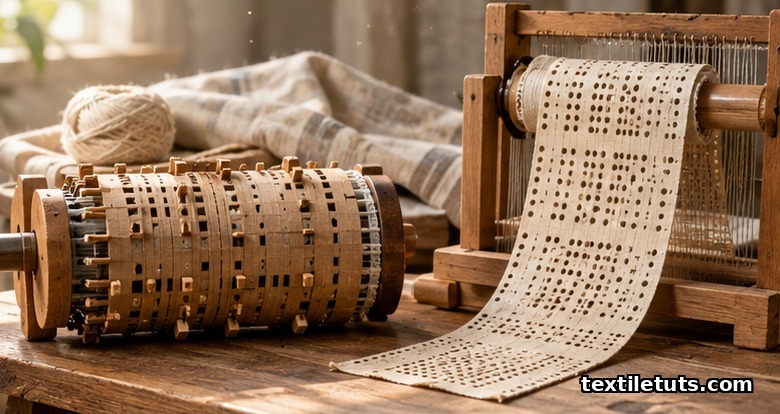
A dobby loom controls 16 to 32 warp threads per pattern repeat and produces small geometric weaves under 25.4 mm in repeat, while a jacquard loom controls each of up to 25,000 individual warp threads via punched cards or electronic equivalents and produces motifs that can exceed 100 cm in repeat.
The single mechanical difference between the two is scale of warp control: a dobby uses a cam-driven or pattern-chain mechanism tied to one harness cycle, whereas a jacquard lifts each warp thread independently. That difference cascades into repeat-size limits, yarn-count flexibility, fabric-weight ranges, design complexity, loom cost, and the end-use applications each weave serves.
What follows covers the loom mechanics of both, the weave-structure taxonomy, the GSM and yarn-count ranges each loom handles best, the typical defects of each, and the application categories each fabric fits into.
What Is a Dobby Weave?
A dobby weave is a small-pattern woven structure produced on a dobby loom. The name comes from “dobby boy,” the draw-loom apprentice who originally pulled cords by hand to lift selected heddles. The dobby mechanism, mounted above an ordinary power loom, replaced the draw boy with a wooden, plastic, or paper pattern chain wrapped around a rotating cylinder. Each peg, slot, or hole in the chain selects a different combination of warp ends for each pick, typically between 16 and 28 ends but occasionally up to 32.
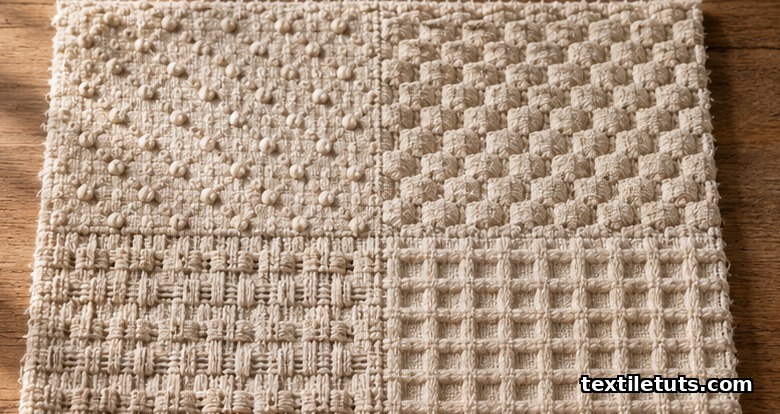
Common dobby structures include bird’s eye, honeycomb, huckaback, waffle, and small geometric repeats of twill or satin. The motif repeat is fixed by the pattern-chain length, and most commercial dobby fabrics repeat inside a 25.4 mm square. Because the warp selection is finite and the chain is physical, changing a dobby pattern on a mechanical loom requires stopping the machine and fitting a new chain, an operation that historically took 30 to 60 minutes per pattern.
Modern electronic dobby machines (Stäubli, Bonas, Groz-Beckert) replaced the chain with a digital map of lifts that can be changed in seconds from a console, but the harness count and repeat-size limit stay the same.
What Is a Jacquard Weave?
A jacquard weave is a large-pattern woven structure produced on a jacquard loom. The mechanism was patented in 1804 by Joseph Marie Jacquard in Lyon, France, and was the first industrial use of binary information storage: a chain of punched cards read one card per pick, with each card selecting which warp ends to lift out of a field of several hundred to several thousand hooks.
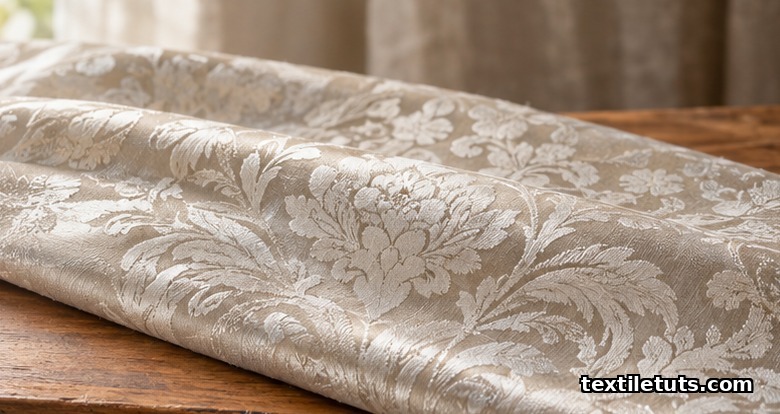
A modern electronic jacquard (Stäubli Lx or Vamatex Leonardo) carries 10,000 to 25,000 hooks and can lift each warp thread independently. That lets the loom render a photograph, a logo, or an arbitrarily large paisley without geometric simplification. The pattern repeat is limited only by the fabric width and the warp-creel capacity, and motifs of 100 cm by 100 cm are routine in damask bedding and furnishing fabrics.
Three sub-classes of jacquard deserve mention. Damask is a single-color warp-and-weft jacquard in which the pattern shows through contrasting floats of warp and weft. Brocade is a multi-color jacquard with supplementary wefts laid in and then cut or left floating on the back. Matelassé is a double-cloth jacquard in which two warps and two wefts are interlaced to produce a quilted, three-dimensional surface.
How the Looms Differ Mechanically
The mechanical heart of the difference is the harness. A dobby loom uses one harness per warp-end group plus a pattern-selection device. A cam dobby (used for short, repeating weaves like 1/3 twill or plain derivatives) reads lift information from a barrel cam; a chain or electronic dobby reads lift information from a pattern chain or digital map. Maximum hook count is usually between 16 and 32, with high-end electronic dobbies reaching 40 harnesses.
A jacquard loom replaces the harness assembly with one hook per warp end and uses a needle-and-spring selection system above the harness. Each pick, the card or digital file tells the machine which hooks to lift. There is no harness-cycle limit; the only constraint is the total number of hooks the machine carries. The earliest practical jacquard (1804) had about 1,200 hooks; modern electronic jacquards have 10,000 to 25,000.
Shed formation is also different. Dobby shed changes are synchronized with the loom cycle: the harness reaches top dead center, the pattern selection rotates, and the next pick’s shed is ready before the weft is inserted. Jacquard shed changes are independent of the loom cycle because every hook can move on its own, which allows very long lift cycles and is the reason complex jacquards run at slower weft-insertion rates, often 200 to 400 picks per minute versus 600 to 1,200 on a dobby.
Pattern Size, Complexity, and Design Limits
Dobby repeat length is bounded by the harness count multiplied by the longest reasonable warp float. With 24 harnesses and a maximum float of four warp ends, the smallest practical geometric motif is 24 ends by 24 picks, equal to 576 intersections. At a typical 60 ends per inch by 60 picks per inch, this yields a repeat of about 9.6 mm by 9.6 mm. Larger dobby motifs, up to 25 mm, use 32-harness machines with up to 8-end floats.
Jacquard repeat is bounded by the warp and weft count of the fabric and the hook count of the machine. A 200 cm wide, 200 cm long damask tablecloth at 60 ends/cm and 60 picks/cm is 12,000 ends wide and 12,000 picks long, well within the 25,000-hook limit of a modern electronic jacquard and well beyond any dobby.
Design complexity flows from this. A dobby can render small geometric textures, surface interest, and micro-patterns. A jacquard can render pictorial detail, tonal shading through weave gradient, and large-format branding. The trade-off is loom capital cost: an electronic jacquard with 10,000 hooks costs roughly 4 to 10 times more than an electronic dobby with 24 hooks.
Yarn Count, GSM, and Fabric Property Ranges
Both weaves accept a wide range of yarn counts, but each performs best in a particular window. Dobby fabrics typically use 10s to 80s Ne cotton (or equivalent in Nm, Tex, or denier) and weigh 80 to 250 GSM. The relatively short repeats let dobby fabrics use fine to medium yarn counts without long floats that would catch and abrade.
Jacquard fabrics typically use 20s to 100s Ne cotton (or finer filament equivalents) and weigh 90 to 450 GSM. Damask and brocade for furnishing can push past 400 GSM because long floats are accepted and even desired for surface luster. Lightweight apparel jacquard (dress shirts, blouses) drops to 90 to 120 GSM with filament polyester or silk.
Both weave families tolerate similar finishes: singeing, mercerizing, calendering, and resin finishing. Dobby has an advantage for stretch because a small geometric repeat can be combined with elastic weft without distorting the pattern; jacquard stretches unevenly because long floats shift.
Common Applications of Dobby vs Jacquard
Dobby is the workhorse weave for textured household and apparel basics. Shirt fabrics use dobby for self-cloth patterning (subtle vertical or geometric interest), and huckaback towels rely on the weave’s absorbent surface. Bed linen, blanket binding, pique knit substitutes, and apparel linings are typical dobby applications. Dobby is also widely used in casual shirting and some types of bottom-weight bottoms, where the small repeat adds hand-feel without visual noise.
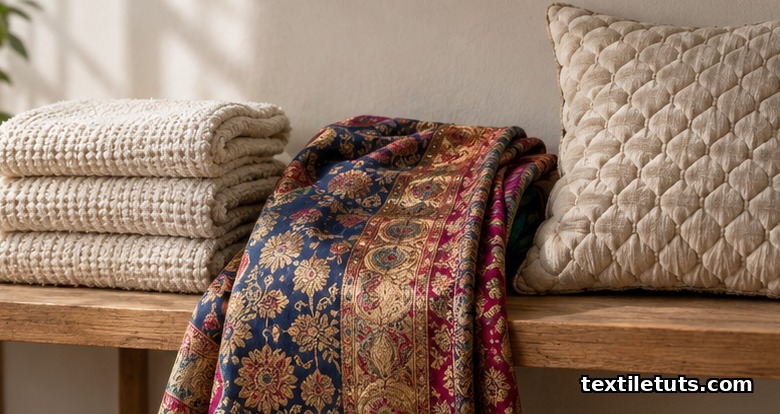
Jacquard dominates where the pattern is the product. Damask table linen, brocade saris and sherwanis, matelassé upholstery, and tapestry furnishing fabrics are all jacquard. Branded apparel (woven logos, end-on-end patterns), decorative bedding, ties, and scarves rely on the loom’s ability to render a graphic. Technical applications include woven carbon-fiber preforms for composites and three-dimensional reinforcement textiles for aerospace, both of which use the hook-level control to place fibers along load paths.
Dobby vs Jacquard: At-a-Glance Comparison
| Property | Dobby | Jacquard |
|---|---|---|
| Harness / hook count | 16 to 40 harnesses | 1,200 to 25,000 hooks |
| Maximum repeat size | About 25 mm typical | Up to fabric width by length |
| Minimum motif resolution | About 9.6 mm by 9.6 mm | Single-thread resolution |
| Typical yarn count (cotton) | 10s to 80s Ne | 20s to 100s Ne |
| Typical GSM range | 80 to 250 GSM | 90 to 450 GSM |
| Loom speed (picks per min) | 600 to 1,200 | 200 to 400 (complex patterns) |
| Capital cost (electronic, 2024) | USD 80,000 to 150,000 | USD 350,000 to 1,500,000 |
| Pattern-change time | Seconds (electronic dobby) | Minutes (electronic file load) |
| Typical applications | Shirting, towels, linens, linings | Damask, brocade, matelassé, branding |
Frequently Asked Questions
Is jacquard a type of dobby?
No. Jacquard and dobby are two different loom mechanisms and two different weave categories. They share the broad category of figured weave (weaves with a pattern), but they are not subtypes of one another. Dobby is its own weave family with its own harness and repeat limits; jacquard is its own family with hook-level warp control.
Which is more expensive, dobby or jacquard?
Jacquard is significantly more expensive on every cost line. An electronic jacquard with 10,000 hooks costs USD 350,000 to USD 1,500,000 in 2024, versus USD 80,000 to USD 150,000 for a 24-harness electronic dobby. Jacquard fabrics also run slower, at 200 to 400 picks per minute on complex patterns versus 600 to 1,200 on dobby, so per-meter production cost is higher. The end-user price gap narrows for short runs because jacquard setup cost is amortized over fewer meters.
Can a jacquard loom weave a dobby pattern?
Yes. A jacquard loom can produce any dobby pattern and any plain, twill, or satin pattern, because hook-level control is a strict superset of harness-level control. The reverse is not true: a dobby loom cannot produce a jacquard pattern because it does not have enough harnesses to lift individual warp ends across hundreds of hooks.
Which weave is better for upholstery, dobby or jacquard?
Jacquard, specifically matelassé or damask, is preferred for decorative upholstery where the pattern is the design feature. Dobby is preferred for textured but visually quiet upholstery, such as huckaback-style weaves used in casual seating or as the back of mattress ticking. The deciding factor is whether you want the weave to be seen (jacquard) or felt (dobby).
How do I tell a dobby fabric from a jacquard fabric on the finished cloth?
Look at the repeat. Dobby fabric repeats inside a small area, typically a 25 mm square; if you flip the fabric and find a geometric motif you cannot see more than once in a credit-card-sized patch, it is dobby. Jacquard fabric has a repeat that can span the entire fabric width, and you can usually see the same motif mirrored or tiled several times across the width. Under a pick glass, jacquard has long warp or weft floats of 4 to 12 ends per float while dobby floats stay under 8 ends.
References
- International Organization for Standardization. ISO 3572:1976 Textiles, Weaves, Definitions of general terms and basic weaves. iso.org, the canonical definition of plain, twill, satin, and figured weaves.
- International Organization for Standardization. ISO 9354:1989 Textiles, Weaves, Coding system and examples. iso.org, point-paper notation used by both dobby and jacquard designers.
- ASTM International. ASTM D579 Standard Tables of Weaves. astm.org, American classification of basic weave constructions including dobby and jacquard variants.
- Adanur, S. Handbook of Weaving. Woodhead Publishing (referenced via ScienceDirect), engineering treatment of dobby and jacquard mechanisms, shed formation, and loom kinematics.
- Mahapatra, N. N. Textile Engineering: Weaving and Weaving Preparations. Springer, applied reference for figured-weave design, repeat calculation, and loom selection.
This article is the working reference for dobby vs jacquard loom mechanisms and weave structure. Editorial by Mohammad Yousuf (Anik), TextileTuts. Sources: ISO 3572:1976, ISO 9354:1989, ASTM D579, Adanur (Woodhead), and Mahapatra (Springer) as cited.


