
American Heritage Denim Brands

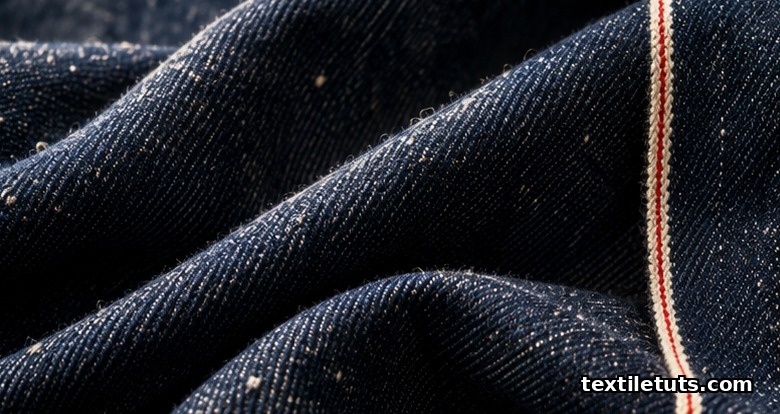
American heritage denim brands are defined by three measurable technical foundations: continuous U.S.-based production since before 1950, ring-spun cotton warp dyed with indigo using the ring-dye method that deposits pigment in the outer 20-40% of the fiber radius, and signature construction details (arcuate stitching, copper or copper-plated rivets, chain-stitched hems) that survive on the production floor today.
What separates heritage denim from generic denim is engineering, not marketing. The brands operating today share a common production backbone: ring-spun yarn, indigo applied by the dip-and-air method on cotton warp, and finishing that controls mass per unit area within ISO 3801 tolerances of ±3%.
Below: the four largest U.S. heritage denim apparel makers still in production, the mill supply chain that supports them, the loom and finishing technology behind their core fabrics, and the technical reasons heritage jeans fit, fade, and wear differently from generic denim.
Why “Heritage” Is an Engineering Term
In textile engineering, heritage denim refers to denim whose production chain survives within a domestic (U.S.) supply ecosystem. Concretely, this means three things: yarn is spun from cotton on a ring-spinning frame, the warp is dyed on a continuous indigo range using the rope-dye process, and the fabric is woven on either shuttle looms (selvedge, 28-32 inch width) or modern projectile/air-jet looms (60+ inch width). When any of those steps disappears from the domestic supply chain, the “heritage” claim weakens.
Mass per unit area (fabric weight) is the most useful single metric for heritage denim. ISO 3801 specifies the gravimetric method for measuring mass per unit area of woven fabrics. Heritage denim fabrics from U.S. mills fall in a tight range:
| Weight class | Mass (oz/yd²) | Mass (g/m²) | Typical use |
|---|---|---|---|
| Light | 7-9 | 237-305 | Summer shirts, lightweight jeans |
| Standard | 10-12 | 339-407 | Standard five-pocket jeans |
| Heavy | 13-16 | 441-542 | Workwear, raw denim, jackets |
| Extra-heavy | 17+ | 576+ | Specialty heritage reproductions |
Most heritage jeans from U.S. brands fall in the 10-14 oz/yd² (339-475 g/m²) range, with selvedge lines trending toward 12-16 oz/yd². Fast-fashion denim typically uses lighter 6-8 oz/yd² (203-271 g/m²) fabric to reduce cost.
Levi Strauss & Co.: The Origin (1853)
Levi Strauss & Co. was founded in San Francisco in 1853 by Levi Strauss, a Bavarian immigrant who arrived in New York in 1847. The company began as a dry-goods wholesaler and entered the work-pants business in 1873, when Jacob Davis, a Reno, Nevada tailor, partnered with Strauss to patent copper-rivet reinforcement at the stress points of work pants. U.S. Patent 139,121, granted May 20, 1873, is the foundational document of American heritage denim.
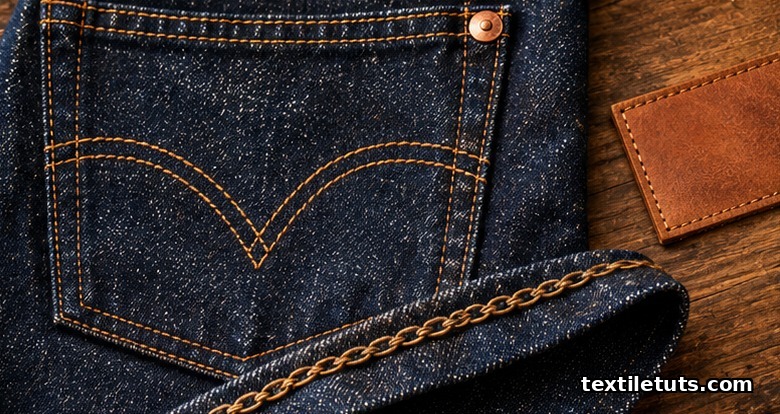
Levi’s signature features that survive today are engineering decisions, not aesthetic choices:
Arcuate stitching. The decorative double-arc stitching on the back pockets has been protected continuously as a trademark since 1873 and remains one of the oldest continuously held trademarks in apparel.
Hidden rivets. Copper rivets were originally visible on the front of jeans. After 1937, Levi’s moved the front pocket rivets to the inside of the pocket to prevent damage to saddles, school desks, and car upholstery. The hidden rivet is a manufacturing change with a documented engineering rationale.
Chain-stitched hem. The rosette effect that appears when a Levi’s hem is let out is created by a chain stitch (ISO 4916 stitch type 101, single thread chain) rather than a lockstitch (stitch type 301). A chain stitch consumes roughly 4 cm of thread per 2.5 cm of seam, versus 6 cm for a lockstitch.
Levi Strauss & Co. operates denim weaving and finishing in the U.S. and several other countries, with the 501 button-fly jean still produced in the original shrink-to-fit (unsanforized) construction. Sanforized versions carry a “Sanforized” label that guarantees residual shrinkage below 3% per ISO 139 and AATCC TM-135.
Lee: The Middle America Heritage Brand (1889)
The H.D. Lee Mercantile Company was founded in Salina, Kansas, in 1889 by Henry David Lee. The company began as a grocery wholesaler and entered workwear in the 1920s, becoming the second-largest jeans manufacturer in the U.S. by the 1950s. Lee’s signature engineering contribution to heritage denim is the union-all (coverall) construction and the lazy-S stitching on the back pockets, both protected trademarks.
Lee’s fabric specifications are tracked by ASTM D5034 (tensile) and ASTM D2261 (tongue-tear) for the workwear line. Lee has remained continuous through several corporate ownership changes; its denim is currently sourced from U.S. and international mills, with cut-and-sew operations in Mexico, Central America, and parts of Asia. The company does not maintain its own weaving operation, so “heritage” here is the design and finishing specification, not the loom.
Wrangler: Western Workwear Heritage (1947 Brand, 1904 Roots)
Wrangler jeans were introduced in 1947 by Blue Bell Overall Company, which had been making work overalls since 1904. The Wrangler brand was developed with input from professional rodeo cowboys, including the 13MWZ model (introduced 1947) developed with competitor Jim Shoulders. Wrangler was acquired by VF Corporation in 1986.
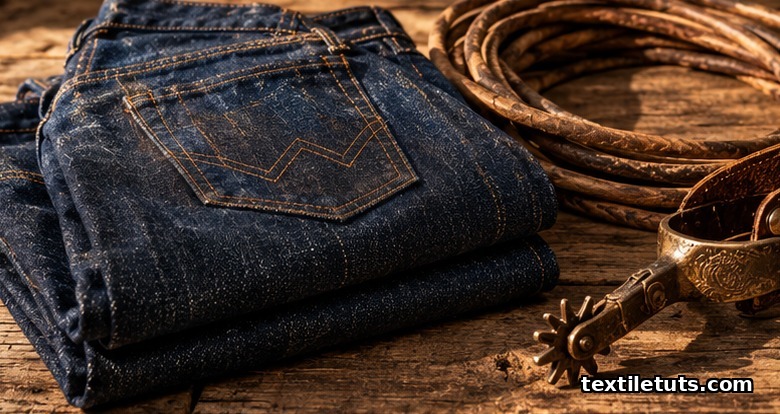
The 13MWZ is a 100% cotton, 14.5 oz/yd² (491 g/m²) rigid denim that has been in continuous production for over 75 years. The 13MWZ specifications are engineering constants: ring-spun cotton warp, indigo rope-dyed, natural (unbleached) weft, sanforized to less than 3% residual shrinkage per AATCC TM-135 (dimensional changes after home laundering). The same fabric specifications persist on the production floor today.
Carhartt: The Workwear Specialist (1889)
Carhartt was founded in 1889 by Hamilton Carhartt in Detroit, Michigan. The company began by manufacturing work overalls for railroad laborers and has remained family-influenced across four generations. Carhartt’s heritage denim line, particularly the B01 double-front duck-style pant and the V01 work pant, uses heavyweight ring-spun cotton denim in the 12-15 oz/yd² (407-508 g/m²) range.
Carhartt publishes fabric specifications openly. Tensile strength is tested per ASTM D5034 (grab method) and tear strength per ASTM D2261 (tongue method). These are the engineering tests used to validate the workwear specification, not optional marketing claims.
Cone Mills: The Mill Behind the Brands
Cone Mills Corporation operated the White Oak Mill in Greensboro, North Carolina, from 1905 until its closure in late 2017. White Oak was the last major selvedge denim mill in the United States, producing denim exclusively on American-made Draper X3 shuttle looms. At its peak, White Oak supplied a major share of the U.S. denim apparel market, and its selvedge denim was the substrate for the highest-end heritage jeans, including Levi Strauss & Co.’s Vintage Clothing and Made & Crafted lines.
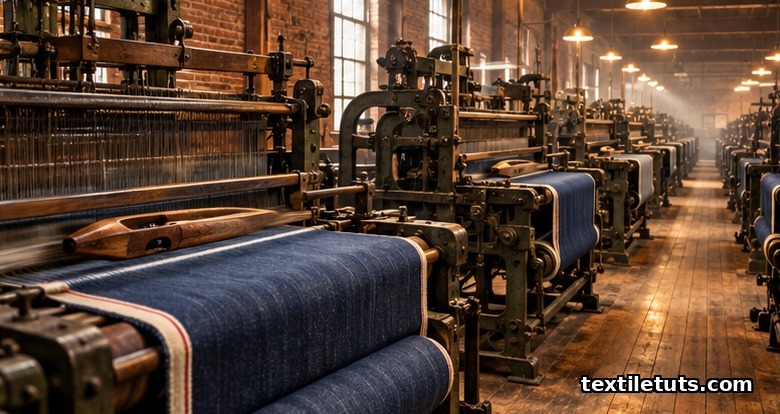
White Oak operated more than 200 Draper shuttle looms at approximately 100 picks per minute, versus 600-800 picks per minute on a modern projectile loom. That slow pace, and the 29-32 inch finished fabric width (versus 60-75 inch for shuttleless looms), is the engineering reason selvedge denim exists as a separate category: shuttle looms cannot economically produce wider fabric, so they were displaced by shuttleless looms for most apparel applications. When White Oak closed, large-scale U.S. selvedge production effectively ended.
The White Oak Mill closure did not end U.S. heritage denim entirely, but it ended large-scale U.S. selvedge production. Smaller mills, including Vidalia Mills (Louisiana, restarted 2017) and a few Japanese-owned shuttle operations in North Carolina, now produce limited selvedge output, but volumes are a fraction of White Oak’s peak. The heritage selvedge category today is dominated by Japanese shuttle-loom production (Kaihara, Kuroki, Collect, and others) shipped to U.S. brands.
Shrinkage, Sanforization, and Why Heritage Jeans Fit Differently
Raw (unsanforized) heritage denim shrinks 5-10% on the first wash, primarily in the warp direction. The sanforization process, developed by Sanford Lockwood Cluett in the late 1920s and patented under the Sanforized trademark in 1930, mechanically compresses the fabric to pre-shrink it. Sanforized denim shows residual shrinkage below 3% per AATCC TM-135 or ISO 5077 (determination of dimensional change on washing and drying).
Heritage denim frequently offers both sanforized and unsanforized versions of the same fabric. The unsanforized version is preferred by raw-denim enthusiasts because the initial indigo loss during the first wash is reduced (less dye crocking from washing a stiffer, more pigment-loaded fabric). The sanforized version is preferred for ready-to-wear reliability.
Frequently Asked Questions
What makes a denim brand “American heritage”?
American heritage denim brands are typically manufacturers with continuous U.S.-based production since before 1950, using ring-spun cotton warp dyed with indigo, signature construction details (arcuate stitching, copper rivets, chain-stitched hems), and published fabric specifications tied to ISO and ASTM standards. The four apparel brands most often cited are Levi Strauss & Co. (1853), Lee (1889), Wrangler (1904 roots, 1947 brand), and Carhartt (1889); a fifth, Cone Mills’ White Oak Mill (1905-2017), supplied most of the U.S. selvedge market.
Is selvedge denim the same as heritage denim?
No. Selvedge denim refers specifically to denim woven on shuttle looms, with a tightly woven self-edge that prevents fraying. Heritage denim is a broader term that includes selvedge and non-selvedge denim made by heritage brands. Until 2017, most U.S. selvedge denim was produced at Cone Mills’ White Oak Mill; today, U.S. selvedge production is limited and most heritage selvedge fabric is imported from Japanese shuttle looms (Kaihara, Kuroki, and others).
Why do heritage jeans shrink in length but not width?
Heritage denim is woven with indigo-dyed cotton warp (lengthwise) and undyed or lightly dyed cotton weft (crosswise). During wet processing, especially sanforization, the warp yarns swell and contract more than the weft because indigo pigment on the warp slows water absorption. The result is that heritage jeans typically shrink 3-5% in length (warp direction) and 1-2% in width (weft direction) on the first wash, even when sanforized.
Are heritage jeans more durable than modern denim?
Not necessarily. Modern denim can match or exceed heritage denim on tensile strength (ASTM D5034) and tear strength (ASTM D2261) tests, often because modern yarns are spun with higher twist multipliers and tighter weave constructions. Heritage denim’s reputation for durability comes from heavier fabric weights (12-16 oz/yd² versus 8-10 oz/yd² for fast-fashion denim) and traditional construction details like bar tacks and chain-stitched hems, not from any inherent fiber superiority.
Why did Cone Mills’ White Oak Mill close?
White Oak Mill closed in late 2017 as part of a restructuring by Cone Mills’ parent company (International Textile Group, then owned by Platinum Equity). The closure reflected declining demand for selvedge denim from U.S. brands, the high operating cost of 1905-era Draper shuttle looms, and corporate decisions to focus Cone Mills on open-end and air-jet denim for mass-market customers. The closure ended a 112-year run and shifted U.S. selvedge supply to Japanese mills.
References
- Paul, R. (ed.). Denim: Manufacture, Finishing and Applications. Woodhead Publishing, 2015.
- ISO 3801:1977. Textiles — Woven fabrics — Determination of mass per unit area. International Organization for Standardization.
- ISO 139:2005. Textiles — Standard atmospheres for conditioning and testing. International Organization for Standardization.
- ISO 5077:2007. Textiles — Determination of dimensional change. International Organization for Standardization.
- ASTM D5034-21. Standard Test Method for Breaking Strength and Elongation of Textile Fabrics (Grab Method). ASTM International.
- ASTM D2261-22. Standard Test Method for Tearing Strength of Fabrics by the Tongue (Single Rip) Procedure. ASTM International.
- AATCC TM-135. Dimensional Changes of Fabrics After Home Laundering. American Association of Textile Chemists and Colorists.
- U.S. Patent 139,121. Improvement in Fastening Pocket-Openings. Granted May 20, 1873, to Jacob Davis and Levi Strauss & Co.
- ISO 4916:1991. Textiles — Stitch types — Classification and terminology. International Organization for Standardization.
Editorial by Shahrukh Islam, TextileTuts. Sources: ISO 3801, ISO 139, ISO 5077, ISO 4916, ASTM D5034, ASTM D2261, AATCC TM-135, Paul (2015), U.S. Patent 139,121 as cited.


