
Fiberglass Weaving

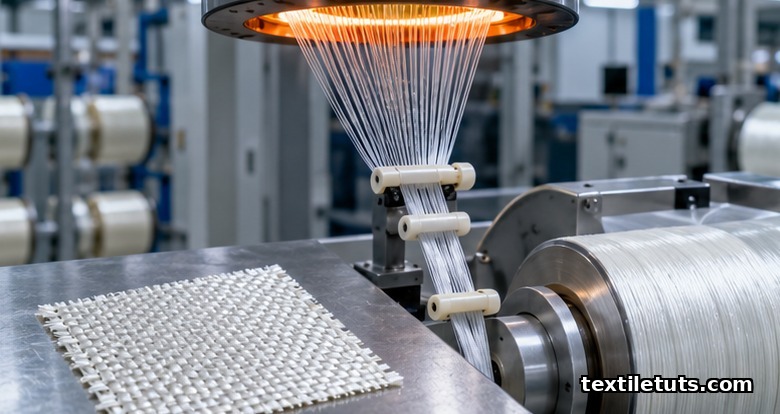
Fiberglass weaving produces textiles from continuous glass filaments with fiber diameters of 5 to 25 micrometers and tensile strengths of 1,700 to 4,800 MPa, using E-glass fiber (alkali oxide content under 1% by weight) as the standard reinforcement for roughly 90% of the woven glass fabrics manufactured worldwide.
These fabrics, classified under ISO 2078 and tested per ASTM D578, serve as the load-bearing skeleton in composites, fire-resistant barriers, and printed-circuit substrates. The cloth’s mechanical behavior is set by three controls: filament tex, weave geometry, and finish chemistry. This article walks through each, with the underlying material science, the loom settings that produce them, and the standards engineers rely on to grade the output.
What Fiberglass Actually Is
Fiberglass is a textile made by attenuating molten glass (typically melted at 1,260 to 1,540 °C depending on the formulation) into continuous filaments thinner than a human hair. The two grades that dominate woven fabric are E-glass and S-glass.
E-glass, the electrical grade, is defined by an alkali oxide (Na₂O + K₂O + Li₂O) content of less than 1% by mass. It is the workhorse for most woven cloth because it balances mechanical performance with cost. Its tensile strength at room temperature is typically 3,400 MPa, with a Young’s modulus near 72 GPa and a density of 2.54 g/cm³.
S-glass, the high-performance grade, holds about 25% more tensile strength (around 4,800 MPa) and tolerates higher service temperatures (up to approximately 550 °C versus 480 °C for E-glass). It is reserved for aerospace and defense applications where the extra 30 to 40% performance gain justifies the 4 to 6 times higher fiber cost.
After the filaments are drawn, they are bundled into strands (typically 204 filaments per strand for the most common E-glass designation, designated “EC9 68” per ISO 2078 nomenclature) and coated with a size that protects the filaments from abrasion during weaving and chemically bonds the eventual fabric to a polymer matrix.
Yarn and Tow Specifications Used in Weaving
Fiberglass is woven from two yarn forms: filament yarns (single-end strands) and texturized or plied yarns. The linear density is expressed in TEX (grams per 1,000 meters) or in the older yield system of yards per pound (Table 1).
| Yarn Type | TEX (g/km) | Yield (yd/lb) | Typical Use |
|---|---|---|---|
| EC5 11 | 11 | 41,200 | Very fine cloth, PCB laminate |
| EC6 17 | 17 | 26,500 | Lightweight reinforcement fabric |
| EC7 22 | 22 | 20,500 | General-purpose woven roving base |
| EC9 34 | 34 | 13,200 | Standard composite reinforcement |
| EC9 68 | 68 | 6,600 | Heavy roving and stitched fabric |
| EC12 136 | 136 | 3,300 | Woven roving, ballistic core |
The “EC” prefix denotes E-glass composition; the first number is the filament diameter in micrometers; the second is the linear density. These codes follow ISO 2078:2022 and form the backbone of any fiberglass datasheet or ASTM D578 yarn specification.
Weave Patterns Used in Fiberglass Cloth
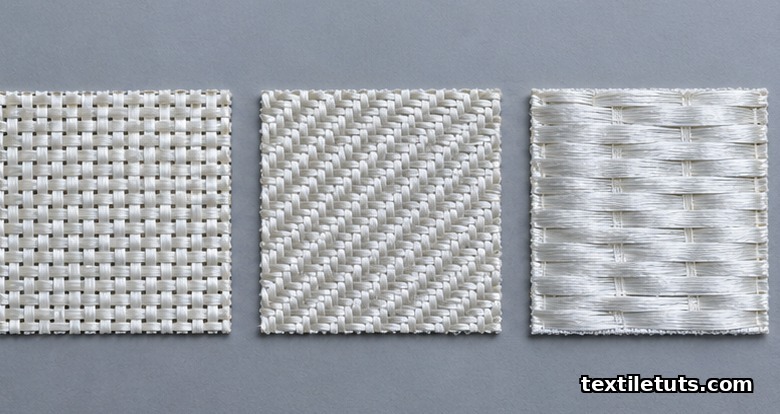
Four weave structures account for nearly all commercial fiberglass fabric. Each geometry gives a different balance of drapability, stability, and in-plane mechanical performance.
Plain Weave
Plain weave (1/1) is the most common fiberglass structure. Each warp yarn passes over one weft yarn and under the next, producing a balanced, stable fabric with the highest crimp and the lowest mechanical efficiency. Mass per unit area ranges from 25 to 200 g/m². Plain-weave cloth is the standard for surfacing veils, printed-circuit board substrates, and filtration media because it lies flat and accepts surface coatings evenly.
Twill Weave
Twill (typically 2/2) allows each warp to pass over two wefts before going under, creating the diagonal wale that gives the fabric its name. The lower crimp improves tensile load transfer, raising in-plane strength by 10 to 20% over plain weave at the same yarn count. Twill fiberglass is the preferred substrate for molded composites where conformability to compound curves is required.
Satin Weave
4-harness satin (4HS) and 8-harness satin (8HS) put each warp over three or seven wefts before binding, producing the smoothest surface and the highest mechanical translation from yarn strength to fabric strength. 8HS is the default for aerospace prepreg because it drapes over complex tooling and reaches fiber-volume fractions of 58 to 62% after cure.
Leno and Mock-Leno
Leno weave uses paired warps twisted around each weft, locking the yarns in place. The structure prevents yarn shift in very open, lightweight scrims (under 30 g/m²) where a plain weave would be too unstable. It is common in insulation facing and reinforcing scrim for construction membranes.
How the Weaving Process Differs from Conventional Textile Weaving
Fiberglass weaving borrows the loom architecture of cotton and worsted systems but adapts every friction, tension, and surface-contact point. Glass filaments are brittle; their elongation at break is only 4 to 5%, versus 20 to 30% for cotton and 10 to 25% for polyester. The loom must therefore maintain lower and more uniform tension, and every guide surface is chrome-plated or ceramic to minimize abrasion damage.
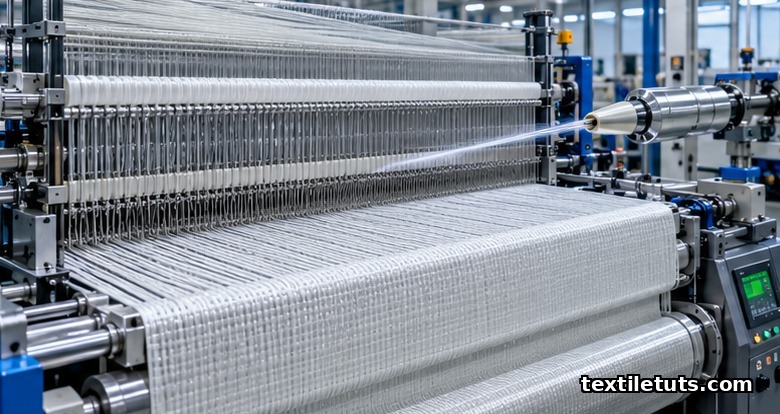
The typical sequence on a modern rapier or air-jet loom is:
- Creel loading of yarn packages (cones or bobbins, often warp-dyed onto a beam at 200 to 600 ends).
- Wax or starch size application during warp preparation to reduce fiber-to-fiber abrasion (most fiberglass is already sized at filament formation, but a secondary “slashing” pass boosts weavability).
- Shedding and weft insertion at reduced shed angles (typically 8 to 12° rather than the 25 to 30° used for cotton) to keep tension flat.
- Beat-up at lower reed impact forces, with the reed count matched to the yarn tex.
- Take-up at controlled positive tension (4 to 12 N per meter of fabric width) to prevent slack that would form wrinkles.
Modern air-jet looms can run fiberglass at 600 to 800 picks per minute for plain-weave constructions under 100 g/m². Heavier roving fabrics (above 400 g/m²) are usually woven on rapier or projectile looms at 100 to 250 picks per minute, because the heavier weft cannot be reliably propelled by air.
Sizing, Finish, and Coupling Chemistry
Once woven, the cloth is heat-cleaned at 350 to 400 °C to burn off the starch/oil weaving size, then treated with a finish that dictates end-use compatibility. The two main finish families are:
- Silane-based coupling finishes (e.g., amino-silane, epoxy-silane): chemically bond the glass surface to epoxy, polyester, or phenolic resin matrices. Used for structural composites.
- Hydrophobic or fluorocarbon finishes: repel water and reduce wicking. Used in architectural membranes, filtration, and fire-rated duct coverings.
Without a properly selected finish, the fabric-matrix interface fails at 30 to 50% of the theoretical strength. A properly silane-coated E-glass laminate typically retains 75 to 90% of the dry, single-fiber strength after full cure, a figure documented in ASTM D2344 short-beam-shear testing.
Key Properties of Woven Fiberglass
| Property | Plain Weave (EC9 68, 200 g/m²) | 8HS Satin (EC9 68, 200 g/m²) | Test Method |
|---|---|---|---|
| Tensile strength (warp) | 240 MPa | 320 MPa | ASTM D3039 |
| Tensile strength (weft) | 220 MPa | 300 MPa | ASTM D3039 |
| Thickness | 0.21 mm | 0.20 mm | ASTM D1777 |
| Continuous service temperature | 480 °C | 480 °C | ASTM D794 |
| Dielectric strength | 18 kV/mm | 20 kV/mm | ASTM D149 |
| Moisture regain | <0.1% | <0.1% | ISO 3344 |
The two figures that most often surprise new users are the moisture regain (effectively zero, which is why fiberglass does not rot but also why it needs a finish to bond to resin) and the dielectric strength, which is the reason fiberglass cloth is the dominant substrate in FR-4 printed-circuit boards.
Applications That Drive Modern Production
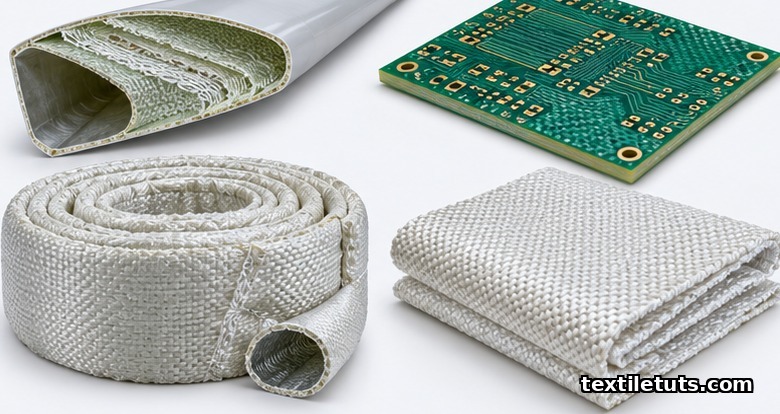
Woven fiberglass fabric flows into four end-use markets that together consume about 1.2 million tonnes of material annually, based on figures compiled in MDPI’s 2022 review of the glass-fiber composites industry.
- Wind-turbine blades: biaxial and triaxial fabrics form the structural spar caps. A single 80-meter offshore blade can contain 12 to 18 tonnes of E-glass cloth.
- Printed-circuit boards: FR-4 laminate is built from woven E-glass impregnated with epoxy resin. The cloth gives the cured PCB its mechanical stability and most of its dielectric performance.
- Fire-rated construction: coated fiberglass cloth is wrapped over steel ducts and structural members to provide 1- to 4-hour fire ratings per ASTM E119.
- Filtration and high-temperature insulation: texturized fiberglass cloth handles continuous service temperatures of 260 to 540 °C in bag-house filters for power plants and cement kilns.
Standards That Govern Fiberglass Weaving
- ISO 2078:2022 — glass fiber nomenclature (the EC designation system)
- ISO 3375:2009 — determination of stiffness of rovings
- ISO 3616:2001 — determination of tensile breaking force and elongation at break
- ASTM D578 / D579 — standard specifications for glass fiber yarns and fabrics
- ASTM D3039 — tensile properties of polymer-matrix composite materials
- ASTM D2344 — short-beam strength of polymer-matrix composites
Adherence to these standards is the difference between a fabric that meets aerospace prepreg specifications and one that fails qualification testing on the first cure cycle.
Frequently Asked Questions
What is fiberglass cloth made of?
Fiberglass cloth is made from continuous filaments of E-glass (borosilicate glass with alkali oxide content below 1% by weight) or S-glass (a magnesium aluminosilicate with higher tensile strength). The filaments are drawn from molten glass at diameters of 5 to 25 micrometers, bundled into strands, sized for abrasion resistance, and then woven on rapier, air-jet, or projectile looms.
Is fiberglass weaving dangerous?
Fiberglass weaving is safe when standard controls are in place. Airborne filament fragments larger than 3 micrometers are trapped in the upper respiratory tract and do not reach the deep lung; the fraction that does reach the alveoli is typically non-respirable fragments that the body clears within days. Proper controls include local exhaust ventilation at creels, looms, and slashing stations, plus PPE (N95 or P100 respirators, long sleeves, and gloves) during creel loading and slashing where fragment release is highest. Modern sized fibers with low dust release have reduced airborne fragment counts by more than 60% compared to unsized glass.
Can fiberglass cloth be cut and sewn like regular fabric?
Yes, but with sharp tools and protective handling. Fiberglass can be cut with a freshly sharpened rotary blade, shears, or a CNC fabric cutter, and it can be sewn with a heavy-duty lockstitch machine using a size 18 to 22 needle and bonded nylon or PTFE thread. Edges should be sealed with a thin coat of epoxy or PVA to prevent fraying, because cut filaments release tiny shards that irritate skin.
What temperature can woven fiberglass withstand?
Woven E-glass cloth withstands continuous service temperatures of 480 °C in air and short excursions up to 700 °C. S-glass extends the continuous rating to about 550 °C. Above 800 °C, the fibers begin to devitrify and lose strength, but the fabric can still act as a thermal barrier above this point because glass does not combust.
Why is fiberglass cloth used in PCBs?
Fiberglass cloth is used in printed-circuit boards because it offers a unique combination of high dielectric strength (18 to 20 kV/mm), near-zero moisture absorption, dimensional stability above 130 °C, and mechanical strength at low cost. The standard FR-4 laminate is built from 8 to 16 plies of woven E-glass impregnated with epoxy resin, providing the structural backbone of nearly every consumer and industrial circuit board.
This article is the working reference for fiberglass weaving. Editorial by Mohammad Yousuf (Anik), TextileTuts. Sources: ISO 2078:2022, ASTM D578, ASTM D3039, MDPI 2022 composites review as cited.


