
Seam Types: Plain, French, Flat-Felled, Bound

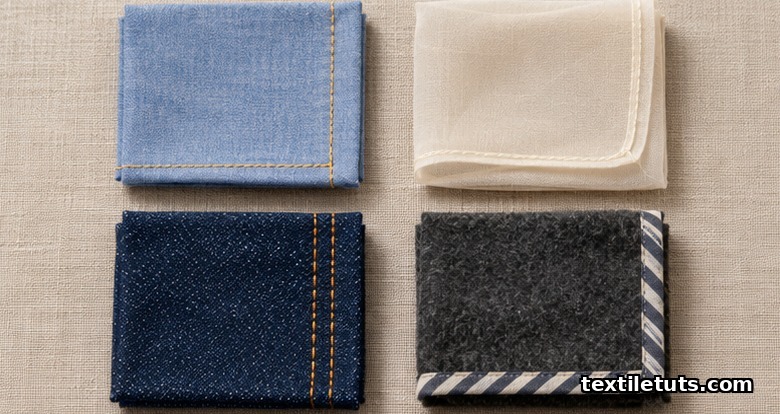
A plain seam (ISO 4916 class 1, superimposed seam) is constructed by placing two fabric pieces together with a 10–15 mm seam allowance and joining them with a lockstitch of 8–12 stitches per inch (SPI), and it accounts for roughly 90% of all woven-garment seaming because it balances production speed, cost, and adequate seam strength for most apparel end uses. Seam selection changes everything about how a garment looks, how long it lasts, and how it behaves in the wash, and the four workhorse seam types every production engineer, fashion student, and home sewist must understand are the plain seam, the French seam, the flat-felled seam, and the bound seam.
This guide walks through each seam type in the order ISO 4916 classifies them, then explains how fabric weight, garment end use, and stitch density drive the right pick for your project.
What Is a Plain Seam and Why Is It the Default in Garment Construction?
A plain seam, also called a superimposed seam, is formed by aligning two fabric pieces right sides together, sewing a single line of stitching through both layers, and pressing the seam allowance open or to one side. ISO 4916:1991 (Textiles, Seam types, Classification and terminology) catalogs it as class 1 and lists six sub-classes that vary by the number of rows of stitching (one row is class 1.01, two parallel rows is class 1.05). ASTM D6193 (Standard Practice for Stitches and Seams) treats the plain lockstitch seam (stitch type 301) as the reference construction for nearly all sewn-fabric strength testing.
In an industrial setting, the plain seam is run on a single-needle lockstitch machine at 8–12 SPI for woven fabrics and 10–14 SPI for knits, with a standard seam allowance of 10 mm for shirt panels and 15 mm for trouser panels. Production throughput runs 3,500–5,000 stitches per minute on a modern lockstitch head, which is why the plain seam dominates ready-to-wear. Its weakness is the raw edge left inside the garment, which can fray, show through thin fabric, and unravel if a stitch breaks. That weakness is exactly what the next three seam types are engineered to fix.
French Seam: The Double-Stitched Enclosed Seam for Sheer and Lightweight Fabrics
The French seam is a class 6 (clean-finished) seam in ISO 4916 built from two stitched passes that completely enclose the raw edge inside the seam itself. The first pass sews wrong sides together at a 6 mm allowance, the fabric is then flipped and folded right sides together, and a second pass sews at a 5–8 mm allowance from the fold, hiding every raw fiber inside a small fabric tunnel. The finished seam stands about 7–10 mm wide from the outside, with both rows of stitching visible on the face of the garment.
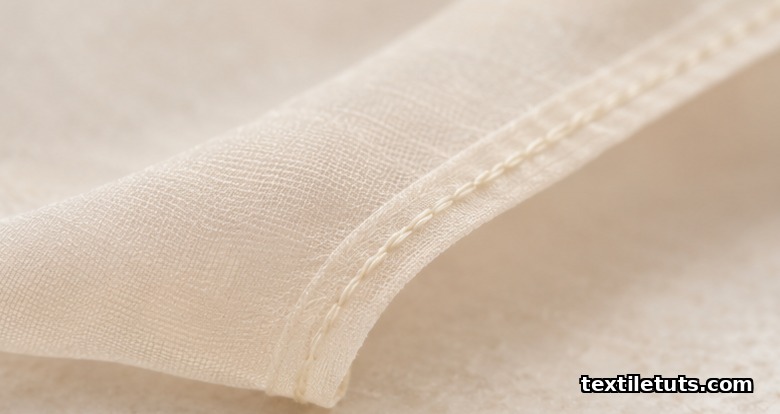
French seams are the standard for silk blouses, chiffon dresses, voile curtains, organza linings, and any garment where a raw edge would show through a transparent or semi-transparent fabric. French seams typically show higher seam efficiency than a plain seam on lightweight cloth because the raw edges are enclosed and double-stitched. The trade-off is bulk: the double-fold construction adds roughly 0.6 mm of seam thickness per layer, so French seams are unsuitable for heavy denim, coating wool, or any fabric above about 200 GSM. Production is also slower, two stitch passes per seam instead of one, which is why French seams appear in premium and luxury tiers rather than in high-volume fast fashion.
Flat-Felled Seam: The Double-Fold Seam Behind Denim and Workwear
The flat-felled seam (ISO 4916 class 2.01, lap-felled) is the construction you see on the inseam and outseam of every pair of jeans, on work shirts, on coveralls, and on most military field uniforms. It uses two folds and two rows of stitching, with the lower seam allowance trimmed to about 3 mm and the upper allowance wrapped around it, pressed flat, and top-stitched into place. The visible result is two parallel rows of stitching on the face of the garment and a clean, fray-proof finish on the inside.
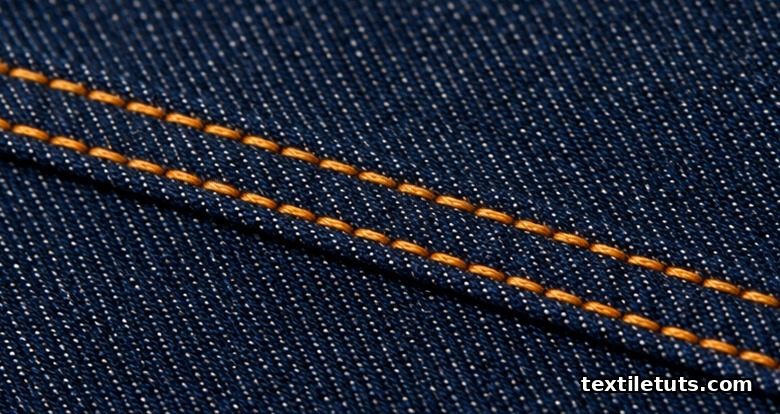
Flat-felled seams earn their place in heavy-duty apparel because the enclosed raw edge cannot unravel, the seam lays completely flat against the body for comfort under load, and the dual-stitch structure resists seam slippage under the high tension generated when a worker bends, lifts, or climbs. ASTM D1683 (Standard Test Method for Failure in Sewn Seams of Woven Fabrics) reports that flat-felled seams on 12 oz cotton denim routinely withstand 350–500 N of tensile pull before failure, roughly 30–50% higher than a plain lockstitch seam on the same cloth. The construction requires a folder attachment on the sewing machine and about 60% more stitch length per seam than a plain seam, which is why flat-felled jeans take 18–22 minutes of sew time for the leg seams alone on a standard jean line. Two rows of topstitch at 6–8 SPI, often in a contrasting gold or brown thread, are the visual signature of the construction.
Bound Seam: The Tailored Finish for Jackets, Lining Panels, and Outerwear
A bound seam (ISO 4916 class 6.02, bound edge) finishes a raw seam allowance by wrapping it in a separate strip of fabric, usually cut on the bias for flexibility, and stitching through the binding to enclose the edge. The binding strip is typically 25–40 mm wide before folding, and is sewn first along the raw edge with a 5–6 mm allowance, then folded over the edge and top-stitched from the face. A variation called the Hong Kong seam uses bias binding along each seam allowance separately rather than wrapping a single seam, and is the standard internal finish on high-end unstructured jackets and hand-finished blazers.
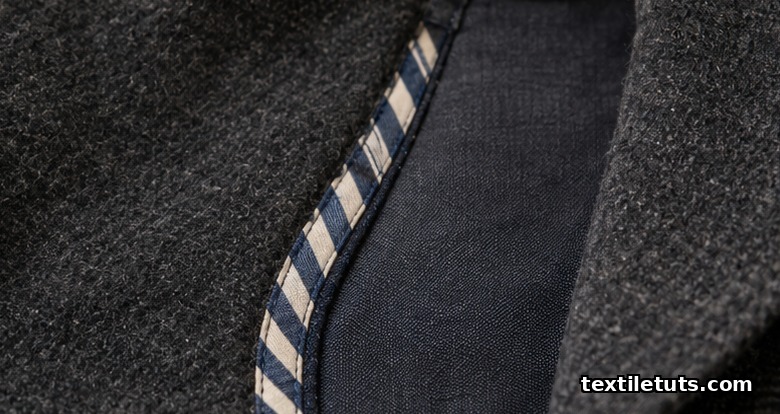
Bound seams are common on unlined blazers, trench coats, lined jackets with visible interior seams, sportswear where the binding doubles as a decorative trim, and on the inside seams of premium wool overcoats. The advantage is twofold: the binding protects the raw edge from fraying through years of wear, and the bias-cut strip allows the seam to flex without puckering on curved panels such as armholes, princess seams, and set-in sleeves. The main limitation is the extra material and labor. A bound seam uses 30–50 mm of binding per linear centimeter of seam and requires either a binding folder attachment or skilled hand work, so production is slower and per-garment cost is higher. For fabrics heavier than 350 GSM, a bound seam can add visible bulk that flattens the silhouette of the garment, which is why heavy wool coatings more often use a plain seam with a separate Hong Kong finish.
Seam Selection by Fabric Weight and Garment Type
The right seam is not a style preference, it follows from the fabric weight, the desired end use, and the wash-care cycle the garment must survive. The table below summarizes the dominant choice for the most common apparel categories. The numbers reflect widely cited industry ranges and the published guidance in the textile-engineering reference “Sewing Technology” by Gladius Radhakrishna (university textbook, used in BUTEX and AUST textile programs).
| Fabric weight / category | Dominant seam type | Typical SPI | Seam allowance | Why this seam |
|---|---|---|---|---|
| Lightweight woven (≤120 GSM): silk, chiffon, voile | French seam (class 6.01) | 10–12 | 6 + 6 mm double pass | Encloses raw edge; raw fibers would show through sheer cloth |
| Medium woven (120–250 GSM): cotton shirting, rayon, linen | Plain seam (class 1.01) with overlocked edge | 8–10 | 10 mm | Balanced strength-to-bulk; serging the edge prevents fray |
| Heavy woven (≥250 GSM): denim, canvas, twill | Flat-felled seam (class 2.01) | 6–8 | 13 mm folded to 6 mm | Maximum strength; fray-proof; signature topstitch |
| Lined jackets, unlined blazers, overcoats | Plain seam with bound or Hong Kong edge | 8–10 | 10 mm seam + 25 mm binding | Bias binding flexes on curved panels; clean interior |
| Knits and jersey | Plain seam with overedge (serger) stitch 504 | 10–14 | 8–10 mm | Stretch seam accommodates fabric recovery |
Two additional rules of thumb: always match stitch type 301 (lockstitch) to a plain seam, stitch type 401 (chainstitch) to a flat-felled or bound seam for elasticity on woven bottoms, and stitch type 504 (four-thread overedge) to knit construction. Stitch type is governed by ISO 4915:1991 and is the second half of the seam designation: seam type 1.01 + stitch type 301 is the formal ISO 4916 designation for the standard plain seam.
Stitch Density, Thread Tension, and Seam Slippage: Engineering a Durable Seam
The seam type is only half the durability story. Stitch density (SPI), thread tension, and needle size together determine how the seam performs under ISO 13935-1 (strip tensile test) and ISO 13936 (seam slippage test). Tightly woven, lightweight fabrics such as cotton poplin need higher SPI (10–12) to hold the yarns together under load, while heavy denim needs lower SPI (6–8) so the thread does not perforate the cloth and create a row of weak points. ISO 4916 sets a stitch length range of 2.5–4 mm for most apparel seaming; going outside that range is a common cause of seam failure in production audits.
Seam slippage, the displacement of fabric yarns perpendicular to the seam under stress, is the single most common durability defect in lightweight wovens and is measured under ISO 13936-2 (fixed-load method). A bound seam or a French seam reduces slippage on cotton shirting by 25–40% relative to a plain seam at the same SPI, because the second row of stitching locks the yarns mechanically. Thread choice matters just as much: a bonded nylon thread (Tex 27–40) holds the plain seam on denim, while a core-spun polyester-cotton thread (Tex 40–60) is preferred for the second topstitch row on flat-felled construction because its cotton sheath resists the heat of garment-dye finishing.
Frequently Asked Questions
Which seam type is the strongest?
The flat-felled seam is the strongest standard seam type for woven fabrics, withstanding 350–500 N of tensile pull on 12 oz denim under ASTM D1683, about 30–50% higher than a plain lockstitch seam on the same fabric. For sheer fabrics, the French seam outperforms the plain seam by a similar margin because the enclosed edge resists slippage and yarn displacement.
Why do jeans use flat-felled seams instead of plain seams?
Jeans use flat-felled seams because the construction completely encloses the raw edge inside two folds, preventing the fray that would otherwise occur after dozens of wash cycles, and because the two rows of topstitch distribute mechanical load across a wider fabric zone when the seam is pulled. The construction also produces the iconic double-row topstitch that is a visual marker of denim.
Can French seams be used on medium-weight fabrics?
French seams work on medium-weight fabrics up to about 200 GSM, but the two-pass construction adds visible bulk and the seam lies stiffer than a plain seam. Above 200 GSM, the seam becomes too thick to press flat and a plain seam with a serged edge is the standard production choice.
What is the difference between a bound seam and a Hong Kong seam?
A bound seam wraps a single seam allowance in one continuous strip of bias binding and finishes both fabric edges together, while a Hong Kong seam binds each of the two raw edges of the seam allowance separately. The Hong Kong finish is the traditional tailoring construction used inside premium unstructured jackets; the bound edge is more common on sportswear and casual outerwear.
How does seam type affect seam slippage?
Seam slippage (yarn displacement at the seam under transverse load, ISO 13936) is reduced by 25–40% when a plain seam is replaced by a French seam or a bound seam on cotton shirting, because the second row of stitching or the binding strip mechanically locks the warp and weft yarns together at the seam line.
References
- International Organization for Standardization. ISO 4916:1991, Textiles, Seam types, Classification and terminology. ISO, Geneva, 1991. The classification system for all seven classes of seam used in apparel.
- International Organization for Standardization. ISO 4915:1991, Textiles, Stitch types, Classification and terminology. ISO, Geneva, 1991. Companion standard to ISO 4916 covering chainstitch, lockstitch, and overedge stitch families.
- ASTM International. ASTM D6193, Standard Practice for Stitches and Seams. ASTM, West Conshohocken, PA. Reference construction for sewn-fabric strength testing in North American labs.
- ASTM International. ASTM D1683, Standard Test Method for Failure in Sewn Seams of Woven Fabrics. ASTM, West Conshohocken, PA. Tensile-failure data for plain and flat-felled seam constructions.
- International Organization for Standardization. ISO 13935-1:2014, Textiles, Seam tensile properties of fabrics and made-up textile articles, Part 1: Strip method. ISO, Geneva, 2014. The reference method for seam strength reporting.
- International Organization for Standardization. ISO 13936-2:2004, Textiles, Determination of slippage resistance of yarns at a seam in woven fabrics, Part 2: Fixed load method. ISO, Geneva, 2004. The standard method for measuring seam slippage on woven fabrics.
- Radhakrishna, Gladius. Sewing Technology: A Production Guide. Butina Fashion Tech Publications, used as a reference textbook in textile-engineering programs at BUTEX and AUST.
This article is the working reference for the four most-used seam types in apparel construction: plain, French, flat-felled, and bound. Editorial by Kazi Sifat Muntasir, TextileTuts. Sources: ISO 4916, ISO 4915, ISO 13935-1, ISO 13936-2, ASTM D6193, ASTM D1683, Radhakrishna (textbook) as cited.


