
Seam Construction: Stitch Types and Applications

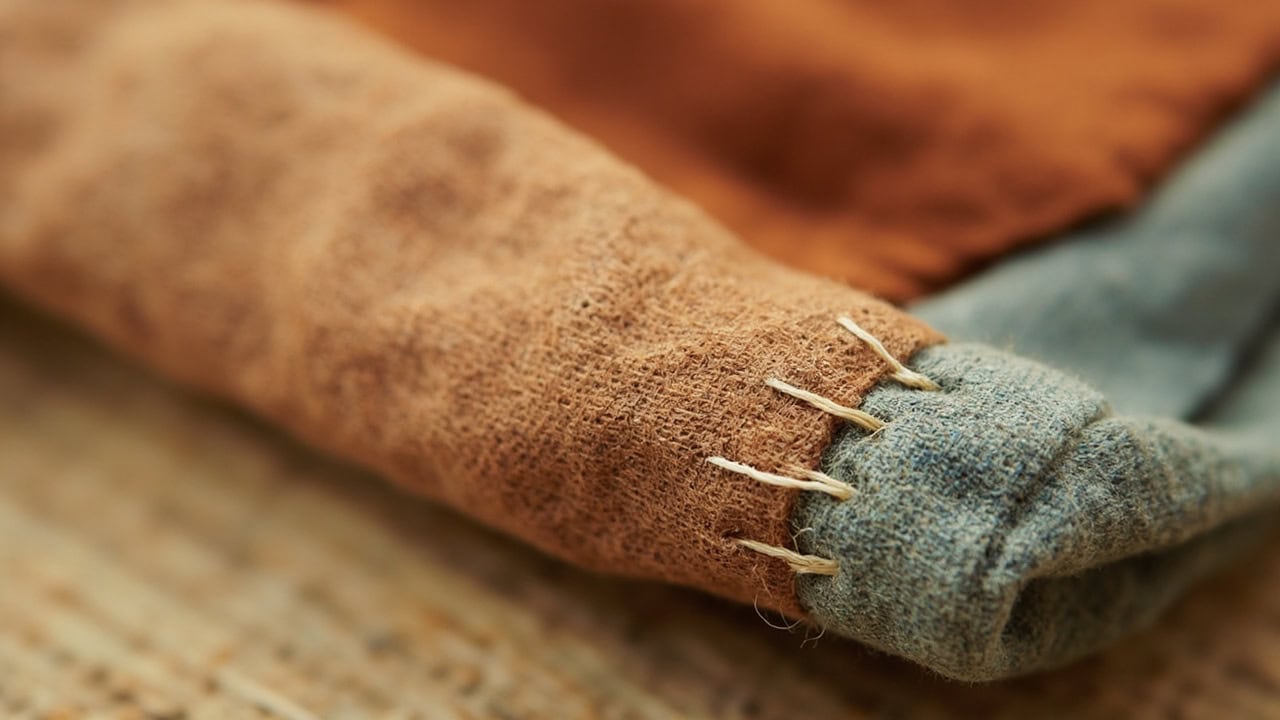
ISO 4915 groups commercial sewing stitches into seven primary numeric classes (100 through 700, with class 800 reserved for technical-textile auxiliary stitches), and stitch type 301 (lockstitch), stitch type 401 (single-thread chain), and stitch type 504 (two-thread overlock) account for the majority of stitches sewn in apparel manufacturing worldwide.
Pairing a stitch class with the matching seam type from ISO 4916 (the SS, LS, FS, BS, EN, OS family) typically shifts seam breaking strength by a factor of two or more, which is why every apparel specification sheet is written in those two codes rather than in descriptive English.
This article walks through the ISO classification systems, matches the most-used stitches to the seams and fabrics they suit, and shows how stitches per inch (SPI), seam type, and thread choice together decide whether a seam survives a domestic wash cycle.
The two international classification systems: ISO 4915 and ISO 4916
Commercial seam construction sits on two parallel ISO standards. ISO 4915 (Textiles – Stitch types – Classification and terminology) classifies stitches by the geometry of the thread interlacing inside the seam, while ISO 4916 (Textiles – Seam types – Classification and terminology) classifies seams by the way the fabric plies lie relative to one another during sewing. The first standard describes what happens inside one repeat of thread; the second describes how the plies are arranged when that thread goes in.
Together the two systems let a tech pack speak one language across Bangladesh, Portugal, Vietnam, and Honduras. A buyer writing “401 SS-a” tells the production floor: single-thread chain stitch, superimposed seam, plain edge. The receiving factory does not need to translate.
Stitch classes, by ISO 4915
| Class | Thread setup | Typical application |
|---|---|---|
| 100 | Single thread, no interlacing | Hand stitches, basting, temporary holds |
| 200 | Hand stitching | Decorative hems, buttonholes, ornamental work |
| 300 | Lockstitch (two-thread) | Woven apparel seams, topstitching, button attach |
| 400 | Chain stitch (one- and two-thread) | Denim, knitwear, serger applications |
| 500 | Overlock / serger | Edge neatening, joining knit panels |
| 600 | Cover stitch (three or more threads) | Hemming knits, decorative topstitch |
| 700 | Special purpose | Blind hemming, embroidery attachment, button sew |
| 800 | Auxiliary | Technical textile and leather goods |
A stitch code such as 301 means class 300 (lockstitch), subclass 01 (single needle, plain lockstitch). A code such as 504 means class 500 (overlock), subclass 04 (two-thread overlock, needle threads only). Adding further digits distinguishes twin-needle, three-needle, and multi-looper variants inside each subclass.
Seam types, by ISO 4916
| Code | Seam type | Where it appears |
|---|---|---|
| SS | Superimposed seam | Side seams, sleeve attachment, most woven seams |
| LS | Lapped seam | Denim outseam, jeans seat seam, workwear panels |
| FS | Flat seam | T-shirt side seam, underwear, knit hems without bulk |
| BS | Bound seam | Sportswear panels, raw-edge finishes, lined jackets |
| EN | Edge neatening | Single-piece edge finishing on a serger |
| OS | Ornamental seam | Decorative topstitch, leather goods, accents |
A spec reading “504 SS-g” tells the floor to run a two-thread overlock on a superimposed seam in the closed-lapped configuration. Adding a third digit unlocks dozens of subtypes used in awnings, leather, and technical-textile applications covered in the full ISO 4916 document.
The five stitches that build most apparel
Five ISO 4915 classes produce the overwhelming majority of stitched seams in mass-market apparel. Knowing what each does, and where it should not be used, lets a spec writer cover most garments with five options.
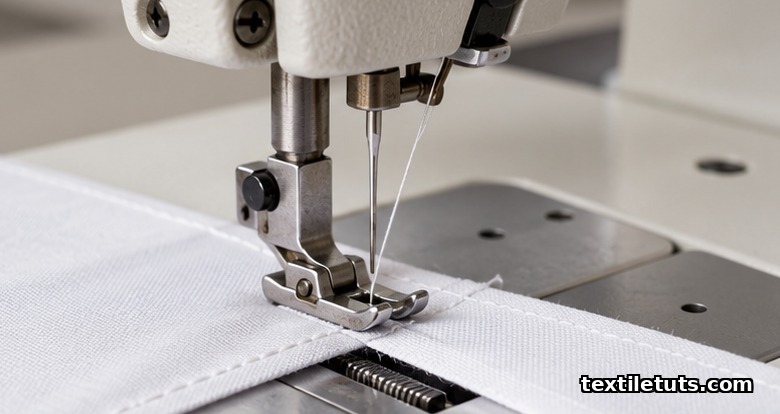
Stitch 301 – lockstitch
The two-thread lockstitch is the default construction seam for woven apparel. The needle thread and bobbin thread interlock inside the fabric thickness, so both faces look similar and there is no exposed thread loop on either side. The geometry makes the seam thin and comparatively non-extensible in the stitch direction, which suits crisp shirting, fitted woven trousers, and structured outerwear. Lockstitch also sits flat under a hot iron, the reason most lined jackets use it for panels.
Drawback: a lockstitch uses the same length of needle thread on both faces, so a broken needle thread mid-seam can allow the entire seam to unravel from the break point. Buttons, buttonholes, and bartacks are therefore commonly sewn on the same lockstitch machine for reinforcement at the seam ends.
Stitch 304 – zigzag lockstitch
Same lockstitch geometry, but the needle travels side to side. The zigzag path adds a small amount of elongation across the seam, supports curved and bias seams, and stops a single broken needle thread from raveling the way a straight 301 would. Common in elastic attachment, lace joining, and shaped panel construction where a curve would pucker under a straight stitch.
Stitch 401 – single-thread chain
The single-thread chain uses one needle thread that loops with itself on the underside, anchored by the next needle penetration. It is fast to sew (one bobbin change covers thousands of seams) and slightly more extensible than a 301, which makes it common in denim (chaining the side seam and seat seam before topstitching), in knitwear, and in elastic applications where the seam must stretch.
Because the chain is anchored by the next stitch, breaking one needle thread can ravel a long length of seam. Modern jeans operations mitigate this by overcasting the seam end and pairing the 401 with a bartack.
Stitch 504 – two-thread overlock
The two-thread overlock trims, edges, and seams in one pass, with one or two needles laying straight stitches and one or two loopers wrapping the fabric edge. The result is a flat, flexible, low-bulk seam with raw edges fully wrapped, well suited to knit jersey and lingerie. Stitch 504 leaves both faces showing the loopers crossing over the edge.
It is almost always paired with seam type FS on T-shirt side seams and with EN on the raw edges of cut panels. Three- and four-thread variants (stitches 503 and 516) add a second needle line or a second looper for additional seam security.
Stitch 605 – four-thread cover stitch
The cover stitch (stitch 605) loops two parallel needle threads over a single looper thread on the underside, producing a flat top face and a parallel looper crossing on the back. Most readers know it from the twin-needle top of a T-shirt hem. Its strong suit is high elongation along the stitching line, which is exactly what a knit hem needs when stretched over a body. Cover stitch machines run a separate operation from the lockstitch and overlock machines on the floor, which is why knit apparel lines lay out as separate cells.
SPI: how stitch density sets seam behaviour
Stitches per inch (SPI) is the second number that always appears on a seam spec, and it changes seam behaviour independently of stitch type. SPI is measured as the count of needle penetrations in one inch of seam length, taken on a conditioned specimen held flat under standard tension.
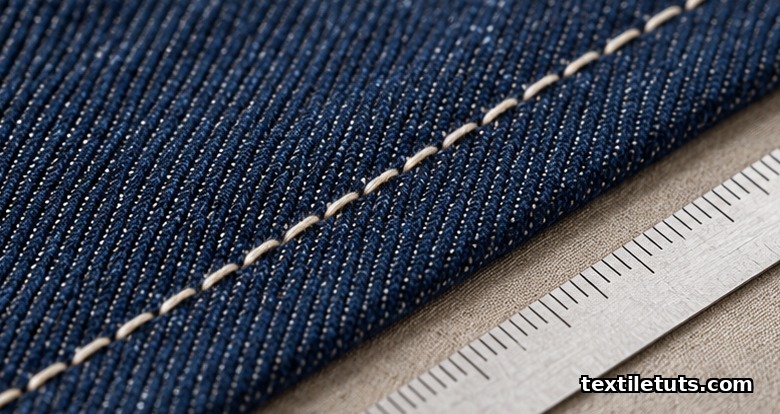
Typical SPI ranges by application:
- Lightweight woven shirting: 10 to 12 SPI
- Denim and workwear: 7 to 10 SPI (heavier thread, fewer stitches, intentionally tougher)
- T-shirt side seam: 12 to 14 SPI on an overlock or cover machine
- Stretch knit hems: 10 to 12 SPI on a cover stitch
- Leather goods: 5 to 7 SPI (to avoid perforating the substrate)
More stitches per inch does not always mean a stronger seam. Beyond about 14 SPI on a woven fabric, the needle starts cutting through thread previously laid, and tensile strength falls. Spec sheets also separate construction SPI (the functional seam) from topstitch SPI (the visual rhythm); the two are chosen for different reasons and can differ by a factor of two on the same garment.
ISO 13935-1 (strip method) and ISO 13935-2 (grab method) are the two tensile methods most often specified on apparel tech packs. The strip method clamps the full seam width and pulls perpendicular to the seam; the grab method clamps only the centre of the seam width. Spec sheets always declare which method was used so buyers and suppliers compare like with like.
Common stitch-seam pairings worth memorising
A reader new to spec sheets can short-cut the learning curve by recognising a few standard pairings that appear in nearly every apparel tech pack.
| Construction | Stitch | Seam type | Where it is used |
|---|---|---|---|
| Woven shirt side seam | 301 | SS-a | Plain superimposed seam |
| Jeans outseam | 401 plus 301 topstitch | LS-a | Lapped with chain, locked by topstitch |
| T-shirt side seam | 504 | FS-b | Flat overlock seam |
| Knit hem | 605 | FS-a | Cover stitch with two-needle top |
| Lingerie elastic | 304 | SS-c | Zigzag on superimposed elastic |
| Panel edge neatening | 504 | EN-1 | Overlock around panel edge only |
| Bound jacket edge | 301 | BS-a | Bound seam binding a raw edge |
| Polo placket | 401 | SS-a | Chain on superimposed seam |
When a specification sheet swaps a stitch or seam code, it is the result of a deliberate choice about strength, extensibility, bulk, and appearance. Treat the codes as one of the cheapest, fastest ways to read a tech pack accurately.
How to choose the right stitch and seam for a fabric
Three operating rules cover most selection questions.
1. Woven, low-stretch fabrics default to 301 lockstitch on a superimposed seam. Add a 304 zigzag where the seam crosses a curve, the fabric is bias-cut, or the substrate is elastic.
2. Knits and any fabric with more than about 15% stretch default to 504 overlock for seams and 605 cover stitch for hems. The chain of loopers handles elongation the way a lockstitch cannot.
3. Heavier denim, technical outerwear, and leather goods default to lapped seams (LS-a or LS-b) with a 401 chain tucked under a 301 topstitch or a heavier bonded nylon thread. The lap geometry concentrates stress away from the needle holes.
Validate the choice with ASTM D1683 (Standard Test Method for Failure in Sewn Seams of Woven Fabrics) or ISO 13935-1, both of which report seam breaking strength as a percentage of the parent fabric strength. Aim for 70% or higher for general apparel and 80% or higher for protective and load-bearing seams. Knit apparel typically validates with AATCC TM135 (dimensional changes after home laundering) plus a stretch-based wear test, since lockstitch-style tensile comparisons understate knit performance.
Five common seam defects and what causes them
When a production run produces a failure, the cause is almost always traced back to a stitch choice, a seam type, an SPI value, or a thread that did not match the fabric. Five defects account for the majority of inspection rejections.
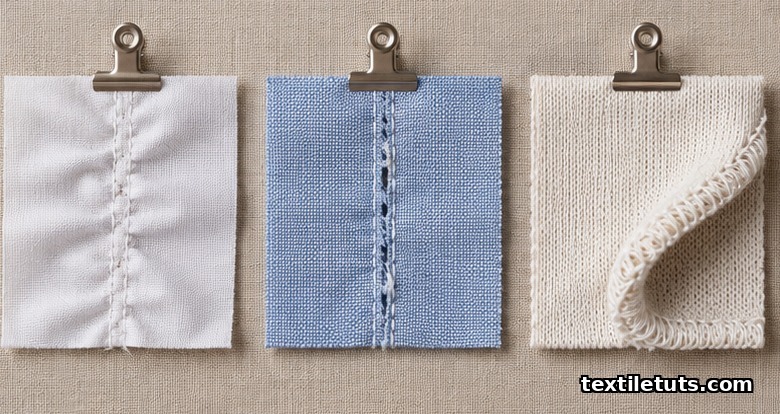
1. Seam slippage. The warp or weft yarns on the surface of the woven fabric pull apart under stress, leaving visible gaps along the seam. Fix: lower SPI by one or two units to reduce needle damage, switch to a thread with higher cohesion, or apply a seam-slippage-resistant finish.
2. Seam grinning. The seam opens visibly when tension is released, exposing the underside of the stitch. Fix: replace a 301 with a 304 zigzag or 401 chain, or add a topstitch row alongside.
3. Pucker. The fabric ripples along the seam line, especially on lightweight wovens. Fix: lower thread tension, increase SPI marginally to spread the load, or switch to a finer needle and thread.
4. Broken needle thread on knitwear. The stretch in the knit pulls the loop apart at the lockstitch, leaving a visible ladder. Fix: replace the lockstitch with a 504 overlock or a 605 cover stitch, which absorbs the stretch instead of fighting it.
5. Edge curling on the overlock. The cut edge rolls inward, allowing the looper thread to miss the needle bite. Fix: adjust the knife position, change the differential feed ratio, or fit a curled-edge presser foot.
Tying each defect back to a stitch and seam code keeps the correction in standard terminology, which is also what tech packs and critical-to-quality (CTQ) control plans expect.
Frequently Asked Questions
What is the difference between a stitch and a seam?
A stitch is the single repeating unit of thread interlacing inside a sewn line, classified by ISO 4915. A seam is the joint formed between two or more fabric plies, classified by ISO 4916. A seam is built from one or more rows of stitches; the spec sheet describes both, and a stitch can sit on top of many different seam types.
Why is stitch 301 so common in shirts and trousers?
The 301 lockstitch has both faces look the same (no exposed looper), lies thin and crisp in the fabric, and produces a stable seam well suited to woven fabrics that do not stretch. It is also the stitch most industrial machines default to, so factories standardise on it for shirts, trousers, linings, and most structured woven garments.
Which stitch has the highest breaking strength?
No single stitch wins every comparison. Chain stitches (401, 404) lay slightly more thread per stitch than 301 lockstitch of the same length, so on heavy denim they often reach a higher seam-breaking force. Overlock seams (504, 516) test lower in straight tensile methods because the looper thread runs mostly across the seam, but they hold up better in cyclic and stretch conditions, which is why knit apparel specs insist on them.
Why do knit hems use a cover stitch instead of a lockstitch?
A lockstitch hem lays a low-extensibility thread line across a high-stretch fabric; the first time the wearer stretches the hem, the seam thread breaks well before the knit does. A cover stitch (605) places all the thread in parallel loops on the underside, allowing the seam to elongate with the fabric, which is why T-shirt hems, leggings, and polo cuffs run on cover-stitch machines.
What is the difference between SPI and stitch length?
Stitches per inch (SPI) is the number of stitches packed into one inch of sewn line, while stitch length is the distance, in millimetres, between two consecutive needle penetrations. SPI is the inverse of stitch length multiplied by 25.4. Spec sheets usually quote SPI because it is faster to read on the shop floor.
References
- International Organization for Standardization. ISO 4915:1991 – Textiles – Stitch types – Classification and terminology. iso.org – defines the numeric stitch classification (100 to 800) used throughout this article.
- International Organization for Standardization. ISO 4916:2007 – Textiles – Seam types – Classification and terminology. iso.org – defines the SS, LS, BS, FS, EN, OS seam family referenced in every spec sheet.
- ASTM International. ASTM D1683/D1683M – Standard Test Method for Failure in Sewn Seams of Woven Fabrics. astm.org – the most widely cited seam breaking-strength test method in apparel sourcing.
- International Organization for Standardization. ISO 13935-1:2014 – Textiles – Seam tensile properties of fabrics and made-up textile articles, Part 1: Determination of maximum force to seam rupture using the strip method. iso.org – strip tensile method for seam strength reporting.
- International Organization for Standardization. ISO 13935-2:2014 – Textiles – Seam tensile properties of fabrics and made-up textile articles, Part 2: Determination of maximum force to seam rupture under perpendicular force (grab method). iso.org – grab tensile method for seam strength reporting.
- AATCC. AATCC TM135 – Dimensional Changes of Fabrics after Home Laundering. aatcc.org – reference test for knit seam behaviour after repeated wash cycles.
This article is a working reference for ISO-standard seam construction terminology and stitch selection in apparel manufacturing. Editorial by Kazi Sifat Muntasir, TextileTuts. Sources: ISO 4915, ISO 4916, ISO 13935-1, ISO 13935-2, ASTM D1683, and AATCC TM135 as cited.


