
Seam Slippage: ISO 13936

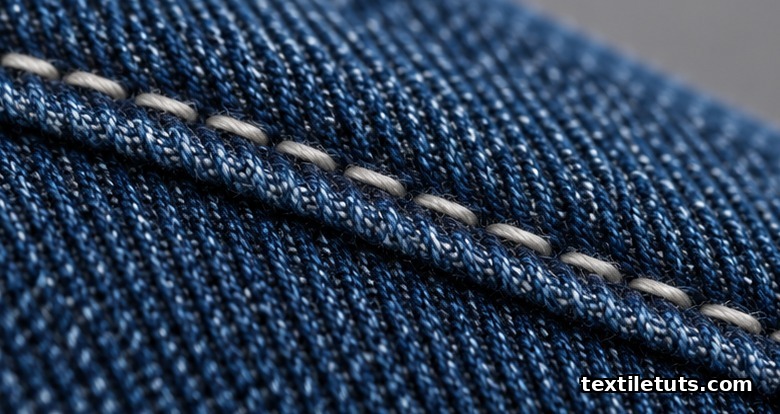
Seam slippage is the displacement of yarns across a sewn seam in a woven fabric under transverse load, measured by ISO 13936 which reports either the force required to open the seam to 2 mm, 3 mm, 5 mm, or 6 mm (Part 1, fixed seam opening method) or the seam opening in millimeters produced by a fixed load of 40 N, 60 N, or 80 N (Part 2, fixed load method), with the load or opening tier selected by the fabric’s mass per unit area.
Seam slippage is distinct from seam strength, and the two tests address different failure modes. A seam can pass a strength test at the ISO 13935 peak load and still gap visibly under normal wear if the yarns slip past one another between stitches. The two ISO 13936 methods address the same property from opposite directions (fixed opening versus fixed load), and a buyer specification will name one or the other depending on fabric category and end use. This article covers the science of seam slippage, both ISO methods, the test procedure, common failure modes, and how to read the report.
Why seam slippage is a separate test from seam strength
Seam strength (ISO 13935, ASTM D1683) measures the maximum load a seam sustains before failure. The failure mode is recorded (thread break, fabric tear, thread pull-out) and a single peak load number is reported. Seam slippage measures something different: at loads well below the seam strength peak, the yarns crossing the seam can shift relative to each other, opening a visible gap between the two pieces of fabric. The seam has not failed, but it has deformed.
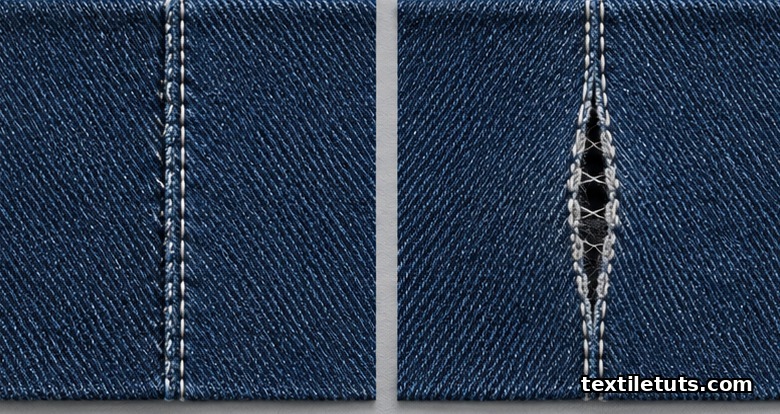
In wear, the deformation is what the wearer sees. A trouser side seam that gapes 3 mm when the wearer sits down has slipped, not broken. The slippage comes from the threads in the seam rotating or sliding relative to the fabric yarns, and the fabric yarns themselves shifting along the line of the seam. Three engineering variables drive slippage: yarn-to-yarn friction in the fabric (set by weave density, yarn count, and yarn crimp), the stitch density (stitches per cm, which sets how often the thread re-engages a yarn), and the thread’s grip on the yarn it crosses (set by thread size, tension, and stitch balance).
Loosely woven fabrics with low yarn density are the highest-slippage fabrics. Lightweight polyester lining, open-weave cotton voile, and loosely woven worsted suiting all slip readily under seam load. Tightly woven fabrics with high yarn density and high crimp (denim, heavy canvas, dense worsted) are low-slippage, often below 1 mm opening at substantial loads. Yarn friction scales with the number of yarn crossover points per cm, which is why a 60 ends per cm by 30 picks per cm plain weave slips more than a 40 by 40 twill of the same yarn count, because the plain weave has fewer interlacements per unit area when one set is sparse.
ISO 13936 Part 1: Fixed seam opening method
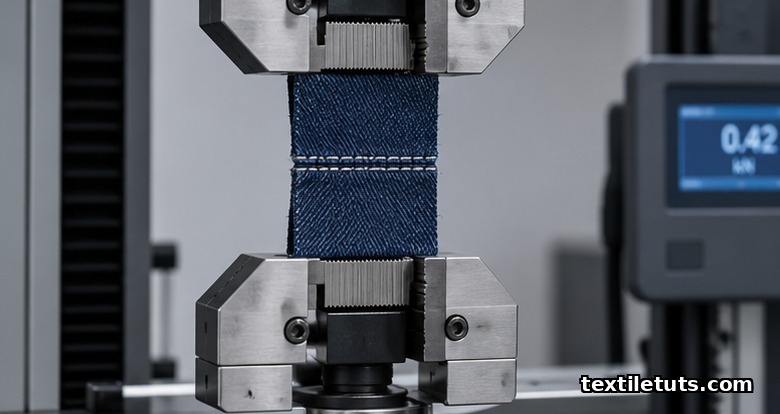
Part 1 loads the seam to a specified opening and reports the force. The specimen is gripped in a constant-rate-of-extension tensile testing machine and pulled at 50 mm/min until the seam opens to the specified width. The force at each specified opening is recorded.
The specified opening depends on fabric mass per unit area:
- Lightweight fabrics (≤ 100 g/m²): 2 mm opening.
- Medium-weight fabrics (100 g/m² to 200 g/m²): 3 mm or 5 mm opening.
- Heavyweight fabrics (> 200 g/m²): 5 mm or 6 mm opening.
Force is reported in newtons at each named opening. A high force at small opening is the engineering goal because it means the seam resists slippage up to that load. A typical buyer minimum for a woven trouser or jacket fabric is 80 N to 150 N at the specified opening. Lightweight linings accept lower numbers (40 N to 80 N at 2 mm is reasonable for a 60 g/m² lining). The minimum is written into the tech-pack and enforced in pre-production testing and during bulk production QC.
ISO 13936 Part 2: Fixed load method
Part 2 applies a fixed load and measures the resulting opening. The specimen is pulled to a specified load and the opening between the two fabric pieces at the seam is measured at that load. The load tier is set by fabric mass:
- ≤ 100 g/m²: 40 N load.
- 100 g/m² to 200 g/m²: 60 N load.
- > 200 g/m²: 80 N load (or as agreed between buyer and supplier).
Opening is reported in millimeters at the specified load. A typical minimum for a medium-weight woven trouser or jacket fabric is 2 mm or less at 60 N. Anything above 4 mm at 60 N is usually a fail because the gap is visible when the garment is worn and the seam appears to “open” on the body.
Part 2 is more common in European retail specifications for woven apparel. Part 1 is more common in technical-textile, workwear, and protective-clothing specifications where the buyer wants to know how much force the seam resists at a defined deformation. The two methods are not directly interchangeable: a fabric that passes Part 1 with a high force at 5 mm opening may show 3 mm opening at 80 N on Part 2. Convert by plotting both as load-versus-opening curves, not by single-point comparison.
Comparison of Part 1 and Part 2
| Parameter | ISO 13936-1 (Fixed seam opening) | ISO 13936-2 (Fixed load) |
|---|---|---|
| Independent variable | Seam opening (mm) | Applied load (N) |
| Reported value | Force (N) at each specified opening | Opening (mm) at each specified load |
| Typical opening/load | 2, 3, 5, or 6 mm | 40, 60, or 80 N |
| Selection by fabric mass | Yes (lower opening for light, higher for heavy) | Yes (lower load for light, higher for heavy) |
| Test speed | 50 mm/min | 50 mm/min |
| Common use | Technical textiles, protective clothing, workwear | Apparel retail, EU and US woven fabric specifications |
| Specimen count | 5 in warp direction + 5 in weft direction | 5 in warp direction + 5 in weft direction |
| Result direction | Warp slippage and weft slippage reported separately | Warp slippage and weft slippage reported separately |
Specimen preparation
The specimen is a rectangular piece of woven fabric with one or two parallel seams sewn perpendicular to the loading direction. Standard preparation per ISO 13936:
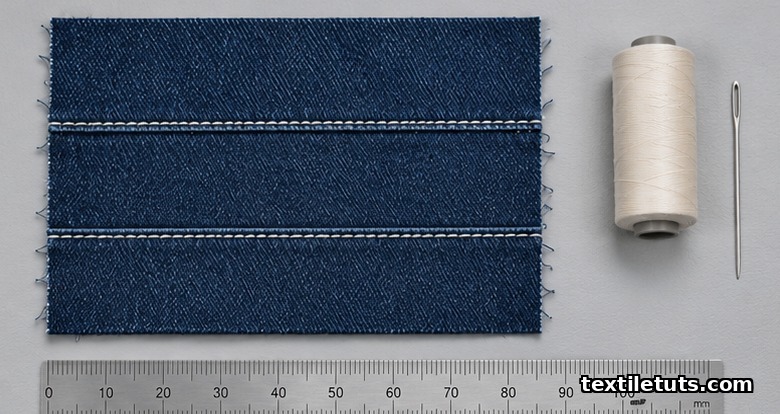
- Specimen dimensions: 100 mm × 200 mm is common, with two parallel seams sewn 100 mm apart across the width.
- Standard atmosphere: 20 °C and 65 % RH per ISO 139. Specimens are conditioned for 24 hours before mounting.
- Seam sewing: standard lockstitch (ISO 4916 Type 301 seam with stitch type 301) using a defined sewing thread, typically 100 % polyester core-spun, ticket 80 or 100 depending on fabric mass.
- Stitch density: 5 stitches per cm is typical (some specs use 4 or 6). The exact SPI must match the production intent or the test result is not representative of bulk production.
- Needle: a standard needle size and point type suited to the fabric. Ballpoint for knits (not relevant here since ISO 13936 is woven-only), sharp for tightly woven wovens, light ballpoint for loose wovens. Size 90 (metric) is typical for medium-weight wovens.
- Number of specimens: 5 specimens in the warp direction (warp yarns crossing the seam) and 5 in the weft direction (weft yarns crossing the seam), giving 10 specimens total per fabric.
The seam direction matters. Specimens cut so that warp yarns cross the seam give the warp-direction slippage value; specimens cut so that weft yarns cross the seam give the weft-direction value. Most woven fabrics slip more in one direction than the other, and the buyer spec typically states the minimum for each direction separately because warp slippage and weft slippage are not interchangeable.
Test procedure
- Condition specimens for 24 hours at 20 °C and 65 % RH (ISO 139).
- Mount the specimen in the tensile testing machine with the seam at the center, jaws gripping the full width of the specimen.
- Set the crosshead speed to 50 mm/min (or as agreed for non-standard fabrics).
- For Part 1: pull the specimen until the seam opens to the specified width (2, 3, 5, or 6 mm). Record the force in newtons at each opening.
- For Part 2: pull the specimen to the specified load (40, 60, or 80 N) and hold. Measure the opening between the fabric pieces at the seam at each load level.
- Repeat for all specimens. Discard outliers only by an agreed statistical method (Dixon’s Q test for n = 5 to 10, or Grubbs’ test for larger sets). Never drop results to make the average look better; document every discarded point.
- Report the mean for each direction and, where requested, the standard deviation or 95 % confidence interval.
Most universal testing machines can run either protocol with the appropriate grip fixtures and software. An extensometer or calibrated camera is required for opening measurement in Part 2 because the opening is typically only 1–6 mm and human read error is large relative to the measurement. A simple ruler is not adequate.
What the numbers mean in practice
A typical 14 oz (470 g/m²) cotton denim will show warp-direction slippage well under 1 mm at 80 N and weft-direction slippage of around 1 to 2 mm at 80 N. A lightweight polyester lining (60 g/m²) will show 4 to 8 mm opening at 40 N. The lining can pass a Part 1 spec that requires only 40 N at 2 mm opening but will fail most apparel Part 2 specs for trouser and jacket shells because the gap is too large.
When slippage fails QC, the engineering fix is usually applied in this order:
- Increase stitch density (more stitches per cm reduces the gap each stitch must bridge).
- Use finer thread at higher tension (more threads per cm of seam).
- Switch to a more balanced stitch (lockstitch balanced top and bottom, with equal thread consumption on both sides).
- Switch fabric construction (denser weave, higher yarn crimp, higher ends per cm).
- Apply seam sealant, seam tape, or fusible interfacing behind the seam (technical textiles and performance apparel).
Increasing SPI alone usually gives the biggest gain. Going from 4 SPI to 6 SPI can reduce measured slippage by 30 to 50 % in open-weave fabrics. Beyond 8 SPI the gain is small and the fabric perforates faster, weakening the fabric yarns themselves.
Common testing errors
- Wrong stitch density in the test specimen: testing at 6 SPI when production sews at 4 SPI gives a falsely low slippage value. Always test at the production SPI, and document the SPI on the report.
- Wrong thread: testing with cotton thread when production uses polyester, or vice versa, changes the slippage result because thread extensibility, friction, and yarn-grip differ.
- Skipping conditioning: a wet or damp fabric gives artificially low slippage because water increases inter-yarn friction temporarily. ISO 139 conditioning is mandatory.
- Mixing directions: cutting all specimens the same way (warp or weft) and reporting the lower value as “the” slippage. Warp and weft must be reported separately because they are typically not equal.
- Dropping outliers without a statistical method: removing the highest reading to lower the average is falsification. Use Dixon or Grubbs and document every discarded point on the report.
Frequently Asked Questions
What is the difference between seam strength and seam slippage?
Seam strength (ISO 13935, ASTM D1683) is the maximum load the seam takes before failure. Seam slippage (ISO 13936) is the displacement at a load well below the failure load. A seam can have very high strength but high slippage, and still be unsuitable because the seam gapes visibly under normal wear. Both tests are typically required by woven-fabric buyer specifications, and both are reported separately.
Which ISO 13936 method should I use, Part 1 or Part 2?
Match the buyer’s spec. Part 1 (fixed seam opening) is more common in workwear, protective clothing, and technical-textile specifications. Part 2 (fixed load) is more common in woven-apparel retail specifications, especially in Europe. If you are writing your own spec from scratch, Part 2 is usually simpler because it mimics how a fabric actually behaves under a fixed load (sitting, lifting, bending) and the result is a single opening value in mm that maps directly to a wearer-visible defect.
How many specimens are required?
ISO 13936 specifies 5 specimens in each direction (warp and weft), so 10 specimens per fabric sample. Each specimen provides one data point. The standard deviation is meaningful only when all 5 readings per direction are reported; reporting a mean without the standard deviation hides the production variability and makes the QC result unreliable as a release decision.
Why does my warp slippage differ so much from my weft slippage?
Woven-fabric slippage is almost always higher in one direction because yarn count, yarn density, and crimp differ between warp and weft. A typical 3/1 twill denim has many more warp yarns per cm than weft yarns, so the weft yarns slip past each other more easily, giving higher weft-direction slippage. Always report both directions and always meet the buyer’s minimum in both directions separately.
Can I improve seam slippage without changing the fabric?
Yes, in most cases. The three practical levers are stitch density (more stitches per cm reduces slippage), thread size and finish (finer thread at higher tension packs more threads per cm of seam), and seam type (a flat-felled seam usually slips less than a superimposed seam in the same fabric). If the slippage still fails after these adjustments, the fabric is genuinely too open for the intended end use, and a denser construction (more ends per cm, more picks per cm, or higher crimp) is the only remaining engineering fix.
References
- ISO 13936-1:2014, Textiles, Determination of slippage resistance of yarns at a seam in woven fabrics, Part 1: Fixed seam opening method.
- ISO 13936-2:2004, Textiles, Determination of slippage resistance of yarns at a seam in woven fabrics, Part 2: Fixed load method.
- ISO 139:2005, Textiles, Standard atmospheres for conditioning and testing.
- ISO 4916:1991, Textiles, Seam types, Classification and terminology.
- ASTM D1683 / D1683M-22, Standard Test Method for Failure in Sewn Seams of Woven Fabrics. https://store.astm.org/d1683_d1683m-22.html
- Fan, J., and Hunter, L. (2009). Engineering Apparel Fabrics and Garments. Woodhead Publishing (now part of Elsevier), Cambridge. Chapter 9 covers seam slippage and the mechanics of yarn displacement at seams.
This article is the working reference for seam slippage testing under ISO 13936. Editorial by Iftay Khairul Alam, TextileTuts. Sources: ISO 13936-1 and 13936-2 (primary test method standards), ISO 139 (conditioning atmosphere), ISO 4916 (seam classification), ASTM D1683 (related seam strength standard), Fan and Hunter (Engineering Apparel Fabrics and Garments) as cited.


