
Bursting Strength: ISO 13938

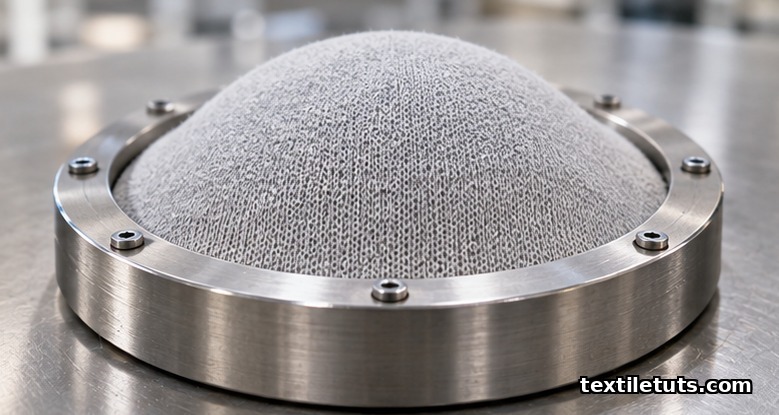
ISO 13938 measures the bursting strength of textile fabrics using either a hydraulic pressure method (Part 1, test area 30.5 mm², fluid volume rate 100–200 cm³/min) or a pneumatic steel-ball method (Part 2, test area 50 cm², ball diameter 38 mm), and reports results as bursting pressure in kilopascals (kPa) plus bursting height in millimetres (mm).
The standard is the go-to method for knitted fabrics, nonwovens, and other isotropic materials where a strip tensile test on a single direction would understate real-world multi-axial failure. This article walks through how ISO 13938-1 and ISO 13938-2 work, when each method applies, what the numbers mean, and how they line up against the common ASTM alternatives.
Why bursting strength exists as a separate test
Woven fabrics carry load along two perpendicular yarn systems. Knitted fabrics, nonwovens, and lace spread stress radially because every loop or fibre interacts with its neighbours in all directions. A conventional grab or strip tensile test forces the load through one axis only and tends to record an artificially low value for those structures. Bursting strength solves this by pressing a circular area of the fabric from below until it ruptures, which loads every direction at once.
The measured properties are:
- Bursting pressure — the pressure (kPa) at the moment the specimen ruptures.
- Bursting height (or bursting distension) — the vertical displacement of the centre of the specimen at rupture, in mm.
- Bursting volume — for hydraulic testing only, the volume of fluid pumped under the diaphragm at rupture, in cm³.
ISO 13938-1: hydraulic pressure method
Part 1 specifies a fluid (usually glycerine or similar) pumped beneath a circular rubber diaphragm that pushes the clamped fabric upward until rupture. The test piece is held by an annular ring clamp with an internal test area of 30.5 mm² (the standard’s “30.5 mm²” circular opening). The fluid volume increase rate is 100–200 cm³/min, and pressure versus height or pressure versus volume is plotted continuously until the specimen fails. Three burst regions are commonly identified on the curve:
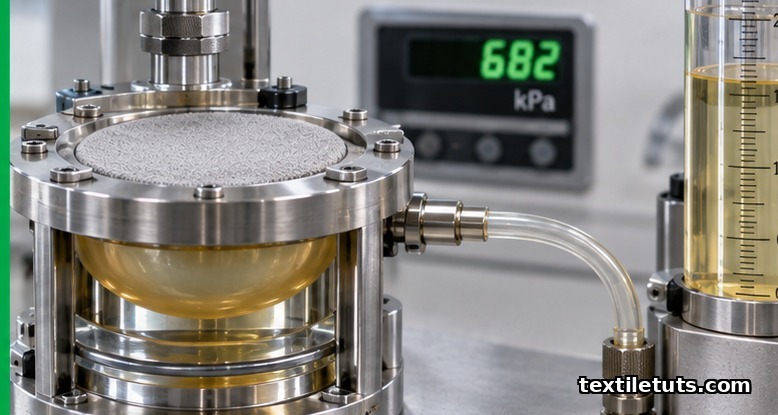
- Initial — multidirectional stretch of the fabric before localised thinning.
- Middle — progressive yarn slippage or fibre reorientation; slope decreases.
- Burst — abrupt pressure drop where rupture occurs.
Condition the specimens at 20 ± 2 °C and 65 ± 4 % RH (ISO 139). Report the mean and standard deviation of bursting pressure, bursting height, and (if measured) bursting volume from at least five tests in each warp, weft, or principal direction.
ISO 13938-2: pneumatic pressure method (steel ball)
Part 2 replaces the fluid with compressed air acting on a polished steel ball that presses against the underside of the clamped fabric. The test area is 50 cm² (a larger opening than Part 1), and the standard ball diameter is 38 mm. Air pressure rises at a controlled rate until the fabric bursts; the instrument records peak pressure as bursting strength in kPa.
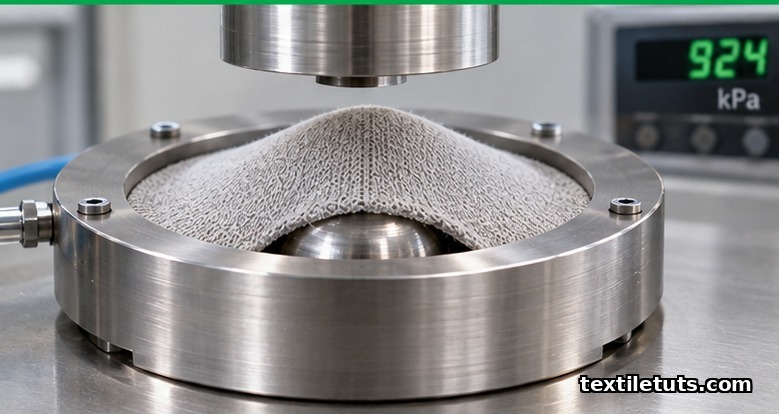
Part 2 is faster, easier to automate, and avoids fluid leaks or diaphragm replacement, which is why most commercial knitting mills default to it for routine quality control. The trade-off is that the method only reports bursting pressure; there is no height or volume equivalent to Part 1 because the ball’s displacement is not tracked.
ISO 13938 vs ASTM D3786 vs ISO 3303 — quick orientation
ASTM D3786 (“Standard Test Method for Hydraulic Bursting Strength of Knitted Goods and Nonwoven Fabrics”) uses the same Mullen-type hydraulic principle as ISO 13938-1, but with a 30.5 mm² test area and a glycerine fill rate typically around 95 cm³/min. ISO 3303 (rubber- or plastic-coated fabrics) is a separate family of standards that uses a hydraulic diaphragm with a smaller test area of 7.5 mm² and is aimed at coated substrates rather than apparel knits.
| Standard | Method | Test area | Typical substrate | Reports |
|---|---|---|---|---|
| ISO 13938-1 | Hydraulic, expanding diaphragm | 30.5 mm² (circular) | Knits, nonwovens, lace | Pressure (kPa), height (mm), volume (cm³) |
| ISO 13938-2 | Pneumatic, 38 mm steel ball | 50 cm² (annular) | Knits, nonwovens | Pressure (kPa) |
| ASTM D3786 / D3786M | Hydraulic (Mullen-type) | 30.5 mm² | Knits, nonwovens | Pressure (psi or kPa) |
| ISO 3303 | Hydraulic, small diaphragm | 7.5 mm² | Rubber-/plastic-coated fabrics | Pressure |
The two ISO parts and ASTM D3786 are not interchangeable; a mill that sells to both EU and US buyers typically quotes both values on the same lot.
How to prepare specimens
Cut at least five specimens per fabric sample, taking them from positions spaced across the width of the lot so the result represents both edges and the centre. Each specimen must be larger than the clamp ring; for ISO 13938-1 a common working size is 113 mm in diameter, while for ISO 13938-2 the recommended working size is 125 mm square. Avoid folded areas, selvedges, creases, and visible defects; mark the face side so all specimens are tested the same way up.
Condition specimens for 24 hours in a standard atmosphere of 20 ± 2 °C and 65 ± 4 % RH before testing. Knitted fabrics in particular are sensitive to humidity because cotton and wool regain several percent of their weight, which changes the load needed to rupture them.
Reading the result
For most apparel knits, a single-jersey cotton tee will burst around 300–600 kPa, while a typical polyester/spandex warp-knit for sportswear will burst around 700–1,200 kPa. Heavy fleece and weft-insertion knit fabrics for outerwear can exceed 1,500 kPa. Nonwoven coverstock for hygiene products usually bursts in the 20–80 kPa range. Always interpret these numbers with the standard deviation, because bursting strength is notoriously variable; a coefficient of variation above 10 % between five specimens means the result is closer to a screening number than a release-spec value.
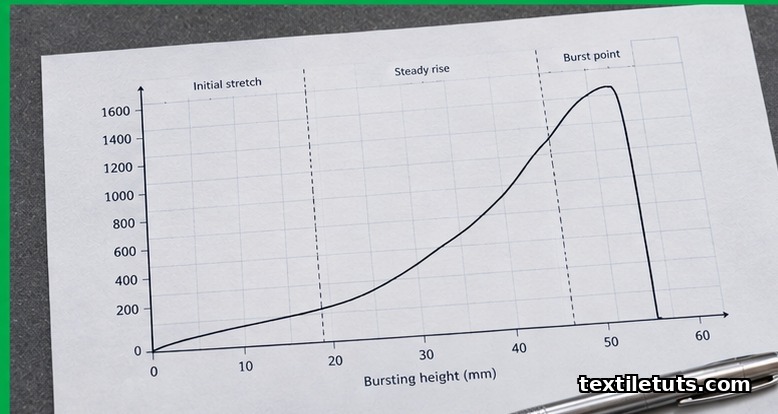
Bursting height gives a second, complementary signal. A fabric that bursts at high pressure but at a low height is brittle; one that bursts at moderate pressure but at a high height is stretchy. For end uses that need both burst resistance and conformability, such as medical gowns or hygiene topsheets, you want a higher curve area, not just a higher peak.
Common troubleshooting
- Rupture outside the test area. If the burst occurs at the clamp edge, the clamp torque is too low or the specimen is too small. Tighten the clamp and re-cut.
- Slow pressure creep instead of a sharp peak. Air leak in pneumatic testing, or fluid leak past the diaphragm in hydraulic testing. Replace seals and re-run.
- Results trending low. Check that the diaphragm has not been permanently stretched; diaphragms are wear items and ISO 13938 requires periodic replacement.
- Edge cracks rather than radial burst. Specimen too close to selvedge, or fabric damaged by the cutter. Discard and re-cut.
Frequently Asked Questions
What is the difference between bursting strength and tensile strength?
Bursting strength applies a multi-axial load through a circular area, while tensile strength applies a uniaxial load along a strip of fabric. For woven fabrics with clear warp and weft, tensile strength is usually the specifier’s choice. For knits, nonwovens, lace, and any fabric whose behaviour depends on interactions in every direction, bursting strength is more representative of how the fabric fails under real pressure, e.g., an elbow patch or a knee bulge.
Which ISO 13938 method should a knitting mill use?
Most knitting mills default to ISO 13938-2 (pneumatic) because it is faster, easier to automate, and gives a single clean pressure number that can be directly entered into a quality database. ISO 13938-1 (hydraulic) is preferred when buyers also ask for bursting height and bursting volume, for example on medical textiles and technical nonwovens, or when the fabric’s conformability matters as much as its peak burst.
Why does bursting strength sometimes come out higher than expected?
Three causes account for most over-spec readings: insufficient conditioning time (humidity not at 65 % RH), an uncalibrated pressure transducer, or a brand-new diaphragm that is stiffer than the in-service diaphragm it replaced. Check these three first; only then look for genuine fabric differences such as tighter stitch density or a higher stitch length.
Can ISO 13938 results be compared with ASTM D3786 results?
Not directly. ISO 13938-2 uses a 50 cm² test area and a 38 mm steel ball; ASTM D3786 uses a 30.5 mm² hydraulic diaphragm. The two methods give different absolute numbers on the same fabric. Build internal conversion charts on your own production runs to translate one to the other, and document the conversion in your QC SOP.
How does bursting strength relate to seam slippage or snagging?
It does not. Bursting strength measures multi-axial rupture of the fabric body; seam slippage measures how the stitch line opens under load; snagging measures yarn pull-out from the surface. A fabric with a high bursting strength can still fail at the seam, and vice versa. Specifiers should treat these as three independent tests, not as substitutes for each other.
References
- International Organization for Standardization. ISO 13938-1:2019, Textiles — Bursting properties of fabrics — Part 1: Hydraulic method for determination of bursting strength and bursting distension. iso.org.
- International Organization for Standardization. ISO 13938-2:2019, Textiles — Bursting properties of fabrics — Part 2: Pneumatic method for determination of bursting strength and bursting distension. iso.org.
- ASTM International. ASTM D3786 / D3786M-18, Standard Test Method for Hydraulic Bursting Strength of Knitted Goods and Nonwoven Fabrics. astm.org.
- Müller, D., and Tobler-Rohner, A. Application of the hydraulic bursting test to knitwear quality control. ResearchGate.
- MDPI. Comparison of bursting strength test methods for nonwoven fabrics. mdpi.com (peer-reviewed).
- International Organization for Standardization. ISO 139:2005, Textiles — Standard atmospheres for conditioning and testing. iso.org.
Editorial by Iftay Khairul Alam, TextileTuts. Sources: ISO 13938-1:2019, ISO 13938-2:2019, ASTM D3786/D3786M-18, ISO 139:2005, and the cited peer-reviewed papers as listed.


