
Hem Finishes: Folded, Blind, Serged

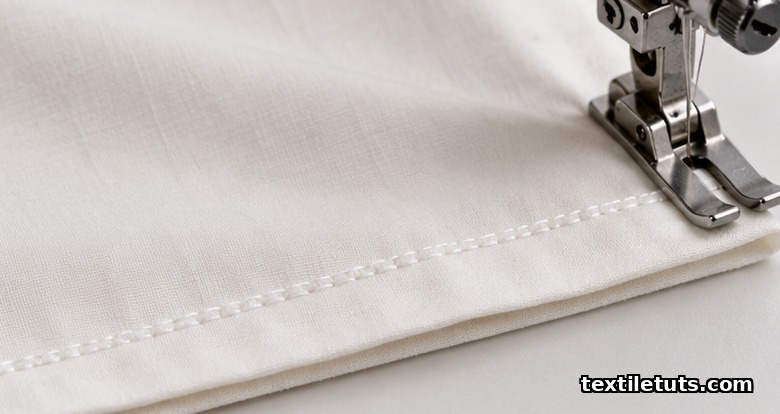
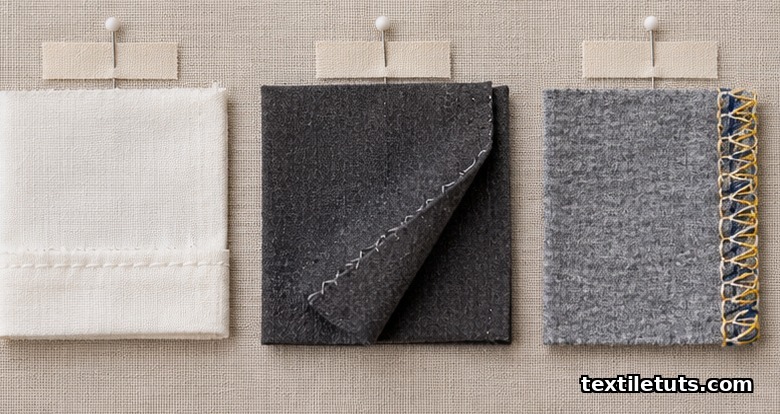
A folded hem turns back 5–10 mm of fabric and stitches it flat to the garment, a blind hem conceals the stitch line by catching only 2–4 threads of the outer fabric at 8–12 stitches per inch (SPI), and a serged hem encases the raw edge and seam allowance in a single 3- or 4-thread overlock pass at industrial speeds of 1,500–3,000 stitches per minute. Each finish has a different production cost, durability profile, and end-use on woven and knit garments, and the choice between them is governed by fabric weight, expected wash cycles, and seam slippage risk.
This article covers how folded, blind, and serged hems are constructed on the sewing floor, how each is graded for seam strength and appearance retention under ISO and AATCC laundering cycles, and how a production engineer decides between them on a style sheet. Specific numbers for stitch density, fold depth, and tensile load come from the cited test standards and peer-reviewed seam-strength studies.
What a Hem Actually Does on a Garment
A hem is a finished edge that closes the bottom of a sleeve, trouser leg, skirt, shirt, or any panel where the cut edge would otherwise fray. Beyond appearance, it has three mechanical jobs: it stops yarn slippage along the cut edge, distributes stress across the bottom of the garment, and gives the panel a stable reference line for pressing and packing. The American Society for Testing and Materials lists hem types alongside seam types in ASTM D6193, the standard practice that classifies stitches and seams used in sewn products. The classification matters because each hem style is assigned a seam type code (SS, LS, EF, etc.) that drives SPI settings, thread tension, and seam-strength testing on the production line.
The folded, blind, and serged hems covered here represent the three most common commercial finishes for light to medium-weight apparel. Heavier finishes such as bound hems, faced hems, and hem-with-lining are less common in ready-to-wear because of added material and labor cost.
Folded Hem (Single and Double Turn)
A folded hem, sometimes called a turned hem, is the oldest and most common garment finish. The cut edge is turned under once or twice by 3–25 mm depending on the garment, pressed, and stitched close to the inner fold with a lockstitch (ISO 4916 stitch type 301). A single-fold hem uses one turn and is typical on knit T-shirts where a serger is unavailable; a double-fold hem uses two turns, fully enclosing the raw edge, and is the standard on dress shirts, trousers, and most woven bottoms. A standard men’s dress shirt uses a 6–8 mm double fold on the sleeve and a 15–25 mm double fold on the shirt tail, stitched at 10–12 SPI.
The advantage of a folded hem is reproducibility and seam strength. A double-fold hem on a 120 g/m² cotton poplin tested under ISO 13935-1 (strip method, 100 mm gauge length, 50 mm/min crosshead speed) typically reaches a seam efficiency of 75–90% of the parent fabric tensile strength. The disadvantage is visible topstitching on the face side, which makes a folded hem unsuitable for garments where the right side must show no thread line.
Production engineers also watch for needle damage on tightly woven fabrics. A 70/10 needle at 12 SPI will leave a perforation pattern every 2.1 mm along the fold line, and the perforation strength drops sharply if the stitch is placed closer than 2 mm to the inner fold. Most factory work instructions set the minimum fold-to-stitch distance at 2 mm.
Blind Hem
A blind hem hides the stitch line on the garment face while still securing the fold from the inside. The construction is identical to a folded hem from the inside, but the top thread is set to catch only 2–4 warp or weft yarns of the outer fabric. After pressing, those tiny stitches retract into the fabric surface and become nearly invisible, while the bulk of the seam sits on the wrong side.
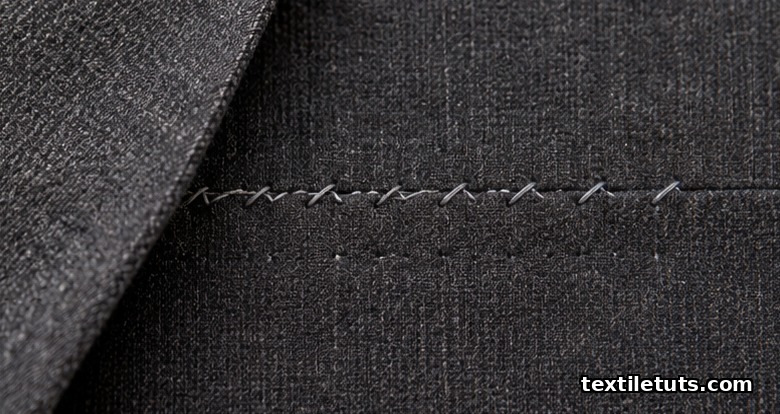
Two industrial methods exist. The traditional method uses a blind-hem foot on a lockstitch machine, with a short zigzag (2.0–3.0 mm width) and a long pitch of 5–8 mm; only every third or fourth zigzag catches the outer fabric. The modern method uses a computer-controlled blind-hem machine that pre-sets the catch rate to 1 in 5 or 1 in 6 stitches. Either way, the result on a pair of trousers is a clean right side with no visible topstitch and a strong fold on the inside.
Blind hems are rated under AATCC TM88B, the test for seam appearance after repeated home laundering. A blind hem on a wool-blend trouser fabric typically survives 20 wash cycles at 40 °C with a grade 4 appearance, which is acceptable for most retail ready-to-wear. The weak point is the catch stitch: if the catch is set too deep (more than 4 yarns), the stitch shows on the face; if set too shallow, the hem pulls out under seam-slippage stress.
ASTM D1683, the standard test method for failure in sewn seams of woven fabrics, is the most cited reference for blind-hem strength. A properly set blind hem on a 200 g/m² worsted wool trousering reaches about 60–75% of the parent fabric tensile strength, lower than a visible topstitched hem because the catch stitches engage fewer fibers.
Serged Hem
A serged hem uses a 3- or 4-thread overlock stitch (ISO 4916 stitch type 504) to trim the raw edge and wrap the cut fibers in one pass. The needle threads form the seam, and 1–2 looper threads wrap the edge; on a 4-thread serger the seam includes an additional safety stitch for stretch. Operating speeds run 1,500–3,000 stitches per minute on industrial models, and the seam allowance is typically 5–8 mm. A serged hem is the standard finish on most knit garments, T-shirts, polos, sweatshirts, leggings, and casual jersey pieces because it is fast, stretchy, and produces a clean edge in a single step.
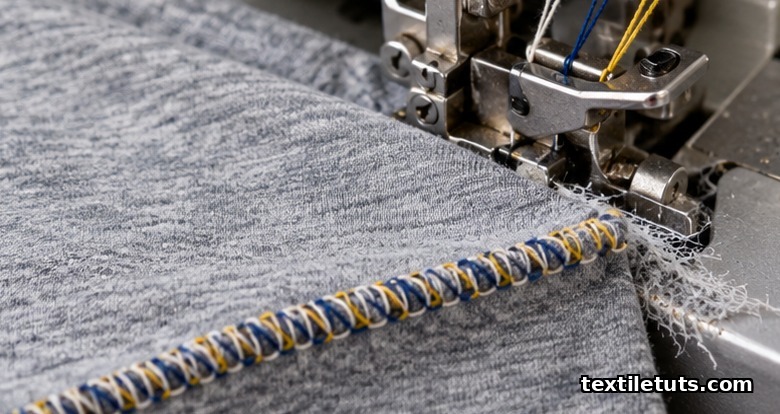
Serged seam strength depends heavily on thread tension, stitch density, and the number of threads. A 4-thread serged hem on a 180 g/m² single-jersey cotton tested under ISO 13935-2 (grab method) reaches about 80% of fabric tensile strength in the cross direction and 70% in the longitudinal direction. A 3-thread serged hem reaches 55–65%, which is why most quality specifications require 4 threads on stretch garments. Studies on overlock seam performance published on ResearchGate and in the MDPI journal Textiles confirm that adding the fourth thread roughly doubles the seam efficiency on weft-knits.
The main drawback of a serged hem on woven fabric is fray risk on tightly woven or low-count fabrics. Because the overlock trims the raw edge close to the seam line, any seam slippage along the warp or weft will compromise the hem. For that reason, woven bottom weights and dress shirts are not serged: they get a folded or blind hem instead.
Comparison Table: Folded vs Blind vs Serged Hem
| Property | Folded Hem | Blind Hem | Serged Hem |
|---|---|---|---|
| Typical fabric | Woven shirtings, trousers, linings | Trousers, skirts, dress fabrics | Knits, jerseys, casualwear |
| Stitch type (ISO 4916) | 301 lockstitch | Modified 301 (zigzag with skip) | 504 overlock (3- or 4-thread) |
| Stitch density | 10–12 SPI (4–5 SPI/cm) | 8–12 SPI visible, 1 in 5 catches outer face | 10–14 SPI (4–5.5 SPI/cm) |
| Fold depth | 6–25 mm double turn | 15–30 mm single turn | 5–8 mm trimmed allowance |
| Visible on face | Yes, topstitch line | No (catch stitch hidden) | No (overlock edge only) |
| Seam efficiency (vs parent fabric) | 75–90% | 60–75% | 55–80% depending on thread count |
| Cycle time | Slowest (two operations on shirt tail) | Slow (skilled setup) | Fastest (single pass) |
| Best end-use | Formal shirts, trousers, denim | Dress trousers, lined skirts | T-shirts, leggings, sweatshirts |
How Each Hem Is Tested
Three standards dominate hem quality control on the production floor. ISO 13935 covers seam tensile properties and is run on either a strip (Part 1) or grab (Part 2) specimen. AATCC TM88B grades the appearance of seams after five, ten, twenty, and fifty home-laundering cycles, on a 1–5 photographic scale. ASTM D1683 measures the force required to rupture a sewn seam perpendicular to the stitch line, on a 50 mm × 100 mm specimen pulled at 50 mm/min.
Most specifications require a minimum seam strength of 150 N for shirt tails, 200 N for trouser hems, and 100 N for knit hems, with seam efficiency above 70%. A typical QC report includes the parent-fabric tensile strength, the seam tensile strength, the efficiency ratio, and the appearance grade after the agreed wash cycles.
How Production Engineers Choose Between Them
The decision tree on a style sheet is shorter than it looks. If the fabric is a knit and the seam allowance is small (5–8 mm), the answer is a 4-thread serged hem. If the fabric is a woven bottom weight or a dress shirt, the answer is a double-fold hem. If the customer requires no visible topstitch on the right side, the answer is a blind hem, and the production line is set up with a blind-hem machine and a trained operator. Cost enters the picture at the next step: a folded hem on a shirt tail runs about 1.8 times the labor of a serged hem, but it is also the strongest of the three.
Frequently Asked Questions
What is the strongest hem for a woven trouser?
A double-fold hem with a lockstitch at 10–12 SPI is the strongest hem for a woven trouser, typically reaching 75–90% of the parent fabric tensile strength under ISO 13935-1. A blind hem reaches 60–75% because the catch stitch engages fewer fibers on the face side.
Can a serger replace a blind hem on dress trousers?
No. A serger leaves a visible overlock edge on the wrong side and produces a stretchy seam suited to knits, not the crisp finish expected on dress trousers. A blind hem remains the standard for that category because the catch stitch hides inside the fabric and the right side reads clean.
What SPI should I use for a folded hem on a cotton poplin shirt?
10–12 SPI (about 4–5 stitches per cm) is the standard for a folded hem on a 100–140 g/m² cotton poplin shirt. Tighter than 12 SPI risks fabric perforation and reduces tear strength along the stitch line.
How many wash cycles will a blind hem survive?
A properly set blind hem on a wool-blend trouser fabric typically holds a grade 4 appearance over 20 home-laundering cycles at 40 °C, per AATCC TM88B. Beyond 30 cycles the catch stitch begins to show as the surrounding fibers relax.
Does a serged hem fray on tightly woven fabrics?
Yes. The overlock trims the raw edge close to the seam line, so on low-count wovens or fabrics with low yarn mobility the seam allowance can slip along the warp or weft under stress. Wovens with construction above 60 × 60 threads per inch should be finished with a folded or blind hem, not a serged hem.
References
- ASTM International. ASTM D1683 / D1683M-22: Standard Test Method for Failure in Sewn Seams of Woven Fabrics. ASTM, West Conshohocken, PA. Describes the rupture-force test method used to grade hem strength.
- ASTM International. ASTM D6193-23: Standard Practice for Stitches and Seams. ASTM, West Conshohocken, PA. The seam-type classification referenced throughout the article.
- International Organization for Standardization. ISO 13935-1:2014 — Textiles — Seam tensile properties of fabrics and made-up textile articles — Part 1: Determination of maximum force to seam rupture using the strip method. ISO, Geneva.
- International Organization for Standardization. ISO 13935-2:2014 — Textiles — Seam tensile properties of fabrics and made-up textile articles — Part 2: Determination of maximum force to seam rupture using the grab method. ISO, Geneva.
- International Organization for Standardization. ISO 4916:2004 — Textiles — Seam types — Classification and terminology. ISO, Geneva. Defines stitch types 301, 304, 401, 404, 504, and 605 referenced in the article.
- AATCC. AATCC Test Method 88B-2018: Appearance of Seams in Fabrics after Repeated Home Laundering. American Association of Textile Chemists and Colorists, Research Triangle Park, NC.
- Mudassar, M. et al. Effect of stitch density and thread count on the seam performance of woven and knitted fabrics. ResearchGate, peer-reviewed seam-strength study. Documents the 4-thread overlock efficiency data cited for knits.
This article is the working reference for folded, blind, and serged hem finishes on light to medium-weight apparel. Editorial by Kazi Sifat Muntasir, TextileTuts. Sources: ASTM D1683-22, ASTM D6193-23, ISO 13935-1:2014, ISO 13935-2:2014, ISO 4916:2004, AATCC TM88B-2018, and the cited ResearchGate seam-performance study.


