
Digital Textile Printing: Inkjet Technology

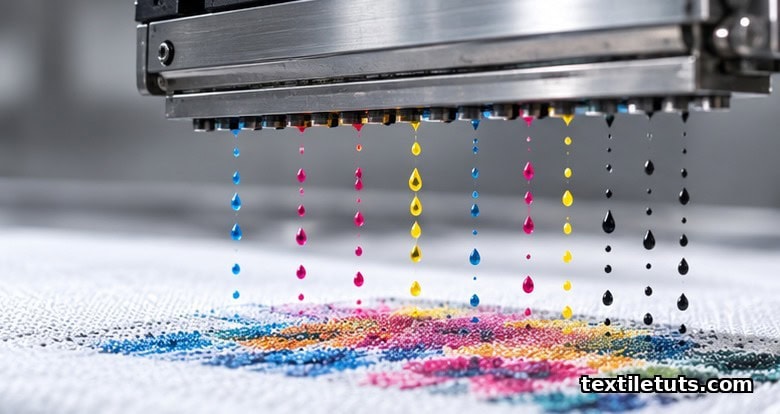
Inkjet textile printing deposits 1–80 picoliter ink droplets from a non-contact print head onto fabric, achieving resolutions of 300–2,400 dpi at production speeds up to 6,000 m²/hour on single-pass industrial presses.
This digital route eliminates the screens, engravings, and color-mixing rooms of conventional textile printing, so short runs, customized designs, and on-demand production are economically viable. Below we walk through the print head physics, fabric pretreatment chemistry, ink classes matched to each fiber type, throughput and water-economics data, and the colorfastness standards an inkjet print must pass before a mill can ship it.
1. How Inkjet Textile Printing Works
An inkjet textile press is a digitally controlled XY positioning system with one or more non-contact print heads. Image data in raster form is sliced into passes, and each head ejects droplets only where ink is needed on the substrate. Because there is no screen and no physical master, changing designs means swapping a file rather than re-engraving a nickel sleeve, which is why run lengths below 50 meters become profitable.
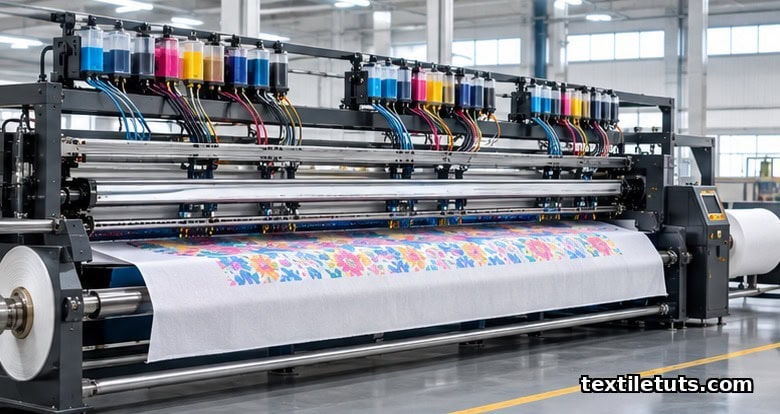
Two head architectures dominate the industrial market. Thermal (bubble-jet) heads, used mainly in early work and still common in office printers, superheat the ink to ~300 °C for a few microseconds, nucleating a vapor bubble that expels a droplet. Piezoelectric heads, the workhorse of textile production, apply a voltage pulse to a piezoelectric crystal that mechanically deforms the ink chamber and ejects the drop on demand. Piezo heads tolerate higher-viscosity inks and disperse pigment dispersions without nozzle clogging, which is why every commercial single-pass textile machine (MS JP Mini, MS LaRio, SPGPrints PIKE, Durst Alpha, Kornit Breeze) uses piezoelectric heads exclusively.
Droplet volume is the key resolution lever. Commercial textile heads produce drops in the 1–80 pL range, with some multi-pulse heads capable of grayscale droplets (1, 2, 3, 4, 5, 6, 7, 8, 14, 21, 32 pL) to render smooth gradients without resorting to dithering. Native head resolution typically runs 360–600 nozzles per inch, and physical print resolution on fabric is reported in 300–2,400 dpi depending on dot placement strategy and substrate absorption.
2. Drop-on-Demand vs Continuous Inkjet
The two operational modes serve different production niches. Continuous inkjet (CIJ) charges every ejected drop and deflects unused droplets into a recirculation gutter, producing very high drop frequencies (up to 100 kHz per nozzle) and excellent reliability on long runs, but the recirculated ink rules out reactive chemistries. Drop-on-demand (DOD), which includes all piezoelectric textile machines, fires only when a dot is needed. DOD is the dominant textile technology because it supports reactive, acid, and disperse inks without contamination from the gutter return path.
| Property | Drop-on-Demand (Piezo) | Continuous Inkjet |
|---|---|---|
| Drop volume | 1–80 pL | 5–40 pL |
| Drop frequency | Up to 80 kHz per nozzle | Up to 100 kHz per nozzle |
| Ink recirculation | None | Required, restricts reactive chemistries |
| Typical use | Cotton, silk, polyester digital printing | Marking, coding, some specialty decor |
| Head resolution | 360–600 dpi native | 100–150 dpi native |
| Maintenance cycle | Auto-wipe, head cleaning at shift changes | Gutter returns ink; less nozzle dry-out |
3. Fabric Pretreatment for Inkjet
A greige fabric straight from the loom is not a printable substrate. Fibers carry waxes, sizes, and pectin that resist wetting, and the capillary structure varies between weaves and knits. To prevent ink bleed (chromatographic wicking along fiber boundaries), the mill applies a pretreatment paste before printing that flattens the surface wetting and pins the dye or pigment in place.
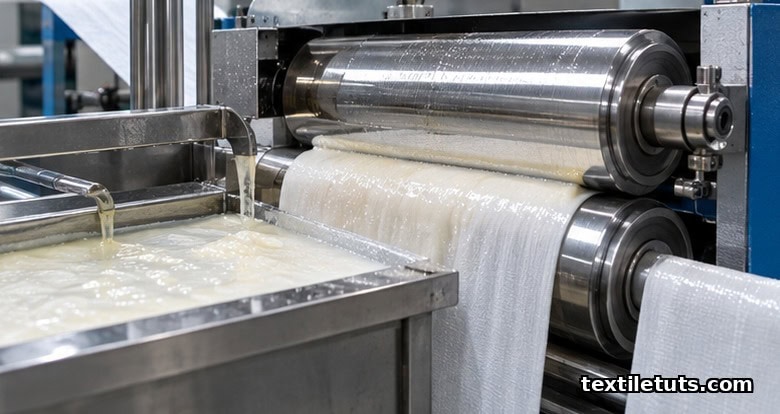
For cotton knits and wovens, a typical pretreatment is a pad-dry-cure application of sodium alginate (1–3% w/w), a humectant such as urea (5–10%), a weak alkali, and a thickening agent to control ink absorption. Urea swells cotton’s cell wall and helps reactive dye diffuse into the fiber, while alginate increases paste viscosity so the printed droplet does not run on contact. The treated fabric is dried at 110–130 °C and then printed.
For polyester, the pretreatment is lighter: a low-residue surfactant and an anti-static finish that smooths ink landing without leaving hydrophobic patches. Silk and wool are pretreated with a thin cationic or amphoteric layer that helps acid dye fix in a neutral pH bake rather than an acid steam.
4. Ink Chemistries by Fiber
The ink must match the fiber to deliver wash, light, and rub fastness comparable to screen printing. Textile engineers pick from four families.
Reactive inks for cellulose (cotton, linen, viscose)
Reactive inks carry a chlorotriazine or vinyl sulfone group that forms a covalent bond with the hydroxyl groups on cellulose under alkaline conditions (pH 10–11). Covalent bonding is why a properly cured reactive print survives 50+ home launderings at 60 °C with minimal shade loss. The post-print workflow is: print, dry, steam at 102–105 °C for 8–15 minutes to fix, then wash off unfixed dye and thickener in a series of rinses ending in a soap-off bath at 95 °C.
Acid inks for protein fibers (silk, wool, polyamide)
Acid dyes form ionic bonds with the amino groups of wool and silk. Inks are buffered to pH 4–6 and printed onto pretreated fabric, then fixed by steaming at 100–102 °C for 30–45 minutes. Acid inks give the brightest gamut on silk, which is why high-fashion digital print houses still favor them.
Disperse inks for polyester
Disperse inks carry a water-insoluble dye in a sub-micron dispersion. After printing, the fabric is heat-fixed at 180–200 °C for 30–90 seconds, which drives the dye into the polyester matrix through thermal diffusion. This high-temperature step is why most digital polyester printers integrate a hot-air or calender fixation unit on-line.
Pigment inks for blended substrates
Pigment inks are insoluble color particles suspended in a binder resin. They sit on the fiber surface rather than diffusing in, which means they print on any substrate but offer lower wash fastness unless cured properly (150–170 °C for 2–3 minutes). Pigment inks are the only viable option for cellulose/polyester blends, where reactive and disperse chemistries would compete.
5. Throughput and Water Economics
Production speed on a single-pass industrial machine is set by fabric width, drop volume, and number of heads. A 1.85 m wide MS JP Mini running four color bars prints up to 6,000 m²/hour at coarse resolution for fashion flags, while the same machine at 1,200 dpi drops to ~800 m²/hour. A scanning multi-pass machine like the Kornit Breeze prints ~40–80 m²/hour at 600 dpi but supports thicker knit piles that single-pass cannot handle.
Water consumption is the second major economic advantage. Conventional screen printing on cotton typically uses 50–150 liters of water per kilogram of fabric across dye baths, washing, and finishing. A digital cotton inkjet line using reactive inks consumes 8–20 liters/kg, and a pigment-ink line drops to 2–5 liters/kg because there is no dye bath, only a wash-off for thickener. The smaller effluent stream also simplifies wastewater treatment and reduces salt load in the discharge.
6. Colorfastness Standards Every Mill Tests Against
Digital textile prints are tested against the same colorfastness standards as screen prints, because the downstream customer (apparel brand, home furnishing brand) cannot tell how the fabric was printed.
- ISO 105-A05: Instrumental assessment of change in color for gray-scale rating of shade change after fastness tests.
- ISO 105-X12 / AATCC TM 8: Colorfastness to rubbing (crocking), dry and wet. A grade 4–5 wet rub is the typical buyer requirement on apparel.
- AATCC TM 61 (Test 1A, 2A, 3A): Colorfastness to laundering, with controlled mechanical action, water temperature, and detergent load. AATCC 61 Test 1A simulates five home launderings at 40 °C.
- ISO 105-B02 / AATCC TM 16: Colorfastness to light, using a xenon arc lamp or fluorescent UV cabinet at 40–80 °C black-panel temperature.
- ASTM D5034: Breaking strength and elongation of woven fabrics, used to confirm that pretreatment chemicals and curing temperatures have not degraded substrate strength.
- AATCC TM 173: CMC color difference calculation, used by mills and brand colorists to set pass/fail tolerances against a Pantone or lab-dip reference.
A properly fixed reactive inkjet print on mercerized cotton typically scores 4–5 on the gray scale for wash fastness and 4 on the blue scale for light fastness, both of which meet the bar set by conventional reactive screen printing.
7. Common Defects and How Mills Prevent Them
Nozzle clogging is the single most common inkjet defect. Reactive inks have a working life of 8–48 hours once charged into the print bar; pigment inks tolerate days but settle if circulation stops. Mills counter this with auto-wipe routines at every shift change, vacuum capping of idle heads, and inline 0.2 µm filters that trap aggregated pigment particles before they enter the nozzle plate.
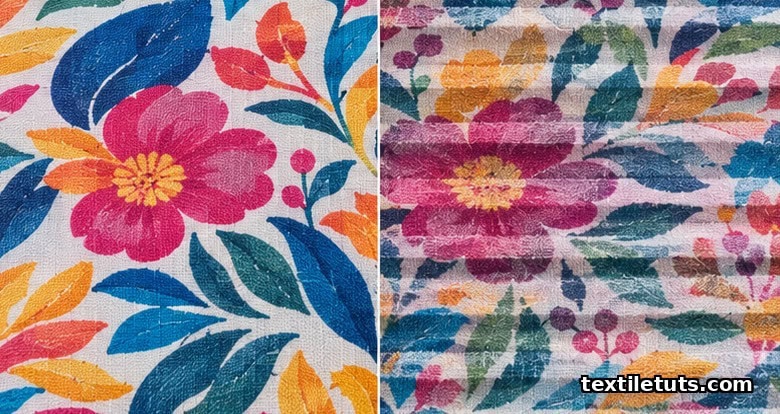
Banding shows up as visible horizontal stripes across the print and traces to misaligned heads, fluctuating head temperature (which changes droplet velocity), or mechanical jitter in the fabric transport. Single-pass machines with encoder feedback keep banding below 0.1 mm by synchronizing drop ejection to the measured fabric velocity, rather than to an assumed nominal speed.
Strike-through and back-graying happen when pretreatment is uneven, so the dye wicks along some yarns and not others. Mills measure pretreatment pickup by weighing the fabric before and after the pad mangle, targeting 70–90% wet pickup depending on fabric weight.
Frequently Asked Questions
What is inkjet textile printing and how is it different from screen printing?
Inkjet textile printing is a non-contact digital process that fires 1–80 pL droplets from a print head directly onto fabric according to a raster image file. Screen printing uses a physical mesh, one screen per color, to push ink through open areas onto the fabric. The digital method needs no screens, supports short runs and customization, and cuts water use from 50–150 L/kg (screen) to 2–20 L/kg (inkjet) on cotton, depending on ink chemistry.
Which fabrics can be inkjet-printed?
Cotton, linen, viscose, silk, wool, polyamide, polyester, and most cotton-poly blends are commercially printable. The ink chemistry is matched to the fiber: reactive for cellulose, acid for silk and wool, disperse for polyester, and pigment for blends. Spandex and other elastic fibers require lower-temperature fixation to preserve stretch.
How fast can industrial digital textile printers run?
Single-pass industrial presses such as the MS JP Mini and SPGPrints PIKE reach 4,000–6,000 m²/hour on cotton at 600 dpi with four-color ink sets. Multi-pass scanning presses run at 40–80 m²/hour at 600 dpi but handle heavier knits and thicker piles. Speed at fixed dpi scales with the number of head bars and the native head resolution.
Is digital textile printing more sustainable than screen printing?
On cotton reactive inks, yes. Digital reactive inkjet cuts water use to 8–20 L/kg versus 50–150 L/kg for conventional screen, and the smaller effluent stream cuts salt load in the wastewater. Pigment inkjet is even drier at 2–5 L/kg because there is no dye bath to wash out. On polyester, inkjet saves water but still requires a heat-fixation step at 180–200 °C that consumes energy.
How do I check the colorfastness of an inkjet print?
Run ISO 105-X12 or AATCC TM 8 for crocking, AATCC TM 61 (1A or 2A) for home laundering, and ISO 105-B02 for light. A reactive print on properly pretreated cotton typically scores 4–5 on the gray scale for wash and 4 on the blue scale for light, which is the same range as a reactive screen print. If a print fails at 3 or below, the usual culprit is insufficient steaming time or cure temperature, not the inkjet process itself.
References
- Tyler, D. J. (2005). Textile digital printing technologies. Textile Progress, 37(4), 1–65. ResearchGate / Taylor & Francis. — review of DOD and CIJ head architectures and their adaptation to textile substrates.
- ISO 105-A05:1996. Textiles — Tests for colour fastness — Part A05: Instrumental assessment of change in colour for determination of grey scale rating. International Organization for Standardization.
- AATCC Test Method 8-2016. Colorfastness to Crocking: AATCC Crockmeter Method. American Association of Textile Chemists and Colorists.
- AATCC Test Method 61-2013. Colorfastness to Laundering: Accelerated. American Association of Textile Chemists and Colorists.
- ASTM D5034-21. Standard Test Method for Breaking Strength and Elongation of Textile Fabrics (Grab Test). ASTM International.
- AATCC Test Method 173-2009. CMC: Calculation of Small Color Differences for Acceptance, Practical Use, and Accuracy. American Association of Textile Chemists and Colorists.
- MDPI Polymers review article on pigment-based inkjet inks for textile printing (2022). Polymers, MDPI. — peer-reviewed survey of binder chemistry, dispersant selection, and wash-fastness performance.
- ResearchGate paper on reactive inkjet printing of cotton (Štěpánková, Wiener, and others). Journal of the Textile Institute / FIBRES & TEXTILES — peer-reviewed study on pretreatment, steaming, and wash-fastness outcomes for reactive inkjet on cotton.
This article is the working reference for digital inkjet printing on textile substrates. Editorial by Shahrukh Islam, TextileTuts. Sources: ISO 105-A05, AATCC TM 8, AATCC TM 61, AATCC TM 173, ASTM D5034, MDPI Polymers (2022), and peer-reviewed work cited in the references above.


