
Scouring Process: Alkali Scouring

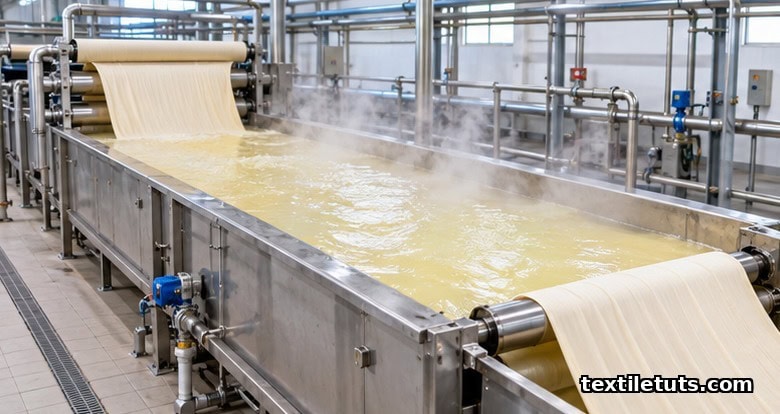
Alkali scouring treats greige cotton fabric in a sodium hydroxide (NaOH) bath, typically 2 to 4 percent NaOH on weight of fabric (owf) at 80 to 100 degrees Celsius and a pH above 12 for 30 to 60 minutes, which removes 5 to 10 percent of the fabric mass as natural waxes, pectins, proteins, and mineral salts and converts the hydrophobic fiber surface into a uniformly wettable substrate for dyeing.
The scouring step is the single largest source of mass loss in cotton wet processing, and the chosen parameters directly control whiteness, absorbency, fiber damage, and downstream chemical demand. Mis-scoured cotton resists level dyeing, prints patchily, and absorbs finishing chemicals unevenly, so alkali scouring is treated as the foundation of every subsequent wet process in cotton manufacturing.
What Raw Cotton Contains Before Scouring
Greige (loom-state) cotton is not pure cellulose. A typical analysis of a raw cotton fiber shows about 83 to 90 percent cellulose, 4 to 6 percent hemicelluloses, 0.6 to 1.0 percent waxes, 1.0 to 1.5 percent pectins, 0.3 to 1.0 percent proteins, 0.8 to 1.5 percent mineral ash (mostly potassium, calcium, and magnesium salts of organic acids), and 1 to 2 percent other compounds. The waxes are concentrated on the fiber surface, and they are the primary reason untreated cotton floats, sheds water, and resists dye penetration. Pectins cement the fibers to one another in the boll and remain partly on the yarn surface after spinning. Minerals cross-link the pectin layer through calcium and magnesium bridges.
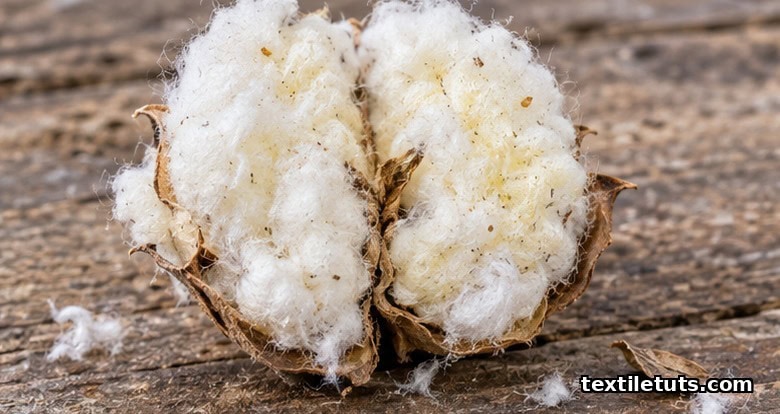
Alkali scouring must attack all three layers: the surface waxes, the pectin matrix, and the mineral cross-links. Sodium hydroxide is the only commercial reagent that accomplishes all three in a single step at reasonable cost, which is why it has been the scouring base for more than a century.
Chemistry of Alkali Scouring
Three reactions do most of the work. First, sodium hydroxide saponifies the wax esters on the cotton surface, converting fatty acid esters into soluble sodium soaps and releasing fatty alcohols. The reaction is identical to soap making from animal fat: triglyceride plus NaOH gives glycerol plus sodium salt of the fatty acid. Second, NaOH de-esterifies and de-methylates the pectins, converting polygalacturonic acid into soluble sodium pectate, which washes out in the hot rinse. Third, NaOH exchanges calcium and magnesium ions bound to the pectin layer for sodium ions, breaking the mineral cross-links that hold pectins in place.
A useful side reaction is cellulose swelling. Concentrated NaOH above about 8 percent owf begins to swell the cellulose crystal lattice, the same chemistry used in mercerization. Under normal scouring conditions (2 to 4 percent NaOH) the swelling is mild and reversible, but under aggressive continuous scouring or hot caustic bleaching, the fabric can take on a permanent increase in luster and tensile properties that is, strictly speaking, a partial mercerization. Process engineers set the NaOH concentration to balance wax removal against fiber damage.
Standard Process Parameters
Most batch scouring recipes on knitted cotton run at 2 to 4 percent NaOH owf, 0.5 to 1.0 percent nonionic wetting agent, 80 to 100 degrees Celsius, 30 to 60 minutes, and a liquor ratio of 1:8 to 1:12. Woven cotton is often scoured at the boil (about 98 to 100 degrees Celsius at sea level) with 3 to 4 percent NaOH owf. Continuous scouring on a pad-steam range uses higher concentrations, typically 5 to 8 percent NaOH owf in the pad bath, followed by steaming at 100 to 103 degrees Celsius for 5 to 15 minutes. The higher concentration is required because contact time is short.
Wetting agents are essential, not optional. Raw cotton floats on water because of the surface wax layer. A nonionic surfactant (often an ethoxylated alcohol with 7 to 12 moles of ethylene oxide) at 0.5 to 1.0 g/L pulls the NaOH solution into the yarn package and across the fabric surface within minutes. Without the wetting agent, batch scouring leaves dry spots that show up as unlevel dyeing downstream.
Batch Equipment for Scouring
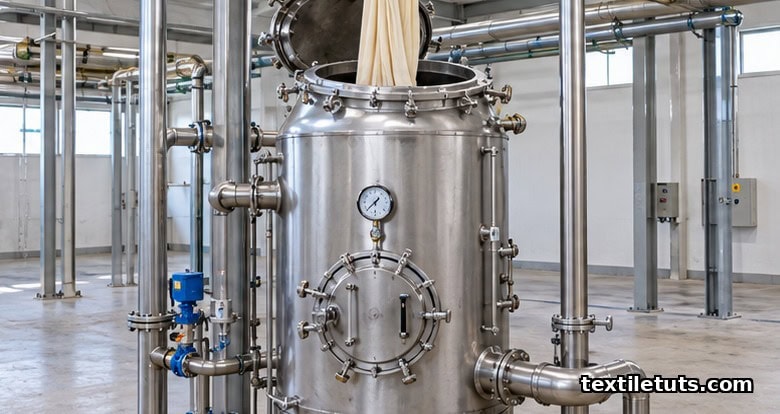
Three pieces of equipment dominate batch alkali scouring. The kier is a closed, vertical pressure vessel that holds the fabric in rope form, recirculates liquor through a heater, and runs at 1 to 2 bar of steam pressure (about 105 to 120 degrees Celsius). The kier gives the most thorough scour because the elevated pressure lifts the boil above 100 degrees Celsius and the forced circulation reaches the inside of every rope. The jigger is an open-width machine that passes fabric from one roll to another through a trough of scouring liquor at atmospheric pressure. The jigger is gentler on the fabric and is preferred for sensitive constructions, but it requires multiple passes (typically 4 to 6) to reach the same effect as a kier. The winch processes rope fabric in an open bath at the boil, with slow circulation driven by a paddle wheel; it is common for knit goods.
After the scouring step, fabric goes through a sequential rinse: a hot wash at about 80 degrees Celsius to remove most of the NaOH and dissolved impurities, a warm wash at 60 degrees Celsius, and a cold wash. The rinse water is tested with phenolphthalein; if the wash turns pink, alkali is still present and one more wash is required.
Continuous Scouring
Continuous scouring dominates in modern high-volume mills because it cuts labor cost and gives tighter control of the process. The standard layout is a pad mangle, where fabric passes through a hot NaOH bath and is squeezed to a controlled wet pickup (typically 80 to 100 percent on weight of dry fabric), followed by a steamer. The J-box is a tall, U-shaped chamber in which the padded fabric folds on a moving belt and dwells in saturated steam for 5 to 15 minutes. The roller-bed steamer is a horizontal series of driven rollers inside a steam chamber; fabric snakes through on top of the rollers and exits continuously. After steaming, the fabric passes through a hot wash section, often a series of cascaded wash boxes with countercurrent liquor flow.
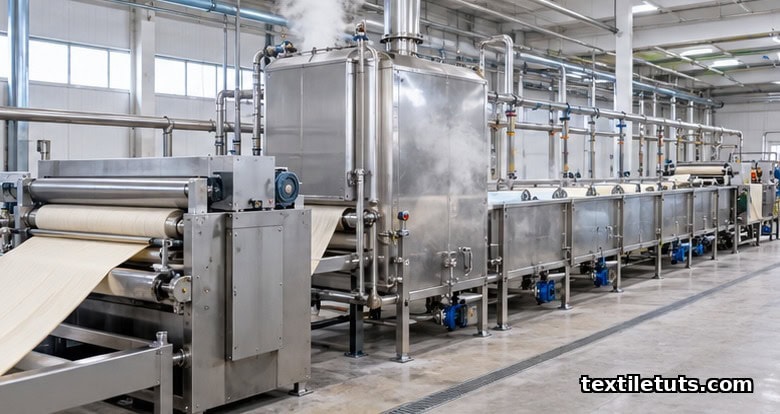
Continuous scouring recipes often combine scouring and bleaching in a single pad-steam step by adding hydrogen peroxide (3 to 5 g/L) and a stabilizer (sodium silicate or a phosphonate) to the pad bath. The combined scour-bleach produces a white fabric in one pass and is standard for cotton knit goods going directly to reactive dyeing.
Process Parameters at a Glance
| Parameter | Batch (kier/jigger) | Continuous (pad-steam) |
|---|---|---|
| NaOH concentration | 2 to 4 % owf | 5 to 8 % owf in pad bath |
| Wetting agent | 0.5 to 1.0 % owf nonionic | 2 to 5 g/L nonionic |
| Temperature | 80 to 100 °C | 100 to 103 °C in steamer |
| Time | 30 to 60 min | 5 to 15 min steam dwell |
| Liquor ratio | 1:8 to 1:12 | Wet pickup 80 to 100 % |
| Mass loss expected | 5 to 8 % | 4 to 7 % |
| Typical fabric form | Rope or open width | Open width |
Quality Control After Scouring
The standard tests after alkali scouring measure absorbency, residual extractables, whiteness, and fabric strength. Wettability is the most common quick check, run on a drop test where a drop of water is placed on the fabric and timed; well-scoured cotton absorbs the drop in under 5 seconds. Residual wax content is measured by Soxhlet extraction with an organic solvent such as ethanol or dichloromethane, with the result expressed as percent extractable matter. Weight loss between the greige and scoured state should be in the 4 to 8 percent range for cotton; lower loss indicates under-scouring, higher loss indicates fiber damage. Whiteness is read on a spectrophotometer against a barium sulfate standard. Tensile strength retention above 90 percent of the greige fabric is the practical floor; below that, the scouring is too aggressive.
If hydrogen peroxide has been added to the scour bath, residual peroxide must be neutralized before dyeing, otherwise reactive dyes will be oxidized and shade reproducibility will suffer. Catalase enzyme or sodium bisulfite is added in a separate bath.
Environmental and Safety Notes
Spent scouring liquor is strongly alkaline (pH above 12) and carries a high chemical oxygen demand from dissolved waxes, pectins, and proteins. Mills typically neutralize the effluent with sulfuric acid or carbon dioxide and route it through biological treatment. Modern recipes increasingly replace part of the NaOH with enzymes (pectinases, lipases, cellulases) to lower both the chemical oxygen demand of the effluent and the fiber damage; the trade-off is longer process time and higher enzyme cost.
Operators handling NaOH flakes or concentrated liquor must wear chemical-resistant gloves, splash goggles, and an apron; concentrated NaOH is caustic and causes immediate chemical burns on contact with skin.
Frequently Asked Questions
What concentration of NaOH is used for cotton scouring?
Batch scouring on cotton typically uses 2 to 4 percent NaOH on weight of fabric at 80 to 100 degrees Celsius for 30 to 60 minutes, while continuous pad-steam scouring uses 5 to 8 percent NaOH in the pad bath with 5 to 15 minutes of steam dwell at 100 to 103 degrees Celsius.
Why is alkali scouring necessary before dyeing cotton?
Raw cotton carries a hydrophobic wax layer on the fiber surface that prevents water, dye, and finishing chemicals from penetrating the yarn. Alkali scouring saponifies those waxes into soluble soaps, removes pectin and protein impurities, and leaves a uniformly wettable fabric that absorbs dye evenly across the full width of the batch.
How much weight does cotton lose during scouring?
A well-scoured cotton fabric loses 4 to 8 percent of its greige weight, depending on the cotton variety, the NaOH concentration, and the process time. Weight loss below 3 percent usually signals under-scouring, while weight loss above 10 percent indicates fiber damage and excessive hydrolysis of the cellulose.
Can alkali scouring damage cotton fibers?
Yes. Hot concentrated NaOH above about 4 percent owf starts to hydrolyze the cellulose chain, reducing tensile strength and causing weight loss beyond what the impurities alone explain. Process engineers control the risk by holding NaOH concentration at 2 to 4 percent owf for batch work, keeping the bath temperature under 100 degrees Celsius, and limiting contact time to 30 to 60 minutes; tensile strength retention above 90 percent of the greige fabric is the practical safety threshold.
What is the difference between scouring and bleaching?
Scouring removes the natural non-cellulosic impurities (waxes, pectins, proteins, minerals) using NaOH, while bleaching removes the natural color bodies (primarily flavones) using hydrogen peroxide or sodium hypochlorite. In modern continuous ranges the two steps are combined into a single scour-bleach pad-steam process, but they remain chemically distinct reactions and are controlled by different parameters.
References
- AATCC Technical Manual. AATCC Test Method 79: Absorbency of Textiles (Drop Test). American Association of Textile Chemists and Colorists. Method for measuring wettability of scoured cotton.
- AATCC Technical Manual. AATCC Test Method 97: Extractable Matter in Textiles. American Association of Textile Chemists and Colorists. Soxhlet extraction method for residual wax on cotton.
- ASTM International. ASTM D2257: Standard Test Method for Extractable Matter in Textiles. ASTM International. Solvent extraction procedure for natural impurities on cotton.
- ASTM International. ASTM D629: Standard Test Methods for Quantitative Analysis of Textiles. ASTM International. Method for cellulose content and non-fibrous material determination.
- ISO. ISO 105-C06: Textiles — Tests for Colour Fastness — Part C06: Colour Fastness to Domestic and Commercial Laundering. International Organization for Standardization. Standard wash test referenced in scouring QC.
- Karmakar, S. R. Chemical Technology in the Pretreatment Processes of Textiles. Elsevier Science, 1999. Textile engineering reference covering alkali scouring chemistry and process parameters.
- Wang, Q., Fan, X., Hua, Z., & Chen, J. Optimizing Scouring Process of Cotton Knits with Environmentally Friendly Pectinase. ResearchGate / peer-reviewed textile chemistry literature. Enzyme-assisted scouring of cotton as a lower-impact alternative to NaOH-only processes.
Editorial by Shahrukh Islam, TextileTuts. Sources: AATCC Test Methods 79 and 97, ASTM D2257 and D629, ISO 105-C06, Karmakar (1999), and Wang et al. on enzymatic scouring as cited.


