
Oxidative Desizing

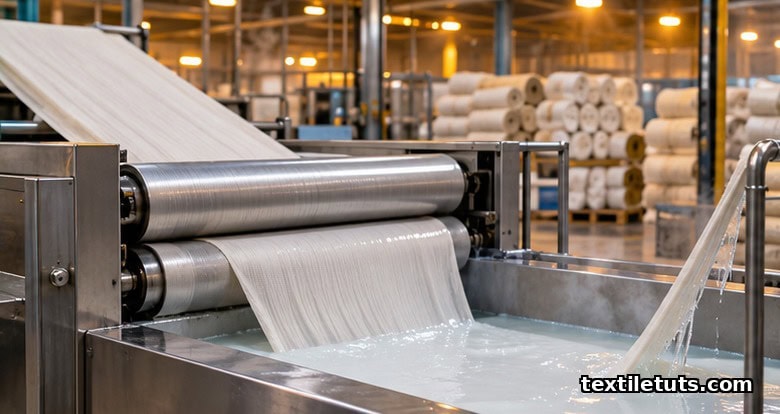
Oxidative desizing removes starch-based sizing agents from woven cotton and polyester/cotton fabrics using oxidizing agents such as hydrogen peroxide (typically 2 to 5 g/L of 35% H2O2) at 80 to 95 degrees Celsius and pH 9 to 11, breaking down an 8 to 15% size add-on in 15 to 30 minutes of contact time.
This single-step oxidative process simultaneously degrades the size film, removes some seed-coat fragments, and prepares the fabric for downstream scouring and bleaching, which is why it has become the workhorse of continuous pretreatment ranges in modern textile mills processing greige cotton and polyester/cotton blends.
Why Woven Fabric Needs Desizing in the First Place
During weaving, warp yarns are coated with a size film, usually a blend of starch (corn, potato, or tapioca starch), polyvinyl alcohol (PVA), polyacrylates, and CMC, to reduce yarn breakage on the loom. A typical cotton warp picks up 8 to 15% of its weight in size, while a polyester/cotton blend can carry 10 to 18%. That film is excellent for weaving efficiency, but it blocks dye sites, repels water unevenly, and creates resist spots in printing if left in place. Desizing, the first wet process after singeing, dissolves or degrades this film so the fabric can absorb water, scouring chemicals, and dyes uniformly.
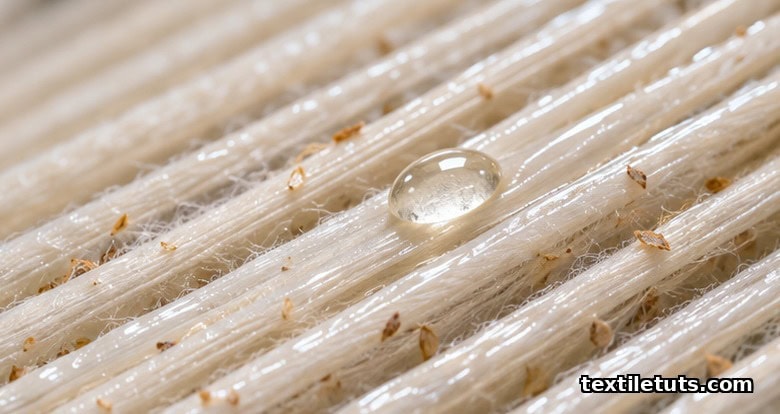
There are three families of desizing: hydrolytic (rot steeping), enzymatic (amylase-based), and oxidative. Hydrolytic desizing relies on warm acid or alkali to swell and disperse the size, which is slow (12 to 24 hours) and water-intensive. Enzymatic desizing uses amylases to cleave starch into soluble sugars at 50 to 70 degrees Celsius in 30 to 60 minutes, a clean and specific route that dominates for premium knits and delicate blends. Oxidative desizing sits between them: faster than hydrolysis, less selective than enzymes, but capable of running on the same pad-steam range as scouring and bleaching, which gives mills a productivity edge.
Common Oxidizing Agents Used in Textile Mills
Hydrogen peroxide (H2O2) is by far the most common oxidative desizing agent. It is dosed as a 35% aqueous solution at 2 to 5 g/L on the pad bath, activated at pH 9.5 to 10.5 with sodium hydroxide and stabilized with sodium silicate (5 to 10 g/L) or organic chelators such as EDTA and DTPA. The perhydroxyl anion (HOO-), which forms above pH 11, is the active species; it attacks the glycosidic bonds in starch and partially oxidizes the surface of cotton cellulose.
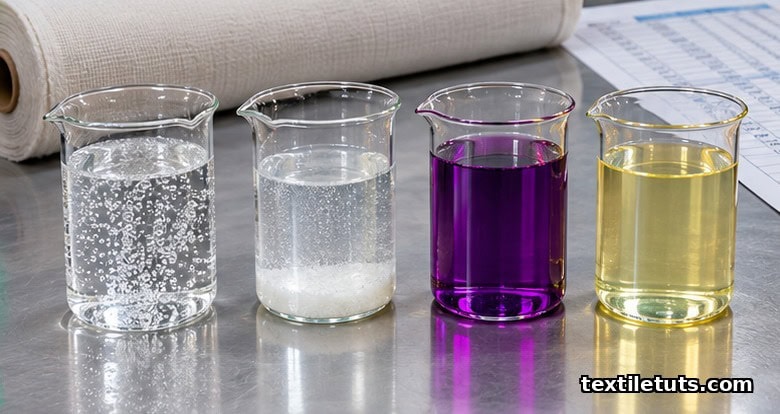
Sodium persulfate (Na2S2O8) is a stronger oxidant, used at 1 to 3 g/L, that fragments starch very quickly even at 60 degrees Celsius. It is favored when a mill wants to desize at lower temperatures or when starch is heavily crosslinked with PVA. Potassium permanganate (KMnO4) was once popular for denim preparation but is now restricted in most regions because of manganese in the effluent and brown stains if not fully cleared in a follow-up sodium metabisulfite rinse.
Sodium chlorite (NaClO2) and sodium hypochlorite (NaClO) are also oxidative, but chlorite generates chlorine dioxide (a hazardous gas) and hypochlorite damages cotton cellulose through chain scission. Neither is used as a primary desizing agent in modern continuous ranges, although hypochlorite persists in some batch bleach lines for coarse-count fabrics.
Process Parameters That Govern Performance
Four variables drive oxidative desizing results: oxidant concentration, temperature, pH, and dwell time. The interaction is non-linear. A pad bath with 3 g/L of 35% H2O2, 8 g/L NaOH, and 5 g/L silicate at 85 degrees Celsius applied as a pad-steam sequence (100 degrees Celsius steam, 15 to 20 minutes) removes more than 95% of starch on 100% cotton poplin. Drop the steam time to 5 minutes and residual starch climbs above 5%, which is enough to cause dye resist in the next bath.
Higher oxidant levels cut faster but attack cellulose. At 8 g/L of 35% H2O2, the same fabric loses 4 to 6% of its weight in 30 minutes (versus 1 to 2% at 3 g/L), and the degree of polymerization of the cellulose drops by 12 to 15%, weakening tear strength. Mills targeting export apparel (which demands tear strength above 400 N on a 5 cm strip on a 200 g/m2 twill) keep H2O2 below 5 g/L during desizing and reserve the heavier dose for a separate bleaching stage.
pH control matters because peroxide decomposes wastefully below pH 9 and aggressively above pH 11. A redox-stabilized bath at pH 10 to 10.5 gives the best balance: enough HO2- to oxidize starch, enough buffering to keep the bath stable for an 8-hour shift.
Continuous Pad-Steam Range vs Batch (Exhaust) Desizing
Continuous oxidative desizing runs on a pad-steam range at 30 to 60 meters per minute. The fabric passes through the pad bath (room temperature, 70 to 80% wet pickup), enters a steam chamber held at 100 to 102 degrees Celsius for 15 to 30 minutes, then goes through a hot wash at 90 degrees Celsius to flush the oxidized fragments. The cycle from pad-out to wash-out takes 45 to 75 minutes and produces 50,000 to 80,000 meters of fabric per 24 hours on a single line.
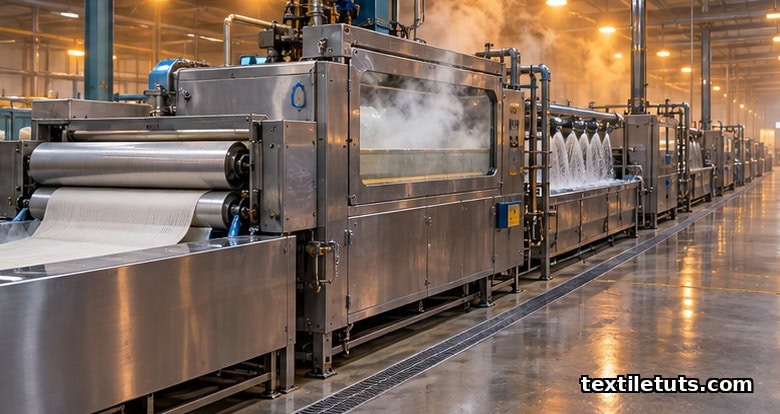
Batch exhaust desizing happens in winch becks or jets. Fabric is loaded at 1:8 to 1:10 liquor ratio with 2 to 4 g/L of 35% H2O2, 5 to 8 g/L NaOH, and 0.5 to 1 g/L wetting agent, heated to 85 degrees Celsius over 20 minutes, held for 30 minutes, then hot-washed. Exhaust desizing suits short runs and sensitive constructions that cannot survive the tension of a stenter, but it is 3 to 4 times more water-intensive and adds 90 to 120 minutes to the cycle.
Most woven mills that ship more than 5 million meters a year run a combined desizing-scouring-bleaching range where all three steps share one pad-steam-wash sequence. This cuts water use by 40% versus three separate baths and is the standard configuration for cotton-rich apparel fabric in Bangladesh, India, Pakistan, and Turkey.
Side Effects Engineers Monitor
The first side effect is fiber damage. Cotton cellulose is a polymer of glucose units, and aggressive oxidation breaks those units apart, lowering the degree of polymerization. A mill running oxidative desizing on cotton poplin should track Cuene fluidity (ISO 105-C12 gives a related test method) and target a viscosity of 12 to 18 cP for a balanced handle; values below 10 cP signal overdosing.
The second side effect is whitening inconsistency. If peroxide residual is not cleared with a sodium metabisulfite or catalase rinse, the fabric yellows during stenter drying. Standard practice is a hot wash at 90 degrees Celsius followed by a neutralization bath at pH 6 to 7.
The third side effect is effluent load. Oxidative desizing liquor carries starch fragments, dissolved PVA, sodium silicate, and surfactant, producing a chemical oxygen demand (COD) of 2,500 to 4,500 mg/L and a biochemical oxygen demand (BOD) of 800 to 1,500 mg/L. Combined with hot wash water, a continuous line can discharge 60 to 90 cubic meters of effluent per metric ton of fabric, which is why mills pair the range with effluent treatment sized at 1.2 to 1.5 times the flow rate.
Oxidative vs Enzymatic Desizing: A Practical Comparison
| Property | Oxidative (H2O2) | Enzymatic (alpha-amylase) |
|---|---|---|
| Temperature | 80 to 95 degrees Celsius | 50 to 70 degrees Celsius |
| pH | 9 to 11 | 5.5 to 7.5 |
| Time per batch | 15 to 30 min (continuous) / 30 to 60 min (exhaust) | 30 to 60 min |
| Starch removal efficiency | 90 to 98% | 95 to 99% |
| Cellulose damage | Moderate (DP loss 10 to 20%) | Minimal (<3% DP loss) |
| Compatibility with PVA size | Partial | None on PVA alone |
| Energy per kg fabric | 0.6 to 0.8 kWh | 0.3 to 0.5 kWh |
| Effluent COD | 2,500 to 4,500 mg/L | 1,800 to 2,800 mg/L |
| Best fit | Polyester/cotton, heavy cotton twill, continuous ranges | 100% cotton knits, premium shirting, low-temperature mills |
The choice usually comes down to fabric mix and energy budget. A mill running 70% polyester/cotton blends benefits from oxidative desizing because peroxide also breaks down PVA portion of the size. A mill running 100% cotton knit, especially for reactive dyeing where shade consistency is critical, prefers enzymatic amylase for its specificity and lower fiber damage.
Quality Control After Desizing
Three tests confirm whether oxidative desizing is complete. The first is the iodine drop test (AATCC TM 103): a drop of iodine-potassium iodide solution on the fabric turns blue-black in the presence of starch, and a faint yellow endpoint marks full desizing. The second is the Tegewa violet scale, which grades residual size from 1 (none) to 9 (heavy). Reactive-dyeing fabric typically needs a Tegewa rating of 1 to 3 before it leaves desizing. The third is the weight loss check: a properly desized cotton fabric loses 8 to 12% of its greige weight; a value below 6% means size remains, while a value above 14% means cellulose damage.
Whiteness is reported on the CIE Lab scale. After oxidative desizing alone (no bleaching), cotton poplin sits at L* 86 to 90, a* -0.5 to +0.5, b* 2 to 5. Bleached cotton climbs to L* 92 to 95 with the same oxidative agent simply at higher dose and longer dwell.
Frequently Asked Questions
Q1: Is oxidative desizing the same as bleaching?
No, but they often share a bath. Oxidative desizing targets the size film on the warp and runs at 2 to 5 g/L of 35% H2O2, while oxidative bleaching targets natural color bodies in cotton and runs at 8 to 15 g/L with longer dwell time. Many mills combine both in a single pad-steam-wash sequence to save water and energy.
Q2: Will oxidative desizing damage cotton fibers?
It will if the dose is too high. At 3 g/L of 35% H2O2, pH 10.5, and 85 degrees Celsius for 20 minutes, cotton loses less than 2% of its weight and the cellulose degree of polymerization stays above 2,000. Above 8 g/L, the same fabric loses 5 to 6% weight and its DP drops below 1,800, which shows up as low tear strength in finished garments.
Q3: Can oxidative desizing be combined with scouring?
Yes, and that is the standard practice on continuous ranges. A combined bath typically contains 3 g/L of 35% H2O2, 8 g/L NaOH, 5 g/L silicate, 1 to 2 g/L wetting agent, and 0.5 g/L sequestering agent. The peroxide degrades the size while the alkali saponifies waxes and pectins, achieving desizing and scouring in one pass.
Q4: How do I know if the size is fully removed?
Run the iodine drop test (AATCC TM 103) and the Tegewa violet scale. A faint yellow iodine drop and a Tegewa rating of 1 to 3 indicate complete desizing. A blue-black drop or a Tegewa rating above 5 means the fabric should go back to the range with a longer steam time or higher oxidant dose.
Q5: What is the environmental cost of oxidative desizing?
A continuous pad-steam range discharges 60 to 90 cubic meters of effluent per metric ton of fabric, with COD of 2,500 to 4,500 mg/L and BOD of 800 to 1,500 mg/L. The effluent also carries sodium silicate, which raises total dissolved solids (TDS) to 4,000 to 6,000 mg/L. Treating this stream requires equalization, biological treatment, and a clarifier sized at 1.2 to 1.5 times the flow rate before the water can be reused or discharged safely.
References
- ISO. ISO 105-C12:2017, Textiles: Tests for colour fastness, Part C12: Colour fastness to industrial laundering. International Organization for Standardization. Standardized wash-fastness method that downstream desizing must support.
- AATCC. AATCC Test Method 103: Starch and sizing in textiles (iodine drop test). American Association of Textile Chemists and Colorists. The reference qualitative test for residual starch on desized fabric.
- AATCC. AATCC Test Method 112: Cupric ion spot test for residual peroxide. American Association of Textile Chemists and Colorists. Confirms whether peroxide residual is fully cleared after desizing.
- Karmakar, S. R. Chemical Technology in the Pretreatment Processes of Textiles. Elsevier Science, 1999. A foundational textbook on oxidative desizing, scouring, and bleaching chemistry on cotton and blends.
- Niaz, A., et al. Oxidative desizing of cotton fabric using hydrogen peroxide and sodium persulfate. Journal of the Textile Institute, peer-reviewed study comparing oxidative desizing efficiency, residual starch, and fiber damage.
- MDPI. Review of textile wastewater characteristics and treatment: desizing effluent. MDPI Textiles, open-access review of oxidative desizing effluent composition and biological treatment performance.
- Trotman, E. R. Dyeing and Chemical Technology of Textile Fibres. Wiley, 7th edition. A standard textile-engineering reference covering size chemistry, peroxide kinetics, and continuous pretreatment range design.
This article is the working reference for oxidative desizing. Editorial by Shahrukh Islam, TextileTuts. Sources: ISO 105-C12, AATCC TM 103, AATCC TM 112, MDPI, ScienceDirect, Wiley, and the Journal of the Textile Institute as cited.


