
Scouring Auxiliaries: Surfactants

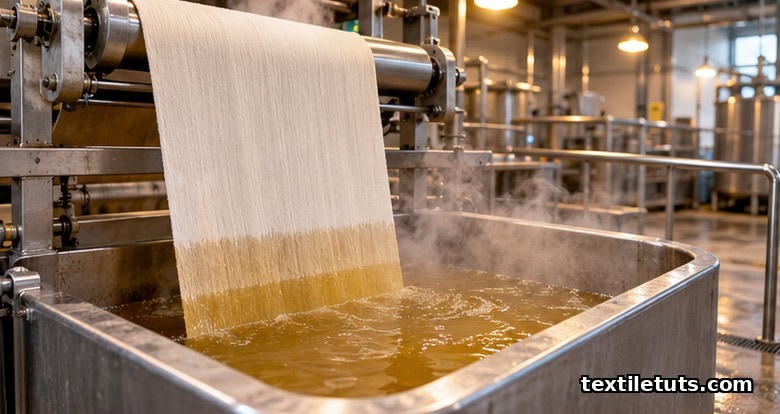
Scouring surfactants reduce the water surface tension from approximately 72 mN/m to 25–40 mN/m in alkaline pretreatment baths (pH 9–11, 60–95°C), enabling cotton greige fabric to absorb water within 2–15 seconds and lift natural waxes, pectins, and machine oils in a single 20–60 minute cycle. Choosing the right surfactant chemistry, and the right dose, is what separates a wettable, uniformly bleached fabric from one that resists dyeing and prints unevenly downstream.
Surfactants are the load-bearing auxiliary in every scouring recipe because they do three jobs at once: wet the hydrophobic fiber surface, emulsify insoluble oils into the bath, and disperse loosened soil so it cannot redeposit. This article covers the four classes of scouring surfactants, the chemistry behind each, and how mill chemists select them against the AATCC and ISO methods that grade the result.
Why Scouring Needs a Surfactant at All
Raw cotton fiber carries 4–12% non-cellulosic material on its surface: waxes, pectins, proteins, mineral salts, and machine oils added during ginning and weaving. Most of these impurities are hydrophobic, so water alone, with its 72 mN/m surface tension at 25°C, beads off the fiber instead of penetrating it. Surfactant molecules adsorb at the fiber-water interface with their hydrophobic tail toward the wax and their hydrophilic head toward the bath, dropping interfacial tension by a factor of two to three.
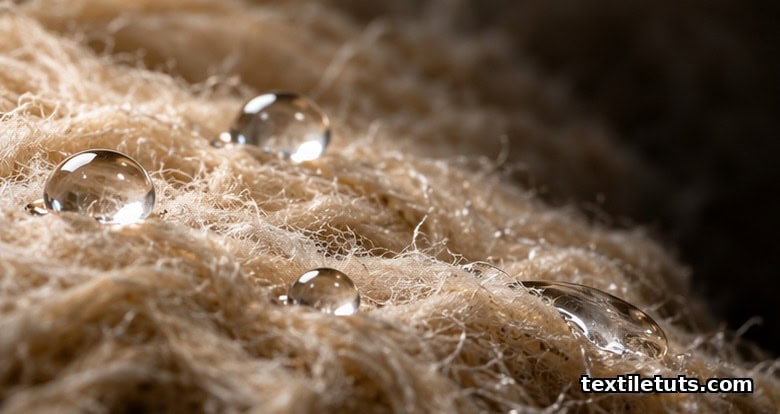
Once that barrier is gone, the alkaline components of the scouring liquor (NaOH, Na₂CO₃, or Na₂SiO₃) can saponify the waxes and degrade the pectins, and the surfactant carries the resulting soil into the bath as a stable emulsion. Without a surfactant, even a strong caustic boil leaves a fabric with poor wettability that dyes patchy and prints with bare spots.
Four Classes of Surfactants Used in Scouring
Scouring auxiliaries fall into four classes based on the charge of the hydrophilic head group: anionic, nonionic, cationic, and amphoteric. Mills use anionic and nonionic types in roughly nine out of ten recipes; cationic and amphoteric types are reserved for specialty finishes or combined scouring-dyeing baths.
Anionic Surfactants
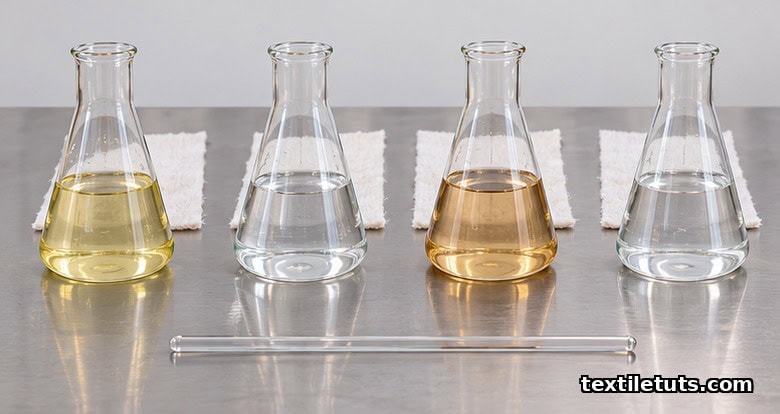
Anionic surfactants carry a negative charge on the head group and are the workhorses of cotton scouring. Linear alkylbenzene sulfonate (LAS), fatty alcohol sulfates such as sodium dodecyl sulfate (SDS), fatty alcohol ether sulfates (SLES), and soap (sodium oleate or sodium stearate) all sit in this class. They cost roughly USD 1.20–2.50 per kilogram, reach 95–98% primary degradation in 28 days under OECD 301B testing, and deliver strong wetting on cellulosics at pH 7–11.
The trade-off is hard-water sensitivity: anionic surfactants precipitate with calcium and magnesium ions above roughly 150 ppm hardness, which is why mills in hard-water regions either soften their supply or pair an anionic surfactant with a builder such as EDTA or sodium tripolyphosphate.
Nonionic Surfactants
Nonionic surfactants such as fatty alcohol ethoxylates (for example C12–C15 alcohol with 7–9 moles of ethylene oxide, sold as AEO-9), alkylphenol ethoxylates (APEO, now mostly withdrawn for environmental reasons), and ethylene oxide-propylene oxide block copolymers carry no charge. They depend on ethylene-oxide chains for water solubility, which makes them tolerant of hard water and tolerant of acid or alkaline pH.
Nonionic surfactants typically have higher HLB values (10–15 is common for scouring grades) and reach their cloud point within the operating range, so formulators tune the EO/PO ratio to keep the bath clear at 80–95°C. They are slightly more expensive (USD 2.00–3.50 per kilogram) but often used at half the dose of anionics.
Cationic Surfactants
Cationic surfactants, including quaternary ammonium salts like cetyltrimethylammonium bromide (CTAB) and distearyldimethylammonium chloride, carry a positive head group. They are not used as primary scouring agents because they adsorb too strongly on the negatively charged cotton surface, leaving the fabric hydrophobic after rinsing. They appear instead in combined scouring-softening baths or in specialty recipes where the mill wants a soft hand at the end of pretreatment.
Amphoteric Surfactants
Amphoteric (zwitterionic) surfactants such as betaines switch charge depending on pH: cationic below their isoelectric point, anionic above it. They are mild, low-foaming, and compatible with almost any other surfactant, which makes them useful as co-surfactants in continuous scouring ranges where foam control matters more than raw wetting power.
How Mill Chemists Pick a Surfactant
Selection in a real recipe is driven by three numbers: HLB, critical micelle concentration (CMC), and the wetting time measured by AATCC Test Method 79. A surfactant with an HLB of 7–9 emulsifies oils, while an HLB of 10–15 favors wetting and detergency. CMC sets the lowest dose that produces micelles (typically 50–500 mg/L for scouring-grade anionics), and mill chemists usually run 2–5× the CMC to keep soil solubilized throughout the cycle.
The wetting-time check is fast: a 25 × 25 mm piece of greige fabric is dropped onto the bath and timed. A well-formulated scouring bath passes AATCC 79 in under 5 seconds for bleached cotton and under 15 seconds for greige cotton. Bath reuse and foam control are the next constraints, because high-foaming surfactants give uneven wetting on long jigs and break the vacuum on jet machines.
Comparison Table: Anionic vs Nonionic Scouring Surfactants
| Property | Anionic (e.g., LAS, SDS) | Nonionic (e.g., AEO-9) |
|---|---|---|
| Typical dose in scouring | 1–3 g/L | 0.5–1.5 g/L |
| pH operating range | 7–11 | 4–12 |
| Hard-water tolerance | Poor (precipitates above 150 ppm) | Good (insensitive) |
| HLB range | 10–15 (wetting types) | 10–15 (scouring grades) |
| Foaming | High | Low to moderate |
| Biodegradability (OECD 301B) | 95–98% in 28 days | 80–95% in 28 days |
| Approximate cost (2024–2026) | USD 1.20–2.50 / kg | USD 2.00–3.50 / kg |
| Typical AATCC 79 wetting time | 3–8 s on greige cotton | 2–6 s on greige cotton |
Process Parameters Around the Surfactant
The surfactant does not work in isolation. The standard cotton scouring recipe runs at 90–95°C for 30–60 minutes, with 2–4% NaOH on weight of fiber, 0.5–1.5% surfactant on weight of fiber, and a liquor ratio of 8:1 to 12:1. Continuous ranges run hotter (95–100°C) for shorter times (2–5 minutes) but use proportionally more surfactant (up to 3 g/L) to keep wetting performance under the dwell-time limit.
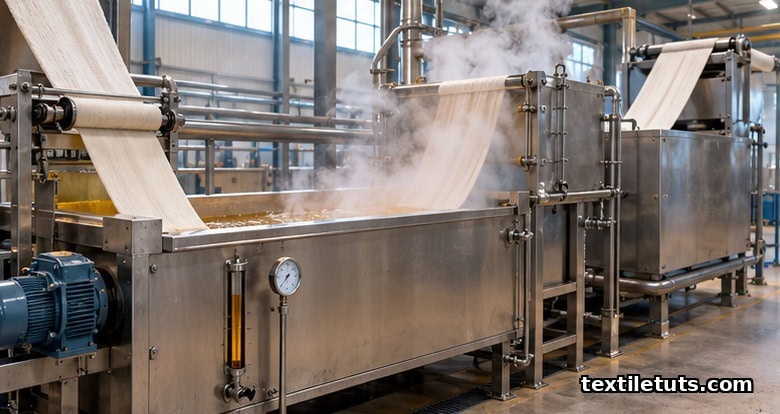
AATCC Test Method 97 quantifies the result: a fabric scoured to commercial whiteness leaves less than 1.0% extractable matter, against 5–8% for greige cotton. ISO 105-C08 and ISO 105-C10 anchor the downstream wash-fastness tests that catch any residual surfactant that would otherwise cause foaming or spotting in the dye bath.
Environmental and Safety Considerations
Alkylphenol ethoxylates (APEOs, including nonylphenol ethoxylates) have been the industry standard for decades but are now restricted under EU REACH and several buyer RSLs because their breakdown products are persistent and endocrine-active. Most mills have switched to fatty-alcohol ethoxylates (FAE or AEO), which degrade faster under OECD 301B conditions and do not carry the same xeno-estrogen concern.
Effluent guidelines also limit total surfactant discharge: the OECD 301B reference requires 60% CO₂ evolution within 28 days, and many mills target 80%+ to stay comfortably below their permitted load. Effluent with high surfactant content also demands dissolved-air flotation (DAF) before biological treatment, because residual surfactants strip oxygen from activated-sludge basins.
Frequently Asked Questions
What is the role of a surfactant in textile scouring?
A surfactant in scouring reduces the bath’s surface tension from ~72 mN/m to 25–40 mN/m and adsorbs at the fiber-water interface, allowing water and alkali to penetrate the hydrophobic wax layer on raw cotton. The same molecule then emulsifies the lifted waxes and oils into the bath and disperses them so they do not redeposit on the fabric before rinsing.
Which surfactant class is most commonly used in cotton scouring?
Anionic surfactants, chiefly linear alkylbenzene sulfonate (LAS), sodium dodecyl sulfate (SDS), and sodium salts of fatty acids, dominate cotton scouring recipes because they cost the least per kilogram and deliver strong wetting on cellulosics in the pH 9–11 range. Nonionic alcohol ethoxylates (AEO-9 and similar) are the second-most-common choice when hard water or low foam is a constraint.
How much surfactant should be used in a scouring bath?
Exhaust scouring baths typically dose 1–3 g/L of anionic surfactant or 0.5–1.5 g/L of nonionic surfactant, equivalent to 0.5–1.5% on weight of fiber at an 8:1 to 12:1 liquor ratio. Continuous ranges run hotter and shorter, and may push surfactant concentration to 3 g/L to keep AATCC 79 wetting time under 5 seconds at the available dwell.
Are alkylphenol ethoxylates still used in scouring?
Alkylphenol ethoxylates (APEOs) including nonylphenol ethoxylates are largely withdrawn from modern scouring recipes in Europe, North America, and most export-oriented Bangladesh mills because their degradation products are persistent and endocrine-active. The replacements are fatty-alcohol ethoxylates (AEO), which clear OECD 301B at 80–95% in 28 days and are accepted under current ZDHC and buyer RSL limits.
How do you test whether a scouring bath has worked?
Three tests cover most cases: AATCC 79 for wetting time (under 5 s on bleached cotton, under 15 s on greige), AATCC 97 for extractable matter (under 1.0% on commercial scoured cotton), and ISO 105-C08 or AATCC 135 for downstream dimensional and wash-fastness behaviour. A pass on all three is the standard mill release criterion before the fabric moves to bleaching or dyeing.
References
- ISO. ISO 105-C08:2010 — Textiles — Tests for colour fastness — Part C08: Colour fastness to domestic and commercial laundering using a non-phosphate reference detergent incorporating a low-temperature bleach activator. iso.org — washing-fastness method that catches residual surfactant defects in scoured fabric.
- ISO. ISO 105-C10:2006 — Textiles — Tests for colour fastness — Part C10: Colour fastness to washing with soap or soap and soda. iso.org — soap-scouring method used in many buyer specifications for pretreatment verification.
- AATCC. AATCC Test Method 79-2014 — Absorbency of Bleached Textiles. aatcc.org — wetting-time test that defines whether scouring has removed the hydrophobic wax layer.
- AATCC. AATCC Test Method 97-2019 — Extractable Content of Greige and/or Prepared Textiles. aatcc.org — extractable-matter method that quantifies residual wax, pectin, and oil after scouring.
- Sharma, R., & Singh, R. (2014). Surfactants in textile processing. Journal of Textile and Apparel, Technology and Management, 9(2). researchgate.net — peer-reviewed review of anionic, nonionic, cationic, and amphoteric surfactant classes in wet processing.
- OECD. OECD Guideline for the Testing of Chemicals No. 301B — Ready Biodegradability: CO₂ Evolution (Modified Sturm Test). oecd.org — the 28-day biodegradability reference most mill RSLs cite for surfactant effluent targets.
- Holmberg, K., Jönsson, B., Kronberg, B., & Lindman, B. Surfactants and Polymers in Aqueous Solution. Wiley — textbook reference for HLB, CMC, and micelle chemistry underpinning surfactant selection.
This article is the working reference for surfactant selection in textile scouring. Editorial by Shahrukh Islam, TextileTuts. Sources: ISO 105-C08, ISO 105-C10, AATCC 79, AATCC 97, Sharma & Singh (2014), OECD 301B, and Holmberg et al. as cited.


