
Scouring of Cotton: Kier Scouring

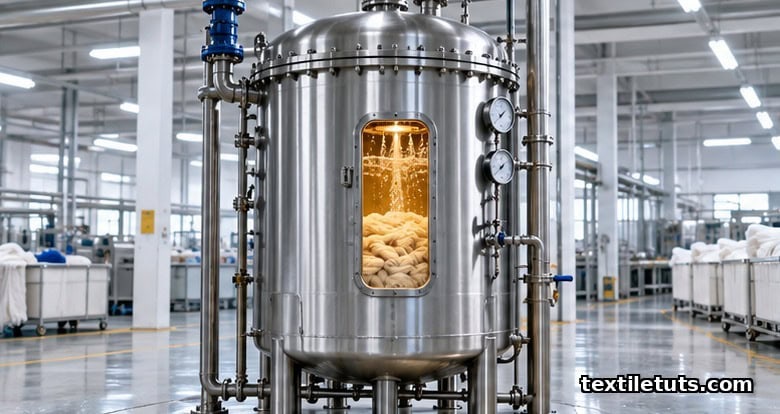
Kier scouring is a batch pretreatment process for cotton that removes 4-8% of the fiber’s dry mass as pectins, waxes, proteins, oils, and motes by boiling the fabric or yarn in 2-4% sodium hydroxide solution at 100-130 °C for 6-12 hours, producing a permanently hydrophilic substrate ready for bleaching, dyeing, or printing. The kier itself is a closed pressure vessel, usually vertical, that holds the textile in rope or bale form while alkali liquor circulates through the load.
Without scouring, raw cotton is hydrophobic: a water droplet sits on greige fabric for minutes rather than seconds, because the cuticle wax layer and pectin matrix on the primary cell wall block liquid uptake. Kier scouring hydrolyzes that pectin, saponifies the wax, and lifts the non-cellulosic load out of the fiber, after which the same fabric wets out in under one second.
This article covers the chemistry, machinery, process parameters, and quality control behind kier scouring, plus the practical differences between atmospheric and pressure kiers, the additives that make the boil work, and the limits you hit when you try to cut cycle time.
Why Raw Cotton Needs Scouring Before Bleaching or Dyeing
Raw cotton fiber is not pure cellulose. A typical mature upland cotton fiber (Gossypium hirsutum) contains 88-95% cellulose on a dry-weight basis; the remaining 5-12% is a mixture of non-cellulosic substances that textile chemists call “impurities” or “incrustations.” These substances sit on the outer cuticle and between the fibrils of the secondary cell wall, and they directly block water and dye from reaching the cellulose backbone.
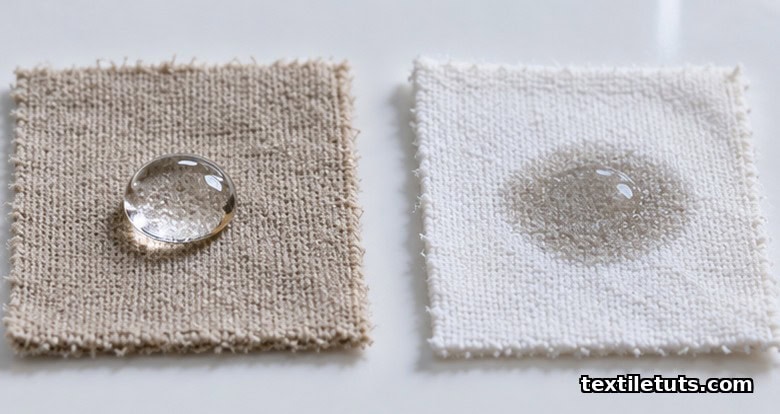
The largest fraction is pectin (0.7-1.2% by mass), followed by waxes (0.4-1.0%), proteins (1.0-1.5%), organic acids, sugars, and mineral salts. There are also “motes,” immature or dead seeds caught in the ginned lint, plus residual spinning oils and sizing from the yarn-preparation stage. The combined hydrophobic layer is what makes greige cotton shed water like a raincoat.
Kier scouring targets this layer with hot alkali. Sodium hydroxide at 2-4% on weight of fabric (owf), with a wetting agent, hydrolyzes pectin to soluble pectates, saponifies triglycerides to glycerol and fatty-acid soaps, and dissolves proteins and amino acids into the liquor. The result is a fiber that absorbs water instantly, takes up dye uniformly, and bleaches evenly in the next step.
The weight loss you measure after scouring is your direct quality control: a well-scoured greige cotton will lose between 4% and 8% of its dry weight, and anything outside that range usually means the scour was too short (residual impurities, poor wettability) or too aggressive (excessive cellulose damage, low tensile retention).
How a Kier Works: Vessel Design and Liquor Circulation
A kier is a cylindrical pressure vessel built to withstand internal steam pressure and the corrosive action of hot caustic. Modern kiers are vertical, with capacities from 1,000 kg to 5,000 kg of fabric per batch. The vessel has a domed top and a false bottom that holds the textile load while letting liquor drain through.
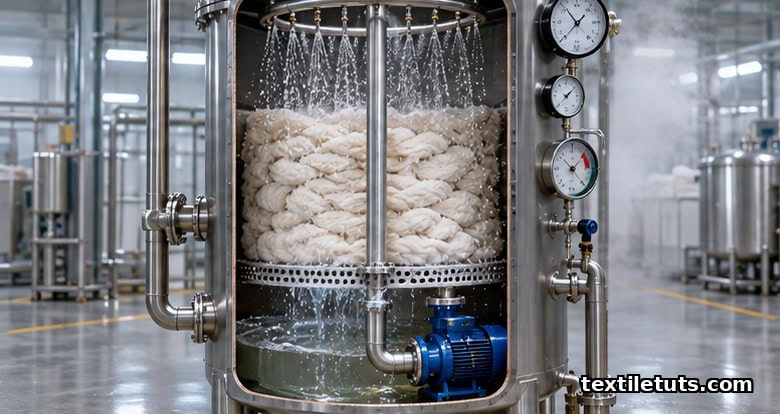
Liquor circulation is the heart of the design. A pump pulls caustic solution from the bottom of the kier and pushes it back over the top of the load through a spray ring or distribution plate. This forced circulation is what gets fresh alkali into the center of a packed rope or bale, where static soaking would leave an unscoured core. Typical flow rates on industrial kiers run 4-6 liquor exchanges per hour, meaning the entire bath volume cycles through the fabric 4-6 times every hour of the boil.
There are two broad types. The atmospheric kier runs at 100-105 °C under normal boiling conditions, takes longer (8-12 hours), and uses more alkali to compensate for the lower reaction rate. The pressure kier runs at 120-130 °C under 1.5-2.5 bar steam pressure, cuts the cycle to 4-6 hours, and uses a tighter chemical formula because temperature is doing more of the work. Pressure kiers are now standard in modern mills; atmospheric kiers survive mainly in older factories and in some yarn-hank scouring operations.
Process Recipe: Chemicals, Temperatures, and Time
A standard pressure-kier scouring recipe for cotton woven fabric looks like this:
- Sodium hydroxide (NaOH, solid or 50% liquor): 2.5-4.0% on weight of fabric (owf), supplying roughly 8-12 g/L of active alkali in a 1:4 liquor ratio.
- Wetting agent (non-ionic or anionic surfactant): 0.5-1.0% owf. The surfactant lowers the surface tension of the bath so the alkali can wet out hydrophobic greige cotton within the first 10-15 minutes; without it, the bath beads on the surface and the core stays dry.
- Sequestering agent (EDTA, DTPA, or polyphosphate): 0.2-0.5% owf, to bind calcium and magnesium ions from the cotton and from process water. Hard-water salts otherwise form insoluble hydroxides that deposit as a gray scale on the fabric.
- Optional reducing agent: 0.1-0.3% owf sodium sulfite or hydrosulfite, used when the cotton has heavy seed-coat fragments that are dark and resistant.
The temperature ramp matters. Cotton is loaded into the kier at 40-50 °C, the bath is set with alkali and auxiliaries, and the temperature is raised to the boil at 1-2 °C per minute. A typical ramp-up takes 30-45 minutes; if it is too fast, the outer layers of the load over-scour while the inner layers have not yet seen the boil. Once at 120-130 °C, the boil is held for 3-5 hours under pressure, then cooled to 80 °C before the kier is dropped. Cooling under pressure keeps the fabric from creasing and avoids a thermal shock that could distort fiber structure.
The liquor-to-material ratio (L:R) is normally 1:3 to 1:5 by mass. Lower liquor ratios save water and energy but make circulation harder; ratios above 1:5 dilute the alkali and slow the reaction. Most mills target 1:3.5 to 1:4 as the practical compromise.
What Scouring Does to the Fiber: Chemistry in Plain Terms
Three chemical reactions do the actual cleaning, and they all run simultaneously during the boil:
Saponification of wax and oil. Triglycerides in cotton wax and any residual spinning oil react with sodium hydroxide to form glycerol and the sodium salts of long-chain fatty acids. Those sodium salts are water-soluble soaps that dissolve into the bath. A saponification number of 180-210 mg KOH/g is typical for raw cotton wax.
Hydrolysis of pectin. Pectin in cotton is primarily polygalacturonic acid with methyl ester groups. Hot alkali de-esterifies the methyl groups and cleaves the glycosidic bonds, releasing polygalacturonate chains that dissolve as sodium pectate. Pectin hydrolysis is the rate-limiting step of scouring; below 90 °C it barely runs.
Protein and amino-acid dissolution. Cotton proteins contain peptide bonds that alkali cleaves through beta-elimination, releasing amino acids and small peptides that stay in solution. This contributes the nitrogen measured in a Kjeldahl test of scouring effluent.
Cellulose itself is chemically resistant to dilute caustic below 130 °C, but it does swell. Mercerization-grade NaOH is 18-25%, far higher than scouring, so the modest 2-4% concentration used here produces swelling without conversion to alkali cellulose. The fiber becomes rounder in cross-section, the lumen collapses, and the surface becomes rougher at the microfibril scale. That rougher, more open structure is what traps dye molecules in the next step.
Quality Control: How to Know the Scour Worked
Three quick tests tell you whether kier scouring delivered the substrate you need.
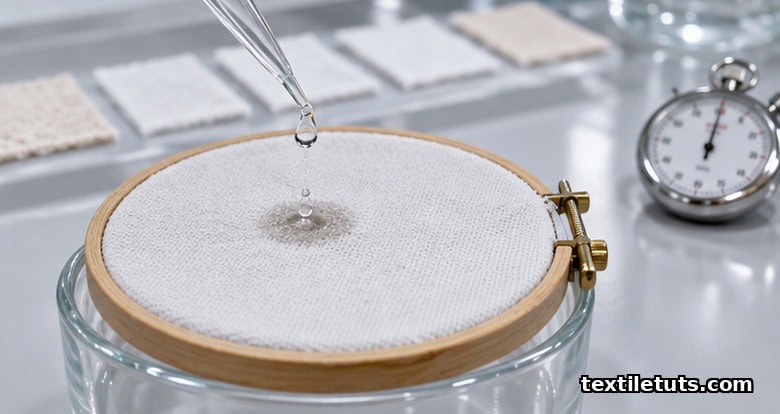
Wettability (drop test or sink test). AATCC Test Method 79 places a fixed volume of water on the fabric and times how long it takes to disappear. A well-scoured cotton absorbs the drop in under 1 second; a poorly scoured sample holds the drop for 30 seconds or more. The AATCC sink test inverts the question by timing how long a fabric strip takes to sink when laid gently on water; under 10 seconds is the typical plant target.
Weight loss. Weighing the fabric before and after scouring on a conditioned basis (ISO 139, 20 °C / 65% RH) gives the direct measure of impurity removal. A 4-8% drop is the healthy operating window. Anything below 4% means the scour was under-dosed or under-cooked; anything above 8% means cellulose degradation is starting to chew into tensile strength.
Tensile strength retention. ASTM D5034 or ISO 13934-1 strip tensile tests on scoured vs. unscoured fabric should show less than 10% loss. A scour that costs more than 10% of warp or weft tensile strength is over-scouring and will produce shade variation and pill-prone surfaces downstream.
Residual wax and pectin. Soxhlet extraction with ethanol-toluene measures residual wax; a well-scoured cotton shows under 0.2% extractable wax. Pectin can be quantified by the m-hydroxydiphenyl colorimetric method at 525 nm after carbazole extraction; the target is a 70-85% reduction from the greige value.
Kier Scouring vs. Continuous Scouring: When Batch Still Wins
Continuous scouring, using a J-box or pad-steam range, runs at 30-90 meters per minute and dominates woven cotton processing for high-volume orders. But kier scouring still has three strongholds:
Yarn in hank form. Loose yarn cannot be padded and steamed without tangling, so it is hung on carriers and scoured in atmospheric kiers. Carpet yarn, knitting yarn, and dyed-yarn packages all rely on kier-type batch equipment.
Heavy and dense fabrics. Denim, canvas, and industrial cotton fabrics are too heavy for continuous J-box penetration in a reasonable dwell time; pressure kiers scour them more uniformly.
Small lots and short runs. A 600-piece dye lot of specialty cotton can be processed in a kier without tying up a continuous range for several hours. Make-to-order mills run kiers for this reason alone.
The trade-off is cycle time and labor. A kier batch takes 8-12 hours total (load, ramp, boil, cool, drop, wash) versus 2-4 hours on a continuous line. Energy per kilogram of fabric also runs 15-25% higher in the kier because of the higher liquor ratio and longer boil. Where the fabric permits continuous processing, the line wins on cost; where the format demands it, the kier remains the right tool.
Effluent and Environmental Considerations
Kier scouring effluent is one of the most contaminated streams in a textile mill. A typical cotton kier discharges liquor with pH 12-14, a chemical oxygen demand (COD) of 8,000-15,000 mg/L, and a total suspended solids of 200-500 mg/L, dominated by dissolved pectinates, proteins, and fatty-acid soaps.
Modern mills neutralize the spent liquor with sulfuric acid or with flue-gas CO2 before biological treatment, recover the fatty acids as a saleable by-product in some facilities, and reuse the wash water in the next kier fill after filtration. Closed-loop kier systems that recycle 60-80% of the process water are commercially available and are increasingly mandated by buyer compliance programs.
For mills without on-site effluent treatment, kier scouring liquor must be sent to a central treatment plant at controlled pH, since untreated alkali discharge kills the biological activity of an activated-sludge system within hours.
Frequently Asked Questions
What is the difference between kier scouring and kier bleaching?
Kier scouring is the alkali boil that removes pectins, waxes, and proteins using 2-4% NaOH at 100-130 °C. Kier bleaching is a separate subsequent step that uses hydrogen peroxide (or, historically, sodium hypochlorite) to destroy the natural pigments in cotton. The two are often run in the same kier in a combined scour-bleach recipe, but the chemistry is sequential: scouring first to open up the fiber, then bleaching to whiten it.
Can kier scouring damage cotton fabric?
Yes, if the alkali concentration exceeds 5% owf, the boil temperature goes above 140 °C, or the dwell time extends past 8 hours at full temperature. Over-scouring shows up as excessive weight loss (above 8%), tensile-strength loss above 10%, a harsh yellowed hand, and uneven dye uptake. The safe operating window is 2-4% NaOH, 120-130 °C, and 3-5 hours under pressure.
Why does scoured cotton absorb water so much faster than greige cotton?
Raw cotton has a waxy outer cuticle and a pectin matrix that make the surface hydrophobic. Hot alkali saponifies the wax and hydrolyzes the pectin, removing the hydrophobic layer and exposing the hydroxyl groups of cellulose. Water, which is also polar, then wets the surface instantly; a water droplet disappears in under one second on well-scoured cotton, versus 30 seconds or longer on greige.
Is kier scouring still used in modern mills?
Yes, although continuous pad-steam ranges dominate high-volume woven fabric scouring, kier scouring remains standard for yarn in hank form, heavy fabrics like denim and canvas, and small lots that cannot justify tying up a continuous line. Modern pressure kiers with forced liquor circulation run shorter cycles than the atmospheric kiers of the mid-20th century and still produce the most uniformly scoured substrate for downstream bleaching and dyeing.
What is the role of a wetting agent in kier scouring?
A non-ionic or anionic surfactant at 0.5-1.0% on weight of fabric lowers the surface tension of the alkali bath so it can penetrate the hydrophobic greige cotton within the first 10-15 minutes of the boil. Without a wetting agent, the caustic beads on the surface, the core stays dry, and the load comes out with an unscoured center. Wetting agents also help emulsify the wax and oils as they are saponified, keeping the bath from re-depositing contaminants on the fabric.
References
- American Association of Textile Chemists and Colorists. AATCC Test Method 79: Absorbency of Textiles. AATCC Technical Manual, current edition.
- ASTM International. ASTM D5034-21: Standard Test Method for Breaking Strength and Elongation of Textile Fabrics (Grab Test). ASTM Standards, 2021.
- International Organization for Standardization. ISO 139: Textiles – Standard atmospheres for conditioning and testing. ISO, Geneva.
- International Organization for Standardization. ISO 13934-1: Textiles – Tensile properties of fabrics – Part 1: Determination of maximum force using the strip method. ISO, Geneva.
- Lewin, M., and Sello, S. B. (Editors). Handbook of Fiber Science and Technology: Volume II – Chemical Processing of Fibers and Fabrics – Fundamentals and Preparation. Marcel Dekker, 1984.
- Marmol, G., et al. “Chemical and Physical Aspects of Cotton Scouring.” Cellulose (Springer), 2018.
- Hashem, M., et al. “Optimization of Cotton Scouring Process using Response Surface Methodology.” Egyptian Journal of Chemistry, 2020.
This article is the working reference for kier scouring of cotton. Editorial by Shahrukh Islam, TextileTuts. Sources: AATCC TM 79, ASTM D5034, ISO 139, ISO 13934-1, Lewin & Sello Handbook, Marmol et al. 2018, Hashem et al. 2020 as cited.


