
Preparation of Silk: Degumming

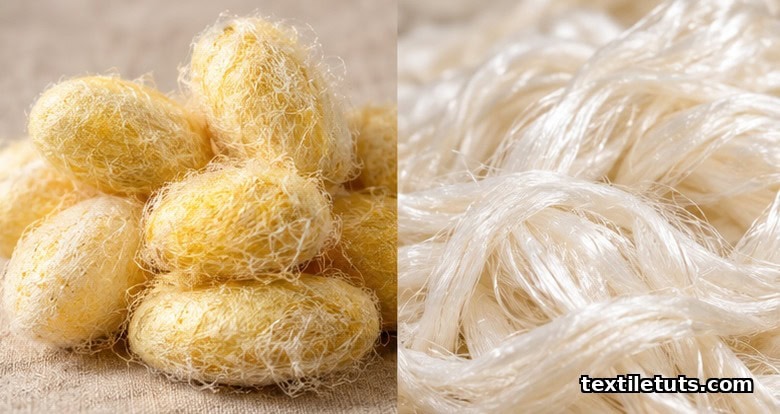
Silk degumming removes 20 to 30 percent of the fiber’s weight as sericin, the natural protein gum that coats raw silk fibroin, and is performed at 85 to 95 degrees Celsius in a mildly alkaline bath (pH 9 to 11) for 30 to 90 minutes using either soap and sodium carbonate or an alkaline protease enzyme. The controlled removal of sericin is the single most important wet-processing step in silk manufacturing, because it converts the dull, stiff, yellowish raw silk (called “grege” or “padda silk”) into the soft, lustrous, white, dye-receptive fibroin yarn or fabric that defines commercial silk quality.
This article walks through what degumming actually removes from the fiber, the three industrial methods (soap-alkali, enzymatic, and acid), the process parameters that control sericin removal, and the downstream effects on handle, luster, and dye uptake. You will also see why under-degumming leaves silk harsh and patchy, and why over-degumming destroys tensile strength, so the process is a balancing act textile engineers tune on every batch.
What Silk Degumming Removes: Sericin and Its Role
Raw silk is a composite of two proteins secreted by the silkworm (Bombyx mori) when it spins its cocoon. The inner core is fibroin, the structural protein that gives silk its strength and luster, and the outer coating is sericin, a globular protein that cements the two fibroin filaments (brins) together into the single cocoon thread. In raw silk yarn as it leaves the reeling machine, sericin typically accounts for 20 to 30 percent of the total weight, depending on silkworm variety, rearing conditions, and whether the silk is mulberry or wild (tasar, muga, or eri) silk.
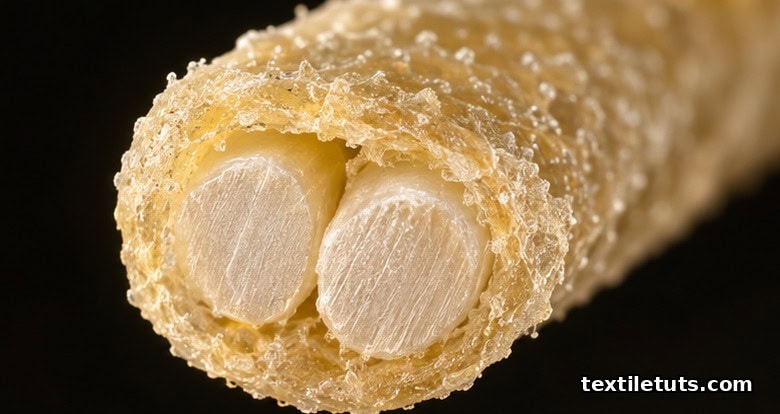
Sericin is hot-water-soluble above about 85 degrees Celsius and is readily hydrolyzed by alkali and by proteolytic enzymes, which is exactly why silk processors exploit these weaknesses to remove it. The fibroin underneath is far more resistant and survives the same treatment largely intact, provided the bath is not pushed too high in pH or temperature. The result is a 20 to 30 percent mass loss, a transition from dull yellow to creamy white, and a dramatic change in hand feel from boardy and crisp to soft and fluid.
The Three Industrial Degumming Methods
Three families of process dominate the world’s silk-finishing industry today. Each operates on the same chemistry (sericin hydrolysis) but with very different control, ecology, and equipment profiles.
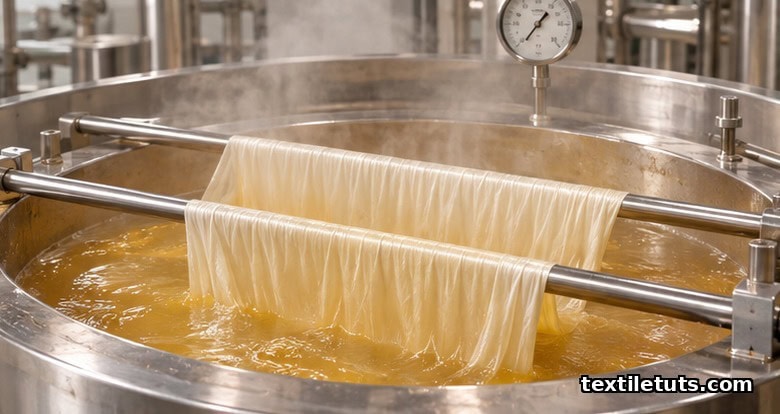
1. Soap-alkali degumming (Marseille-soap process). The traditional and still widely used method. A bath of 5 to 10 grams per liter of olive-oil-based soap (historically Marseille soap) plus 1 to 3 grams per liter of sodium carbonate (soda ash) is heated to 90 to 95 degrees Celsius and the silk is treated for 30 to 90 minutes. The alkali swells and partially hydrolyzes the sericin; the soap emulsifies the freed protein and prevents it from redepositing on the fiber. A second rinse bath at the same temperature with reduced soap completes the process. Total sericin removal is typically 22 to 28 percent by weight on mulberry silk.
2. Enzymatic degumming. A modern, lower-temperature alternative using alkaline proteases such as alcalase, savinase, or trypsin at 0.5 to 2 percent on weight of fabric, at pH 8 to 10 and 50 to 60 degrees Celsius, for 30 to 60 minutes. The enzyme cleaves sericin’s peptide bonds selectively, leaving fibroin largely untouched. Enzyme baths run much cooler than soap baths, save energy, and discharge far less chemical oxygen demand in the effluent, although residual enzyme cost is higher per batch.
3. Acid degumming and specialty methods. Less common but used for specific end uses. Dilute mineral acid (sulfuric or hydrochloric acid at pH 1.5 to 2.5) at 90 to 95 degrees Celsius can remove sericin, but acid hydrolysis is less selective than alkali and tends to damage fibroin if pushed. Acid degumming is reserved for very specific hand-feel targets and for some wild silk varieties. Boiling-water-only (“degumming by extraction”) is also practiced for the highest-quality crepe silks, where minimal fiber damage is desired.
Process Parameters That Control the Result
Degumming is governed by four variables: temperature, pH, time, and mechanical action. Push any one of them too hard and the result shifts from “clean fibroin” to “weakened fibroin.”
- Temperature: Below 80 degrees Celsius, sericin removal is incomplete even after long baths. The standard industrial window is 90 to 95 degrees Celsius. Above 98 degrees Celsius, fibroin itself begins to hydrolyze and the silk loses tensile strength rapidly.
- pH: Alkaline conditions (pH 9 to 11) are the most efficient. Below pH 7 the bath is too slow; above pH 11 the silk yellows and the fibroin surface is etched, dulling the luster.
- Time: 30 to 90 minutes is typical. Longer baths give no additional sericin removal once the gum layer is gone and instead begin to attack the fibroin.
- Mechanical action: Agitation must be gentle. Excessive stirring causes chafing between filaments, leading to surface fibrillation and a hazy, “frosted” appearance called chafing damage.
For high-quality mulberry silk woven fabrics, the conventional target is 23 to 25 percent weight loss in the bath, which correlates with residual sericin on the fiber of 1 to 2 percent. This residual level gives the silk a soft hand while keeping enough surface protein to protect the yarn during subsequent dyeing and finishing.
Why Degumming Changes Handle, Luster, and Dye Uptake
The same reaction that strips off sericin also transforms the way the silk behaves. Degummed silk reflects light more uniformly because the smooth fibroin filaments are no longer coated in rough, opaque sericin, so the characteristic silk luster increases by 30 to 50 percent in photometric measurements compared to grege silk. Handle softens dramatically: grege silk has a bending rigidity around three times higher than fully degummed silk, which is why raw silk feels like coarse paper and finished silk feels like liquid.
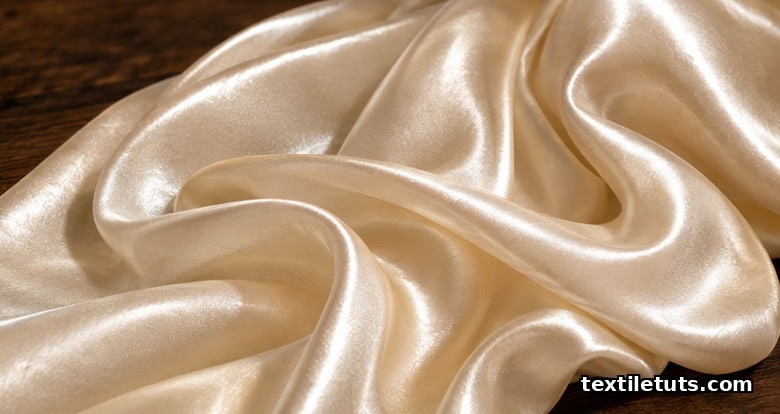
Degumming is also the prerequisite for level dyeing. Sericin contains very few of the amine and carboxyl groups that acid and reactive dyes bond to, so a grege silk absorbs dye poorly and unevenly. Once sericin is removed, the fibroin’s lysine and arginine residues are exposed, and acid dyes exhaust rapidly and evenly onto the fiber. This is why degumming always precedes dyeing in any silk-finishing sequence, and why partially degummed silk shows the patchy, skittery dyeings textile dyers call “unlevel uptake.”
Standard Test Methods Used to Verify Degumming
Processers use standardized tests to confirm that degumming has gone far enough but not too far. The most common are:
- ISO 15625: describes test methods for silk fibroin content, including a controlled alkali boil-off that defines the “true fibroin” mass against which the degummed sample is compared.
- AATCC TM28: covers insect-resist treatments but is widely cited alongside ISO silk methods for related finish testing.
- Weight-loss method: the simplest shop-floor check: weigh the silk before and after degumming, and target 22 to 28 percent loss on mulberry silk. Any deviation outside this band flags either under- or over-degumming.
- Staining test with picric acid / C.I. Acid Black 24: a qualitative method where dyed sericin appears dark against light fibroin under a microscope, used to confirm whether sericin still clings to the surface.
A mill running a quality-management program (such as ISO 9001 or OEKO-TEX certified production) will record weight loss, residual sericin, pH of the spent bath, and tensile strength of the degummed silk on every batch. A tensile-strength drop of more than 5 to 8 percent from the grege baseline is a strong signal of over-degumming.
Environmental and Operational Notes
Soap-alkali degumming effluent carries a high chemical oxygen demand (often 8,000 to 15,000 mg/L), because the dissolved sericin and soap both consume oxygen in the wastewater plant. Enzymatic processes discharge far less (typically 2,000 to 4,000 mg/L) but generate a separate enzyme-handling burden. Modern mills recover heat from the spent bath through heat exchangers and frequently reuse the rinse water for the next bath, a technique called counter-current rinsing that can reduce both water and energy consumption by 30 to 50 percent versus single-pass setups.
Frequently Asked Questions
What percentage of silk weight is removed during degumming?
On mulberry (Bombyx mori) silk, standard degumming removes 22 to 28 percent of the grege weight as sericin. Wild silks such as tasar and eri contain more sericin and may lose 30 to 35 percent. Residual sericin on a fully degummed mulberry silk should be 1 to 2 percent by weight.
Can silk be degummed at home?
Yes, with caution. A bath of 5 g/L neutral soap plus 1 g/L baking soda (sodium bicarbonate) at 85 to 90 degrees Celsius for 30 minutes will remove most sericin from a small quantity of silk fabric. Use a stainless-steel or enamel pot (no aluminum, which the alkali will attack), stir gently, rinse twice in warm water, and dry flat. Do not boil the silk or leave it unattended, because over-degumming destroys the fiber’s strength within minutes.
Does enzymatic degumming damage silk?
Alkaline proteases are highly selective for sericin and leave fibroin largely intact when run at the recommended pH (8 to 10) and temperature (50 to 60 degrees Celsius). Tensile-strength loss is typically under 3 percent, compared to 5 to 10 percent for soap-alkali. The main risk is using too much enzyme or running too long, which starts to digest the fibroin surface and produces a thin, papery handle.
Why is degummed silk more lustrous than raw silk?
Raw silk is coated in rough, light-scattering sericin. Once that layer is removed, the smooth triangular cross-section of the fibroin filaments reflects light specularly, producing the characteristic silk shine. Photometric measurements show 30 to 50 percent higher luster on fully degummed silk compared to grege silk of the same yarn count.
What happens if silk is under-degummed?
Under-degummed silk retains patches of sericin, which dye up at a different rate than the surrounding fibroin and produce skittery, uneven color. The fabric also feels stiff and boardy, has a dull surface, and may turn yellow in storage as the residual sericin oxidizes. Standard fix is to re-degum in a fresh soap-alkali bath for an additional 20 to 30 minutes, then rinse and re-dye.
References
- International Organization for Standardization. ISO 15625:2014 — Silk — Determination of fibroin content. iso.org. Standardized alkali boil-off method that defines true fibroin mass for silk quality control.
- American Association of Textile Chemists and Colorists. AATCC Test Method 28 (TM28) — Insect Resistance. aatcc.org. Cited in mill process-control records alongside ISO silk methods.
- Padmavathi, V. & Santhosh, R. (2020). Degumming of silk: a review. Journal of Textile Engineering & Fashion Technology, ResearchGate. Peer-reviewed overview of soap-alkali, enzymatic, and acid degumming methods.
- Arami, M., Rahimi, S., Mivehie, L., Mazaheri, F., & Mahmoodi, N. M. (2007). Degumming of Persian silk with mixed proteolytic enzymes. Journal of Applied Polymer Science, Wiley. Original study on alcalase / savinase enzyme performance versus soap-alkali.
- Freddi, G., Mossotti, R., & Innocenti, R. (2003). Degumming of silk fabric with several proteases. Journal of Biotechnology, Elsevier / ScienceDirect. SEM and tensile data on fibroin preservation under enzymatic conditions.
- Kundu, S. C., et al. (2008). Sericin: a versatile protein and its industrial applications. ScienceDirect (Advances in Polymer Science). Comprehensive review of sericin chemistry, solubility, and recovery options.
This article is the working reference for silk degumming as a textile wet-processing operation. Editorial by Shahrukh Islam, TextileTuts. Sources: ISO 15625, AATCC TM28, Padmavathi & Santhosh (ResearchGate), Arami et al. (Wiley), Freddi et al. (ScienceDirect), and Kundu et al. (ScienceDirect) as cited.


