
Continuous Pretreatment Process

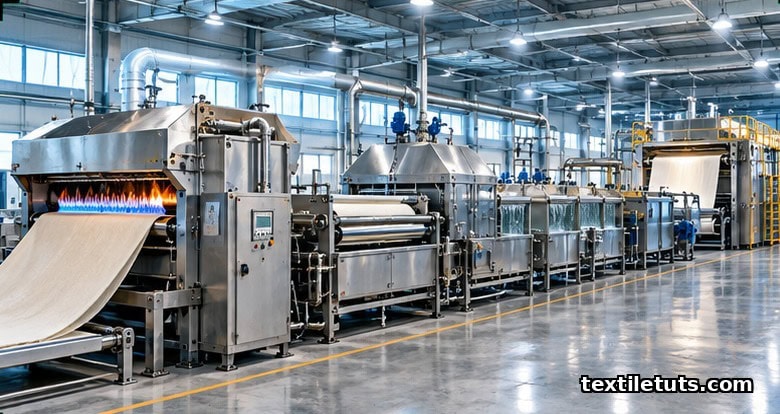
A continuous pretreatment process combines singeing, desizing, scouring, and bleaching on open-width ranges operating at fabric speeds of 60–120 m/min, and a 100% cotton woven fabric that exits a properly tuned line reaches a CIE whiteness index of 78–82 with residual size below 1% and a water drop absorbency time under 2 seconds. Modern ranges pair this with cold-pad-batch bleaching or peroxide-steam bleaching, allowing a mill to treat 8–12 tonnes of greige fabric per hour with water consumption as low as 25–35 L per kg of fabric. This guide walks through each stage, the chemistry and temperatures that govern it, the machines that make continuous operation possible, and the quality checks textile engineers use to verify that the prepared fabric is ready for dyeing.
What Continuous Pretreatment Means in a Textile Mill
Continuous pretreatment is a fabric-preparation sequence in which greige (loom-state) fabric moves, end to end, through a series of wet and dry stations without stopping between stages. A typical line starts with singeing, then desizing, scouring, and bleaching, and finishes with washing, neutralizing, and drying. The fabric is held at open width by roller frames, and each treatment zone is followed by a steamer or hot-water wash that drives the chemistry forward.
The continuous format differs from batch (exhaustion) preparation in two important ways. First, the contact time per stage is short, usually 20–90 seconds of impregnation plus 30–120 seconds of steaming, so reactions must be accelerated by temperature and catalysis rather than by long liquor contact. Second, water and chemicals flow in a counter-current pattern, with the cleanest water entering the final wash and the dirtiest water leaving after the scouring zone. This both saves water and prevents redeposition of impurities onto the fabric.
Continuous pretreatment is most often used for woven cotton, polyester/cotton blends, and similar cellulosic-rich fabrics. Knitted fabrics, very heavyweight fabrics, and small-lot specialty orders are usually prepared in batch jets or winches because their geometry does not feed smoothly through open-width machinery.
Stage 1: Singeing
Singeing burns off the surface fuzz and protruding fiber ends that would otherwise show up as a milky or pilled face on the finished fabric. The fabric passes over a gas flame or a heated copper plate at a controlled speed, and the loose fibers singe off while the body of the yarn stays cool enough to retain its strength.
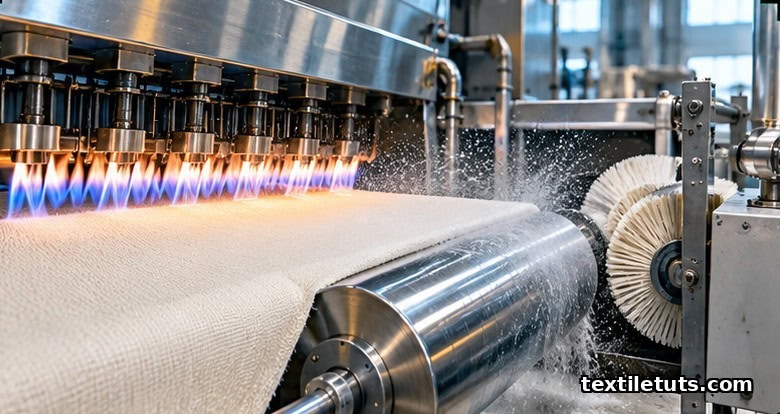
On a gas singeing machine, burners typically run with a flame temperature of 1200–1400 °C and fabric speeds of 80–150 m/min for lightweight cotton fabrics and 60–100 m/min for heavier constructions. The fabric spends only 0.5–1.5 seconds in direct contact with the flame, but the heat must be intense enough to combust fiber ends 1–3 mm long without scorching the yarn itself. Modern singeing ranges pair the burner with a water-cooled roller just past the flame to quench residual heat instantly. After singeing, the fabric passes over a rotary brush that removes the ash before wet processing begins.
A practical quality check is the visual rating of the singed surface under standard lighting. AATCC TM 124 describes the smoothness appearance of fabrics after repeated home-laundering, and it is often used as a comparative reference even for greige samples, but for singeing itself the direct measure is absence of protruding fibers when viewed under magnification.
Stage 2: Desizing
Desizing removes the size film that the weaver applied to the warp yarns to protect them from abrasion during weaving. The most common size on cotton is starch or modified starch, applied at 8–15% on warp weight, while polyester/cotton blends often carry polyvinyl alcohol (PVA) or polyacrylate sizes. Residual size on the fabric must drop below 1% (often expressed as a Tegewa drop test rating of 8–9) before the fabric can absorb liquor evenly in scouring and bleaching.
Continuous desizing on a pad-steam range uses an enzymatic amylase at 60–70 °C and pH 6–7, with a dwell time of 10–20 minutes in a steamer. The enzyme hydrolyzes the starch chains into water-soluble sugars, and the following wash box rinses them out. For PVA and polyacrylate sizes, which enzymes do not attack, oxidative desizing with sodium persulfate (5–10 g/L) or hydrogen peroxide (3–5 g/L) at 90–100 °C is preferred. A modern combined system adds both an amylase and a persulfate to the pad bath so a mill can handle mixed-size recipes without changing tanks.
Stage 3: Scouring
Scouring removes the natural hydrophobic impurities of cotton: waxes, pectins, proteins, and seed-coat fragments. Without scouring, these impurities would resist wetting, interfere with bleach penetration, and give the finished fabric a harsh hand. A continuous scouring pad bath typically contains sodium hydroxide (NaOH) at 30–60 g/L for cotton, an anionic or non-ionic wetting agent at 1–3 g/L, and a sequestering agent at 0.5–2 g/L to bind calcium and magnesium that would otherwise precipitate the alkali as scale on the rollers.
The impregnated fabric enters a roller steamer where it dwells for 60–90 minutes at 95–100 °C, although compact conveyor steamers can shorten this to 5–15 minutes when paired with higher NaOH concentrations and a wetting agent that wicks the liquor into the fiber bundle. After the steamer, a multi-stage counter-current wash box removes the hydrolyzed impurities and the alkali. Effective scouring drives the wax content below 0.2% on weight of fiber and produces a water drop absorbency time under 2 seconds when tested by AATCC TM 79.
Stage 4: Bleaching
Bleaching decolorizes the natural pigments left in the cotton fiber, mainly flavonoid-type compounds that survived scouring. Hydrogen peroxide (H₂O₂) is the dominant bleaching agent because it produces water and oxygen as byproducts rather than the absorbable chlorinated compounds associated with older hypochlorite systems. A standard continuous bleaching bath holds 3–5 g/L of H₂O₂ (35% active), 2–3 g/L of NaOH, 0.5–1.5 g/L of a silicate-based stabilizer, and 1–2 g/L of a wetting agent. The impregnated fabric enters a steamer at 95–100 °C and dwells for 60–90 minutes.
The bleaching reaction has to be controlled. Insufficient activator leaves the fabric yellow; too much alkali or too high a temperature causes oxidative damage to the cellulose chain, measured as a drop in degree of polymerization (DP). A safe operating target is a final DP of 1800–2200 for knit fabric and 2200–2800 for woven fabric, with copper number below 1.0 indicating limited over-oxidation. A combined scour-and-bleach stage is increasingly common: the same pad bath carries NaOH and H₂O₂ together, and a single steamer drives both reactions forward. This cuts water use and process time by roughly 30% compared with separate scouring and bleaching lines.
The bleached fabric leaves the range through a hot wash, an acid neutralization (usually acetic acid to bring pH from 10–11 down to 6–7), a final rinse, and a dryer set at 120–140 °C. CIE whiteness on the dried fabric should land between 78 and 82 for a fully prepared bleached cotton suitable for medium to dark shades, and above 85 for a fabric headed to a pastel or white end use.
Stage 5: Mercerizing (Optional but Common)
Mercerizing is a separate continuous stage that dips cotton fabric in concentrated NaOH (22–26% by weight) at 20–30 °C while the fabric is held under tension. The alkali causes the cotton fiber to swell, change its cross-section from kidney-shaped to round, and reorient the cellulose chains along the fiber axis. The visible effect is a brighter, more lustrous fabric that also takes up dye more readily, with dye uptake typically increasing by 25–40% on a mercerized substrate.
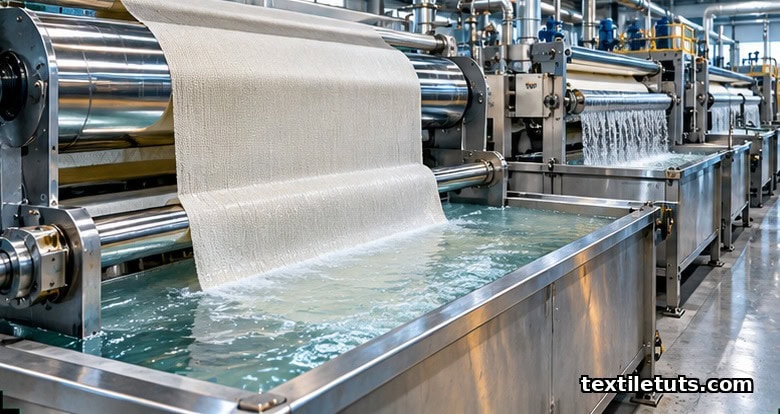
Continuous mercerizing ranges run the fabric through a pad bath of concentrated NaOH, a controlled residence section of 30–60 seconds, a tensioned washer that removes most of the alkali, an acid neutralizer (dilute sulfuric or acetic acid), and a final rinse. The fabric never dwells long enough to over-swell, and the tension prevents shrinkage that would otherwise distort the weave. Dimensional stability improves by 30–50% on a mercerized cotton compared with an untreated control, according to standard ASTM Dimensional Stability test methods.
Continuous Versus Batch Pretreatment: When to Choose Which
| Parameter | Continuous (open-width range) | Batch (jet / winch) |
|---|---|---|
| Typical lot size | 5,000–50,000 m | 500–5,000 m |
| Processing time | 15–45 minutes end-to-end | 4–8 hours per batch |
| Water use | 25–35 L per kg fabric | 60–120 L per kg fabric |
| Energy per kg fabric | 1.5–2.5 kg steam equivalent | 3.0–5.0 kg steam equivalent |
| Best suited to | Woven cotton and poly/cotton, large runs | Knits, small lots, specialty fibers |
| Process flexibility | Limited (each zone tuned to one recipe) | High (recipe changed between batches) |
| Consistency | High, especially across long runs | Variable between batches |
A mill should run continuous pretreatment when the lot is large enough to keep the range fed for at least 4–6 hours and the fabric geometry tolerates open-width handling. Batch processing wins for knits, very heavy fabrics, or short production runs of specialty fibers such as linen or ramie.
Quality Control After the Range
Three checks gate the fabric into the dyehouse:
- Absorbency: AATCC TM 79 water drop test must show a wetting time of 2 seconds or less on a scoured and bleached sample. A slow drop signals leftover wax or size.
- Whiteness: CIE whiteness on the spectrophotometer should meet the agreed shade minimum (typically 78 for medium shades, 85+ for whites).
- Chemical residue: pH of the hot-water extract should land between 6.0 and 7.5, and residual H₂O₂ should be below 50 mg/L before the fabric enters a dye bath. Reactive dyes in particular are sensitive to residual peroxide.
Physical tests complete the gate. Tensile strength (ASTM D5034) and tear strength (ASTM D1424) should remain within the construction’s tolerance, and a degree of polymerization test on the cellulose (using cupriethylenediamine viscosity or GPC) confirms that oxidative damage is within control limits.
Process Flow Reference
The following sequence represents a typical modern continuous pretreatment line for woven cotton.
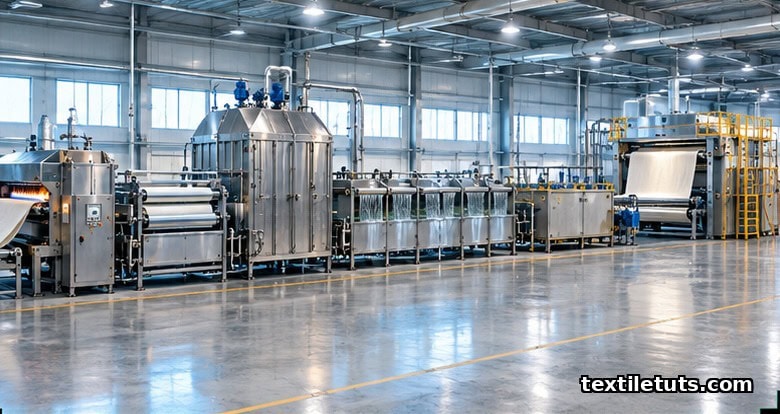
- Singeing at 1200–1400 °C flame temperature, 80–150 m/min.
- Pad-steam desizing with amylase, 60–70 °C, 10–20 min dwell.
- Counter-current hot wash, 90–95 °C.
- Combined scour-and-bleach pad bath with NaOH and H₂O₂ at 95–100 °C.
- Steamer dwell, 60–90 minutes.
- Multi-stage hot wash, 90 °C falling to 60 °C.
- Acid neutralization with acetic acid to pH 6.0–7.0.
- Cold rinse.
- Optional mercerizing in 22–26% NaOH at 20–30 °C under tension.
- Stenter drying at 120–140 °C, with controlled overfeed for dimensional setting.
Frequently Asked Questions
How long does a continuous pretreatment range take for one lot of fabric?
Once the line is running, a lot of greige fabric reaches the delivery end of a continuous pretreatment range in 15–45 minutes. The slower number applies when the recipe includes a long mercerizing dwell, while the faster number represents a singe-desize-scour-bleach sequence at 100 m/min.
What is the difference between scouring and bleaching in continuous pretreatment?
Scouring uses sodium hydroxide at high temperature to break down and remove the hydrophobic waxy coating on cotton fibers, which lets the fabric absorb water quickly. Bleaching uses hydrogen peroxide to oxidize and decolorize the natural pigments that survive scouring. Most modern ranges combine the two steps in a single pad-steam bath to save water and energy.
Can polyester/cotton blends be continuously pretreated on the same range as 100% cotton?
Yes, with a slightly modified recipe. The desizing chemistry must handle PVA or polyacrylate sizes, the scouring bath runs at a lower NaOH concentration to protect the polyester from alkaline degradation, and the bleaching bath uses a peroxide stabilizer suited to a neutral or slightly acidic pad. Most polyester/cotton blends are pretreated at 80–90 °C rather than the 95–100 °C used for 100% cotton.
How much water does a continuous pretreatment line use per kilogram of fabric?
A modern counter-current continuous range consumes between 25 and 35 L of water per kg of fabric, compared with 60–120 L/kg for a typical batch jet. Mills targeting zero liquid discharge (ZLD) push this number lower by recycling the wash water through an effluent treatment plant and reusing the recovered condensate.
What whiteness index should bleached cotton reach before dyeing?
For medium and dark dye shades, a CIE whiteness index of 78–82 is sufficient. For pastel shades and finished whites, the index should exceed 85. These targets assume standard D65 illumination and a CIE 1964 10° observer, with the fabric measured as a single layer on a calibrated spectrophotometer.
References
- ISO 105-J01:1997. Textiles — Tests for colour fastness — Part J01: General principles for measurement of surface colour. International Organization for Standardization. https://www.iso.org/standard/9158.html — defines the measurement conditions used for whiteness reporting.
- AATCC Test Method 79-2014. Absorbency of Textiles. American Association of Textile Chemists and Colorists. https://www.aatcc.org — the water-drop absorbency procedure referenced in the QC section.
- ASTM D5034-21. Standard Test Method for Breaking Strength and Elongation of Textile Fabrics (Grab Test). ASTM International. https://www.astm.org/d5034-21.html — tensile-strength procedure cited for finished-fabric QC.
- Hashem, M. et al. (2021). Recent trends in sustainable textile pretreatment. Textile Research Journal, 91(5-6), 543–564. https://journals.sagepub.com/home/trj — peer-reviewed review of combined scour-bleach chemistry and water use.
- Broadbent, A. D. (2001). Basic Principles of Textile Coloration. Society of Dyers and Colourists. https://www.wiley.com/en-us/Basic+Principles+of+Textile+Coloration — standard textbook reference on desizing, scouring, bleaching, and mercerizing chemistry.
- Choudhury, A. K. Roy (2020). Principles of Textile Finishing. Woodhead Publishing (Elsevier). https://www.sciencedirect.com/book/9780128200734 — chapter references for continuous mercerizing and combined bleach ranges.
- MDPI Polymers (2022). Sustainable Pretreatment Processes for Cellulosic Fibers. Polymers, 14(17), 3544. https://www.mdpi.com/2073-4360/14/17/3544 — open-access review of low-temperature peroxide bleaching chemistry.
This article is the working reference for continuous pretreatment process design in woven textile mills. Editorial by Shahrukh Islam, TextileTuts. Sources: ISO 105-J01, AATCC TM 79, ASTM D5034, Textile Research Journal (Sage), Broadbent (SDC), Choudhury (Woodhead/Elsevier), MDPI Polymers as cited.


