
Scouring: Chemicals and Conditions

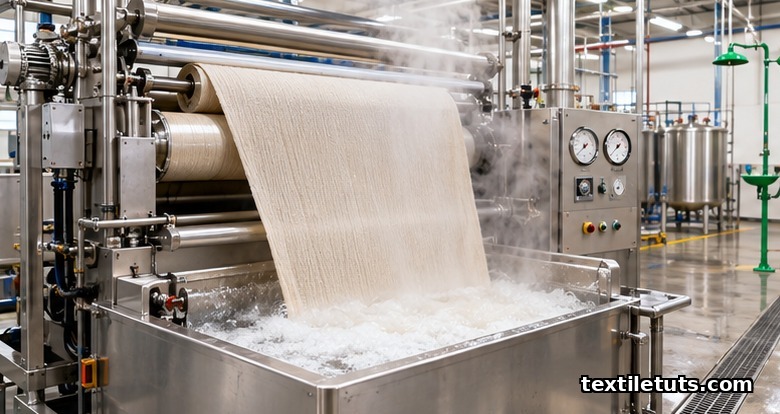
Scouring uses a 2–5% sodium hydroxide (NaOH) solution at 90–100 °C for 30–90 minutes, with non-ionic surfactants and sequestering agents, to remove the 6–10% by weight of natural non-cellulosic impurities (waxes, pectins, proteins, hemicelluloses, seed-coat fragments) that make greige cotton hydrophobic, restoring absorbency for dyeing and finishing.
Without scouring, cotton fabric sheds water droplets, rejects dye evenly, and contaminates downstream baths with greige-mill residues. The process is the second step in the standard pretreatment sequence (desizing → scouring → bleaching) and is the single largest source of wet-process chemistry consumption in a woven cotton mill.
What follows covers the chemicals in the scouring bath, the conditions that govern each one, fiber-specific recipes for cotton, wool, polyester, and polyamide, the position of scouring inside the wider pretreatment flow, and the quality-control checks that tell you whether scouring actually worked.
What Scouring Removes from a Fiber
Greige (loomstate) cotton carries roughly 6–10% of non-cellulosic material by weight: waxes (0.4–1.0%), pectins (0.9–1.2%), proteins (1.0–1.3%), hemicelluloses (1.0–1.5%), mineral salts (0.7–1.0%), and residual seed-coat fragments. None of these dissolve in water alone, and together they reduce cotton’s absorbency to near zero. Polyester and nylon fabrics arrive from the knitting or weaving step with spin finishes (silicone or mineral-oil emulsions) and coning oils (0.5–3% on weight of fabric, owf) that likewise resist water. Wool arrives with 5–25% wool grease (lanolin) plus suint (dried perspiration salts) and dirt picked up at the sheep and at shearing.
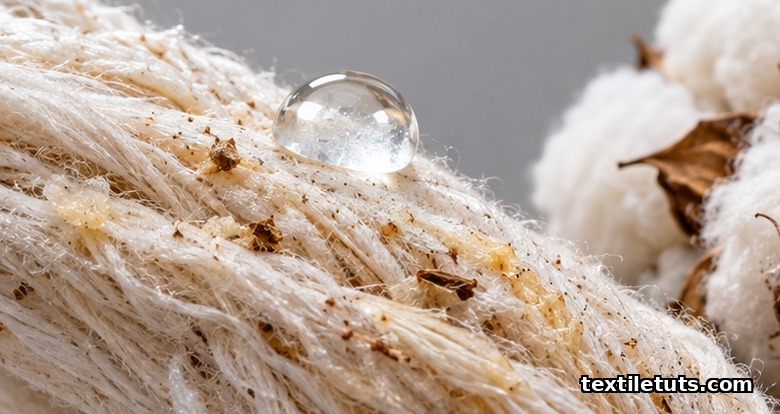
Scouring must therefore do three things at once: hydrolyze the alkali-sensitive impurities (pectin, protein, triglyceride oils), emulsify the alkali-resistant ones (waxes, spin finishes), and hold the suspended soil in the bath so it does not redeposit on the fabric. NaOH alone does the hydrolysis but is poor at emulsifying wax; this is why a surfactant is always added alongside the alkali.
The Chemicals in a Scouring Bath
Sodium hydroxide (caustic soda, NaOH) is the primary saponification and hydrolysis agent. Concentrations of 2–5% owf are typical for cotton; lower concentrations (1–2%) are used when scouring precedes hydrogen-peroxide bleaching in a combined scour-bleach (KSB) bath. NaOH raises the bath pH to 12.5–13.5, which hydrolyzes pectin and proteins within minutes and converts triglyceride oils into soluble sodium soaps that rinse away with the bath liquor.
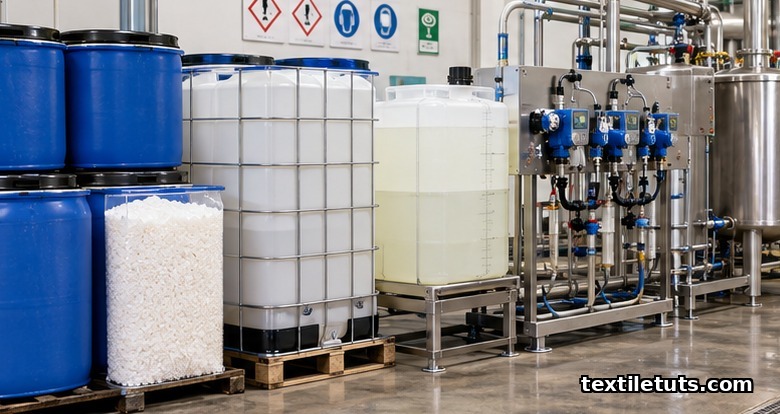
Sodium carbonate (soda ash, Na2CO3) is used at 1–3% owf as a secondary alkali and pH buffer. It is milder than NaOH (pH 11–11.5 at typical dose) and is preferred for wool, synthetics, and delicate blends where fiber damage is a concern. It also softens water by precipitating calcium and magnesium as insoluble carbonates, which keeps the alkali available for the fiber rather than tied up as a soap scum.
Surfactants (wetting agents and emulsifiers) are dosed at 0.5–2.0 g/L. Non-ionic surfactants (alcohol ethoxylates with 7–12 ethylene-oxide groups) are the most common because they are stable in alkali and low-foaming at scouring temperatures. Anionic surfactants (linear alkylbenzene sulfonates, fatty alcohol sulfates) give better wetting on greige cotton but foam heavily and require silicone defoamers. Surfactants reduce the bath surface tension from ~72 mN/m to ~35 mN/m, allowing water to penetrate the fiber within seconds rather than minutes.
Sequestering / chelating agents (0.5–2.0 g/L) bind calcium, magnesium, and iron ions that would otherwise precipitate as hydroxide sludges on the fabric, causing pinpoint stains and dye spots. EDTA, DTPA, sodium tripolyphosphate (STPP), and polyacrylic acid salts are the workhorses. Iron contamination is the most damaging: even 1 ppm Fe³⁺ in the bath accelerates cellulose degradation during bleaching and creates yellow rust spots that no peroxide can remove.
Other auxiliaries appear in specific recipes. Solvents (for wool only: historically perchloroethylene, now mostly mineral spirits or supercritical CO₂) dissolve wool grease directly. Antifoaming agents (silicone emulsions at 0.1–0.3 g/L) suppress foam when anionic surfactants are used in jet or winch machines. Optical-brightener-stable wetting agents are chosen if the scouring step is followed by an optical brightener wash.
Process Conditions: The Four Variables
Temperature is the most influential variable. The Arrhenius relationship for cotton scouring roughly doubles the impurity-removal rate with every 10 °C increase between 60 °C and 100 °C. Practically: cotton is scoured at 90–100 °C for 30–60 minutes; below 70 °C, wax removal drops below 40% even after 90 minutes, and pectin removal is incomplete. Wool is scoured at 40–60 °C because temperatures above 65 °C cause irreversible felting shrinkage by lifting the cuticle scales. Synthetics are scoured at 60–80 °C; above 85 °C, polyester begins to yellow and polyamide loses hand feel.
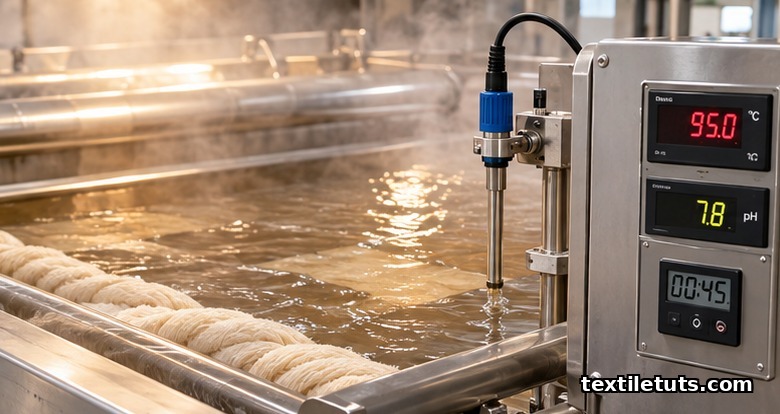
Time scales with temperature. A 100 °C cotton scour typically runs 30–45 minutes; an 80 °C scour needs 60–90 minutes for equivalent removal. The bath is held isothermally until residual wax drops below 0.2% (measured by Soxhlet extraction) before the fabric is rinsed. End-point is judged either by a fixed-time schedule or by conductivity stabilising, which signals that impurity release has slowed.
pH is set by the alkali choice and concentration. Cotton scouring at pH 12.5–13.5 (NaOH-dominated) achieves complete wax removal when paired with a non-ionic surfactant; pH 11 (Na2CO3 alone) removes only 50–60% of wax. Wool scouring is held at pH 7.5–9.0 because alkaline pH above 9 damages the cuticle scale and promotes felting. Polyester and polyamide scouring sit between, at pH 10.5–11.0.
Material-to-liquor ratio (M:L) governs bath concentration and rinsing efficiency. Cotton is scoured at M:L 1:10 to 1:15; jet dyeing machines run at 1:8 (lower liquor saves energy and water), while winches and jiggers run at 1:15–1:20 because mechanical action requires more liquor for even wet-out. Wool scouring uses very high liquor ratios (1:20 to 1:40) because lanolin emulsifies more easily in dilute baths and the bath picks up heavy soil loads that must be diluted.
Fiber-Specific Recipes
Cotton (woven, after desizing): NaOH 3–5% owf, Na2CO3 1–2% owf, non-ionic surfactant 1.0–1.5 g/L, sequestering agent 1.0 g/L, M:L 1:10–1:15, 90–100 °C, 45–60 min, drain and hot-rinse at 80 °C then cold-rinse.
Cotton (knit, combined scour-bleach): NaOH 1.5–2.5% owf, H2O2 2–4 g/L, Na2CO3 1% owf, sodium silicate stabilizer 1 g/L, surfactant 1 g/L, M:L 1:8–1:10, 95 °C, 45 min. Combined baths save one process step and one rinsing sequence in continuous knit ranges.
Wool (raw, yarn, or piece): non-ionic detergent 1.0–2.0 g/L, Na2CO3 0.5–1.0 g/L (pH 8–9), M:L 1:20–1:40, 45–55 °C, 20–30 min in two or three successive baths of progressively cleaner liquor. Solvent-aided scouring with supercritical CO₂ at 200 bar / 50 °C removes over 95% of lanolin without water, and the recovered lanolin is a saleable byproduct for cosmetics and lubricant industries.
Polyester (textured or flat): Na2CO3 1.0–2.0 g/L, non-ionic surfactant 1.0 g/L, sequestering agent 0.5 g/L, M:L 1:10, 70–80 °C, 30 min.
Polyamide (nylon 6,6): Na2CO3 1.5–2.5 g/L, anionic or non-ionic surfactant 1.0 g/L, M:L 1:12, 60–70 °C, 30 min. An acid pre-treatment (acetic acid to pH 4–5) is sometimes used to fix oligomers before scouring, preventing the yellow oligomer deposits that show up on the inside of dyed hosiery after storage.
Process Flow and Quality Control
The standard pretreatment sequence is desizing → scouring → bleaching → neutralization → rinsing. Skipping scouring and going directly to bleaching leaves wax in the fiber, which blocks peroxide penetration and produces uneven white. Skipping scouring before dyeing produces shade variation that cannot be corrected later, because reactive and disperse dyes bond unevenly to regions that still hold non-cellulosic impurities.
Quality checks after scouring:
Absorbency (drop test, AATCC TM 79): a drop of water should wet out within 1 second on cotton, 5 seconds on polyester. A drop that sits on the surface for longer than 10 seconds indicates incomplete scouring.
Residual wax (Soxhlet extraction, ASTM D2257 or ISO 3801): wax content should be below 0.2% on weight of cotton for good dye uptake. Modern solvent-replacement methods reduce the use of carbon tetrachloride while preserving the same accuracy.
Whiteness index (AATCC TM 110 / ISO 105-J01) after bleaching is the downstream check; a poor scour shows up as a low CIE Whiteness value even after a normal peroxide bleach.
Weight loss: well-scoured cotton loses 6–10% of greige weight; weight loss above 12% indicates cellulose damage from excessive NaOH, time, or temperature. Tensile-strength loss above 8% in the warp signals the same defect.
pH at the end of the rinse should be 7–8. Fabric pH above 9 entering the dye bath causes shade shifts in reactive dyeing and corrosion of stainless-steel dyeing machinery.
Comparison: Scouring Recipes at a Glance
| Parameter | Cotton (woven) | Cotton (knit, KSB) | Wool | Polyester | Polyamide |
|---|---|---|---|---|---|
| Main alkali | NaOH 3–5% owf | NaOH 1.5–2.5% owf | Na2CO3 0.5–1% owf | Na2CO3 1–2 g/L | Na2CO3 1.5–2.5 g/L |
| Surfactant | Non-ionic 1.0–1.5 g/L | Non-ionic 1.0 g/L | Non-ionic 1–2 g/L | Non-ionic 1.0 g/L | Non-ionic/anionic 1.0 g/L |
| Temperature (°C) | 90–100 | 95 | 45–55 | 70–80 | 60–70 |
| Time (min) | 45–60 | 45 | 20–30 | 30 | 30 |
| M:L ratio | 1:10–1:15 | 1:8–1:10 | 1:20–1:40 | 1:10 | 1:12 |
| pH range | 12.5–13.5 | 11–12 | 7.5–9.0 | 10.5–11.0 | 10.5–11.0 |
| Target impurities | Wax, pectin, protein | Wax, pectin + bleach | Wool grease, suint | Spin finish, knitting oil | Spin finish, oligomers |
Frequently Asked Questions
What is the purpose of scouring in textile processing?
Scouring removes the natural and added impurities (waxes, pectins, proteins, spin finishes, knitting oils, dirt) that make greige fiber hydrophobic, so the fabric will absorb water and dye uniformly. On cotton, scouring typically removes 6–10% by weight of non-cellulosic material; on wool, it removes 5–25% of wool grease; on synthetics, it removes 0.5–3% of spin finish.
Why is sodium hydroxide the main scouring chemical for cotton?
NaOH at 2–5% owf raises bath pH to 12.5–13.5, which hydrolyzes pectin and protein within minutes and saponifies triglyceride oils into soluble sodium soaps. At 90–100 °C and paired with a non-ionic surfactant, it also emulsifies wax that would otherwise stay on the fiber. No milder alkali achieves the same impurity-removal rate at the same temperature and time.
Can scouring damage cotton fiber?
Yes, if NaOH concentration, temperature, or time exceeds the standard recipe (3–5% owf, 90–100 °C, 60 min), the cellulose itself begins to hydrolyze, and the fabric loses tensile strength and weight. The tell-tale sign of over-scouring is a weight loss above 12% of greige weight, paired with a measurable drop in warp tensile strength above 8%.
Why is scouring done at lower temperature for wool and synthetics?
Wool fibers felt irreversibly above 65 °C because alkaline heat swells the cuticle and lifts the scales, which then lock together under agitation. Polyester yellows and loses dye-site uniformity above 85 °C; polyamide loses hand feel. Both fibers are scoured at 45–70 °C with milder alkali (soda ash instead of caustic soda) to avoid these defects.
How do you know if scouring was successful?
Three checks are used together. The drop test (AATCC TM 79): a water drop should wet out the fabric in under 1 second for cotton, under 5 seconds for polyester. The residual wax test (ASTM D2257 or ISO 3801): wax content should be below 0.2% on weight of fiber. The pH of the rinsed fabric should be 7–8 before it moves to the next bath.
References
- AATCC. TM 79: Absorbency of Textiles (Drop Test). AATCC — method for evaluating water-wetting time after scouring.
- AATCC. TM 110: Whiteness of Textiles. AATCC — CIE whiteness index method for downstream quality checks.
- ASTM. D2257: Standard Test Method for Extractable Matter in Textiles. ASTM — Soxhlet extraction procedure for residual wax and oils.
- ISO. 3801: Textiles — Determination of Substances Soluble in Organic Solvents. ISO — reference method for residual non-cellulosic matter after scouring.
- Choudhury, A.K.R. Textile Preparation and Dyeing. ScienceDirect / textbook — peer-reviewed reference on alkaline scouring of cellulosic fibers.
- Trotman, E.R. Dyeing and Chemical Technology of Textile Fibres. ResearchGate — reference work on scouring chemistry and process recipes.
- MDPI. Cellulose-Based Materials in Textile Wet Processing. MDPI — peer-reviewed review of pretreatment chemistry, scouring baths, and ecological considerations.
- Wikipedia. Scouring (textiles). — definition and overview; used as background only.
This article is the working reference for scouring chemicals and process conditions. Editorial by Shahrukh Islam, TextileTuts. Sources: AATCC TM 79, AATCC TM 110, ASTM D2257, ISO 3801, ScienceDirect Textile Preparation and Dyeing, ResearchGate Trotman, MDPI Cellulose Wet Processing, and Wikipedia as cited.


