
Heat Setting: Synthetic Fabric Stabilization

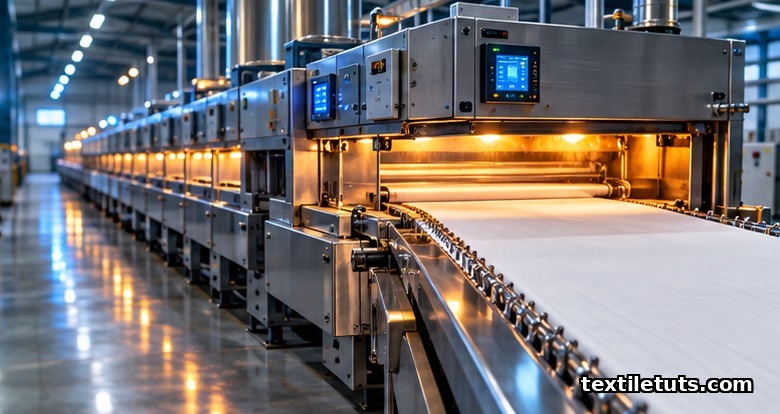
Heat setting is a thermal finishing process that stabilizes synthetic fabrics at 180 to 220 °C for 20 to 60 seconds, locking in dimensional stability by crystallizing the amorphous regions of polyester or nylon fibers and reducing residual shrinkage to below 1 to 2 percent.
This single heat treatment is the difference between a shirt that holds its shape after twenty home washes and one that warps, bags, or twists by wash three. Every finishing house that works with polyester, nylon, or triacetate runs a heat-setting stage for that exact reason, and the parameters are standardized enough that textile engineers can quote the temperature window for any given fiber from memory.
Below is the working reference: the chemistry that makes heat setting effective, the three industrial methods, the parameters that decide quality, the common defects and their root causes, and the standards that measure whether the process worked.
What Heat Setting Actually Does at the Molecular Level
Synthetic fibers like polyethylene terephthalate (PET) and nylon 6 are partially crystalline and partially amorphous. When the melt-spun filament cools on the spinneret, the amorphous regions freeze in a disordered state and the polymer chains carry internal stress. Any later exposure to heat or moisture lets those chains relax, and the fabric shrinks.
Heat setting gives those chains a chance to relax while the fabric is held flat under controlled tension. The high temperature, well above the glass transition but below the melting point, provides enough molecular mobility for the polymer segments to rearrange into a more stable, lower-energy configuration. When the fabric cools under tension, that configuration freezes in place.
The result is three measurable gains. First, residual shrinkage drops below 1 to 2 percent. Second, fabric dimensions stabilize against future hot-wash cycles. Third, any subsequent heat-based process (dyeing, printing, calendaring) no longer deforms the cloth. Heat setting also pre-shrinks the fabric, which is why finished garments hold their size after consumers wash them at home.
Standard Heat-Setting Temperatures and Dwell Times
The exact window depends on fiber chemistry. Polyester (PET) is the most common target and the most forgiving: stenter ovens run at 180 to 220 °C with a dwell time of 20 to 60 seconds, depending on fabric weight and the amount of pre-existing shrinkage the mill needs to cancel out. A 30-second dwell at 200 °C is the most common apparel-grade setting for woven polyester.
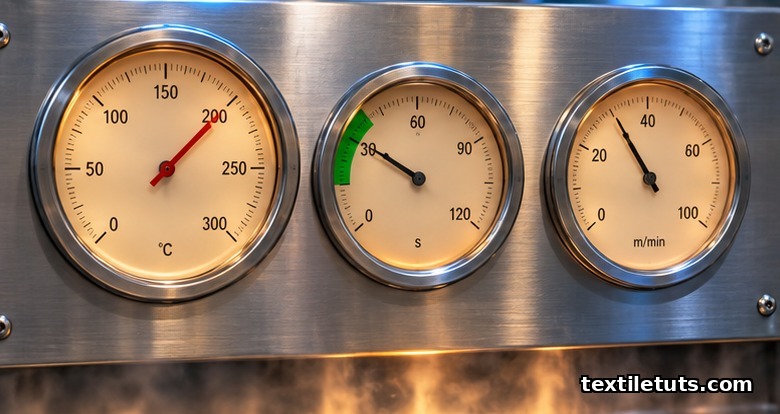
Nylon 6 sets at a lower temperature, typically 160 to 190 °C, because its lower melting point (around 220 °C for nylon 6 versus 260 °C for PET) leaves a narrower thermal window. Nylon 6,6 accepts 170 to 200 °C. Acrylic fibers, which soften far earlier, are heat-set at 120 to 150 °C for similar reasons, and dwell times stretch to 30 to 60 seconds because the temperature must remain conservative.
Spandex-containing knits require a more cautious approach: 170 to 180 °C with very short dwell times of 15 to 30 seconds to lock in stretch and recovery without yellowing the elastane. Triacetate falls in the polyester window at 190 to 210 °C. Outside these ranges, the mill risks either under-setting (residual shrinkage stays above 2 percent) or over-setting (yellowing, stiffness, strength loss).
The Three Industrial Heat-Setting Methods
Three equipment families dominate commercial heat setting. Each trades off capital cost against control precision, and each maps to specific fabric constructions.
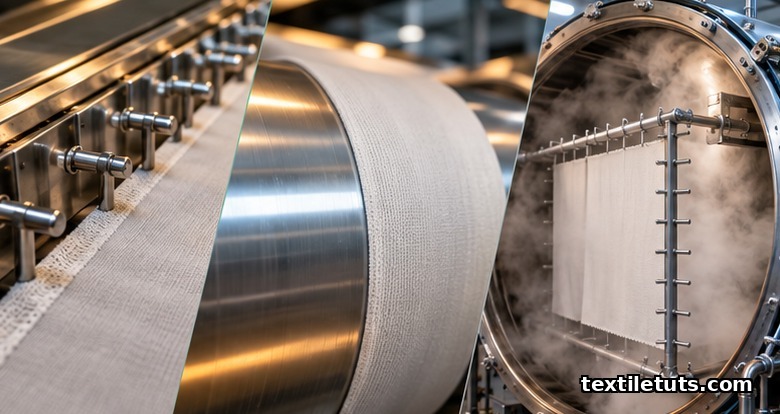
Stenter frame (pin or clip). The most common method for woven and knitted synthetics. The fabric enters a long oven with rails on both sides; pins or clips grip the selvedges and stretch the cloth to its target width while hot air circulates above and below. Modern stenters run 6 to 12 chambers, with each chamber separately controlled for temperature (often graduated, hotter at the entry, cooler at the exit) and dwell time set by line speed, typically 20 to 60 m/min.
Hot-air drum or cylinder. Used for tubular knits and some nonwovens. The fabric passes over a heated metal cylinder while tension is applied by overfeed rollers. Lower capital cost, but less control over width and edge uniformity, which is why this method is rarely used for outerwear-grade wovens.
Steam or pressurized hot water. Less common but valuable for delicate nylon lace and textured yarns where dry heat would mark the surface. The fabric is held to width on a frame inside an autoclave, then saturated with steam at 130 to 140 °C for 5 to 15 minutes. This method sets dye sites at the same time, which is why some dyehouses prefer it for nylon hosiery.
Process Parameters That Decide Quality
Four variables control the outcome, and they are not independent. Changing one without compensating on the others produces defects.
Temperature. High enough to mobilize polymer chains but low enough to avoid surface yellowing, fiber damage, or dye sublimation. For disperse-dyed polyester, an upper limit of 210 °C protects dyestuff integrity; for greige goods, the upper limit is 220 °C.
Dwell time. A 20-second dwell at 200 °C gives roughly the same dimensional stability as a 40-second dwell at 190 °C. Over-lengthy dwells waste energy and risk yellowing. Too-short dwells leave residual shrinkage above 2 percent.
Tension (overfeed and width). Overfeed of 5 to 20 percent compensates for shrinkage during setting and prevents the fabric from being held too tight, which would make it feel paper-like and reduce stretch. Width overfeed is matched to the stenter chain so the cloth exits at its finished width plus a small allowance for downstream relaxation.
Moisture and predry. Wet fabric entering a 200 °C oven flashes to steam, and the localized cooling creates temperature gradients that produce uneven setting. Most lines predry to 8 to 12 percent moisture before the setting zone.
Common Heat-Setting Defects and Their Causes
Skewed weft (bow and skew). A weft yarn that runs at an angle rather than perpendicular to the warp. Cause: differential tension across the fabric width, usually from misaligned stenter rails. Visible immediately on inspection tables; visible to consumers only after one or two washes when the distortion amplifies.
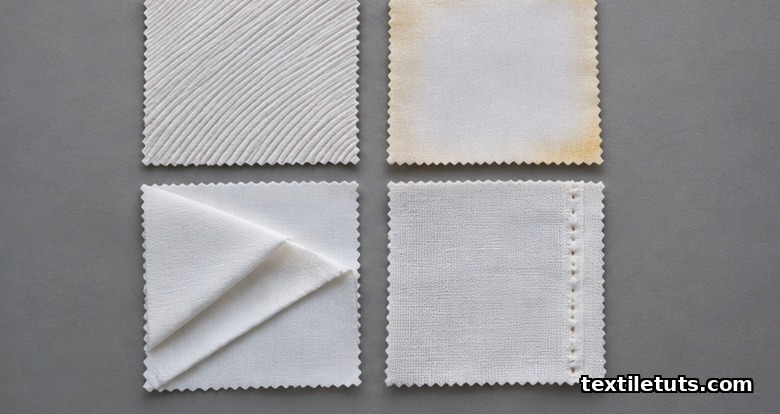
Thermal yellowing. A yellow tint, especially on white or pale shades. Cause: oven temperature above 220 °C, or dwell times above 60 seconds, or both. Yellowing is partly reversible in subsequent open-width washing, but only partly, and at temperatures high enough to set the discoloration, fiber tensile strength also drops.
Stiff or boardy hand. The fabric loses its soft drape. Cause: over-setting from too much heat, too much time, or too much widthwise tension. Most common on lightweight polyester linings where the mill over-compensates for shrinkage.
Setting marks (chatter marks or pin marks). Localized distortion along the selvedge where pins or clips grip the fabric. Cause: pin temperature too high relative to the fabric, or insufficient predry. Modern stenters use Teflon-coated or temperature-monitored pins to limit this.
Uneven setting across the width. The selvedge zones set differently from the center. Cause: poor air circulation in the stenter, fabric folded over itself on entry, or inconsistent dwell time because of width variations. Corrected by re-checking stenter chamber airflow and pin alignment.
Comparison: Heat-Setting Windows for Common Synthetics
| Fiber | Setting Temperature (°C) | Dwell Time (s) | Typical Application |
|---|---|---|---|
| Polyester (PET) | 180 to 220 | 20 to 60 | Apparel, home textiles, technical fabrics |
| Nylon 6 | 160 to 190 | 20 to 40 | Hosiery, lace, swimwear linings |
| Nylon 6,6 | 170 to 200 | 20 to 45 | Sportswear, technical outerwear |
| Acrylic | 120 to 150 | 30 to 60 | Sweaters, pile fabrics, blankets |
| Spandex blends | 170 to 180 | 15 to 30 | Stretch knits, compression wear |
| Triacetate | 190 to 210 | 20 to 40 | Linings, dress fabrics |
Frequently Asked Questions
What is the ideal heat-setting temperature for 100 percent polyester fabric?
Most polyester is heat-set between 180 and 220 °C with a dwell time of 20 to 60 seconds. A common mill setting for apparel-weight woven polyester is 200 °C for 30 seconds on a stenter frame. Lower temperatures risk residual shrinkage above 2 percent; higher temperatures risk yellowing and reduced tensile strength. The exact point inside the window depends on whether the fabric is greige, pre-dyed, or print-prepared.
Does heat setting affect dye uptake or color fastness?
Heat setting increases crystallinity, which slightly reduces dye uptake for disperse dyes applied afterwards. Most mills either dye first and then heat-set, or use a thermofixation cycle that dyes and sets simultaneously at 200 to 210 °C. Properly heat-set polyester shows better wash and rub fastness because the dye molecules are trapped in the more crystalline structure and resist migration during laundering.
Can I heat-set fabric at home with a household iron?
Household irons reach 200 to 230 °C, but they cannot hold the fabric under uniform tension for the required dwell time. The result is uneven setting, scorch marks, and skipped areas. For prototypes and small samples, a laboratory hot-plate press with controlled dwell and pressure gives reproducible results. Full-scale home production is not practical because the dimensional control required (overfeed, selvedge grip, uniform airflow) needs industrial hardware.
What is the difference between heat setting and thermosoling?
Heat setting is a dimensional-stabilization process applied to greige or dyed fabric. Thermosoling is a heat-and-pressure dye fixation step used in pigment printing, where disperse dyes are forced into polyester fibers under dry heat, typically 200 to 220 °C for 60 to 120 seconds. Thermosoling fixes color; heat setting fixes dimensions. A fabric can be heat-set without thermosoling, and thermosoled without prior heat setting, though mills that run both usually heat-set first so that the thermosol step does not introduce new dimensional change.
How do engineers verify that heat setting worked?
Three tests cover most cases. AATCC TM 135 measures dimensional change after five home-laundering cycles; well-set polyester changes less than 1 percent in both warp and weft. ASTM D1204 measures linear dimensional change of thermoplastic fabrics at elevated temperature and confirms that residual shrinkage under heat has dropped below the mill target. ASTM D4974 covers nonwoven variants. Mills also use in-line shrinkage sensors on the stenter to monitor overfeed and exit width in real time, catching drift before the bolt is wound up.
References
- ASTM International. ASTM D1204-14: Standard Test Method for Linear Dimensional Changes of Nonrigid Thermoplastic Sheeting or Film at Elevated Temperature. ASTM International, West Conshohocken, PA. https://www.astm.org/d1204-14.html — covers dimensional change verification under heat.
- ASTM International. ASTM D4974-04: Standard Test Method for Dimensional Change of Nonwoven Fabrics Under Heat. ASTM International, West Conshohocken, PA. https://www.astm.org/d4974-04.html — covers nonwoven variant.
- AATCC. AATCC Test Method 135-2018: Dimensional Changes of Fabrics after Home Laundering. American Association of Textile Chemists and Colorists, Research Triangle Park, NC. https://www.aatcc.org — standard wash-and-measure for setting effectiveness.
- Hu, J. (Ed.). Fabric Testing. Woodhead Publishing in Textiles, Cambridge, 2008. https://www.sciencedirect.com/book/9781845695064/fabric-testing — academic reference for dimensional stability tests.
- Gupta, V.B. and Kothari, V.K. (Eds.). Manufactured Fibre Technology. Springer, Dordrecht, 1997. https://link.springer.com/book/10.1007/978-94-011-5854-1 — peer-reviewed reference on synthetic-fiber heat setting.
- ISO. ISO 30023:2010 Textiles — Determination of the dimensional change of fabrics induced by cold-water immersion. International Organization for Standardization, Geneva. https://www.iso.org/standard/81199.html — verification of stability after setting.
- Tortora, P.G. and Merkel, R.S. Fairchild’s Dictionary of Textiles, 8th Edition. Fairchild Books, New York, 2013. https://www.bloomsbury.com — academic textile reference with heat-setting definitions.
This article is the working reference for heat setting of synthetic fabrics. Editorial by Shahrukh Islam, TextileTuts. Sources: ASTM D1204, ASTM D4974, AATCC TM 135, ISO 30023, Woodhead Publishing, Springer, Fairchild Books as cited.


