
Bleaching: Hydrogen Peroxide vs Sodium Hypochlorite

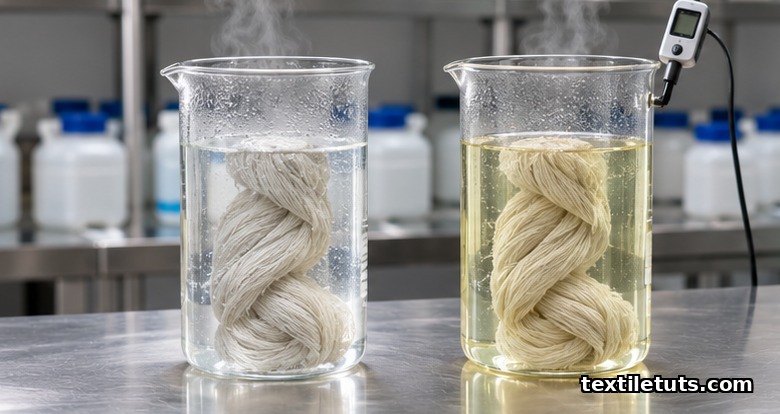
Hydrogen peroxide at 0.5 to 2.0 percent on weight of fiber, pH 10.5 to 11.5, and 80 to 95 degrees Celsius delivers comparable initial whiteness to sodium hypochlorite at 1 to 5 grams per liter available chlorine while preserving 95 to 98 percent of cotton degree of polymerization across multiple cycles. Sodium hypochlorite at the same target whiteness drops cellulose degree of polymerization by 300 to 600 units after six to ten laundering cycles and regresses 4 to 8 Berger units on heat aging at 105 degrees Celsius, where peroxide-bleached cotton regresses only 1 to 2 units. The two reagents look interchangeable on day one, diverge on day thirty, and force different equipment and effluent designs upstream.
For most modern preparation ranges on cotton, hydrogen peroxide is the default because it leaves no halogenated residue, tolerates combined scour-bleach-mercerize sequences, and meets the 0.5 milligrams per liter AOX effluent limit many export buyers enforce. Sodium hypochlorite remains common in denim finishing, household laundry products, and small-batch preparation where its cold bleaching behavior, low chemical cost, and short cycle time outweigh the cellulose damage and chlorinated effluent. The right choice depends on fiber, target whiteness stability, and the discharge limits at your plant.
By the end of this article you will know how each bleach works, the operating window that protects the fiber, how to read the damage data, and which standards your QC lab should run before signing off a batch.
How Each Bleach Works (the Chemistry in Plain Words)
Hydrogen peroxide is a peroxygen. In alkaline conditions it dissociates toward the perhydroxyl anion (HOO negative), the actual bleaching species that attacks conjugated double bonds in natural color bodies and residual lignin. The activator is sodium hydroxide; the stabilizer is sodium silicate, magnesium sulfate, or a chelating agent such as EDTA, all of which bind trace heavy metals (iron, copper, manganese) that would otherwise catalyze peroxide decomposition into oxygen gas before useful bleaching happens. End products are water and dissolved oxygen, so peroxide leaves no halogenated residue on the substrate or in the bath.
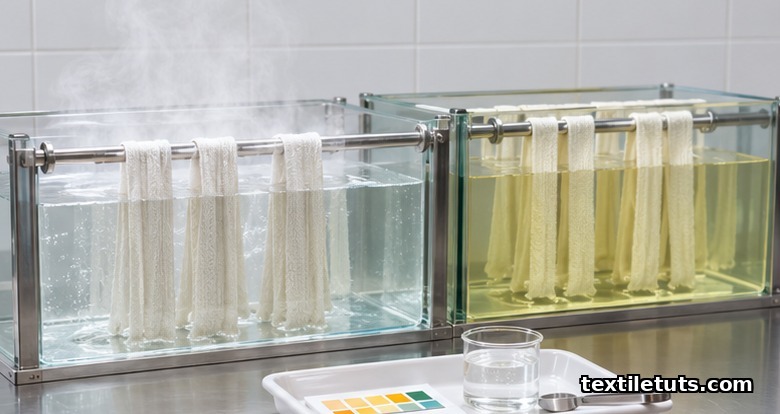
Sodium hypochlorite is a halogenating oxidant. In water it dissociates into hypochlorous acid (HOCl) and the hypochlorite ion (OCl negative), with a pKa of 7.5. At a working pH between 10 and 11, the equilibrium sits almost entirely in the OCl negative form, and that ion carries the bleaching action on cotton, on lignin, and on most natural color bodies. Hypochlorite is a fast, effective bleach at room temperature, but its mechanism is non-selective. It oxidizes C2 and C3 hydroxyls on the cellulose chain into carbonyl groups and shortens the polymer by beta-elimination, which is why cumulative damage is the limiting factor. The chlorinated by-products that wash out of the bath (adsorbable organic halides, or AOX) persist in effluent unless the plant runs an active decolorization stage.
Operating Windows for Cotton (the Reference Fiber)
Cotton is the reference fiber for this comparison because it tolerates both bleaches but pays a different price for each. The table below summarizes typical ranges drawn from mill practice and from AATCC and ISO wet-processing references.
| Parameter | Hydrogen peroxide (H2O2) | Sodium hypochlorite (NaOCl) |
|---|---|---|
| Active concentration | 0.5 to 2.0 percent H2O2 on weight of fiber; 2 to 5 g/L in bath | 1 to 5 g/L available chlorine |
| Temperature | 80 to 95 degrees Celsius (hot bleach) | 20 to 30 degrees Celsius (cold bleach) |
| pH | 10.5 to 11.5 (alkaline) | 10.0 to 11.0 (alkaline) |
| Time | 30 to 60 minutes | 15 to 30 minutes |
| Stabilizer | Sodium silicate 1 to 3 g/L, or MgSO4 plus a sequestrant | Not required; pH buffer only |
| Typical initial whiteness (Berger) | 70 to 82 on greige cotton | 68 to 80 on greige cotton |
| Cotton DP drop per cycle | 50 to 150 units | 300 to 600 units after repeated cycles |
The hot peroxide window is the reason most preparation ranges run at 90 degrees Celsius for 45 minutes. The cold hypochlorite window is the reason denim finishing ranges often run the bleach at ambient temperature for under half an hour, immediately followed by antichlor treatment with sodium bisulfite to neutralize residual active chlorine before the next wet process.
Fiber Damage: the Case the Data Tells
Both bleaches are oxidative, but they break cellulose through different pathways. Peroxide oxidation at controlled alkaline pH attacks reducing end groups and any glycosidic linkages already weakened by scouring. Run inside the standard operating window, peroxide bleaching drops the degree of polymerization (DP) of cotton cellulose by 50 to 150 units per cycle, a manageable loss for downstream mercerizing and dyeing.
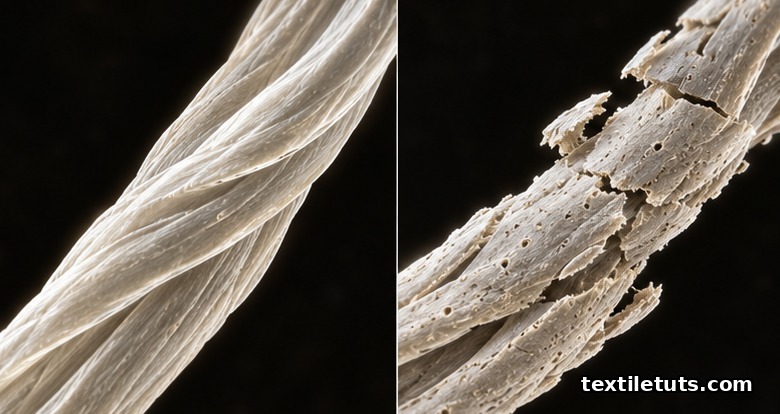
Hypochlorite oxidation is less selective. The OCl negative species directly oxidizes C2 and C3 hydroxyls into carbonyl groups, opens the pyranose ring, and shortens the chain by beta-elimination. Multi-cycle NaOCl bleaching on cotton can drop DP by 300 to 600 units, and tensile-strength losses of 20 to 40 percent appear after 6 to 10 laundering cycles in the field. This is the published finding behind the mill-scale move away from NaOCl in home-textile preparation for export programs.
For protein fibers the picture reverses. Wool is highly sensitive to oxidative bleach above pH 8. Peroxide at pH 8.0 to 8.5 with stabilizers can bleach wool without appreciable yellowing. Sodium hypochlorite on wool causes irreversible yellowing through chloramine formation on the peptide nitrogen, and the yellowing worsens on heat aging. Silk accepts peroxide at pH 8 to 9 with silicate stabilizer; NaOCl on silk causes surface pitting and weight loss above 5 percent in 30 minutes.
For polyester, neither bleach works as a primary bleach. The right step is a reductive clearing after disperse dyeing, using sodium dithionite or thiourea dioxide at 70 to 80 degrees Celsius, to destroy the residual chromophore. For nylon 6,6, oxidative bleach with peroxide at pH 9 and 70 to 80 degrees Celsius is the safer route, since NaOCl generates chloramines that cause yellowing during heat setting.
Whiteness Stability Over Time
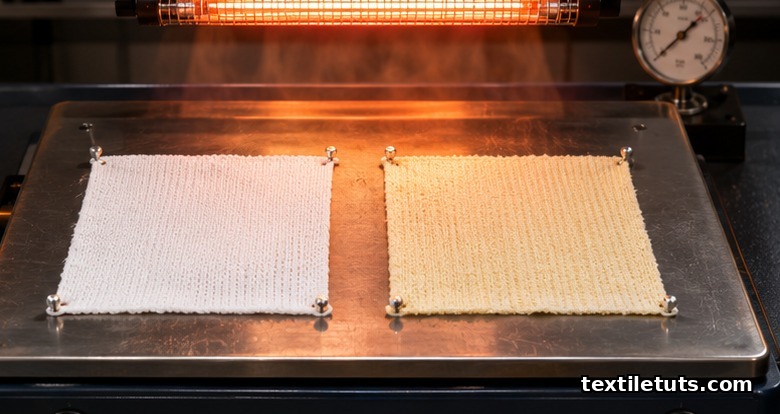
Initial whiteness tells only part of the story. Cotton bleached in NaOCl and stored at 105 degrees Celsius for 4 hours shows whitening reversion of 4 to 8 Berger units, driven by conjugated carbonyls reforming chromophores during heat aging. Peroxide-bleached cotton under the same heat-aging condition drops 1 to 2 Berger units. The test method for this stability check is well established in home-textile and apparel performance labs: ISO 105-N01 covers neighbor-fabric staining and AATCC TM 110 covers whiteness under thermal stress. Run together, the two reagents look identical on day one and diverge by day thirty, which is why export programs specify a peroxide-only preparation route for any cotton that will be hot-finished, hot-ironed, or shipped through tropical warehouses.
Effluent, Safety, and Regulatory Tradeoffs
Per-kg-of-fiber chemical oxygen demand (COD) for peroxide bleaching is high, typically 8 to 15 kg COD per 1,000 kg cotton, but biodegradable. The dissolved residue after rinsing is sodium sulfate, sodium silicate, and water. For NaOCl bleaching, the worry is not COD but AOX. Effluent from a NaOCl stage without an AOX-removal step typically carries 1 to 3 mg/L AOX, well above the 0.5 mg/L limit many European buyers enforce on finished textile imports. A combined biological and activated-carbon step can pull AOX below 0.3 mg/L, but adds capex that small mills cannot absorb.
Worker safety favors peroxide in nearly every comparison. Concentrated H2O2 at 35 or 50 percent is a strong oxidizer, but it decomposes to water and oxygen on skin contact with catalase, and a flush with water is sufficient first aid. NaOCl at 12 percent active chlorine releases chlorine gas if the bath pH ever falls below 5, and any plant that co-processes bleach with acid arrives at accidental mixing risk regularly. Both reagents should be stored in HDPE, well-ventilated, and away from reducing agents. Gloves, goggles, and closed dispensing systems are minimum practice on either line.
Which Bleach Where (the Practical Decision)
Use hydrogen peroxide when the fiber is cotton, the target is durable whiteness, the effluent must be AOX-low, or the process runs on the same machine as scouring and mercerizing. Use sodium hypochlorite when the line is dedicated denim finishing, the substrate tolerates cold bleaching, the cost per kilogram of bleached fiber must be minimized, and the plant has a working AOX effluent train. For protein fibers, the default is peroxide with controlled pH, never NaOCl. For polyester, use neither for pre-bleach; use the right reductive clearing after disperse dyeing.
Frequently Asked Questions
Which bleach is better for cotton, hydrogen peroxide or sodium hypochlorite?
Hydrogen peroxide at 0.5 to 2.0 percent on weight of fiber, pH 10.5 to 11.5, 80 to 95 degrees Celsius, and 30 to 60 minutes delivers equivalent initial whiteness to sodium hypochlorite at 1 to 5 g/L available chlorine but retains 95 to 98 percent of cotton degree of polymerization across multiple cycles. Sodium hypochlorite costs less per kilogram and works at 20 to 30 degrees Celsius, but it lowers cellulose DP by 300 to 600 units after repeated cycles and generates chlorinated by-products that are restricted in effluent discharge to finished textile imports.
Can you bleach wool or silk with sodium hypochlorite?
No. Sodium hypochlorite on wool forms yellow chloramines on the peptide chain that cannot be reversed by antichlor treatment. The standard route for wool and silk bleaching is hydrogen peroxide at pH 8 to 9 with silicate and magnesium stabilizers, at 50 to 70 degrees Celsius, to avoid felting wool and hydrolyzing silk sericin.
What causes cotton to turn yellow after hypochlorite bleaching?
Yellowing on heat aging comes from carbonyl groups on the cellulose chain reforming conjugated chromophores above 100 degrees Celsius. The effect appears in storage warehouses, on hot ironing, and during autoclave finishing. Hydrogen peroxide produces far fewer carbonyl groups, so peroxide-bleached cotton stays whiter through the same heat aging condition. An antichlor rinse with sodium bisulfite after a NaOCl bath reduces but does not eliminate the yellowing tendency.
What is the role of sodium silicate in peroxide bleaching?
Sodium silicate stabilizes hydrogen peroxide by binding trace heavy metals, especially iron, copper, and manganese, that catalyze peroxide decomposition into oxygen gas. Without stabilizer, the bath loses 30 to 50 percent of its active peroxide in the first 15 minutes of heating. Typical loadings are 1 to 3 g/L sodium silicate paired with sodium hydroxide to fix the working pH at 10.5 to 11.5. Magnesium sulfate plus EDTA is the modern alternative when silicate deposits on equipment are a concern.
How do you measure the damage from each bleach?
Use degree of polymerization (DP) on the cellulose, measured by viscometry in cupriethylenediamine or by gel permeation chromatography. Compare the bleached fabric’s DP against greige cotton (typically 1,500 to 2,500 for mature cotton). A drop below 800 indicates unsafe damage for downstream mercerizing and durable finishing. Tensile-strength loss above 15 percent after bleaching also signals over-oxidation, regardless of which bleach ran, and the batch should be reprocessed or downgraded.
References
- AATCC. Test Method 101: Oxidative Bleaching. American Association of Textile Chemists and Colorists, Research Triangle Park, NC.
- ISO. ISO 105-C09:2010, Textiles – Tests for colour fastness – Part C09: Colour fastness to domestic and commercial laundering – Oxidative bleach response. International Organization for Standardization, Geneva.
- AATCC. Test Method 110: Whiteness of Textiles. American Association of Textile Chemists and Colorists, Research Triangle Park, NC.
- ASTM. ASTM D4265: Standard Guide for Evaluating Stain Removal Performance in Home Laundering. ASTM International, West Conshohocken, PA.
- Trotman, E. R. Dyeing and Chemical Technology of Textile Fibres. 6th ed. (referenced chapter on oxidative bleaching of cellulose), Charles Griffin & Co.
- Lewin, M., and Sello, S. B., eds. Handbook of Fiber Science and Technology, Volume II: Chemical Processing of Fibers and Fabrics – Fundamentals and Recent Advances. Marcel Dekker (referenced chapter on bleaching kinetics and cellulose oxidation).
This article is the working reference for peroxide versus hypochlorite bleaching. Editorial by Shahrukh Islam, TextileTuts. Sources: AATCC TM 101, AATCC TM 110, ISO 105-C09:2010, ASTM D4265, and standard textile chemistry texts as cited.


