
Bioscouring: Enzyme-Based

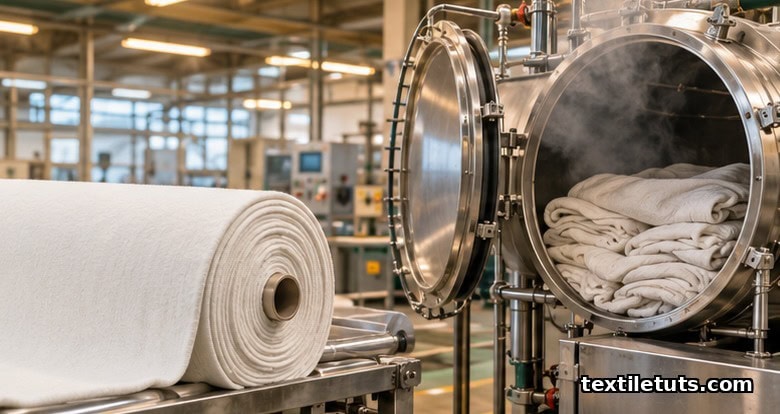
Enzymatic bioscouring uses pectinase enzymes at pH 7-9.5 and 45-65°C to hydrolyze the pectin layer that anchors the waxy cuticle of greige cotton, removing 3-5% of fiber weight while preserving more than 95% of the cellulose degree of polymerization, versus 8-12% chain scission in conventional 95-100°C NaOH scouring.
The treatment replaces caustic soda with biological catalysts, delivering the same wettability and dye uptake at roughly half the temperature and about 60-70% lower effluent chemical oxygen demand, which is why bio-preparation has moved from a research curiosity to a production line option for cotton knit and woven mills since the late 1990s.
Why Cotton Needs Scouring in the First Place
Cotton fiber is roughly 88-96% cellulose by weight on a dry basis, and the remaining 4-12% is a mixture of pectins (0.4-1.2%), waxes (0.3-1.0%), proteins (1.0-1.7%), ash (about 1%), and minor sugars. These non-cellulosic compounds sit in and on the primary cell wall and on the cuticle, the outermost layer that gives a raw cotton fiber its hydrophobic feel and its dull, uneven appearance.
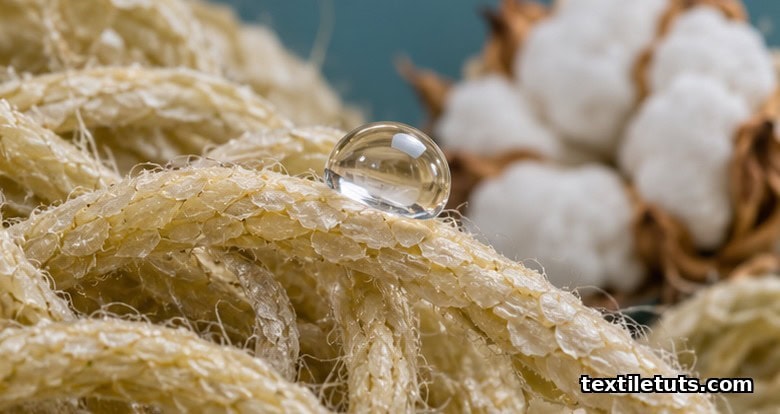
Greige cotton will not absorb water uniformly until that layer is at least partially removed, and a fabric that resists water cannot be bleached evenly, dyed to shade, or printed with sharp edges. AATCC Test Method 79 (Absorbency of Textiles) is the most common way mills verify scouring effectiveness. A drop of water should sink into the fabric in under 5 seconds for a fully prepared cotton. Knit greige fabric straight from the loom typically shows drop times greater than 60 seconds, which is the gap bioscouring or alkaline scouring is supposed to close.
Weight loss after scouring is the second diagnostic. Traditional NaOH scouring removes 5-8% of fabric weight because the alkali hot-washes away pectins, waxes, and a small fraction of the cellulose itself. Bioscouring typically achieves the same wettability at 3-5% weight loss because the enzymes target pectin selectively and leave the cellulose backbone largely untouched, which is why tensile strength retention after bio-preparation is consistently better than after caustic preparation.
How Pectinase Bioscouring Works
Bioscouring depends on a small group of enzymes that hydrolyze pectin, the structural polysaccharide that holds the waxy cuticle to the cellulose microfibrils underneath. Commercial preparations are usually a cocktail of three enzyme activities working in sequence:
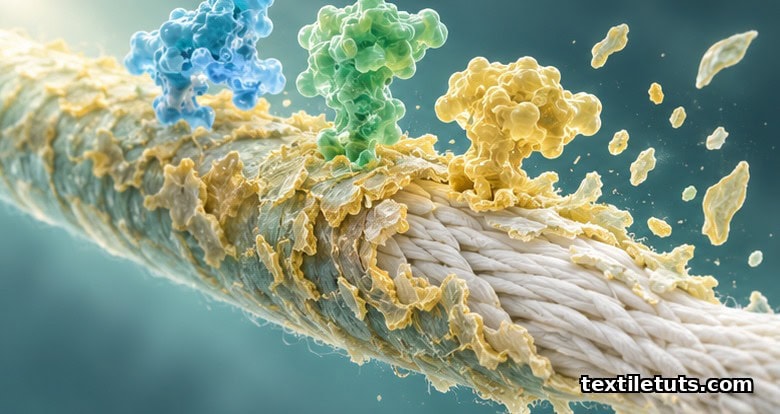
- Polygalacturonase (EC 3.2.1.15), which cleaves the alpha-1,4 glycosidic bonds between galacturonic acid units in the pectin backbone.
- Pectin lyase (EC 4.2.2.10), which breaks the same backbone by beta-elimination and is the most active enzyme in alkaline pH.
- Pectin esterase (EC 3.1.1.11), which removes the methyl groups that make pectin insoluble in water.
Once the pectin skeleton is cut, the waxes and proteins that were anchored to it become dislodged and either dissolve into the liquor or are mechanically removed by the agitation of the machine. The cellulose underneath stays chemically intact, which is why strength loss after bioscouring is consistently lower than after caustic scouring on the same fabric lot.
Most published work uses either a fungal pectinase from Aspergillus niger or a bacterial alkaline pectinase from Bacillus species, and many recent papers report engineered Bacillus strains that tolerate pH 9-10 and temperatures up to 65°C, which match the conditions of a standard jet dyeing machine without requiring any retrofit.
Process Parameters and Enzyme Selection
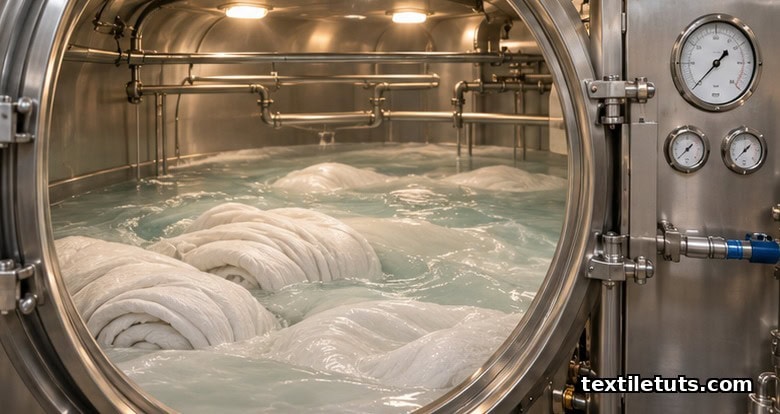
Bioscouring runs at much milder conditions than alkaline scouring, but every parameter still matters. The window below is the range that appears most often in peer-reviewed studies and in supplier technical data sheets for cotton knit fabric.
- pH: 7.0-9.5, depending on whether the enzyme is fungal (neutral) or bacterial alkaline-tolerant.
- Temperature: 45-65°C. Above 70°C most pectinases denature quickly and lose activity.
- Liquor ratio: 1:6 to 1:10 for knit fabric in a jet or soft-flow machine.
- Time: 30-60 minutes, with most of the action in the first 30 minutes.
- Enzyme dose: 0.05-0.5% on weight of fabric (owf), typically 0.1-0.3% owf for knit.
- Surfactant: 0.5-2.0 g/L non-ionic wetting agent, almost always required because the cuticle is hydrophobic and water alone cannot reach the pectin.
- Mechanical action: gentle agitation is enough; high turbulence can foam the enzymes and reduce activity.
A typical recipe for a cotton single jersey is 0.2% owf pectinase, 1 g/L non-ionic surfactant, pH 8.5 buffered with phosphate or citrate, 55°C, 45 minutes, and a liquor ratio of 1:8. After the enzyme step, a hot rinse at 80°C deactivates the enzyme and carries dissolved impurities out of the fabric.
Bioscouring vs Alkaline Scouring: Side-by-Side Numbers
The table below compares the two routes on the variables a production manager cares about. Numbers are drawn from peer-reviewed cotton studies and supplier datasheets, and they fall inside the range most mills see in practice.
| Parameter | Alkaline Scouring (NaOH) | Enzymatic Bioscouring |
|---|---|---|
| Temperature | 95-100°C | 45-65°C |
| pH | 12-14 | 7.0-9.5 |
| Time | 30-60 min | 30-60 min |
| Weight loss | 5-8% | 3-5% |
| Tensile strength loss | 8-12% | 2-5% |
| Water use | High (multiple rinses) | Low (one hot rinse) |
| Effluent COD | 5,000-8,000 mg/L | 1,500-2,500 mg/L |
| Energy (thermal) | Baseline | 40-50% of baseline |
| Wettability (AATCC TM 79 drop time) | Under 5 s | Under 5 s |
| Capital cost | Low (existing machines) | Low (same machines, new chemistry) |
| Chemical cost per kg | Low | 20-40% higher |
Performance Testing After Bioscouring
Bioscouring has to clear the same quality gates as alkaline scouring before the fabric moves to bleaching and dyeing. The four tests that matter most are:
- AATCC TM 79 (Absorbency of Textiles). Drop time under 5 seconds across the full fabric width.
- AATCC TM 97 (Extractable Matter in Greige and Scoured Textiles). Mass loss should fall in the 3-5% range for bioscoured knit.
- ISO 1833-1 quantitative chemical analysis to confirm residual non-cellulosic content is below about 1.5%.
- Tensile strength per ASTM D5034 (Grab Test) or ISO 13934-1 (Strip Test). Bioscoured knit typically loses 2-5% warp and weft strength, versus 8-12% for hot caustic.
Dye uptake is the final integration test. Reactive dyes on bioscoured cotton typically give K/S values within 3% of caustic-scoured controls at the same shade depth, and the levelness rating on a 1-5 gray scale is generally 4 or higher. The cases where bioscouring underperforms are usually traced back to under-dosed surfactant, low bath agitation, or a fabric that was never properly desized before the enzyme step, which is why most mills keep a desize stage in front of bio-preparation.
Limitations and Industrial Reality
Bioscouring is not a drop-in replacement in every mill, and the trade-offs deserve to be named so that production teams do not over-promise on the floor.
First, the cost per kilogram of fabric is still 20-40% higher than caustic soda because enzymes are more expensive per kilogram than NaOH. The savings show up in energy, water treatment, and reduced fiber damage, so the business case depends on local utility tariffs and effluent surcharges.
Second, pectinase alone does not always remove wax to the level that high-end reactive dyeing needs, especially on very waxy cotton varieties such as Indian or Pakistani DCO counts. Most commercial bioscouring recipes therefore pair pectinase with a small dose of lipase or follow the enzyme step with a very dilute NaOH boost at 60-70°C.
Third, enzyme activity is sensitive to metal ions and to residual peroxide, so the bleach and the scour step must be sequenced carefully. A combined scour-bleach with peroxide and pectinase in one bath is possible but requires an alkaline-tolerant, peroxide-tolerant enzyme and tighter process control than the sequential route.
Fourth, bioscouring does not remove knitting oils, machine oil, or coning oils the way a hot caustic wash does. Silicone-based lubricants in particular need a separate detergent step. The same is true for size residues from synthetic warp sizes; PVA or acrylic sizes need an oxidative desize before the enzyme step.
Frequently Asked Questions
What is bioscouring in textile processing?
Bioscouring is an enzymatic pretreatment that removes pectins, waxes, and proteins from greige cotton at pH 7-9.5 and 45-65°C, replacing the conventional 95-100°C NaOH scouring step. It uses pectinase enzymes (polygalacturonase, pectin lyase, pectin esterase) to release the waxy cuticle from the cellulose fiber without dissolving any of the cellulose itself.
Which enzyme is used for bioscouring of cotton?
Pectinase is the primary enzyme, usually supplied as a cocktail of polygalacturonase, pectin lyase, and pectin esterase. Commercial products are sourced from Aspergillus niger (fungal, neutral pH) or from engineered Bacillus strains (bacterial, alkaline-tolerant pH 9-10). Lipase and cellulase are sometimes added to improve wax removal or surface cleaning on heavily waxy cotton.
How does bioscouring compare to alkaline scouring for absorbency?
Both routes deliver AATCC TM 79 drop times under 5 seconds on properly prepared knit cotton. Bio-scoured fabric typically shows the same or slightly higher drop time on first absorbency because the cuticle is removed but the lumen and fine pores are preserved, giving a more uniform wicking profile across the fabric width.
Does bioscouring damage cotton fiber strength?
No. Pectinase is specific to pectin and does not cleave cellulose, so tensile strength loss after bioscouring is typically 2-5%, versus 8-12% for 95°C NaOH scouring. The cellulose degree of polymerization is preserved above 95% in most peer-reviewed studies, which translates to longer service life for the finished fabric and fewer breaks in subsequent knitting or weaving.
Is bioscouring more sustainable than alkaline scouring?
On the metrics that mills track (energy, effluent COD, water use, fiber damage), yes. Bioscouring cuts thermal energy by roughly 50%, lowers effluent COD by 60-70%, and reduces water use because the rinse step is shorter. The trade-off is higher chemical cost per kg fabric, which is offset where effluent surcharges or carbon credits apply. Enzyme effluxants are also fully biodegradable, unlike the highly alkaline spent liquor from caustic scouring that must be neutralized before discharge.
References
- AATCC. Test Method 79-2014: Absorbency of Textiles. AATCC Technical Manual, ResearchGate copy available — drop test method used to verify scouring effectiveness on cotton.
- AATCC. Test Method 97-2013: Extractable Matter in Greige and Scoured Textiles. AATCC Technical Manual — gravimetric method used to confirm the 3-5% mass loss window after bioscouring.
- ASTM International. ASTM D5034-21: Standard Test Method for Breaking Strength and Elongation of Textile Fabrics (Grab Test). ASTM — used to verify tensile strength retention after bioscouring.
- ISO. ISO 1833-1:2020 Textiles — Quantitative Chemical Analysis — Part 1: General Principles. ISO — used to quantify residual non-cellulosic content on scoured cotton.
- ISO. ISO 13934-1:2013 Textiles — Tensile Properties of Fabrics — Part 1: Determination of Maximum Force Using the Strip Method. ISO — alternative tensile method for woven and knit cotton.
- Li, Y. and Hardin, I. R. (1998). Enzymatic Scouring of Cotton: Effects on Structure and Properties. Textile Chemist and Colorist, 30(9), 23-29. ResearchGate — peer-reviewed study that established the temperature and pH window for cotton pectinase bioscouring.
- Calafell, M., Klug-Santner, B., Guebitz, G. and Nyanhongo, G. S. (2004). Bio-scouring of Cotton: The Effect of Pectinases on the Surface Morphology. Journal of Natural Fibers, 1(3), 41-58. Taylor & Francis — peer-reviewed analysis of how pectinase activity alters cotton cuticle surface morphology.
Editorial by Shahrukh Islam, TextileTuts. Sources: AATCC TM 79-2014, AATCC TM 97-2013, ASTM D5034-21, ISO 1833-1:2020, ISO 13934-1:2013, Li & Hardin 1998, Calafell et al. 2004.


