
Sateen vs Satin: Structural Differences

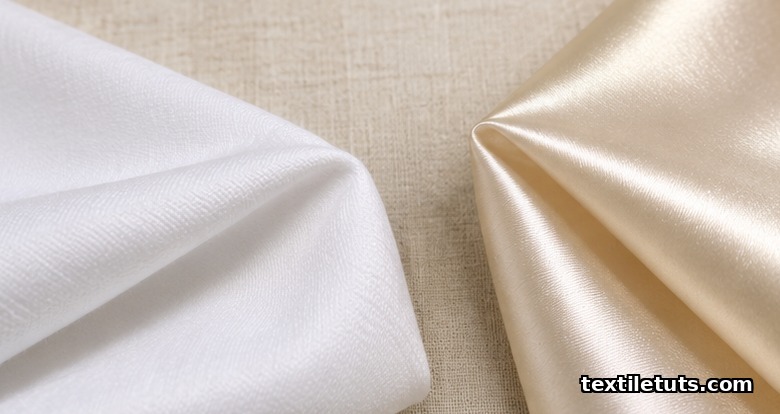
Sateen and satin share the same 4-, 5-, or 8-end satin weave draft but invert which yarn set floats on the face: sateen is a weft-faced weave where the weft (typically spun cotton) floats across 4 to 7 warp ends before going under one, while satin is a warp-faced weave where the warp (typically filament silk, polyester, or nylon) floats across 4 to 7 weft picks before going under one.
That single inversion of the float direction changes the fiber chemistry, the luster mechanism, and the fabric’s end-use performance, which is why cotton sateen sheets feel soft and slightly matte while polyester or silk satin lingerie looks glossy and slippery.
The article below walks through the structural differences that textile engineers actually measure on the loom, then connects those differences to the hand, drape, durability, and finishing of the finished cloth.
The satin weave family: 4-end, 5-end, and 8-end drafts
Both sateen and satin belong to the satin weave family defined in ISO 3572:1976 (“Textiles, Weaves, Definitions of general terms and basic weaves”). A satin draft is identified by a step number between 2 and (N,1) where N is the number of ends in the repeat. The warp and weft never run parallel for more than one pick or end, which is what produces the smooth, almost unbroken surface that distinguishes the family from plain and twill weaves.
The three common repeats are 4-end (also written 3/1 satin, step 2 or 3), 5-end (4/1 satin, step 2 or 3), and 8-end (7/1 satin, step 3 or 5). Each repeat produces a different visual rhythm of the float scatter, but the underlying structural rule is identical: no two adjacent yarn crossings form a straight line, and the maximum float length is N,1.
Because a longer float exposes more yarn surface, luster increases with the repeat length. An 8-end sateen reads as softer and more lustrous than a 4-end sateen at identical yarn count, which is why premium cotton sheets typically use a 5- or 8-end draft woven at 300 to 600 threads per square inch.
Sateen: weft-faced floats from spun yarn
A sateen fabric is built by inverting the satin draft so the weft yarn floats over the warp. On the loom, the warp is held under higher tension than the weft (the warp-beam tension versus the shuttle, rapier, or air-jet insertion), and the weft is beaten up loosely to keep the warp straight and the weft crimped. That crimp pushes the weft loops to the face of the cloth and gives sateen its characteristic soft, full hand.
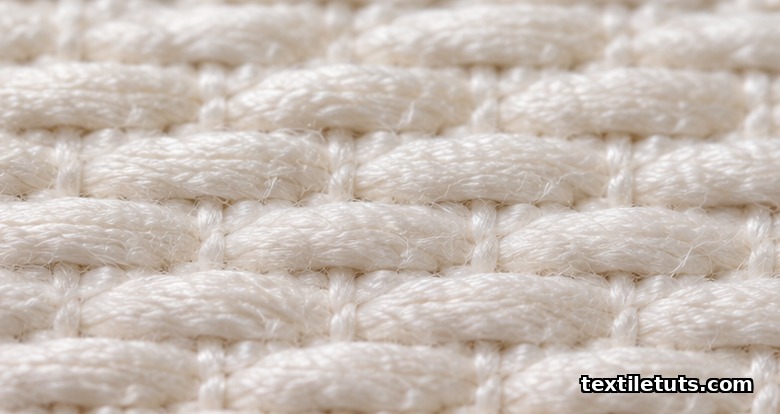
The weft is almost always a spun staple yarn (cotton, sometimes modal or viscose staple). Spun yarns have protruding fiber ends that scatter light, so a piece of greige sateen looks matte. To produce the silken sheen the market expects, sateen is mercerized in a cold sodium hydroxide bath at roughly 20 to 25 percent concentration (per AATCC Technical Manual guidance on mercerization), which swells the cotton fiber, rounds its cross-section, and increases its reflectance by about 15 to 25 percent.
Construction numbers from the trade: a standard 300-thread-count sateen sheet uses roughly 60 to 80 warp ends per centimeter and 35 to 50 weft picks per centimeter, balanced toward the warp so the long weft floats dominate the face. Weights typically run 110 to 180 GSM (grams per square meter, measured per ISO 3801:1977) for sheeting, and 200 to 320 GSM for heavier sateen used in outerwear and shirting.
Satin: warp-faced floats from filament yarn
Satin is the warp-faced twin of sateen. The warp floats across the face and is held under lower tension than the weft so the warp crimps slightly, exposing smooth, parallel yarn runs on the face. Because warp floats dominate the surface, the warp yarn itself must produce the luster, which is why satin is woven almost exclusively from continuous filament fibers (silk, polyester, nylon, or viscose/rayon filament).
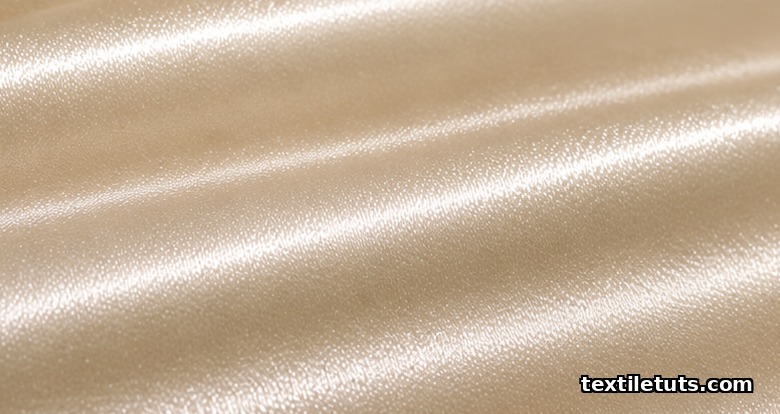
Filament yarns have no protruding fiber ends to scatter light, so each long warp float acts like a tiny mirror. To further increase gloss, satin is hot-calendered between heated steel rollers at 150 to 200 degrees Celsius, a finishing step that flattens any remaining fiber cross-section and aligns the filaments parallel to the calendar roll. The result is the high-gloss satin used in lingerie, evening linings, bridal gowns, and neckties.
Common constructions: 4-end satin ribbon at 30 to 50 GSM, 5-end acetate lining at 60 to 90 GSM, 8-end silk satin at 90 to 130 GSM. Thread counts in filament satins are lower than in cotton sateen (typically 150 to 300 total threads per square inch) because the luster comes from yarn geometry rather than density.
Mechanical differences on the loom
The loom setup is the most concrete difference between the two fabrics. Textile engineers adjust four variables when switching a loom from one face side to the other.
- Draft and lifting plan: identical repeat numbers (4, 5, or 8) but inverted shed timings. Sateen lifts the warp fewer times per repeat; satin lifts the warp more often.
- Yarn tension: sateen uses higher warp tension to suppress warp crimp and expose the weft; satin uses higher weft tension to expose the warp.
- EPI versus PPI (ends per inch versus picks per inch): sateen typically runs higher EPI than PPI; satin typically runs higher PPI than EPI.
- Finishing route: sateen is mercerized; satin is calendered and sometimes heat-set.
Changing the draft direction takes about 30 minutes on a modern cam or jacquard loom; the tension, EPI/PPI balance, and finishing recipe have to be reset by a skilled technician. Thread counts and weight are measured per ISO 7211-2:1984 (number of threads per unit length) and ISO 3801:1977 (mass per unit area).
Hand, drape, and abrasion behavior
The yarn direction on the face controls three end-use properties: hand, drape, and abrasion behavior.
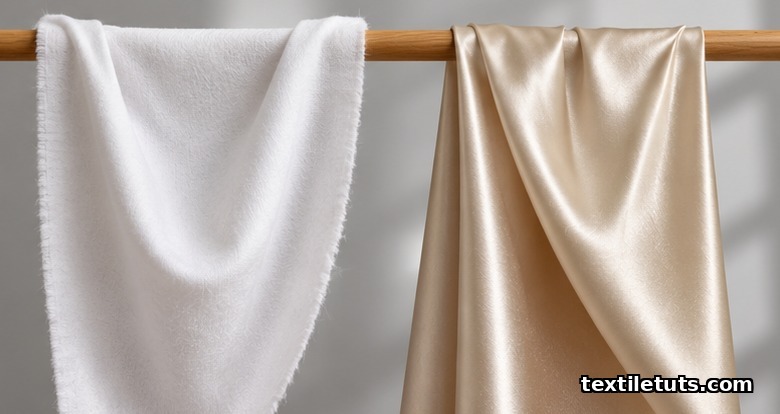
Hand. Sateen feels soft, full, and slightly fuzzy because spun cotton fiber ends protrude. Satin feels slick, cool, and dense because filament yarns are smooth to the touch.
Drape. Sateen drapes in a soft, rounded fold that hugs the body. Satin drapes in a sharper, more angular fold with high liquid-like flow, a property textile engineers call plastic drape. Both fabrics have higher drape coefficients than plain weave, but filament satin’s drape coefficient measured by cantilever-style methods is consistently higher than cotton sateen’s.
Abrasion. Filament yarns lose luster faster than spun yarns when abraded because the smooth floats catch on surfaces. AATCC Test Method 93 (TM-93) for fabric luster after repeated abrasion shows that filament satins lose 30 to 50 percent of their gloss after 5,000 cycles on a Martindale tester, while mercerized cotton sateen retains 80 to 90 percent of its initial gloss at the same abrasion count.
Structural and performance comparison
| Property | Sateen | Satin |
|---|---|---|
| Float direction | Weft-faced (weft floats on face) | Warp-faced (warp floats on face) |
| Typical yarn type | Spun staple (cotton, modal, rayon staple) | Continuous filament (silk, polyester, nylon, viscose) |
| Common repeat | 4-, 5-, or 8-end | 4-, 5-, or 8-end |
| Luster mechanism | Mercerization swells cotton fiber; about 15 to 25 percent reflectance gain | Long parallel filament floats, enhanced by hot calendering at 150 to 200 degrees Celsius |
| Typical thread count | 200 to 600 threads per square inch | 150 to 300 threads per square inch |
| Hand | Soft, full, slightly fuzzy | Slick, cool, dense |
| Drape | Rounded, body-hugging | Sharp, liquid, plastic drape |
| Typical weight (sheeting or lining) | 110 to 180 GSM | 60 to 130 GSM |
| Common finishing | Mercerization, singeing, sanforizing | Hot calendering, heat-setting, sometimes acid finishing for silk |
| Typical end use | Bed sheets, dress shirts, casual linings | Lingerie, eveningwear, formal linings, neckties, ribbons |
Frequently Asked Questions
Is sateen just a synonym for satin?
No. “Satin” historically refers to a warp-faced weave with filament yarns (the original Chinese silk satin, introduced to Europe via the Arab silk road). “Sateen” was coined in the 19th century to describe the weft-faced version made from cotton, which behaves differently in production and finishing. Both fabrics use the same satin weave draft; only the float direction and yarn type differ.
Which fabric is more durable, sateen or satin?
Cotton sateen generally outlasts filament satin under normal use and laundering. Mercerized cotton retains its luster through 100 plus wash cycles (per AATCC Test Method 135 for home laundering), while filament satin loses fiber surface gloss and can develop pulls and snags. For heavy-use items such as bed sheets and shirting, sateen is the more durable choice.
Why does sateen cost less than silk satin at similar thread counts?
Spun cotton is roughly 5 to 10 times cheaper per kilogram than long-staple silk or fine polyester filament, and the mercerization step is faster and cheaper than the multi-stage calendering and degumming process used on silk satin. For the same area of cloth, cotton sateen production cost typically runs 30 to 60 percent lower than silk satin.
Can a fabric legally be called “satin” if it is made from cotton?
Strictly no, in textile-engineering usage. ISO 3572:1976 and ASTM D4850 (“Standard Terminology Relating to Fabrics”) reserve “satin” for warp-faced filament constructions and “sateen” for weft-faced spun constructions. In retail marketing the terms are sometimes used loosely, but on a technical sheet or in a textile specification, the correct term for a cotton weft-faced fabric is sateen.
Does sateen wrinkle more than satin?
Yes. Spun cotton fibers bend plastically under humidity and pressure, so sateen shows creases after washing and needs ironing or tumble-drying to recover. Filament satin springs back because synthetic or silk filaments have higher elastic recovery, and a steamed silk satin recovers most wrinkles without ironing. This wrinkle behavior is a direct consequence of the fiber chemistry, not the weave structure.
References
- International Organization for Standardization. ISO 3572:1976, Textiles, Weaves, Definitions of general terms and basic weaves. iso.org, definitions of plain, twill, and satin family weaves including weft-faced sateen variants.
- ASTM International. ASTM D4850, Standard Terminology Relating to Fabrics. astm.org, canonical definitions for woven-fabric structural terms used in the textile trade.
- American Association of Textile Chemists and Colorists. AATCC Technical Manual, current edition. aatcc.org, includes Test Method 93 (luster after abrasion), Test Method 135 (home laundering), and mercerization process guidance.
- International Organization for Standardization. ISO 3801:1977, Textiles, Woven fabrics, Determination of mass per unit length and mass per unit area. iso.org, the reference method for GSM measurement cited in fabric specification sheets.
- International Organization for Standardization. ISO 7211-2:1984, Textiles, Woven fabrics, Construction, Methods of analysis, Part 2: Determination of number of threads per unit length. iso.org, the reference method for thread-count analysis used in woven-fabric QC.
- Kadolph, S. J., and Langford, A. L. Textiles, 11th Edition. Pearson Prentice Hall, 2007, textile-engineering textbook covering satin and sateen weave structure, drafting, and finishing (chapter on lustrous woven fabrics).
Editorial by Mohammad Yousuf (Anik), TextileTuts. Sources: ISO 3572:1976, ISO 3801:1977, ISO 7211-2:1984, ASTM D4850, the AATCC Technical Manual, and Kadolph & Langford, Textiles, 11th Edition, as cited.


