
Sanforizing: Shrinkage Control

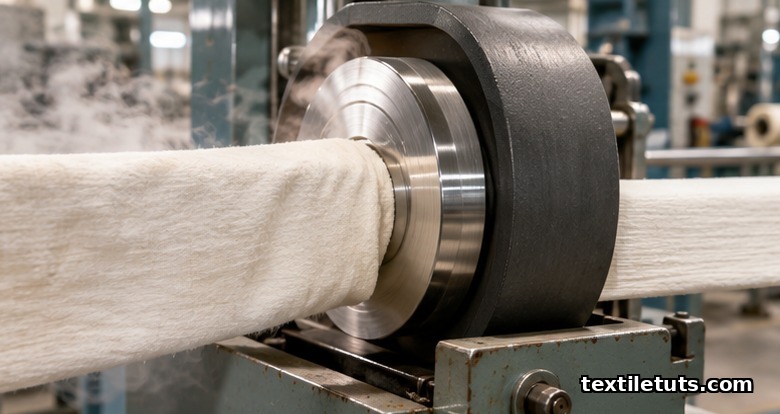
Sanforizing limits residual fabric shrinkage to 1% or less (typically 0 to 1% after five home-laundering cycles) by feeding damp cotton or cotton-blend cloth through a heated rubber belt that mechanically compresses the yarns before the fabric is dried and finished, a process patented in the United States beginning in 1930 by Sanford Lockwood Cluett and trademarked as “Sanforized.”
It is the dominant industrial method for producing pre-shrunk cotton and cotton-rich woven fabric, and it is the reason a sanforized shirt keeps its size after repeated wash cycles at home.
This article covers how the sanforizing machine works at the nip level, the standards that certify its performance, and the practical difference between sanforized and unsanforized cloth on the cutting table and in the finished garment.
What Sanforizing Is
Sanforizing is a controlled compressive-shrinkage finishing process applied to woven cotton and cotton-blend fabric before cutting and sewing. The term is a registered trademark of Cluett, Peabody & Co., Inc., but the underlying process has become the generic industrial name for compressive pre-shrinking of cloth.
The original U.S. patent (US 2,078,898, granted in 1937 to Sanford Lockwood Cluett and assigned to Cluett, Peabody & Co.) describes a method in which moist cloth is passed between a heated cylinder and a thick rubber blanket. As the rubber belt leaves the nip of the cylinder it tries to spring back to its original length, compressing the cloth against the cylinder. The compressive force shortens the fabric in the warp direction by an amount that cancels the relaxation and swelling shrinkage that would otherwise occur during subsequent home laundering.
The output is a fabric that meets the Sanforized standard of 1% or less residual shrinkage in both warp and weft, as measured against AATCC TM135 dimensional-change testing.
How the Sanforizing Machine Works
A modern sanforizing range consists of a fabric-feed section, a moistening or steaming unit, the compressive-shrinkage unit, a felt or woolen blanket dryer, a cooling section, and a winding unit. The key elements are:
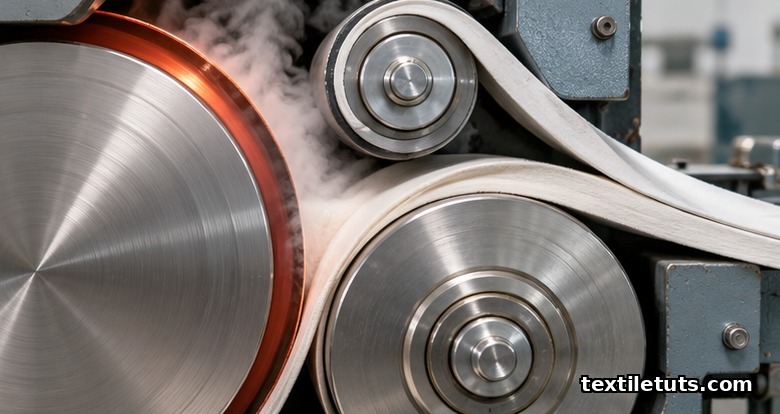
- Moistening unit: Steam or water spray dampens the cloth to a target wet pickup of around 30 to 60% by weight, which plasticises the cotton fibers and lets them be rearranged without damage.
- Feed and overfeed rollers: Overfeed controls how much warp-wise compaction the cloth receives. Typical overfeed is 5 to 15%, set against the shrinkage the mill expects from the unfinished fabric.
- Compressive-shrinkage unit: A heated chrome or cast-iron cylinder (typically 150 to 180 °C surface temperature) presses the cloth against a thick rubber blanket. The blanket is stretched over a smaller roller at the entry and a larger roller at the exit, so its return to natural length applies a controlled compressive force to the cloth.
- Blanket dryer: The blanket is dried and re-tensioned, ready for the next pass.
- Fabric dryer and palmer unit: Sets the final width and removes residual moisture.
The geometry is essentially a friction-driven compressive nip. The warp-direction compression can be measured on-line by comparing input and output speeds of the cloth through the unit, and modern lines are closed-loop controlled to hold shrinkage within plus or minus 0.5% of target.
Standards and Test Methods
Sanforized-quality fabric is verified against the same dimensional-change test methods that apparel brands and retailers use for finished garments:
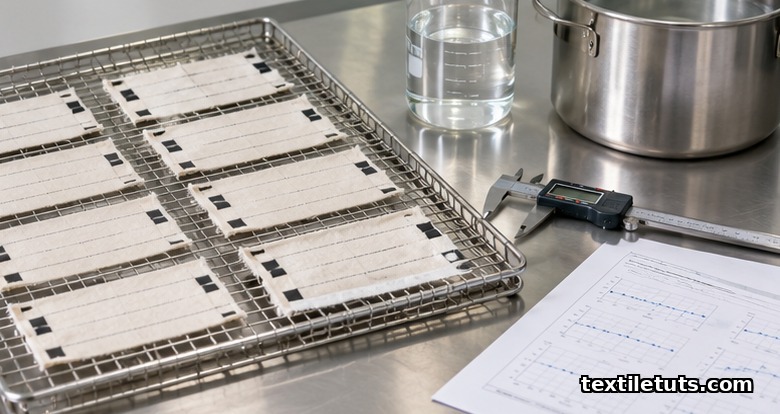
- AATCC TM135, Dimensional Change of Fabrics after Home Laundering, specifies a 5-cycle wash at controlled temperature followed by tumble drying; residual shrinkage is reported as a percentage change in marked dimensions.
- ISO 5077, Determination of Dimensional Change of Woven and Knitted Fabrics after Washing and Drying, uses paired fabric markers and reports change after each cycle.
- ISO 6330, Domestic Washing and Drying Procedures for Textile Testing, defines the wash and dry conditions referenced in ISO 5077.
- ASTM D2724, Standard Test Methods for Bonded, Laminated, and Lined Apparel Fabrics, includes dimensional-change procedures for lined apparel.
- ASTM D3774, Standard Test Methods for Weight of Woven or Knitted Fabrics, is run alongside shrinkage tests to confirm that compressive pre-shrinking has not changed the fabric’s mass per unit area beyond tolerance.
A fabric that carries the Sanforized mark must show 1% or less residual shrinkage in both warp and weft after five AATCC TM135 cycles at 40 °C with tumble drying.
Sanforized vs. Unsanforized Cloth
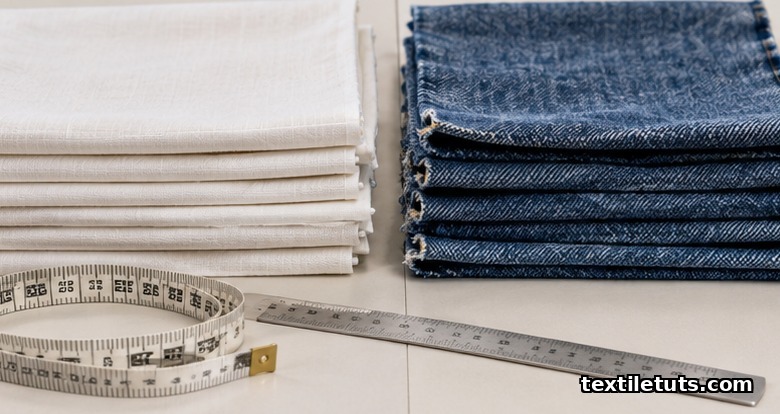
The practical difference is most visible in cotton shirting, workwear, and denim. Unsanforized cloth (also called loom-state) is finished without compressive pre-shrinking and can shrink 5 to 12% in warp and 3 to 8% in weft on the first wash. Sanforized cloth shrinks 0 to 1%.
| Property | Sanforized | Unsanforized (loom-state) |
|---|---|---|
| Residual shrinkage, warp, after 5 home-laundering cycles | 1% or less | 5 to 12% |
| Residual shrinkage, weft, after 5 cycles | 1% or less | 3 to 8% |
| Mill-side shrinkage compensation | Built into the finish | Garment maker must up-size the pattern |
| Stability of finished garment | High | Variable, one wash reshapes the garment |
| Hand (feel) | Slightly smoother, more uniform | Stiffer, more textured |
| Common end uses | Shirts, sheets, mass-market denim, uniform fabrics | Selvedge denim, heritage workwear |
The hand difference comes from the fact that the rubber blanket compresses the surface yarns and slightly flattens the weave. Unsanforized cloth retains the fuller, more open yarn structure it had off the loom, which some wearers prefer for its visual texture.
Limitations of Sanforizing
Sanforizing is a mechanical finish that controls relaxation and swelling-type shrinkage. It does not control every form of dimensional change:
- Heat shrinkage in polyester-cotton blends is not eliminated, because the synthetic component has its own thermal history.
- Felting shrinkage in wool is a separate mechanism (scale-directed fiber migration) and requires a different finishing route, such as chlorination or polymer-based machine-washable treatments.
- Stretch and recovery in knit fabrics is governed by yarn-loop geometry, which sanforizing only addresses indirectly.
- Shrinkage from excessive heat, such as tumble-drying on high settings or ironing above 200 °C, can still cause additional contraction outside the AATCC TM135 test envelope.
For most cotton-rich woven apparel the sanforizing finish keeps the fabric within plus or minus 1% of its cut size, which is the tolerance most ready-to-wear programs require.
Frequently Asked Questions
What does “Sanforized” mean on a fabric label?
“Sanforized” means the fabric has been compressed by the Cluett sanforizing process and tested to a residual shrinkage of 1% or less after five home-laundering cycles per AATCC TM135. The mark is a registered trademark and is licensed to textile mills that pass periodic third-party testing.
Is sanforized cotton really shrink-proof?
No. Sanforized cotton is rated to 1% or less residual shrinkage under standard home-laundering conditions, but exposure to high heat, hot wash cycles above 60 °C, or aggressive tumble drying can still cause additional contraction outside that envelope.
Does sanforizing affect fabric hand or appearance?
Yes, mildly. The compressive nip flattens the surface yarns and gives sanforized cloth a slightly smoother, more uniform hand than unsanforized cloth. In dyed fabrics this can also reduce the surface hairiness that develops with wear.
Why do some denim mills still use unsanforized cloth?
Heritage and selvedge denim programs use unsanforized cloth because the rougher surface texture shrinks in a way that produces more visible fade contrast and a more personalized fit after the first wash. The trade-off is that the garment must be sized larger at the cut stage.
Is sanforizing the same as mercerizing?
No. Mercerizing is a chemical finish that swells cotton fibers in caustic soda to improve luster, dye uptake, and tensile strength; sanforizing is a mechanical finish that controls dimensional change. The two are commonly combined in a single finishing sequence, but they address different properties.
References
- American Association of Textile Chemists and Colorists. AATCC TM135: Dimensional Change of Fabrics after Home Laundering. AATCC Technical Manual. https://www.aatcc.org — defines the 5-cycle wash procedure used to certify Sanforized fabric.
- International Organization for Standardization. ISO 5077: Determination of Dimensional Change of Woven and Knitted Fabrics after Washing and Drying. https://www.iso.org — international method for measuring residual shrinkage.
- International Organization for Standardization. ISO 6330: Domestic Washing and Drying Procedures for Textile Testing. https://www.iso.org — defines the wash and dry conditions referenced in ISO 5077.
- ASTM International. ASTM D2724: Standard Test Methods for Bonded, Laminated, and Lined Apparel Fabrics. https://www.astm.org — includes dimensional-change procedures for lined apparel.
- ASTM International. ASTM D3774: Standard Test Methods for Weight of Woven or Knitted Fabrics. https://www.astm.org — used to verify that compressive pre-shrinking has not altered fabric mass.
- Cluett, S.L. US Patent 2,078,898: Process for Treating Cloth. United States Patent and Trademark Office, 1937. https://patents.google.com — foundational patent for the sanforizing process, assigned to Cluett, Peabody & Co.
- Textile Institute. Woven Textiles: Principles, Technologies and Applications. https://www.textileinstitute.org — reference treatment of compressive pre-shrinking in finishing sequences.
This article is the working reference for sanforizing as a shrinkage-control finish. Editorial by Shahrukh Islam, TextileTuts. Sources: AATCC TM135, ISO 5077, ISO 6330, ASTM D2724, ASTM D3774, US Patent 2,078,898, and the Textile Institute reference cited above.


