
Mercerization: Cotton Treatment

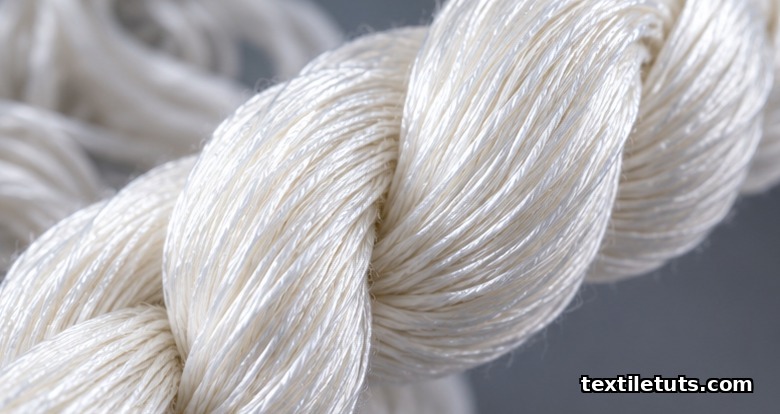
Mercerization is a cotton finishing treatment that immerses cotton yarn or fabric in sodium hydroxide (NaOH) at 20–25% concentration (w/w) and 15–25 °C for 30–60 seconds, increasing fiber tensile strength by 20–25%, dye uptake by up to 25%, and surface luster while converting the native kidney-shaped fiber cross-section into a near-circular one.
This 1844 process, patented by English calico printer John Mercer, remains the standard industrial route to upgrade regular cotton into “pearl” or “mercerized” cotton for shirting, sewing thread, and knitwear. The treatment is chemically irreversible: once cotton has been swollen by concentrated NaOH and rinsed, the cellulose chains never return to their native geometry, even after repeated laundering.
This article walks through the chemistry, process parameters, equipment, property changes, and industry standards for cotton mercerization, and answers the questions textile students and production engineers most commonly ask about it.
What Cotton Mercerization Is and Isn’t
Mercerization is the controlled treatment of native (untreated) cotton cellulose with concentrated aqueous sodium hydroxide, followed by rinsing. The cellulosic hydroxyl groups react with the alkali to form “alkali cellulose,” a swollen gel phase that rearranges the fiber’s internal crystalline structure from Cellulose I to Cellulose II. This polymorphic conversion is permanent; subsequent washing does not reverse it.
What mercerization is not:
- It is not bleaching. Bleaching removes natural color and chromophores using oxidizing agents such as hydrogen peroxide; mercerization changes fiber geometry and reactivity without touching the color bodies in cotton.
- It is not scouring. Scouring removes waxes, pectins, and impurities with hot alkali (typically 2–5% NaOH at the boil); mercerization uses much higher concentration at low temperature and a fundamentally different mechanism.
- It is not a finish or coating. Mercerization is a chemical modification of the cellulose itself, not an applied layer on the fiber surface, so the effect does not wash out or abrade off.
The trade terms “pearl cotton,” “pearl finish,” and “mercerized cotton” describe yarn or fabric that has been through this process. “Pearl” refers to the silky, light-reflective surface produced when tension is held on the fiber during swelling.
The Chemistry: How NaOH Swells Cotton Fiber
Cotton is roughly 88–96% cellulose, the balance being waxes, pectins, proteins, and mineral ash. Cellulose is a linear polymer of β-1,4-linked anhydroglucose units, and each repeat unit carries three hydroxyl groups capable of hydrogen bonding. The native cotton fiber, dried in the field, has these hydroxyls locked into a tight network of intra- and intermolecular bonds that produce the crystalline Cellulose I allomorph.
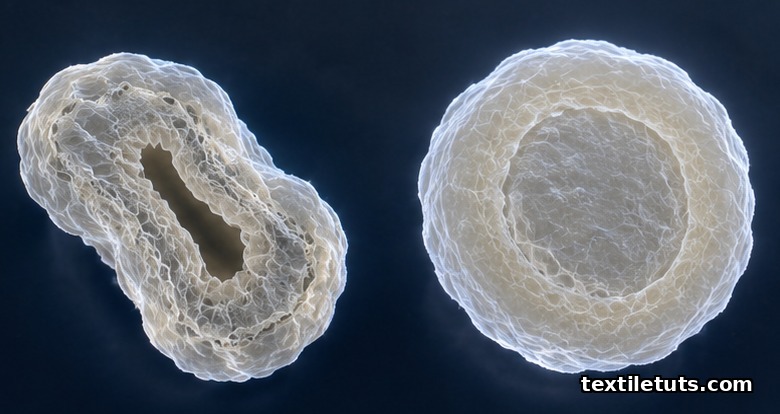
At NaOH concentrations below ~9% (w/w), cotton swells only modestly and the change is largely reversible on rinsing. Above ~15%, NaOH penetrates the fiber’s secondary wall and the central lumen fills with alkali, producing visible fiber swelling of up to 70% in cross-sectional diameter. The fiber cross-section changes from a collapsed, kidney-bean shape to a near-circular tube, and the fiber length also shortens by 1–2% as the chain network relaxes.
Inside the fiber, the alkali disrupts the hydrogen bonds of native cellulose (Cellulose I) and re-forms them in a more stable arrangement known as Cellulose II, the thermodynamically favored allomorph. Cellulose II has a lower degree of crystallinity (about 50% versus 70% for Cellulose I) but a more accessible amorphous phase, which is why mercerized cotton takes up dye, optical brightener, and resin finish more readily than untreated cotton of the same construction.
Process Parameters That Decide Quality
Four variables control the outcome of mercerization: alkali concentration, temperature, immersion time, and applied tension. Each must be held within a tight range, and deviation from the set point shows up immediately in measurable property loss.
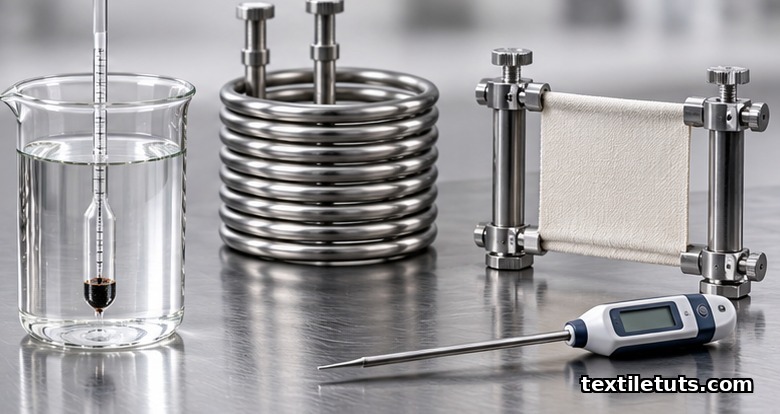
Concentration. The effective window for cotton is 20–25% (w/w) NaOH. Below 18% the swelling is incomplete and the luster gain is poor; above 26% the liquor becomes uneconomical and the risk of oxidative fiber damage rises. Most industrial lines target 22–24% and verify with hourly Baumé hydrometer or acid-base titration checks.
Temperature. Cold is better. Mercerization is carried out at 15–25 °C; higher temperatures (above ~35 °C) reduce fiber swelling and the luster gain. Process lines use chilled NaOH and cooled pad baths to stay in range, and a few specialized ranges add cooling coils inside the saturator to maintain temperature against the heat of dilution.
Time. Immersion time of 30–60 seconds is sufficient for full swelling on yarn or greige fabric. Continuous pad-steam ranges on woven fabric operate at dwell times of 20–40 seconds between impregnation and stabilization, while slack mercerization of yarn in hanks can run 2–5 minutes to allow the alkali to penetrate fully into the yarn bundle.
Tension. This is the variable that controls luster. In slack mercerization (no tension), cotton gains dye affinity and elongation but little luster; the fiber is free to contract as it swells. In tension mercerization (the industrial default for woven fabric), the fibers are held at or near their original length during treatment, which orients the swollen fibrils along the fiber axis and produces the silky, “pearl” reflection that defines premium mercerized cotton.
Yarn Mercerization vs Fabric Mercerization
Yarn mercerization is the original industrial form and remains standard for sewing thread, embroidery thread, and premium knitwear yarns. Hanks or packages of cotton yarn are dipped, held under controlled tension, washed, neutralized with dilute acid, and re-wound. Mercerized sewing thread can reach 25% higher tensile strength than the unmercerized equivalent and shows a marked improvement in loop formation and abrasion resistance on industrial sewing machines, which is why almost every high-end shirt and denim factory specifies mercerized thread.
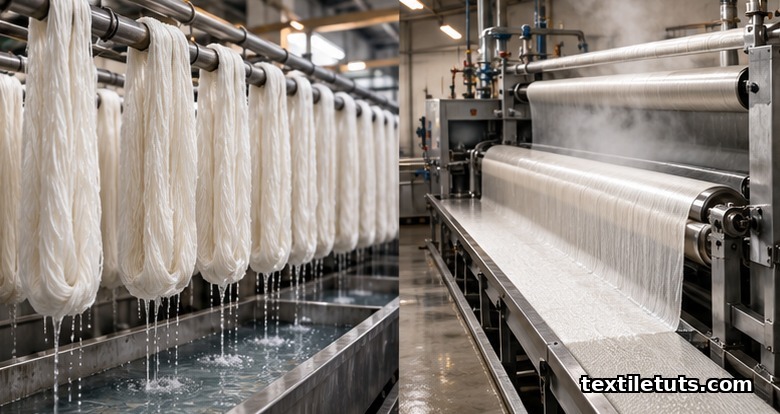
Fabric mercerization is carried out on greige (unbleached) or bleached cotton cloth in open-width form using a chain mercerizer (also called a chainless or clip-stenter mercerizer depending on the design). The sequence is:
- Impregnate with 22–25% NaOH at 15–25 °C in a pad mangle.
- React (dwell) for 30–60 seconds on roller or clip frames, with tension applied to control width and length.
- Stabilize the swollen state with hot water or dilute acid wash.
- Wash counter-currently to remove residual alkali.
- Neutralize with dilute acetic or sulfuric acid.
- Final rinse and dry on a stenter to set width.
Modern ranges run at 30–60 m/min and use caustic recovery systems to recycle up to 95% of the NaOH, which is the largest single operating cost in the process.
Effects on Cotton Properties
The changes mercerization produces are quantifiable, and they are the reason the process has survived 180 years of competition from other finishes.
| Property | Native cotton | Mercerized cotton | Direction of change |
|---|---|---|---|
| Tensile strength | Baseline | +20–25% | Increase |
| Dye uptake (reactive dyes) | Baseline | +20–25% | Increase |
| Luster (visual) | Matte | Silky, pearl-like | Major gain |
| Moisture regain at 20 °C, 65% RH | ~7.0% | ~8.5–9.5% | Higher |
| Crystallinity (XRD) | ~70% (Cellulose I) | ~50% (Cellulose II) | Lower |
| Elongation at break | Baseline | Slightly lower (under tension) | Slight decrease |
| Yarn count (linear density) | Baseline | −5 to −10% | Yarn appears finer |
The dye-uptake gain is the most commercially significant: dyers save dyestuff and achieve deeper shades, and the wash-fastness of reactive dyes on mercerized cotton is consistently higher than on the unmercerized substrate. The strength gain is the second most-cited reason; combined with the smoother surface, it is why mercerized thread outperforms unmercerized thread on high-speed industrial sewing lines.
Industrial Standards and Test Methods
Mercerization is governed by a small set of widely used test methods that mills and buyers reference in specifications:
- AATCC TM 89, Mercerization test, used to confirm that cotton has been through the process by microscopic observation of the swollen cross-section.
- AATCC TM 8, Colorfastness to crocking: AATCC Crockmeter Method, relevant because mercerized cotton is routinely dyed to deep shades that must withstand surface rubbing.
- AATCC TM 61, Colorfastness to laundering, applied to the post-mercerization, dyed product to verify wash durability.
- ASTM D5034, Standard test method for breaking strength and elongation of textile fabrics (grab method), used to confirm the 20–25% strength gain.
- ASTM D3775, Standard test method for warp end count and filling pick count of woven fabric, used to track fabric dimensional change from mercerization.
- ISO 139, Textiles: standard atmospheres for conditioning and testing, applied before tensile or mercerization testing.
Quality control in the plant typically combines three checks: Baumé or titration of the pad-bath NaOH (must stay within ±1% of the set point), on-line width and length sensors on the stenter to track dimensional stability, and laboratory measurement of the iodine sorption value, which correlates directly with the degree of mercerization achieved on the lot.
Frequently Asked Questions
Does mercerization weaken cotton?
No. Mercerization increases cotton’s tensile strength by 20–25% in both warp and weft directions on woven fabric, and by similar margins on mercerized sewing thread. The strength gain comes from the rearrangement of cellulose chains along the fiber axis during the tension-controlled swelling step. Elongation at break decreases slightly, but the load-bearing capacity is unambiguously higher than on the unmercerized substrate.
What concentration of NaOH is used for mercerization?
Industrial cotton mercerization uses sodium hydroxide at 20–25% by weight in water, with most lines targeting 22–24%. Below 18% the swelling is incomplete and the luster gain is poor; above 26% the cost of NaOH, the risk of oxidative fiber damage, and the load on the recovery system all rise without a proportionate gain in properties.
Can mercerization be done at home or in a small lab?
Yes, with appropriate safety controls. A lab-scale mercerization can be done by immersing a scoured cotton swatch in 23% NaOH at 20 °C for 60 seconds under light tension, then rinsing thoroughly, neutralizing with dilute acetic acid, and drying. Concentrated NaOH is corrosive to skin and eyes, so chemical-resistant gloves, goggles, and a fume hood are mandatory. Home-scale cosmetic “NaOH relaxer” treatments sold for hair are a related but uncontrolled process and are not recommended for fabric testing.
Is mercerized cotton better for hot and humid climates?
Mercerized cotton has a higher moisture regain (8.5–9.5% versus ~7% for native cotton), which means it absorbs and releases more perspiration before feeling damp, an advantage in hot, humid wear. The deeper dye shades achievable on mercerized cotton also mean less dye is needed for the same visual depth, which can reduce dye migration in heavy sweat. For shirting, polo knit, and summer-weight knitwear, mercerized cotton is generally preferred in tropical climates.
Does mercerized cotton shrink more than regular cotton?
Mercerized cotton, when properly stabilized and finished, has dimensional stability comparable to or better than unmercerized cotton of the same construction. The Cellulose II allomorph formed during mercerization is more dimensionally stable to repeated laundering than Cellulose I, and tension-controlled fabric mercerization actually pre-shrinks the cloth by 5–10% in length, so residual shrinkage in finished garments is lower than on unmercerized equivalents.
References
- AATCC. TM 89: Mercerization of Cotton. AATCC Technical Manual. https://www.aatcc.org — Test method for confirming cotton has undergone mercerization by microscopic cross-section.
- AATCC. TM 8: Colorfastness to Crocking: AATCC Crockmeter Method. https://www.aatcc.org — Colorfastness test referenced for dyed mercerized cotton.
- ASTM. D5034: Standard Test Method for Breaking Strength and Elongation of Textile Fabrics (Grab Method). https://www.astm.org — Tensile property test used to verify the 20–25% strength gain after mercerization.
- ASTM. D3775: Standard Test Method for Warp End Count and Filling Pick Count of Woven Fabric. https://www.astm.org — Used to track fabric dimensional change of woven cotton during mercerization.
- ISO. ISO 139: Textiles — Standard Atmospheres for Conditioning and Testing. https://www.iso.org — Conditioning standard applied during mercerized-cotton tensile and shrinkage testing.
- S. Park, J. O. Baker, M. E. Himmel, P. A. Parilla, D. K. Johnson. Cellulose crystallinity index: measurement techniques and their impact on interpreting cellulase performance. Biotechnology for Biofuels. https://biotechnologyforbiofuels.biomedcentral.com — Reference for cellulose I (~70%) versus cellulose II (~50%) crystallinity values used in the property table.
This article is the working reference for cotton mercerization. Editorial by Shahrukh Islam, TextileTuts. Sources: AATCC TM 89, AATCC TM 8, ASTM D5034, ASTM D3775, ISO 139, plus peer-reviewed cellulose crystallinity literature as cited.


