
Ruching and Smocking

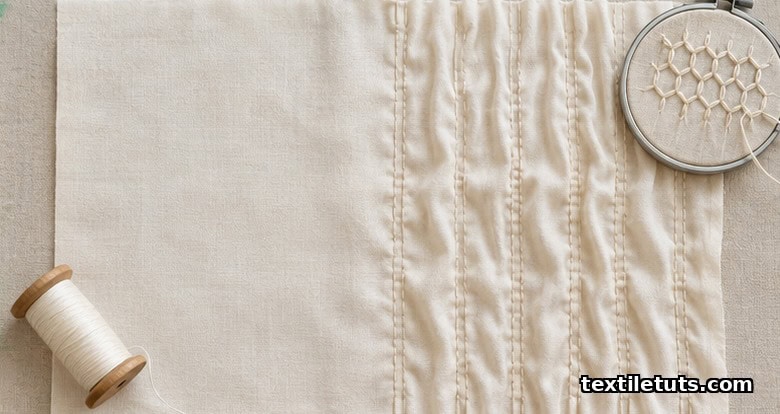
Smocking reduces fabric width by 50 to 67% while adding 50 to 150% stretch along the gathered axis, and ruching creates parallel folds that hold their shape when sewn with elastic or stay stitches at 2.5 to 4.0 mm stitch length. Both finishes depend on controlled thread tension (typically 1.5 to 2.5 N on a home machine) and consistent stitch spacing to gather evenly without puckering the seams.
These two techniques often look similar on a finished bodice, but they belong to different stitch families, suit different fabrics, and serve different constructional goals. Smocking is decorative structural embroidery that locks in stretch. Ruching is parallel pleating that creates drape and surface texture without altering the fabric’s mechanical stretch.
This guide explains how each technique works, the stitches that produce them, the fabrics that hold them, and the failure modes that show up when tension, thread, or fabric choice is wrong.
What Ruching Is, and What It Is Not
Ruching is a fabric gathering technique in which parallel rows of stitches pull the material into soft, uniform folds or ripples. The folds are typically vertical along the panel length on bodices, sleeves, and waist yokes, where they compress width and add gentle dimensional texture. Ruching is decorative. It does not change the fabric’s mechanical stretch, only its surface contour.
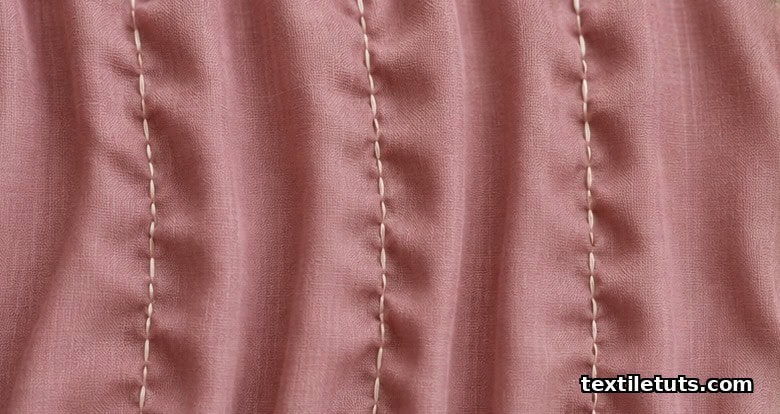
In mass production apparel, ruching is replicated by a panel that is cut on the bias, gathered with a differential-feed serger foot or a Shirring Elastic foot, then topstitched to hold the ripples in place. Garment technicians distinguish ruching from pleating by the absence of a pressed crease line. Pleats are folded and often heat set, while ruched folds are held only by stitch tension.
The simplest ruching method uses two parallel rows of long running stitches (4 to 6 mm stitch length) sewn through a single layer, pulled to gather, then knotted and distributed across the panel. Industrial versions replace this with rows fed through elastic thread on the bobbin, which compresses the panel by 25 to 40% without losing recovery.
What Smocking Is, and How It Differs
Smocking is a structured embroidery technique that combines gathering with surface stitch patterns (most commonly cable stitch, honeycomb stitch, diamond stitch, and V-stitch) to create a panel that is both narrower and stretchier than its flat dimensions. Historical smocking from 15th to 19th century Europe used geometric stitches worked over rows of gathering threads in pleated linen. Modern smocking applies the same logic to lightweight cotton, rayon, or silk.
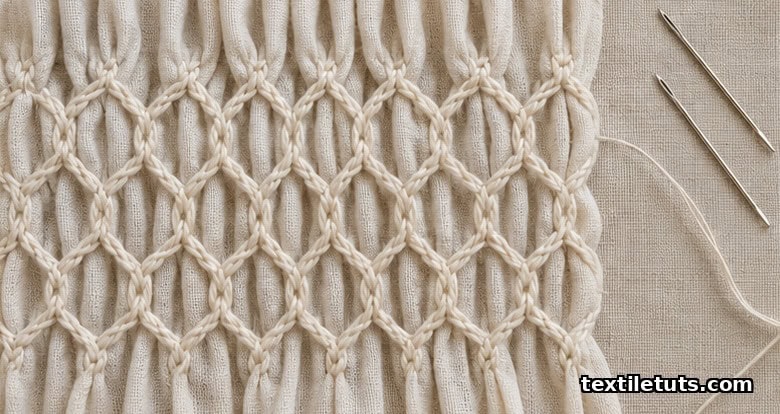
The functional advantage of smocking is that the stitched pattern controls the gathered fabric’s stretch. A standard six-row cable-stitch smocking panel stretches 50 to 150% along the gathered axis and snaps back to its relaxed width when released. This makes smocking a standard construction choice for fitted bodice yokes, children’s wear, and any seam where the fabric must accommodate movement without losing shape.
Unlike ruching, smocking stitches penetrate the full thickness of the fabric at each motif point, locking the gathers in place so the panel does not shift in wear or wash. The pattern is technically embroidery. It counts toward a garment’s stitch density and seaming strategy, not just its surface decoration.
Stitch Anatomy: How the Stitches Differ
Ruching and smocking each rely on different stitch families. Choosing the wrong stitch for the technique is the most common reason samples fail QC.
| Property | Ruching | Smocking |
|---|---|---|
| Primary stitch | Running stitch (stitch type 101 under ISO 4915) | Cable, honeycomb, diamond, V-stitch |
| Typical stitch length | 2.5 to 4.0 mm | 2.5 to 3.0 mm over gathering rows; 4 to 6 mm for surface motifs |
| Row spacing | 8 to 15 mm | 10 to 15 mm |
| Thread type | Ruching elastic (polyester/rubber core) or regular polyester thread | Cotton or cotton/poly smocking thread (50/2 or 60/2) |
| Stitch density per cm² | 2 to 4 stitches | 8 to 20 stitches (motifs cover gathering grid) |
| Stretch gain along gathered axis | 20 to 40% with elastic | 50 to 150% with pattern locks |
ISO 4915:1991 (“Textiles, Stitch types, Classification and terminology”) defines the running stitch family used in ruching as 100-series stitches and the chain and overhand stitches used in traditional smocking motifs as 400-series stitches. ASTM D6193-20 (“Standard Practices for Stitches and Seams”) specifies seam construction tolerances that apply equally to both. Stitch tension should not exceed 2.0 N per needle thread on lightweight woven ground, per AATCC EP5 hand-evaluation guidance.
Fabric Selection
Fabric choice changes the outcome of both finishes more than the technique itself does.
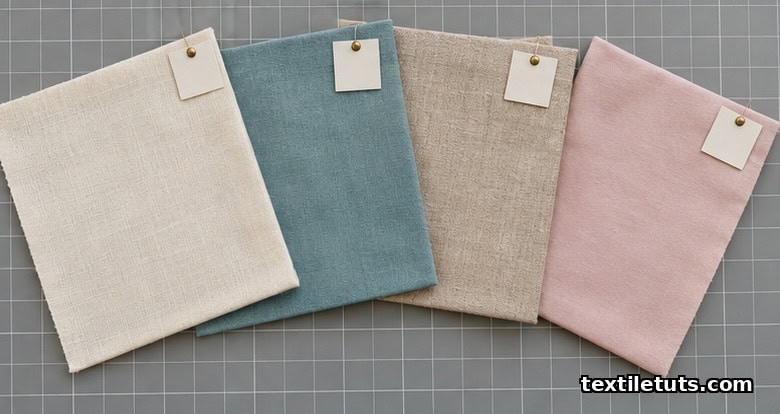
- Ruching works best on lightweight wovens with fluid drape: viscose, silk habotai, polyester chiffon, and cotton lawn. Stiffer fabrics such as denim and canvas will fold sharply and read as pleating rather than soft gathering.
- Smocking needs a fabric with enough body for the embroidery stitches to sit on the surface without pulling through. Plain-weave cotton, cotton/linen blends, and lightweight silk broadcloth are standard. Sheer fabrics such as voile and georgette may tear under the gather density.
- Stretch content shifts the logic. Both finishes are normally applied to woven ground fabric. If the base is a knit such as cotton jersey or interlock, the stretch is already inherent. Smocking then adds structure rather than elasticity, and ruching becomes nearly indistinguishable from seaming ripples.
For consistency under industrial stitching, AATCC Test Method 135 (“Dimensional Changes in Home Laundering”) is the standard reference for predicting how a smocked or ruched panel will recover after wash. Pre-washed, shrink-aged ground fabric shrinks less than 3% post-smocking. Untreated cotton can shrink an additional 5 to 8%, distorting the motif spacing.
Tension, Thread, and Needle
The single biggest controllable variable in either technique is thread tension. The Textile Institute’s “Textile Terms and Definitions” (12th edition) groups ruching and smocking under “ornamental and structural gathering,” noting that tension should be adjusted so the gathering thread lies flat within the fabric surface. Not puckered, not pulled tight enough to distort the weave.
Practical limits for smocking thread tension on a home sewing machine are 2.0 to 2.5 N (about setting 2 to 3 on a typical dial), with a size 9 to 11 needle and 50/2 or 60/2 cotton sewing thread. Industrial smocking machines lock tension between 1.5 and 2.0 N for uniform panels. Above 2.5 N, the smocking thread embeds into the ground fabric and prevents the panel from stretching.
Ruching tension is more forgiving. A 3.0 to 4.0 N upper-thread tension paired with elastic on the bobbin produces the soft ruch effect used in eveningwear. Lower tension produces flatter, more structured folds. Always test tension on a 20 cm square scrap of the actual garment fabric before sewing the panel.
Common Failure Modes
Several predictable problems show up in production runs that mix the two techniques. Knowing the failure mode tells you which stitch family to adjust.
- Asymmetric gathers are caused by uneven backstitch tension at the start and end of the row, not by the technique itself. Lock the start and end with 3 to 4 hand stitches before machine sewing.
- Broken smocking thread in wash is almost always a thread choice issue. Cotton smocking thread under 50/2 weight breaks at temperatures above 60 degrees Celsius. Use a cotton/poly core-spun thread for wash-fast smocked panels.
- Panel growth (the panel stretching out of shape over wear) happens when the elastic thread in ruching has lost recovery. Replace with covered elastic (polyester-wrapped rubber core) that retains 80% or more elongation after 20 wash cycles, per AATCC TM150 conditions.
- Motif distortion in smocking means the decorative stitches pulled the gathering grid out of square. The fix is to baste the gathering rows first, distribute them evenly across the panel width, and only then embroider the motif.
- Visible gathering thread in ruching is a thread color issue. Always match the bobbin elastic to the topstitch thread color, or use a tone-on-tone approach, so the seam stays visually clean.
Production vs. Hand Construction
Hand-smocked panels still appear in heritage garments and high-end childrenswear, where the labor cost is absorbed by the retail price. For volume production, both techniques are typically executed on computer-controlled embroidery machines for smocking, or with multi-needle gathering attachments for ruching. The stitch geometry is identical. Only the speed and the QC tolerance window change.
Industrial tolerances after ASTM D6193-20 set seam slippage at no more than 6 mm under a 100 N load for a 25 mm seam, which applies to the seam joining the ruched or smocked panel to the rest of the garment. A smocked panel that fails this test usually has under-tensioned surface motifs. Re-smocking the grid is more efficient than re-cutting the panel.
Frequently Asked Questions
Is smocking the same as ruching?
No. Smocking is a structured embroidery technique that combines gathering with surface stitch patterns and adds 50 to 150% stretch in the gathered direction, while ruching is parallel gathering without surface motifs that adds drape and visual texture but minimal mechanical stretch. They look similar on a flat garment, but they use different stitch families and serve different constructional purposes.
What fabrics can be smocked?
Lightweight wovens with stable weave structure: cotton lawn, cotton/linen blends, silk broadcloth, and viscose challis. The fabric needs enough body for the embroidery stitches to sit on the surface without tearing, and it should be pre-shrunk if the finished garment will be machine washed.
How much does smocking reduce fabric width?
A standard six-row cable-stitch smocking panel reduces the original fabric width by 50 to 67%. The remaining width retains 50 to 150% stretch along the gathered axis, depending on stitch tension and motif density.
Can ruching be done with elastic thread?
Yes. Industrial ruching almost always uses elastic thread on the bobbin, which compresses the panel by 25 to 40% without losing recovery after washing. For home sewing, wind elastic thread onto the bobbin by hand, use a 4.0 mm stitch length, and reduce upper-thread tension to 2.0 to 3.0 N so the bobbin elastic is not overpowered.
Why does my smocking look uneven after washing?
Because the ground fabric shrank unevenly relative to the smocking thread. Pre-wash the fabric before smocking under AATCC TM135 procedure, or use a cotton/poly core-spun smocking thread that tolerates the wash temperatures cotton cannot. Re-smocking an uneven panel rarely restores the original motif spacing.
References
- International Organization for Standardization. ISO 4915:1991, Textiles: Stitch types, Classification and terminology. iso.org. Defines the 100 and 400 series stitch families used in ruching and smocking.
- ASTM International. ASTM D6193-20, Standard Practices for Stitches and Seams. astm.org. Seam slippage and construction tolerances that govern finished ruched and smocked garments.
- AATCC. AATCC Test Method 135, Dimensional Changes in Home Laundering of Woven Fabrics. aatcc.org. Predicts post-wash shrinkage of smocked and ruched panels.
- AATCC. AATCC Test Method 150, Dimensional Changes in Automatic Home Laundering with Elastic. aatcc.org. Recovery-after-wash testing for elastic-ruched panels.
- The Textile Institute. Textile Terms and Definitions, 12th edition. textileinstitute.org. Canonical reference grouping gathering techniques under ornamental and structural stitching.
- Kadolph, S. and Langford, A. Textiles, 12th edition. Pearson. Sewing-construction chapter, including stitch length and tension tables for gathered finishes.
This article is the working reference for ruching and smocking. Editorial by Kazi Sifat Muntasir, TextileTuts. Sources: ISO 4915:1991, ASTM D6193-20, AATCC TM135, AATCC TM150, Textile Institute Textile Terms and Definitions (12th ed.), Kadolph & Langford Textiles (12th ed.) as cited.


