
A-Line Silhouette Construction

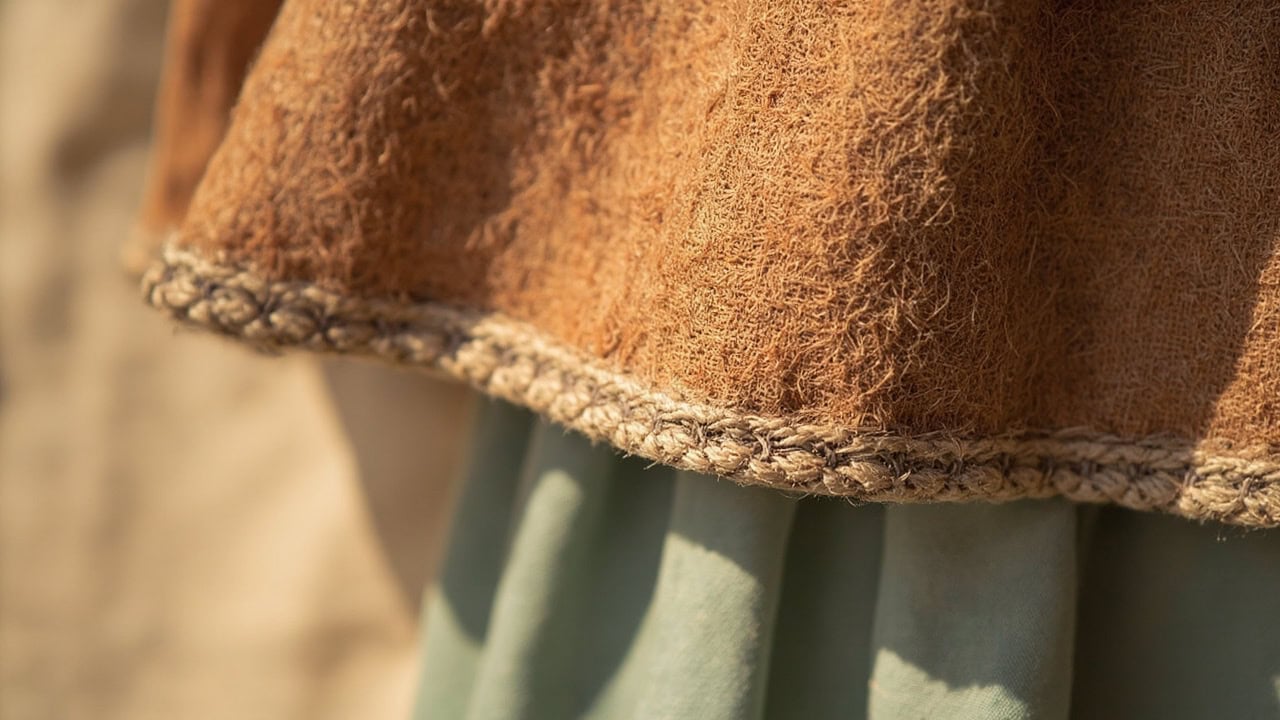
The A-line silhouette is a fitted-through-bust, flared-from-waist garment construction in which the hem circumference measures 1.5 to 3.0 times the waist circumference, producing a triangular profile defined by equal flare increments on either side of the center front line.
This proportional relationship, expressed as a flare ratio between 1.5:1 and 3:1, governs the drape, balance, and walking clearance of the finished garment, and it is the single number a pattern maker adjusts when converting a sheath block into an A-line block.
What follows covers the geometry, pattern drafting, grain alignment, seam engineering, and fit standards that determine whether an A-line garment hangs the way its designer intended.
What makes a silhouette “A-line”
The term was popularized by Christian Dior in his Spring 1955 collection, but the underlying geometry predates that season by centuries of folkwear and workwear construction. The defining property is symmetry of flare: the increase in width from waist to hem, measured at any given distance below the waist seam, is identical on the left side and right side of the garment. This produces the letter-A outline when the garment is laid flat or viewed front-on.
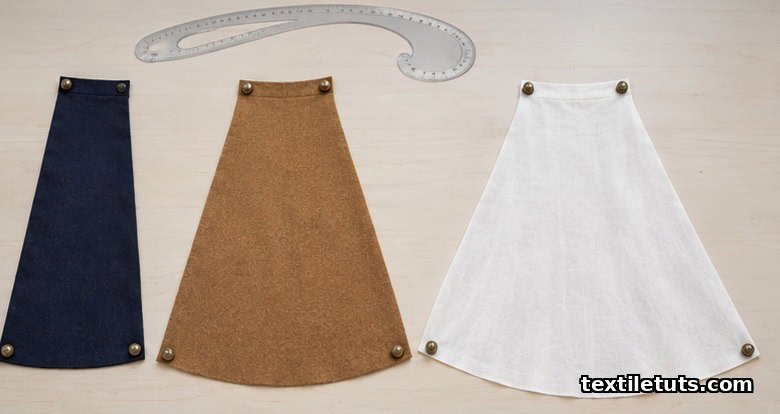
Three flare categories are used in technical pattern work:
- Subtle A-line (1.2:1 to 1.4:1): 6 to 12 cm added to each side seam at the hem. Hangs close to the body, suitable for tailored wool skirts and shirt-dress extensions.
- Classic A-line (1.5:1 to 2.0:1): 15 to 25 cm added per side. The Dior 1955 reference sits in this range, as do most commercial A-line coat and dress blocks.
- Full A-line (2.5:1 to 3.5:1): 30+ cm added per side. Used for tent dresses, full-circle A-line coats, and bridal overskirts.
The flare you select determines both yardage and walking clearance. A 2:1 skirt needs roughly 70 to 90 cm of bottom clearance per step (depending on heel height), while a 3:1 skirt requires 110 to 130 cm. Below that, the wearer catches the hem underfoot.
Pattern drafting mathematics
The A-line block is derived from a basic bodice and straight skirt block by adding wedge-shaped extensions at specific pivot points. The most common drafting method, attributed to the Aldrich drafting system, places two pivot points: one at the waist dart apex and one at the lower hip, then rotates the hem through an arc whose radius equals the desired hem widening.
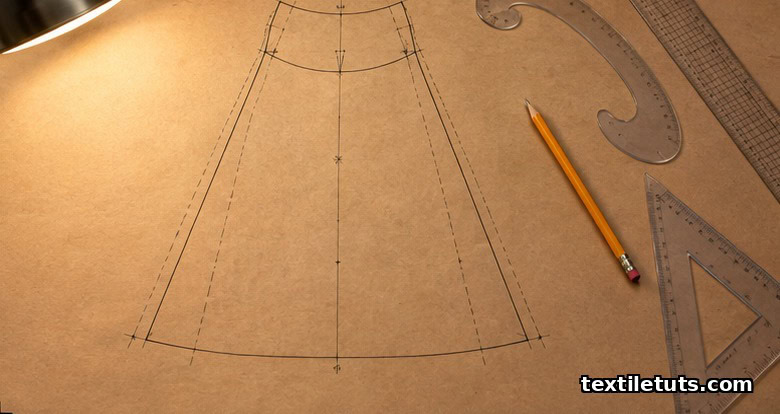
The arithmetic looks like this. For a waist circumference of 70 cm split across four panels (front, side front, side back, back), each panel needs 17.5 cm of waist width. If the target hem circumference is 140 cm (a 2:1 ratio), each panel needs 35 cm of hem width. The pattern maker therefore adds 17.5 cm to each panel’s lower edge, distributed evenly from a pivot point 18 to 22 cm below the waistline.
Three drafting paths give the same result:
- Slash-and-spread: cut the basic block from waist to hem along designated lines, spread the pieces on a flat surface to the desired hem width, and true the new side seams.
- Rotation (pivot method): mark a pivot point at the waist dart, slice the side seam from hem to pivot, and rotate the lower panel until the new hem width is reached.
- Direct measurement: draw the new side seam directly on a fresh pattern block using the formula: added width per side = (target hem circumference minus waist circumference) divided by 4.
Method 1 is the most controllable for grading because the spread amount is recorded as a number rather than buried in a curve. Methods 2 and 3 are faster but harder to scale across sizes.
Grain alignment and its effect on drape
Grain direction matters more in an A-line than in most other silhouettes because the bias grain enters the side seam at an angle that increases as flare grows. In a 2:1 A-line skirt, the side seam sits at roughly 15 to 20 degrees off the straight grain at the hem. In a 3:1 version, that angle grows to 25 to 30 degrees.
Two consequences follow:
- Bias stretch: woven fabric stretched on the bias (45 degrees to warp and weft) exhibits 15 to 25 percent more elongation than on the straight grain. A heavily flared A-line cut on the bias will sag at the side seams over time, dropping the hem 1 to 3 cm below the level line.
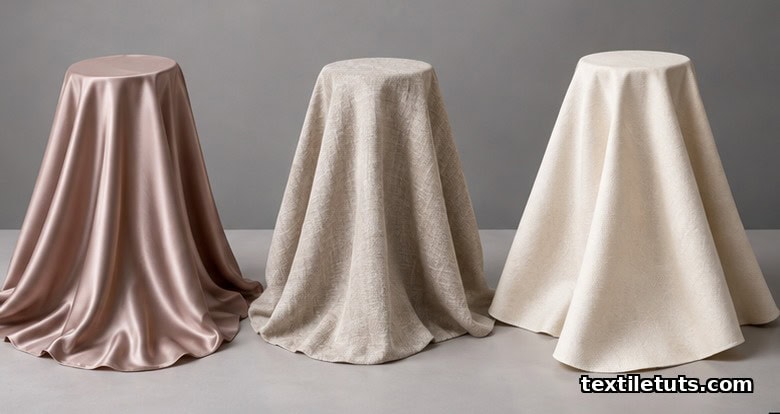
- Drape coefficient: the Cusick drape test, introduced in 1965 and still referenced in textile-engineering curricula, assigns a numerical drape coefficient to fabric based on how it falls over a circular pedestal. Lower coefficients (below 30 percent) describe fluid fabrics such as silk charmeuse and viscose challis; higher coefficients (above 60 percent) describe stiff fabrics such as bonded cotton canvas and wool melton.
For an A-line to hold its shape without an underskirt or hem interfacing, the fabric’s drape coefficient should sit between 35 and 55 percent. Below that range the silhouette collapses against the thighs; above it the hem flares too rigidly and the garment reads as a lampshade.
Seam engineering and structural seams
A-line construction puts more stress on the side seam than a straight skirt does, because the lower edge carries the weight of the wider hem. Three seam treatments are common:
- Plain seam, 10 mm allowance: standard in ready-to-wear. Acceptable for medium-weight wovens with flare up to 2:1.
- French seam, 6 mm then 9 mm: encloses the raw edge and is appropriate for sheer or loosely woven A-line fabrics where raveling would compromise the silhouette.
- Bound seam: the seam allowance is wrapped in bias binding. Used on unlined A-line coats and jackets where the seam must remain flat under pressing.
Hem allowances also change with flare. A 1.5:1 A-line takes a 4 cm double-turned hem. A 3:1 A-line needs 5 to 7 cm to allow the curve to lay flat during pressing; a too-narrow hem on a flared skirt pulls the bias grain and produces a wavy lower edge.
Body measurement and fit standards
The A-line silhouette depends on accurate waist and hip measurements taken at standardized landmark positions. ASTM D6240/D6240M-12 specifies the body measurements for adult female misses figure types, sizes 00 to 20, including the waist (taken at the natural waistline, the narrowest point between the lowest rib and the iliac crest) and the hip (taken at the level of the greatest posterior projection, typically 20 to 23 cm below the waist).
ASTM D5219 supplies the corresponding terminology, while ISO 3635:1981 establishes the size-designation principles used by most international pattern houses: drop-value (the difference between bust and waist, or hip and waist) and vertical intervals between measurement points. ISO 8559-1:2017 extends this work by defining how garment construction relates to anthropometric data, including the 5 to 7 cm ease allowances typically added at the bust and hip for woven garments.
For a fitted-through-waist A-line dress, the waist dart or panel shaping removes between 2.5 cm and 4.0 cm of fabric width at the waist, returning to the natural waist measurement plus 1.0 to 1.5 cm of wearing ease. The lower flare is then added to the lower edge of the same panel without altering the waist fit.
Choosing fabric weight and finish
Fabric choice decides whether the A-line reads as structured or fluid. As a working rule, fabric weight should fall between 150 and 350 grams per square meter (GSM) for a year-round A-line. Lighter than 120 GSM and the silhouette collapses; heavier than 400 GSM and the hem drops cleanly but the garment becomes uncomfortable across the upper back and shoulders.
Finish treatments change the math further. A starched cotton lawn at 110 GSM can hold a 2:1 A-line because the finish adds temporary rigidity. A pre-washed linen at 200 GSM sags more than the same weight in cotton because of flax fiber’s lower elastic recovery.
Construction sequence
The recommended build sequence, used in most production factories and academic pattern-making courses, runs as follows:
- Stay-stitch the waistline and upper edge of the skirt panels on a 6 mm seam allowance to prevent the bias from stretching during handling.
- Join the bodice and skirt at the waistline, matching notches and easing any small difference in length with a 3 to 5 mm ease margin.
- Insert the zipper before closing the side seam, working from the top of the bodice down to a point 12 to 15 cm below the waistline.
- Close the side seams last, using a 10 mm plain seam or a French seam per the fabric requirements.
- Finish the hem with a 4 to 7 cm double-turned fold, hand-felled or blind-hemmed for an invisible finish.
Pressing between every step is non-optional. The flare amplifies any seam that is pressed off-grain, so each seam allowance should be pressed open and the garment should hang on a form for at least 12 hours before the final hem is measured and trimmed.
Frequently Asked Questions
What flare ratio is best for a classic A-line skirt?
A 1.5:1 to 2.0:1 ratio is the most common choice for commercial A-line skirts, meaning the hem circumference is 1.5 to 2.0 times the waist circumference. This range gives a clear A-shape without consuming excessive yardage, and it produces a walking clearance of 70 to 90 cm at the hem, which matches a standard adult stride length.
Why does my A-line skirt hem drop at the side seams?
Side seam drop happens because the bias grain stretches under the weight of the wider hem. In a 2:1 A-line the side seam sits 15 to 20 degrees off the straight grain, and woven fabric elongates 15 to 25 percent more on the bias than on the straight grain. To prevent drop, stay-stitch the waistline and upper edge of the skirt panels before joining them to the bodice, interface the hem allowance, or cut the side panels on the straight grain by adding an additional side panel seam.
Can I draft an A-line without a basic skirt block?
Yes. The direct-measurement method lets you draw the A-line directly on pattern paper using three numbers: waist circumference, target hem circumference, and skirt length. Added width per side equals (hem circumference minus waist circumference) divided by 4. Plot the waistline, mark the center front, and angle the side seam outward to the target hem width measured at the desired skirt length.
What is the difference between an A-line and a trapeze dress?
An A-line is fitted through the bust and waist and flares from the waist down, while a trapeze (or tent-line) dress hangs straight from the shoulders or bustline with no waist shaping at all. The trapeze typically shows a flare ratio measured at the bust or shoulder rather than the waist, and the side seams angle outward continuously from the armhole or yoke rather than from a defined waistline.
How much fabric does an A-line skirt need?
For a knee-length A-line with a 2:1 flare ratio, an average adult needs 1.4 to 1.8 meters of 150 cm wide fabric, depending on hip circumference and pattern layout. A 3:1 flared version with a longer hem requires 2.0 to 2.5 meters. Bias-cut A-lines add 15 to 20 percent to those numbers because the pieces cannot be nested tightly on the fabric.
Should I interface the waistband on an A-line?
Yes, in most woven constructions. A 2.5 to 4.0 cm wide strip of fusible weft-insertion interfacing along the waist seam allowance prevents the waistband from stretching out under the weight of the flared skirt. Use a weft-insertion rather than a non-woven fusible, because the former stabilizes the weave without making the waistband stiff.
References
- ASTM D6240/D6240M-12, Standard Tables of Body Measurements for Adult Female Misses Figure Type, Size Range 00-20, ASTM International, West Conshohocken, PA — defines the waist, hip, and bust landmarks used in A-line drafting.
- ASTM D5219-09, Standard Terminology Relating to Body Dimensions for Apparel Sizing, ASTM International — supplies the vocabulary for garment fit referenced throughout A-line pattern work.
- ISO 3635:1981, Size designation of clothes — Definitions and body measurement procedures, International Organization for Standardization — establishes the size-designation principles used in international pattern grading.
- ISO 8559-1:2017, Garment construction and anthropometric surveys — Body dimensions, International Organization for Standardization — defines the relationship between body measurements and garment construction, including standard ease allowances.
- Cusick, G. E. (1965). “The Measurement of Fabric Drape,” Journal of the Textile Institute Transactions, 56(11), T596-T606 — original reference for the Cusick drape test still used to predict A-line silhouette behavior.
- Mehta, P. V. (2019). An Introduction to Quality Control for the Apparel Industry, Springer Open — peer-reviewed reference on seam allowances, tolerances, and construction standards relevant to A-line garments.
This article is the working reference for A-line silhouette construction. Editorial by Kazi Sifat Muntasir, TextileTuts. Sources: ASTM D6240/D6240M-12, ASTM D5219-09, ISO 3635:1981, ISO 8559-1:2017, Cusick (1965), and Springer Open as cited.


