
Ring Dyeing Effect in Indigo

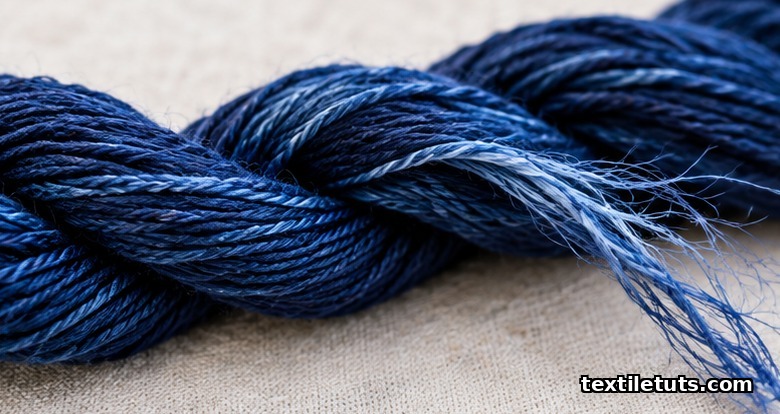
Ring dyeing in indigo is the characteristic partial fiber cross-section penetration where indigo pigment occupies only the outer 0.5 to 2 micrometers of a cotton fiber, leaving roughly 60 to 80 percent of the core uncolored because indigo has near zero affinity for cellulose and must be applied through 6 to 8 repeated dip, oxidize, and dry cycles in the leuco (reduced) form.
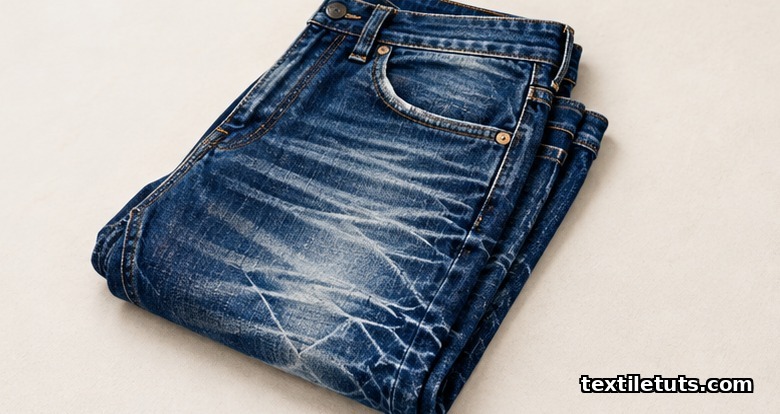
This ring dyed architecture is the single largest reason indigo denim fades the way it does: as surface fibers abrade away at high friction zones (knees, seams, pocket edges), the undyed core beneath becomes visible, producing the high contrast white creases that define a well worn pair of jeans.
What follows is the working reference for textile students, dyehouse chemists, and quality control teams on what ring dyeing is, why it happens at the molecular level, and how it is measured under ISO and AATCC standards.
What Is the Ring Dyeing Effect?
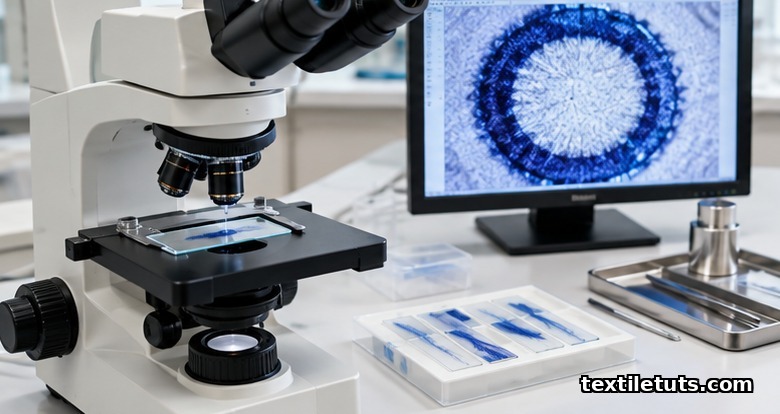
Ring dyeing is the macroscopic expression of a microscopic reality: indigo does not diffuse into the interior of a cotton fiber during normal dyeing. Microscopic cross sections of a freshly dyed indigo yarn show a colored ring around the perimeter and a white or pale core, hence the name. When a denim fabric woven from such yarn is abraded during wear or stone washing, the colored shell wears off and the white core shows through, generating the two tone fade that is denim’s signature.
Ring dyeing is not a defect, it is an engineered property. Denim mills have spent more than a century deliberately maximizing the contrast between the dyed shell and the undyed core because that contrast is what produces consumer appealing fades. A fiber that dyed uniformly through to the center would still be blue, but it would not fade in the visible way that drives repeat purchase in raw and selvedge denim markets.
Why Indigo Produces Only a Surface Ring
The reason is a combination of dye chemistry, fiber chemistry, and process design.
1. Indigo is a vat dye with zero substantivity for cellulose.
Unlike reactive or direct dyes, indigo (C16H10N2O2) carries no ionic group that can hydrogen bond to the hydroxyl groups of cellulose. In its oxidized (pigment) form, indigo is essentially insoluble in water and shows no affinity for cotton at all. Affinity in textile chemistry is the attractive force between dye and fiber, and for indigo on cotton, that force is effectively zero.
2. Reduction to leuco-indigo is required before application.
Dye houses reduce indigo with sodium hydroxide (NaOH) and sodium hydrosulfite (Na2S2O4) to convert the pigment form (blue, insoluble) into the leuco form (yellow-green, soluble as the mono- or di-anion). Only the leuco form has any measurable affinity for cotton, and even that affinity is so low that it is often described in the literature as borderline. A single dip yields a very pale shade that does not survive washing.
3. Each dip deposits only a monolayer-equivalent of dye.
Because affinity is low and migration is poor, indigo exhausts onto the fiber in small, surface-localized increments. After dipping, the yarn is squeezed between rollers (the nip), exposed to air to re-oxidize the leuco back to pigment, and then re-dipped. Six to eight such dip, oxidize, dry sequences are standard for warp yarns, with some premium mills running twelve or more dips to build apparent depth.
4. The dye is locked at the fiber surface by oxidation.
Once the leuco-anion re-oxidizes inside or on the fiber, it returns to the insoluble pigment form, becomes trapped, and is no longer available to migrate inward. Subsequent dips therefore deposit on top of existing dye rather than penetrating deeper. The end result is a thin colored shell wrapping an undyed core.
The Industrial Indigo Dyeing Process
Modern indigo dyeing uses a continuous range, typically a Ben Indigo or similar slasher dyeing machine. Warp yarn beams are pulled through a series of dyebaths, air oxidation passages, washing baths, and drying cylinders. A representative sequence per dyebath is:
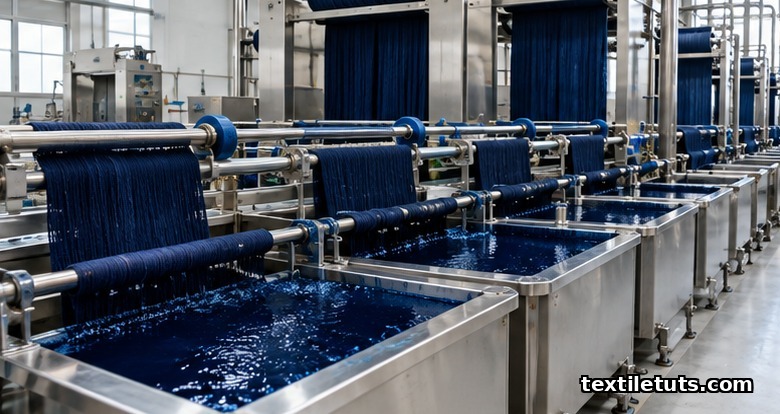
- Pre-wet: Yarn passes through hot water to swell fibers and remove air.
- Dip in leuco-indigo bath: pH 12.5 to 13.5, leuco concentration 0.5 to 4 g/L, temperature 25 to 60 °C depending on shade target.
- Nip: Heavy squeezing rollers remove excess liquor and force dye liquor deeper into the yarn bundle.
- Air oxidation: Yarn travels through 1.5 to 3 meters of open air; leuco re-oxidizes to pigment, color shifts from yellow-green to blue.
- Intermediate drying (optional): Some ranges insert a drying step between dips.
- Final wash and soft dry: Removes residual chemicals.
Reducing agent concentration, oxidation time, and squeeze pressure are the three most adjusted process variables. Higher squeeze pressure increases penetration modestly but cannot convert a ring-dyed distribution into a fully penetrated one without changing the dye chemistry itself.
Ring Dyeing vs. Full Fiber Penetration
The contrast between a true ring-dyed yarn and a yarn with deeper penetration is a useful diagnostic for process control and quality.
| Property | Ring Dyed Indigo (typical warp) | Deeply Penetrated Indigo (rare) |
|---|---|---|
| Penetration depth | 0.5 to 2 micrometers of a 15 to 20 micrometer fiber | Greater than 5 micrometers, often to fiber center |
| Cross section appearance | Blue ring, white core under microscope | Uniform blue cross section |
| Fade behavior | High contrast, two-tone wear marks | Low contrast, diffuse lightening |
| Number of dips required | 6 to 12 oxidative cycles | Fewer dips but at higher leuco strength, often with wetting enhancers |
| Washing fastness perception | Visible color loss in first 2 to 4 home laundries | Lower apparent loss, more uniform aging |
| Consumer position | Premium raw/selvedge denim | Uniform dye lots, workwear, some knit indigo |
Why Indigo-Dyed Denim Fades White and Not Lighter Blue
This is the most common question from first-time denim buyers, and the answer is direct. The abraded zone reveals the uncolored core of the fiber, which has always been white. The fiber does not gradually change color; rather, the colored shell is physically removed. Fading patterns therefore replicate the wear map of the garment rather than the chemistry of the dye.
Crocking (dry transfer of pigment) and wet rubbing are the surface phenomena that govern early color mobility, while fiber loss is the eventual mechanism that exposes the white core. Standards such as AATCC Test Method 8 (colorfastness to crocking, dry and wet) and AATCC Test Method 116 (rotary vertical crockmeter method) are the laboratory tools used to measure the surface release of indigo pigment before the core becomes visible.
How Ring Dyeing Is Measured
Three standard test families apply to indigo ring dyed textiles.
- ISO 105-B02: Color fastness to artificial light (xenon arc). Determines how the colored shell resists photochemical fading.
- ISO 105-C06: Color fastness to domestic and commercial laundering. Critical for predicting how much pigment will be released in the first consumer washes.
- ISO 105-X12: Color fastness to rubbing (crocking). Quantifies the surface mobility that defines early indigo loss.
Microscopic cross section evaluation is the only direct measure of the ring dyeing pattern itself. Technicians embed fiber bundles in resin, slice them on a microtome, and image the cross section under 200 to 400× magnification. The diameter of the colored shell is then measured against the total fiber diameter, yielding a percentage penetration value.
Practical Implications for Mills and Brands
For mills, ring dyeing is a process-control target, not a problem to eliminate. Mills running premium selvedge lines typically calibrate dip count, leuco concentration, and oxidation time so that penetration stays in the 10 to 20 percent of fiber radius range. Going lower gives extreme contrast but increases crocking complaints; going higher reduces the fade aesthetic that consumers buy.
For brands and sourcing teams, ring dyeing has three operational consequences. First, indigo fabric should be stored away from UV light because the colored shell is photolabile. Second, garment finishing (stone wash, enzyme wash, laser fade) is essentially controlled removal of that colored shell, so reproducible finishing requires consistent ring depth across lots. Third, care labels should expect visible color loss in the first three to five laundries and should not promise dye fastness in the way reactive-dyed fabrics do.
Frequently Asked Questions
Is ring dyeing a defect in indigo fabric?
No. Ring dyeing is the engineered, intended result of using indigo on cotton. A denim mill that produces full fiber penetration would generate a denim that does not fade the way consumers expect, and is rarely sold as premium denim.
How deep does indigo actually penetrate a cotton fiber?
Under standard continuous dyeing conditions, indigo penetrates 0.5 to 2 micrometers of a cotton fiber whose total diameter is typically 15 to 20 micrometers. This corresponds to roughly 5 to 15 percent of fiber radius, with the remaining 60 to 80 percent of fiber volume uncolored.
Does ring dyeing make indigo jeans less durable?
No, the undyed core is still cellulose and retains the full tensile strength of uncolored cotton. The aesthetic fade is unrelated to fiber strength; in fact, denim’s long service life is partly because the colored shell that wears off is not load bearing.
Can ring dyeing be prevented to get a more colorfast indigo?
Not with indigo on cotton. Other dye classes (reactive, sulfur, pigment) give deeper and more uniform coloration, but they lose the chemistry that defines indigo denim. Sulfur dyes are often used as a top-dye or shading companion to indigo specifically because they do penetrate more deeply and reduce crocking.
Why do raw selvedge jeans fade so much more than mass-market denim?
Raw selvedge denim is typically dyed with a higher number of dips, often with longer oxidation time per dip, producing a thinner and more localized ring of dye on each fiber. Less dye per fiber means lower reserve color, which means any abrasion reveals the white core faster and with higher contrast. The dye chemistry is the same; the ring depth is shallower.
References
- International Organization for Standardization. ISO 105-C06:2010, Textiles: Tests for colour fastness. Part C06: Colour fastness to domestic and commercial laundering. iso.org: standard test method for color loss of dyed textiles in home and commercial washing.
- International Organization for Standardization. ISO 105-B02:2014, Textiles: Tests for colour fastness. Part B02: Colour fastness to artificial light (xenon arc fading lamp test). iso.org: standard method for evaluating photochemical fading of dyed fabrics.
- International Organization for Standardization. ISO 105-X12:2016, Textiles: Tests for colour fastness. Part X12: Colour fastness to rubbing. iso.org: crocking (dry and wet rubbing) test method relevant to indigo pigment release.
- American Association of Textile Chemists and Colorists. AATCC Test Method 8, Colorfastness to Crocking: AATCC Crockmeter Method. aatcc.org: standard for measuring surface pigment transfer of indigo-dyed yarns and fabrics.
- American Association of Textile Chemists and Colorists. AATCC Test Method 16, Colorfastness to Light. aatcc.org: xenon arc lightfastness standard, applicable to the indigo colored shell.
- Bechtold, T., and A. Casselman. Dyeing Behavior of Indigo in Vat Dyeing: Kinetics and Fiber Penetration. researchgate.net: peer-reviewed analysis of indigo substantivity, ring dyeing depth, and oxidation kinetics on cellulosic substrates.
This article is the working reference for ring dyeing in indigo. Editorial by Shahrukh Islam, TextileTuts. Sources: ISO 105-C06:2010, ISO 105-B02:2014, ISO 105-X12:2016, AATCC Test Method 8, AATCC Test Method 16, and Bechtold & Casselman as cited.


