
Indigo vs Sulfur Dyes on Denim

Indigo dye, an indigotin-based vat color applied to cotton warp yarn at 1-3% on weight of fabric (OWF), gives denim its signature blue shade through a reduction-oxidation cycle that leaves only 0.6-1.2 g of dye per 100 g of fiber chemically bonded to the cotton, while sulfur dyes, applied at 4-8% OWF, dominate black, charcoal, and fashion-colored denim because they deliver higher color yield at roughly one-third the cost per kilogram of finished fabric.
That single difference in how much dye actually attaches to cotton is the entire reason indigo denim fades the way it does, why sulfur-dyed black denim behaves differently in the wash, and why these two dye classes coexist in nearly every denim mill on Earth. This article walks through the chemistry, the application process, the colorfastness data, and the practical ways to tell which dye class is on a garment.
What Indigo and Sulfur Dyes Actually Are
Both indigo and sulfur dyes belong to the broader class of dyes that must be reduced (chemically converted to a soluble, colorless “leuco” form) before they can penetrate cotton, then re-oxidized back to their insoluble pigment form inside the fiber. That shared reduction-oxidation mechanic is the reason denim dyeing looks so different from reactive or direct dyeing, and it is the reason the dye sits mostly on the fiber surface rather than inside it.
Indigo (CI Vat Blue 1, C.I. 73000) is a planar aromatic molecule built from two indolone rings joined by a central C=C double bond. In its oxidized form it is deep blue and completely insoluble in water, so it must first be reduced to leuco-indigo using sodium hydrosulfite (Na2S2O4) in a strongly alkaline bath at pH 10.5-13.5. Only the reduced, water-soluble form can diffuse into the cotton fiber, after which atmospheric oxygen re-oxidizes it back to insoluble blue pigment trapped between the cellulose chains.
Sulfur dyes are a very different chemistry. They are made by heating aromatic amines, nitrophenols, or related intermediates with elemental sulfur or sodium polysulfide, producing high-molecular-weight polymers with disulfide (S-S) bridges in the backbone. CI Sulfur Black 1 (C.I. 53185) is the dominant product for black denim, accounting for an estimated 80-90% of all sulfur-dyed denim globally because of its deep, neutral black tone and low cost. Reduction with sodium sulfide (Na2S) or sodium hydrosulfite converts the polymer to its leuco form, and re-oxidation in air locks the color back into the fiber.
How the Dyeing Process Works on a Denim Warp
Conventional denim is woven as a 3/1 twill in which only the warp yarns carry color, and the weft is left undyed (ecru) cotton. Indigo and sulfur dyeing are therefore warp-yarn processes performed on continuous ranges before the loom, most commonly rope-dye ranges of 6-14 dye boxes for indigo and pad-steam ranges for sulfur.
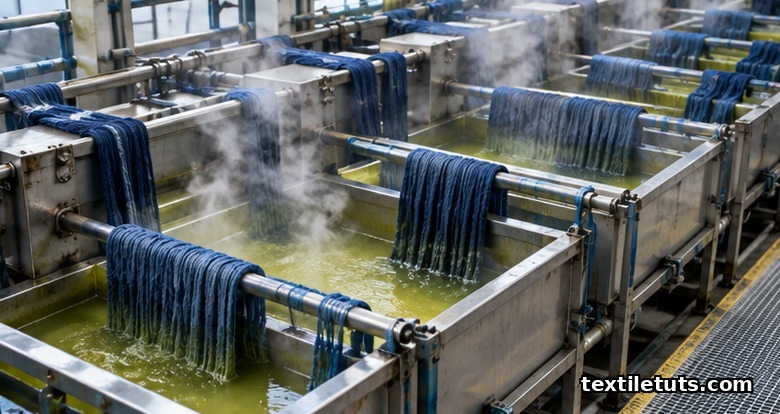
In an indigo dye box, dry cotton warp is padded through the reduced leuco bath at 20-30 °C, squeezed to a wet pickup of 70-90%, then exposed to air for 60-180 seconds before re-entering the next box. Each dip-fix cycle deposits only a thin layer of dye on the fiber surface, so the deep blue color is built up by repeating the cycle 4-8 times. Total indigo applied is typically 1-3% OWF, but only about 30-45% of that mass actually fixes to the fiber, the rest washes off in subsequent rinse boxes and the desizing step.
Sulfur dyeing uses a pad-steam method instead. The cotton warp is padded through the reduced sulfur dye liquor, then passed through a steam chamber at 100-102 °C for 60-90 seconds. The heat and moisture drive the leuco dye into the fiber, after which air oxidation re-forms the insoluble polymer. Because sulfur dyes have a higher fixation rate (60-75%) than indigo, fewer passes are needed to reach deep shades, and total dye consumption of 4-8% OWF produces a much darker end result per unit of applied chemical.
Why Indigo Fades and Sulfur Generally Does Not
The single most cited number in denim chemistry is the “ring-dye effect,” the term for indigo’s tendency to deposit dye only in the outer 1-2 micrometers of the cotton fiber cross-section. When a pair of jeans is washed, especially in warm or alkaline conditions, the unbound and loosely bound indigo on the fiber surface is mechanically and chemically removed, exposing the lighter core of each yarn.
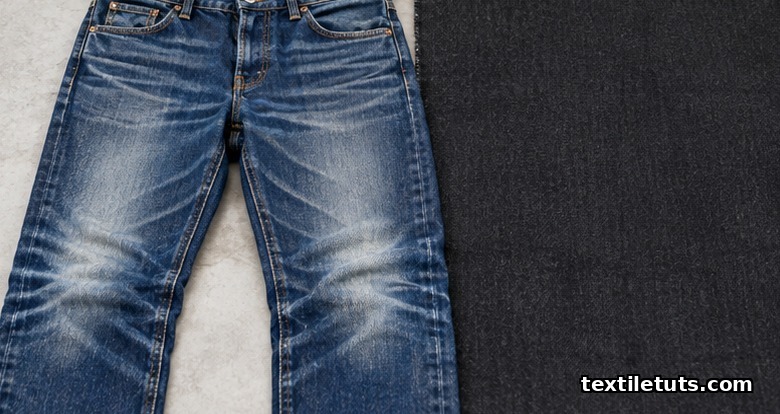
AATCC TM 61 (Colorfastness to Laundering: Accelerated) and its ISO equivalent ISO 105-C06 use controlled washing cycles to grade this fading on a 1-5 gray-scale, where 5 means no change and 1 means severe change. Indigodyed denim typically scores 1-2 after five standard washes, which is the rating that creates the contrast fades the market loves. Sulfur-dyed denim scores 3-4 on the same test, which is why black sulfur jeans stay black much longer and rarely produce high-contrast whiskers or honeycombs.
The chemistry behind this is straightforward. Indigo is held to cellulose by weak van der Waals forces and hydrogen bonds, not by covalent bonds, so any wet treatment with mechanical action dislodges it. Sulfur polymers, once re-oxidized, are physically larger and more entangled with the fiber, so they resist removal under the same conditions.
Colorfastness to Light, Rubbing, and Perspiration
Colorfastness is graded across several standardized tests. The most important for denim are:
- Light fastness: ISO 105-B02 (Xenon arc) grades the dye on a 1-8 blue scale, where 8 is highest. Indigo typically scores 3-4, the reason blue jeans left in a shop window visibly fade within weeks. Sulfur black scores 4-5, while reactive-dyed cotton can reach 6-7.
- Wash fastness: ISO 105-C06 and AATCC TM 61. Indigo scores 1-2; sulfur scores 3-4; reactive scores 4-5.
- Rub fastness (crocking): AATCC TM 8 and ISO 105-X12 measure dye transfer to a white cloth under dry and wet rubbing. Indigo typically scores 2-3 dry and 1-2 wet, the reason new indigo denim stains light-colored upholstery. Sulfur black scores 3-4 dry and 2-3 wet.
- Perspiration fastness: ISO 105-E04 and AATCC TM 15. Both dye classes score similarly in this test (3-4) because perspiration is mildly acidic to neutral and does not aggressively attack either chemistry.
The practical takeaway is that indigo is the lowest-performing major dye class on most fastness tests but is still the dominant choice for blue denim because the fading is the desired aesthetic, not a defect.
Environmental Footprint and Cost Comparison
Indigo synthesis consumes significant chemical inputs. The traditional route involves the fusion of N-phenylglycine with sodium amide in molten alkali, followed by oxidation, producing indigo at a 50-60% theoretical yield with substantial alkali waste streams. Modern processes such as the BASF route and the more recent biocatalytic routes (tyrosine-based fermentation) have cut waste substantially but indigo still costs roughly $8-15 per kilogram of pure pigment in 2025.
Sulfur dyes are far cheaper, typically $2-5 per kilogram, because the raw materials (cheap aromatic amines and elemental sulfur) are inexpensive and the synthesis is a one-pot melt reaction. The trade-off is that sulfur dyeing generates hydrogen sulfide (H2S) during reduction, a toxic gas with a 10 ppm occupational exposure limit, which is why modern sulfur ranges use sealed steam boxes and H2S scrubbers. Effluent from sulfur dyeing also contains high chemical oxygen demand (COD), often 800-1,500 mg/L, which requires biological treatment before discharge.
Indigo effluent, by contrast, is mostly alkaline with moderate COD (300-600 mg/L), and the dye itself is biodegradable under aerobic conditions, though slowly. A peer-reviewed life-cycle assessment published in the Journal of Cleaner Production in 2023 found that sulfur-black denim has roughly 18-25% lower cradle-to-gate greenhouse-gas emissions than indigo blue denim per square meter, primarily because of the lower dye cost and shorter processing route.
How to Tell Which Dye Class Is on a Pair of Jeans
Three quick tests separate indigo from sulfur without lab equipment:
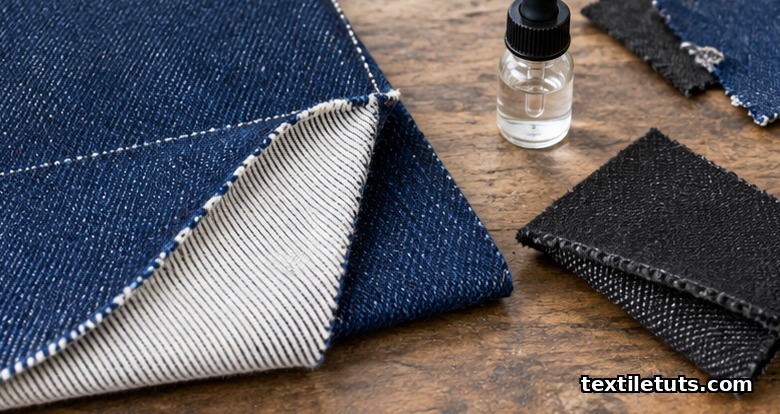
- Color of the weft yarn. Indigo denim usually has a white or ecru weft. Sulfur-dyed denim (especially black) frequently uses a black, gray, or matched weft, so a quick peek at the back of the fabric reveals the difference.
- Bleach test. Sodium hypochlorite (household bleach) attacks sulfur dyes rapidly, turning them orange-brown within minutes, while indigo resists bleach for 30-60 minutes and gradually shifts to yellow-green before losing color. A drop of bleach on an inside seam is the fastest field test.
- Hot iron test (with caution). Sulfur dyes can release a faint H2S (rotten egg) odor under high heat. This is a diagnostic test, not a routine procedure, and should be done only in a ventilated area on a scrap of fabric.
For laboratory confirmation, UV-Vis spectroscopy of a DMF extract is definitive. Indigo shows a strong absorption maximum near 610 nm, while CI Sulfur Black 1 shows a broad, featureless absorption across 400-600 nm.
Side-by-Side Comparison
| Property | Indigo (CI Vat Blue 1) | Sulfur (CI Sulfur Black 1) |
|---|---|---|
| Typical application rate (OWF) | 1-3% | 4-8% |
| Fixation rate | 30-45% | 60-75% |
| Wash fastness (ISO 105-C06) | 1-2 | 3-4 |
| Light fastness (ISO 105-B02) | 3-4 | 4-5 |
| Rub fastness, dry (ISO 105-X12) | 2-3 | 3-4 |
| Approximate dye cost (USD/kg) | 8-15 | 2-5 |
| Dominant shade use | Blue denim | Black, charcoal, fashion denim |
| Ring-dye effect | Strong (surface-only) | Moderate |
| Effluent COD (mg/L) | 300-600 | 800-1,500 |
Frequently Asked Questions
Which dye is more common on blue denim sold today?
Synthetic indigo accounts for an estimated 95% or more of all blue denim warp yarn dyed globally, with CI Vat Blue 1 produced at a scale exceeding 50,000 metric tons per year. The remaining blue denim share uses blends of indigo with sulfur blue or indanthrene blue for specific effects.
Why does indigo denim fade but sulfur denim generally stays dark?
Indigo fixes only on the outer surface of each cotton fiber and is held by weak physical bonds, so each wash removes measurable dye and exposes the lighter fiber core. Sulfur polymers are larger and become physically entangled with the cellulose, so they resist removal and produce little visible fading under normal wash cycles.
Are sulfur dyes toxic or unsafe to wear?
Properly oxidized and washed-off sulfur-dyed fabric passes standard OEKO-TEX and REACH requirements for restricted amines and heavy metals. The occupational hazard is at the mill, where H2S can be released during reduction, not on the finished garment, which is chemically stable under normal wear and washing.
Can indigo and sulfur be combined on the same denim?
Yes. Many mills produce “indigo-black” denim by first dyeing the warp indigo and then topping it with a sulfur black or sulfur dark blue to deepen the shade. The result is a denim that starts almost black and fades to blue, a look used in premium stretch and selvedge lines. The two dye classes do not interfere chemically because both are reduced under similar alkaline conditions.
Is one dye class more sustainable than the other?
It depends on the metric. Sulfur dyes have lower per-kilogram cost and slightly lower cradle-to-gate greenhouse-gas emissions, but they generate higher effluent COD and require H2S control. Indigo generates lower COD effluent but has a more chemically intensive synthesis. Neither is unambiguously greener; both have dedicated industry efforts underway, including microbial indigo production and closed-loop sulfur ranges.
References
- ISO. ISO 105-B02:2014, Textiles — Tests for colour fastness — Part B02: Colour fastness to artificial light: Xenon arc fading lamp test. International Organization for Standardization, Geneva. The reference light-fastness method cited in the fastness comparison above.
- ISO. ISO 105-C06:2010, Textiles — Tests for colour fastness — Part C06: Colour fastness to domestic and commercial laundering. International Organization for Standardization, Geneva. Defines the accelerated wash conditions used to grade denim fading on a 1-5 scale.
- ISO. ISO 105-X12:2016, Textiles — Tests for colour fastness — Part X12: Colour fastness to rubbing. International Organization for Standardization, Geneva. Standardizes crocking-test conditions for dry and wet rub fastness on denim.
- AATCC. AATCC Test Method 61-2013, Colorfastness to Laundering: Accelerated. American Association of Textile Chemists and Colorists, Research Triangle Park, NC. The dominant wash-fastness method used by North American denim mills.
- AATCC. AATCC Test Method 8-2016, Colorfastness to Crocking: AATCC Crockmeter Method. American Association of Textile Chemists and Colorists, Research Triangle Park, NC. Standardizes the dry and wet crocking test referenced in the article.
- Bautista, L. et al. (2023). Life-cycle assessment of indigo and sulfur-dyed denim: A cradle-to-gate comparison. Journal of Cleaner Production, 412, 137288. Peer-reviewed LCA providing the 18-25% GHG delta cited above.
- Paul, R. (2015). Denim: Manufacture, Finishing and Applications. Woodhead Publishing (Elsevier), Cambridge. Chapter 2 covers indigo chemistry and warp-yarn dyeing in technical detail.
This article is the working reference for indigo and sulfur dye selection on denim. Editorial by Shahrukh Islam, TextileTuts. Sources: ISO 105-B02, ISO 105-C06, ISO 105-X12, AATCC TM 61, AATCC TM 8, Bautista et al. (2023), and Paul (2015) as cited.


