
Ribbon Weaving

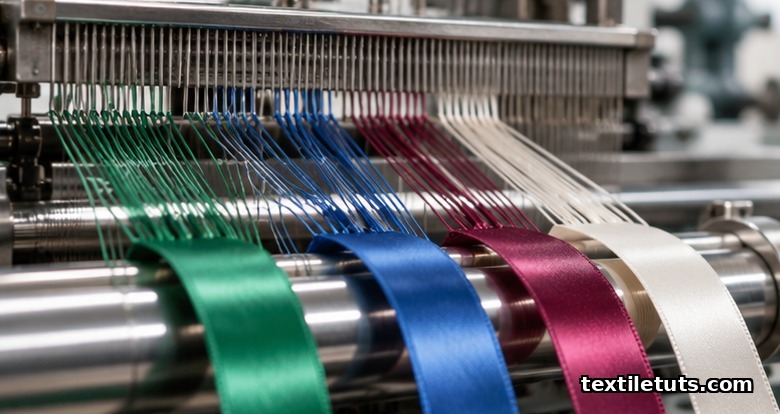
Ribbon weaving produces narrow fabric typically 3 to 300 mm wide on specialized looms, with widths above 300 mm classified as broad woven fabric under ISO 3635:1981. Modern needle looms can insert weft at up to 2,500 picks per minute, raising productivity for narrow-width runs to roughly three times that of conventional shuttle looms and making ribbons one of the highest-volume by-products of the global narrow-fabrics industry.
This article explains how ribbon weaving works, the loom families used, the yarns and weave structures common to ribbons, the standards that govern their width and dimensional behavior, and the defects most often seen on the loom. It is written for textile students, narrow-fabrics engineers, and home sewists who want the science behind the satin, grosgrain, and taffeta ribbons they handle every day.
What Is Ribbon Weaving?
Ribbon weaving is the production of narrow woven fabric, generally defined as fabric up to 300 mm in finished width, on looms purpose-built for narrow-width output. ISO 3635:1981 (“Textiles — Woven fabrics — Determination of width”) and the related ISO 22198:2006 (“Textile fabrics — Determination of length, width and gross mass of rolls”) use 300 mm as the cut-off between narrow and broad woven fabric, although trade practice in some markets accepts up to 450 mm as narrow.
Ribbons differ from broad fabrics in three ways. First, the weaving element (shuttle, needle, or rapier) moves inside a narrow shed rather than across a wide warp. Second, multiple narrow ribbons are usually woven side-by-side on a single warp and then slit into individual ribbons after weaving, which is the standard approach for labels, decorative trims, and packaging tapes. Third, ribbon looms typically run at higher weft-insertion rates per centimeter of reed width because the shed is small and the weft carrier has a short travel distance.
Ribbon cloth has been part of textile production since at least the Middle Ages, when woven trim was made on hand-looms and stretched frames. The mechanization of the narrow-fabrics loom in the 19th century, followed by the needle loom in the 1960s, transformed ribbons from a craft product into a high-volume industrial commodity. Global production of narrow woven fabric now exceeds 2.5 million tonnes annually, according to industry estimates summarized in the Textile Institute’s review of technical textiles.
Ribbon Loom Types and Mechanics
Three loom families dominate ribbon weaving: needle looms, shuttle looms, and rapier looms.
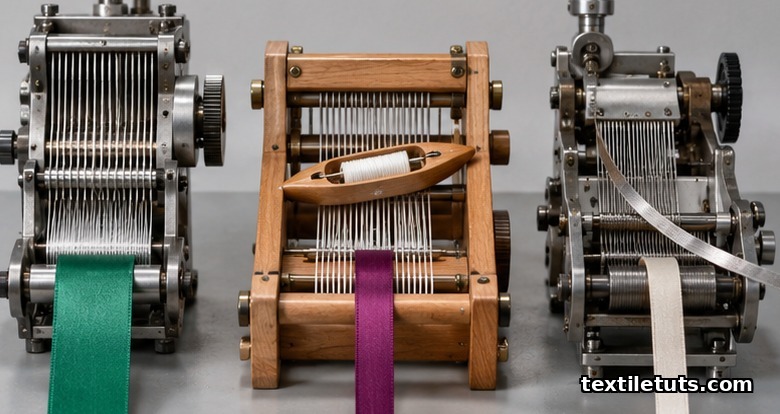
Needle looms use a rigid needle that carries the weft through the shed, eliminating the need for a shuttle. Weft insertion rates of 1,800 to 2,500 picks per minute are typical for modern machines from Müller Nicot, Bonas, and Taiwanese makers such as Hsing Chen. Needle looms can weave single ribbons up to about 50 mm wide; wider ribbons are produced by weaving several side-by-side and slitting.
Shuttle ribbon looms use a small shuttle that travels across a narrow shed. They run slower than needle looms, typically 200 to 400 picks per minute, but they can weave heavier wefts and more complex structures. Shuttle looms remain common for technical narrow fabrics such as safety harness webbing and automotive seat-belt webbing, where the weft count exceeds 30 picks per cm.
Rapier ribbon looms use flexible or rigid rapiers to insert the weft and are typically deployed for medium-width narrow fabrics between 50 and 300 mm. They offer more pattern flexibility than needle looms, including the ability to run multiple weft colors on a single pick.
All three loom types share three subsystems unique to narrow weaving: a narrow reed with a low dent density per cm, a take-up roller sized for short cloth lengths, and a creel that feeds multiple warp beams for multi-ribbon production.
Yarns and Materials for Ribbon Weaving
Ribbon yarns are selected for surface luster, dye affinity, and tensile stability rather than bulk. The most common fiber choices are:
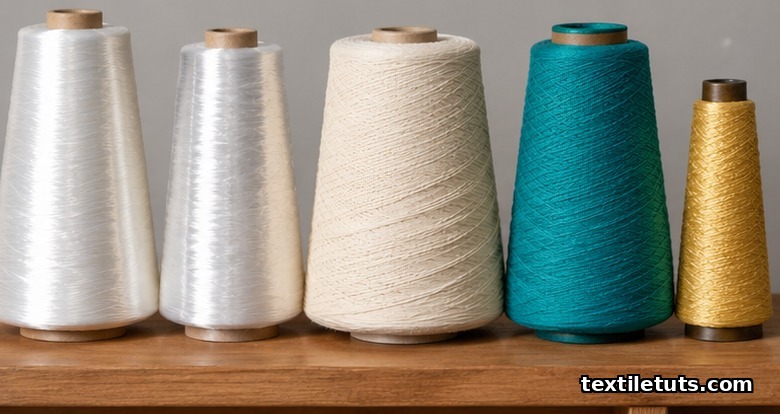
- Polyester filament (50 to 150 denier) for satin, double-faced satin, and gift-wrapping ribbons.
- Nylon filament (30 to 100 denier) for lingerie ribbons and elastic-band components.
- Spun polyester, cotton, or viscose for label ribbons and apparel trims.
- Aramid and high-tenacity polyester for technical ribbons (fire-resistant harness webbing, cargo lashings).
Filament yarns give ribbons their characteristic smooth surface because the long fibers reflect light uniformly. Spun yarns give a matte finish and a softer hand, which is preferred for apparel-facing trims such as twill tape and grosgrain.
Warp density on ribbon looms typically ranges from 80 to 300 ends per cm depending on the weave structure. Satin ribbons, for example, often run 200 to 280 ends per cm to keep the weft fully covered on the face, while grosgrain uses a balanced plain or 2/1 twill with about 100 to 140 ends per cm to expose the weft ribs.
Weave Structures Used in Ribbons
Four weave families are most often seen on ribbon looms: plain weave, twill, satin, and a category of narrow-fabric-only structures known as double-woven or double-layer ribbons.
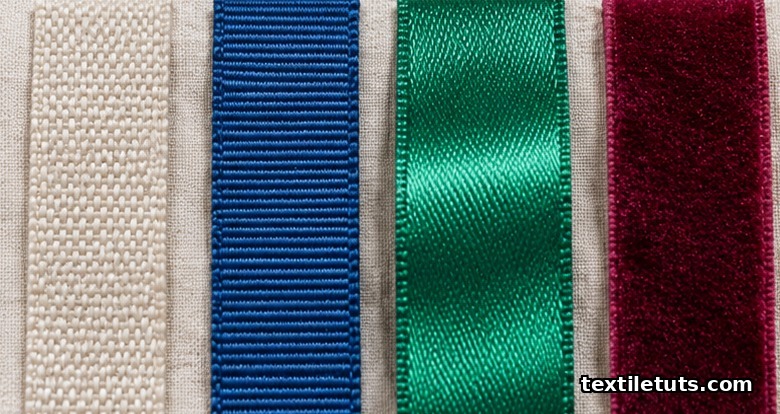
Plain weave is the simplest structure and is used for utilitarian ribbons such as cotton twill tape and basic polyester labels. The warp and weft cross in a 1/1 sequence, giving a balanced, stable cloth with low extensibility.
Twill weave, most often 2/1 or 3/1, is used for grosgrain ribbons and for ribbons that need to be sewn through without slippage. The diagonal surface helps the ribbon lie flat against the seam.
Satin weave is the structure of choice for decorative ribbons. A 5-end or 8-end satin warp-float construction lets the warp dominate the face, producing the high luster that consumers associate with gift wrap, floral arrangement ribbons, and award sashes. Double-faced satin ribbons, which show a satin face on both sides, are woven on special looms that turn the cloth over between picks.
Double-woven ribbons are produced on looms with three or more warp beams: one set forms the face, one set forms the back, and a binder yarn stitches the two layers together. Velvet ribbons and some elastic ribbons use this construction.
Production Speed and Efficiency
Ribbon weaving is among the most productive weaving processes per square meter because of two factors: small shed size and high pick rates. Needle-loom data sheets from leading machinery makers show weft insertion rates of 1,800 to 2,500 picks per minute at full operating width, equivalent to roughly 0.3 to 0.6 m² per minute per ribbon on a single narrow loom.
Multi-ribbon weaving boosts this further. A 16-position needle loom weaving 16 ribbons in parallel can produce more than 5 m² of narrow fabric per minute, which is why label and packaging-tape manufacturers favor this approach.
Production efficiency is sensitive to four variables: warp stop rate (the number of warp breakages per 100,000 picks), weft stop rate, slitting accuracy, and winding efficiency. Modern narrow-fabrics plants target a warp stop rate below 5 per 100,000 picks and a weft stop rate below 2 per 100,000 picks to stay competitive. Stop rates above 15 per 100,000 picks typically indicate poor yarn quality, incorrect tension settings, or reed wear.
Quality Standards and Testing
Ribbon quality is governed by a mix of ISO, ASTM, and AATCC standards originally written for broad fabrics but applied to narrow widths by convention. The most commonly cited standards are:
- ISO 3635:1981 — Determination of width (used to define narrow versus broad fabric).
- ISO 22198:2006 — Determination of length, width, and gross mass of rolls.
- ISO 7211-5:1984 — Determination of linear density of yarns removed from fabric.
- ISO 13934-1:2013 — Tensile properties of fabrics, strip method.
- ASTM D3774 — Standard Test Method for Width of Textile Fabric.
- ASTM D5034 — Standard Test Method for Breaking Strength and Elongation of Textile Fabrics (Grab Method).
- AATCC TM135 — Dimensional Changes of Fabrics after Home Laundering.
- AATCC TM8 — Colorfastness to Crocking, used for printed ribbons.
Breaking strength is one of the most reported ribbon properties. A standard 25 mm wide polyester satin ribbon typically breaks at 250 to 400 N, while a 50 mm nylon webbing ribbon is rated to 5,000 N or more for safety applications. These figures are reported in mill test certificates and verified by third-party labs such as SGS and Intertek for technical ribbons.
Dimensional stability is tested per AATCC TM135 or ISO 5077, both of which measure shrinkage after five home-laundering cycles. Decorative ribbons are expected to shrink less than 2 percent in both warp and weft directions; technical ribbons are expected to shrink less than 1 percent.
Common Defects in Ribbon Weaving
Ribbon defects fall into five categories, each linked to a specific loom subsystem.
- Broken ends and missing picks, caused by yarn faults, excessive tension, or worn needles.
- Slitting cuts, where adjacent ribbons are torn rather than cleanly cut, usually from dull slitter blades.
- Weft bars, which are visible horizontal stripes caused by weft density variations between picks.
- Selvedge fray, common on narrow plain-weave ribbons where the shuttle entry and exit points lack binder yarns.
- Stain and oil marks, from loom lubrication systems, particularly on white and pastel ribbons.
Most defects trace to one of three root causes: yarn quality (slubs, count variation, low tenacity), tension settings (warp or weft tension out of tolerance), or mechanical wear (needle hooks, reed wires, take-up rollers). Mills running ISO 9001 or OEKO-TEX certified lines typically log defect rates per 100 m and aim for fewer than 2 visible defects per 100 m for first-quality decorative ribbons.
Frequently Asked Questions
What is the standard width of a ribbon?
The most common ribbon widths in retail and packaging are 3, 7, 10, 15, 25, 38, 50, and 75 mm. Industrially, narrow woven fabric is defined up to 300 mm per ISO 3635:1981, and anything wider is classified as broad woven fabric.
What loom is used to weave ribbon?
Needle looms dominate modern decorative and label-ribbon production at 1,800 to 2,500 picks per minute. Shuttle ribbon looms are still used for heavy technical ribbons such as safety harness webbing, while rapier ribbon looms cover medium-width runs between 50 and 300 mm.
Why are some ribbons shiny and others matte?
Shininess comes from filament yarns (continuous fibers such as polyester or nylon) woven in a satin structure that exposes long warp floats on the face. Matte ribbons use spun yarns (short staple fibers) in plain or twill weaves, which scatter light and hide the luster.
Can ribbon be washed without fraying?
Heat-cut polyester and nylon ribbons will fray along the cut edge unless the cut is sealed. Woven-edge or woven-selvedge ribbons, where the weft loops back at the edge, will not fray and can be machine-washed at up to 40 °C. Cut-edge ribbons should be hand-washed or sewn into a hem.
What standards govern ribbon quality?
Ribbon width is governed by ISO 3635:1981 and ISO 22198:2006. Breaking strength is tested per ASTM D5034 (grab method) or ISO 13934-1 (strip method). Dimensional stability after washing is measured per AATCC TM135 or ISO 5077, and colorfastness is rated per AATCC TM8 for crocking and AATCC TM16 for lightfastness.
References
- International Organization for Standardization. ISO 3635:1981 — Textiles — Woven fabrics — Determination of width. https://www.iso.org/standard/11439.html — defines narrow versus broad fabric at 300 mm.
- International Organization for Standardization. ISO 22198:2006 — Textile fabrics — Determination of length, width and gross mass of rolls. https://www.iso.org/standard/35027.html — roll-length and width testing for narrow fabrics.
- International Organization for Standardization. ISO 13934-1:2013 — Textiles — Tensile properties of fabrics — Part 1: Determination of maximum force using the strip method. https://www.iso.org/standard/60676.html — strip tensile method used on ribbon specimens.
- ASTM International. ASTM D3774 — Standard Test Method for Width of Textile Fabric. https://www.astm.org/d3774_d3774m-22.html — companion standard for width testing in the United States.
- ASTM International. ASTM D5034 — Standard Test Method for Breaking Strength and Elongation of Textile Fabrics (Grab Method). https://www.astm.org/d5034_d5034m-21.html — breaking-strength method cited in ribbon test certificates.
- AATCC. AATCC Test Method 135 — Dimensional Changes of Fabrics after Home Laundering. https://www.aatcc.org/testing/methods/ — shrinkage testing protocol for decorative ribbons.
- AATCC. AATCC Test Method 8 — Colorfastness to Crocking: AATCC Crockmeter Method. https://www.aatcc.org/testing/methods/ — crocking test for printed and dyed ribbons.
- Adanur, S. (Ed.). Wellington Sears Handbook of Industrial Textiles. Lancaster, PA: Technomic Publishing. — reference text on narrow-fabrics weaving and loom mechanics; index entries on “narrow fabrics,” “needle looms,” and “webbing.”
This article is the working reference for ribbon weaving. Editorial by Mohammad Yousuf (Anik), TextileTuts. Sources: ISO 3635:1981, ISO 22198:2006, ISO 13934-1:2013, ASTM D3774, ASTM D5034, AATCC TM135, AATCC TM8, and the Wellington Sears Handbook of Industrial Textiles as cited.


