
Narrow Fabric Weaving

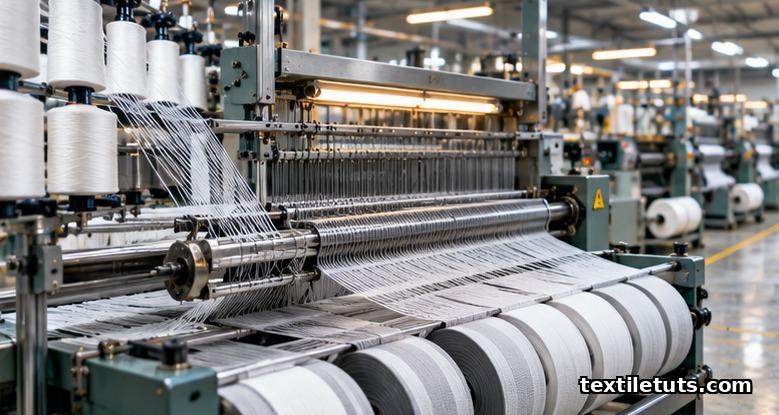
Narrow fabric weaving produces flat textiles up to 450 mm wide on needle looms, shuttle looms, and rigid-rapier looms that run between 800 and 2,400 picks per minute, supplying webbing, tapes, ribbons, and safety straps used in automotive seat belts, military load-bearing gear, and medical braces.
These textiles are defined less by their final use than by their construction: dense picks-per-cm weave structures built on looms that carry the weft across a short, fixed warp bed rather than the wide creel of a conventional shuttleless loom.
This guide explains how narrow fabric weaving differs from broad weaving, which loom suits which end-use, the yarn selections that drive breaking force and elongation, and the international standards used to verify performance.
What Counts as a Narrow Fabric
Textile industry working definitions treat any flat-woven textile under 450 mm in width as a narrow fabric, although many mills reserve the term for constructions under 300 mm where the weft insertion path is too short for a conventional broad loom. The category covers four overlapping families:
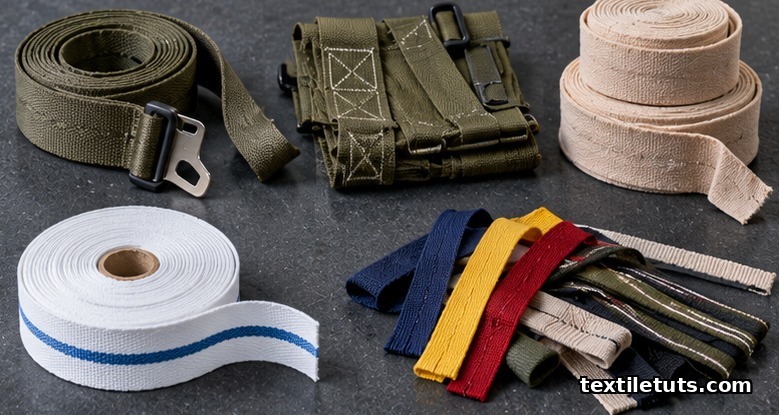
- Webbing, the strongest family, woven from coarse polyester or nylon yarns at 5 to 25 mm wide for safety harnesses and load straps.
- Tapes, narrower finishing aids and binding strips, typically 10 to 50 mm wide, used in garment construction and bookbinding.
- Ribbons, decorative narrow fabrics woven or cut from broad cloth in widths from 3 to 100 mm for packaging, floristry, and apparel trim.
- Slit tapes, made by slitting a wider woven web into 5 to 40 mm strips, used as hook-and-loop backings and elastic cores.
The shared characteristic across all four families is that the loom is built around a fixed warp width with a take-up roll positioned directly behind the reed, so the fabric is wound up under controlled tension as it leaves the fell of the cloth rather than being spread on a tenter frame. That single design choice is what allows a narrow loom to run at twice the picks per minute of a broad loom of comparable shed width.
Narrow Fabric Looms Compared
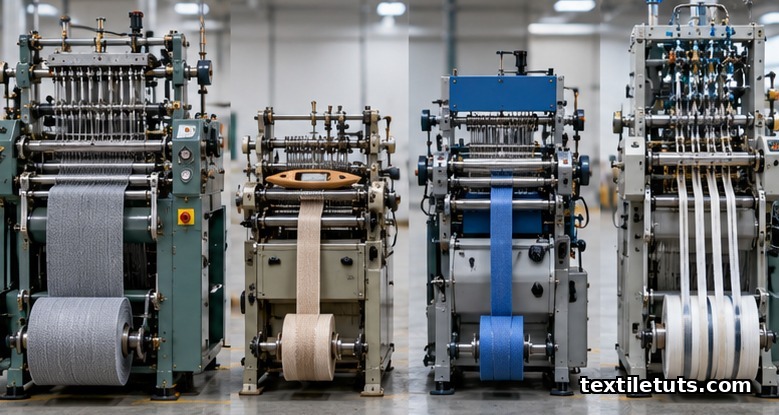
Four loom classes dominate commercial narrow fabric production. Each trades weft insertion speed against fabric width, pattern complexity, and yarn compatibility in a different way.
Needle Looms
Needle looms insert a single weft needle through a row of warp yarns and across the shed, with the needle body itself carrying the weft. They dominate the webbing and heavy-tape market because they handle coarse multifilament and spun yarns from 200 to 5,000 denier, and run at 1,200 to 2,400 picks per minute on machines from Müller Nicross, Jakob Müller, and Bonas. The weft yarn sits straight across the web with no figure, which is exactly what load-bearing applications require. A modern 12-head needle loom can produce 12 parallel webs at once, each wound onto its own take-up package, which is why webbing prices can fall below USD 0.10 per metre at production volumes.
Shuttle Narrow Looms
Traditional shuttle looms carry a small shuttle across the shed on each pick. They run slower than needle looms, typically 200 to 600 picks per minute, but they produce a tighter selvedge and tolerate fancy wefts, multiple wefts, and gripper-style pattern changes. Many heritage ribbon and label mills in South Asia and Europe still run shuttle narrow looms because the selvedge finish is impossible to match with a needle loom, and the slower pace allows finer yarns to be handled without breakage.
Rigid-Rapier and Flexible-Rapier Narrow Looms
Rapier narrow looms grip the weft with a small jaw or hook and pull it across the shed. They reach 1,500 picks per minute and allow up to 16 weft colors with electronic pattern control. Rapier machines are the standard choice for technical ribbons, automotive safety belts, and aerospace webbing where pick density and pattern repeat accuracy must be controlled to within 0.5 mm. The weft insertion is gentler than a needle loom, so finer filament counts in the 30 to 75 denier range can be woven without filament damage.
Crochet Knitting Machines (for Elastic Narrow Fabrics)
Although called knitting machines, crochet warp knitting units such as the Comez and Mayer Raschel systems are the standard way to make narrow elastic bands with integrated rubber or spandex. They are not weaving machines in the strict sense, but they produce the elastic narrow fabric used in waistbands, medical compression wraps, and suspenders, so they belong in the same product family. A typical crochet machine runs 12 to 24 narrow elastic bands side by side at 1,800 courses per minute.
Yarn Selection for Narrow Fabric
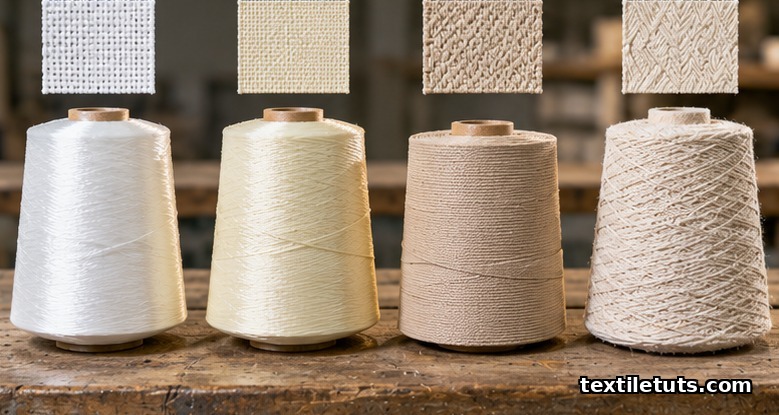
The yarn chosen for a narrow fabric controls its tensile strength, elongation at break, abrasion resistance, and UV stability more than any other design choice. Four yarn families cover the vast majority of production.
| Yarn Family | Common Construction | Breaking Tenacity (cN/tex) | Typical End-Use |
|---|---|---|---|
| Polyester filament | 500D to 1500D, 96 to 192 filament | 60 to 80 | Automotive seat belts, luggage webbing |
| Polyamide (nylon) filament | 210D to 840D | 70 to 90 | Military load gear, climbing harnesses |
| High-tenacity polypropylene | 600D to 2000D | 55 to 70 | Bulk packaging straps, pet leads |
| Cotton or T/C spun | Ne 20/1 to Ne 60/1 | 15 to 25 (spun) | Garment tapes, labels, bookbinding |
For safety-critical webbing, the warp is almost always high-tenacity polyester or nylon, with the weft a lower-denier filament to lock the structure and prevent unraveling on cut ends. For decorative ribbons, cotton and viscose spun yarns dominate because the matte finish accepts dye and print more evenly than a bright filament.
Applications Across Industries
Narrow fabrics are intermediate products that disappear inside the final article. Their performance, however, is often the limiting factor in the larger product.
- Automotive safety: Seat belts, child-restraint tethers, and airbag tether straps must hold a defined load under crash pulse. ECE R16 and FMVSS 209 specify the dynamic performance; the narrow fabric mill supplies the webbing that passes those tests.
- Military and climbing: Load-bearing webbing on rucksacks, body armor, and climbing harnesses is rated in kN breaking force. EN 566 and UIAA 101 are the relevant European and international standards, and they reference textile tensile methods for verification.
- Medical braces and orthotics: Narrow elastic and rigid webbing stiffens ankle, knee, and wrist braces. ISO 13485 governs the medical device manufacturer, and the narrow fabric mill typically supplies under that quality system.
- Furniture and bedding: Mattress border tape, upholstery edge, and elastic strapping for sofas are all narrow fabric constructions.
- Apparel trims: Twill tape, petersham, and pre-shrunk waistband tape are the workhorse narrow fabrics inside every sewn garment.
Quality Control and Testing Standards
Breaking force and elongation at break are the two non-negotiable tests for narrow fabric. They are run on a constant-rate-of-extension tensile tester with a 100 mm or 200 mm gauge length, and the result is reported in newtons and percent. Width tolerance, picks per cm, ends per cm, mass per unit length, and colorfastness round out the standard release package.
The applicable standards vary by region and product. ASTM D6775 covers the breaking strength and elongation of textile webbing, tape, and braided material. ISO 6933 specifies the determination of single-end breaking force using a CRE tester, and is the method most Asian mills adopt for export to European and Japanese customers. AATCC TM 8 covers colorfastness to crocking, which matters wherever the narrow fabric is dyed and will rub against skin or another fabric in service. ISO 9001 governs the quality management system that holds all of the above together and is the baseline certification required by most OEM buyers.
Common Defects and How Mills Catch Them
Three defects dominate the rejection statistics in a modern narrow weaving facility.
- Missing picks: A broken weft needle or a weft run-out produces an unwoven gap. Modern needle looms use a photoelectric weft-feeder monitor that stops the loom within 50 ms of detecting a missed pick, before the defect runs further down the roll.
- Width drift: Narrow fabrics stretch or shrink across the loom as picks accumulate. Mills control this with a take-up dancer roll that maintains a constant fabric tension of 0.5 to 2.0 cN/tex depending on construction.
- Selvedge fray: Needle loom selvedges are raw unless reinforced. Most safety-critical webbing is woven with a tucked-in or leno selvedge that holds the weft during subsequent dyeing and finishing.
Frequently Asked Questions
What is the difference between narrow fabric weaving and broad fabric weaving?
Narrow fabric weaving runs on looms with a fixed warp width up to 450 mm, uses high picks-per-cm construction, and produces a finished roll under controlled tension on the loom itself. Broad fabric weaving runs on wider looms from 1.5 to 3.6 m, uses fewer picks per cm, and typically sends the woven cloth through separate finishing, dyeing, and tentering lines.
What loom type produces the most narrow fabric by volume worldwide?
Needle looms produce the highest global volume of narrow fabric, especially polyester and nylon webbing for automotive and military end-uses. Shuttle looms dominate decorative ribbon production, and rigid-rapier narrow looms dominate technical ribbon and aerospace webbing.
How is narrow fabric breaking strength tested?
Breaking strength is measured on a constant-rate-of-extension tensile tester following ASTM D6775 or ISO 6933, depending on the destination market. The specimen is clamped at a 100 mm or 200 mm gauge length and pulled until rupture, with peak load in newtons and elongation at break reported as a percentage.
What are the most common defects in narrow fabric weaving?
Missing picks, width drift, and selvedge fray are the three defects that account for most rejections. Modern mills catch them with photoelectric weft-feeder monitors, tension-controlled take-up rolls, and tucked-in or leno selvedges, all of which stop the loom or contain the defect before it propagates down the roll.
Can narrow fabric be woven on a small home loom?
Small inkle looms and rigid-heddle looms can weave tape up to about 100 mm wide for craft and trim applications, but they do not reach the picks-per-minute, weft tension control, or yarn count range of an industrial needle loom. Anything that must meet a published tensile standard is woven on a mill-scale machine.
References
- ASTM International. ASTM D6775: Standard Test Method for Breaking Strength and Elongation of Textile Webbing, Tape, and Braided Material. https://www.astm.org/d6775 — tensile test method for narrow woven and braided material.
- International Organization for Standardization. ISO 6933:1984, Textiles — Determination of single-end breaking force and elongation at break using constant rate of extension tester. https://www.iso.org/standard/12074.html — single-end tensile method used on narrow fabric yarns.
- International Organization for Standardization. ISO 9001:2015, Quality management systems — Requirements. https://www.iso.org/standard/62085.html — quality system governing most narrow fabric mills.
- AATCC. AATCC Test Method 8: Colorfastness to Crocking: Crockmeter Method. https://www.aatcc.org — colorfastness method cited for dyed narrow fabrics.
- ResearchGate. Adanur, S. (1995). Wellington Sears Handbook of Industrial Textiles. https://www.researchgate.net — reference text covering narrow fabric loom technology and yarn selection.
- MDPI. Tekla, S. et al. (2021). Tensile Properties of Woven Narrow Fabrics for Technical Applications. https://www.mdpi.com — peer-reviewed study on breaking force and elongation in narrow webbing.
- United Nations Economic Commission for Europe. ECE R16: Uniform Provisions Concerning the Approval of Safety Belts and Restraint Systems for Occupants of Motor Vehicles. https://eur-lex.europa.eu — regulation that defines the load a seat-belt narrow fabric must hold.
This article is the working reference for narrow fabric weaving. Editorial by Mohammad Yousuf (Anik), TextileTuts. Sources: ASTM D6775, ISO 6933:1984, ISO 9001:2015, AATCC TM 8, Wellington Sears Handbook (Adanur), MDPI narrow-fabric tensile study, and ECE R16 as cited.


