
Resist Printing vs Direct Printing

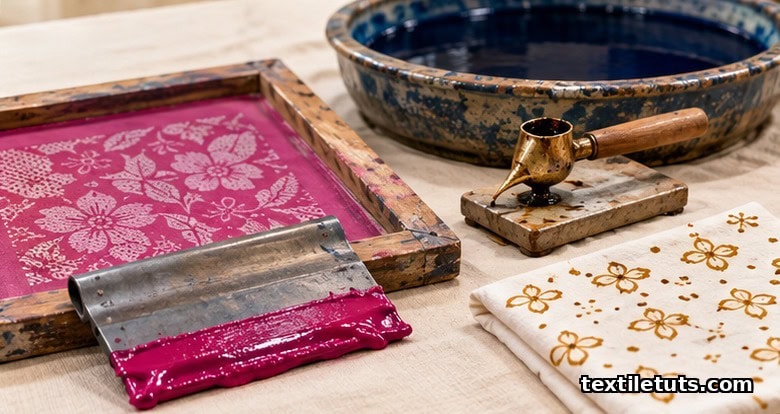
Resist printing blocks 20 to 60 percent of the target fabric area with wax, paste, or a chemical resist before dyeing, leaving the masked portions white or pale against a colored ground, while direct printing applies a thickened dye or pigment paste straight onto the substrate through a screen or roller and needs no barrier step at all.
The trade-off between the two comes down to where the pattern lives. In resist printing the dye bath does the work and the resist agent decides what stays light. In direct printing the print paste itself carries the pattern onto a white or pre-prepared ground. Both methods are older than industrial chemistry, both are still in production today, and both feed the same color-fastness test methods defined in the ISO 105 series and the AATCC Technical Manual.
This article walks through both techniques, the science behind the resist barrier, the practical reasons mills choose one over the other, and what color-fastness, hand feel, and reproducibility look like for each.
Direct Printing: Thickened Color on a White Ground
Direct printing is the workhorse of industrial textile printing. The printer deposits a print paste, a dye or pigment dispersed in a thickener such as sodium alginate, a sodium alginate and carboxymethyl cellulose blend, or a synthetic polyacrylate, directly onto a fabric that has already been bleached and prepared. No blocking step is involved.
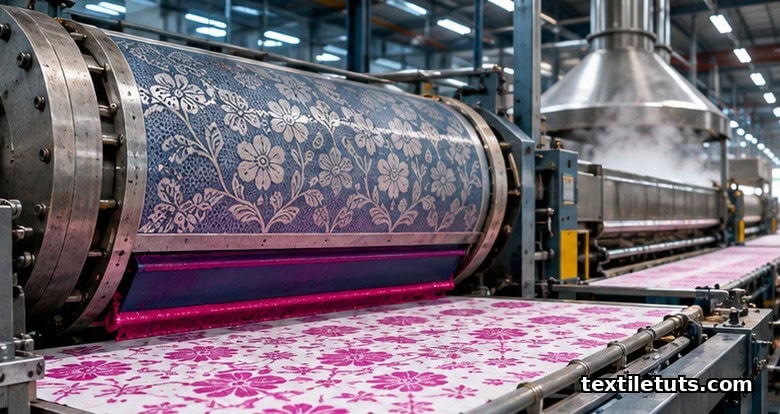
Three printing routes dominate direct application today:
- Flat or rotary screen printing. A perforated stencil carries the pattern, and a squeegee forces paste through the mesh onto the fabric. Modern rotary screens run at 30 to 80 m/min on cotton and up to about 50 m/min on polyester-cotton blends.
- Roller (engraved copper) printing. An engraved metal roll picks up paste from a trough and transfers it under pressure to the cloth. Roller printing still runs at 90 m/min or higher in dedicated cotton print mills.
- Digital inkjet printing of textiles. Droplets of water-based ink — disperse, reactive, acid, or pigment — are jetted onto a prepared substrate. Industrial inkjet lines clear 200 to 600 m²/h depending on resolution.
Direct printing wins on speed, pattern complexity per square meter, and color depth. Pigment direct prints require no washing after fixation, which removes an entire effluent stream from the workflow.
Resist Printing: The Barrier Decides the Pattern
Resist printing inverts the logic. A resist agent is applied first, then the fabric is immersed in dye or coated with paste, and finally the resist is washed out. Anywhere the resist sat stays light; everywhere else takes the color.
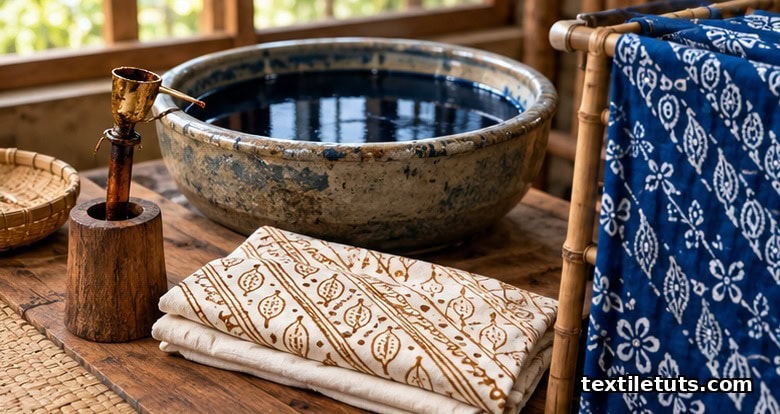
Resists fall into two families:
- Mechanical resists — wax (batik), mud, starch, or gum arabic. These physically block dye liquor from contacting the fiber. Indonesian batik, which UNESCO inscribed on the Representative List of the Intangible Cultural Heritage of Humanity in 2009, is the canonical example; molten wax is applied with a canting tool or a block stamp, the cloth is dipped in indigo or another dye, and the wax is later boiled off.
- Chemical resists — substances that react with the fiber or the dye to prevent fixation. In reactive-dye cotton printing the role is often played by acids, alkalis, or salts applied locally; a thoroughly pre-neutralized region will not form the dye-fiber covalent bond that reactive dyes rely on.
The most familiar chemical-resist dye is indigo. Indigo on cellulose has almost no affinity at room temperature and must be oxidized on the fiber before it becomes the recognizable blue; that slow oxidation makes indigo tolerant of mechanical-resist patterns in a way reactive, acid, or disperse dyes usually are not.
Mechanics: How Color and Resist Interact with Cotton vs Polyester
On cellulosic fibers (cotton, viscose, linen) the print paste for direct printing typically carries a reactive dye (forming a covalent bond with hydroxyl groups on the cellulose), a thickener, urea, sodium bicarbonate, and a wetting agent. The fabric then passes through a dryer at 100 to 160 °C and a steamer at 102 °C for 8 to 15 minutes for fixation, depending on the recipe.
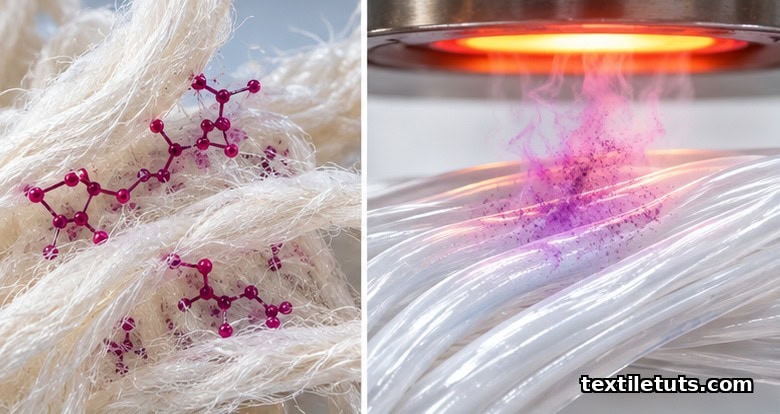
On polyester and polyester-cotton blends the print paste is usually a disperse dye (which sublimes into amorphous regions of the PET fiber) plus a thickener, with fixation in hot air at 180 to 210 °C for 60 to 90 seconds in a thermosol unit. Because disperse dyes diffuse inside the fiber, resist printing them is difficult; mechanical resists tend to fail at the high temperatures and chemical resists interfere with the disperse dye’s vapor uptake.
Resist recipes must hold against the dye liquor or print paste long enough to keep a clean edge and then release cleanly in the wash-off, which is why wax-resist dyeing with indigo, exhausted at room temperature, is far simpler than wax-resist dyeing with a hot reactive dye.
Color Fastness and Wash Performance
Color fastness is tested against the ISO 105 series and the AATCC test methods. The two systems overlap heavily but are not interchangeable; ISO 105 is the international baseline and AATCC is the United States mirror, and many mills run both before shipment.
- ISO 105-C06 (washing). Specifies the conditions under which unfixed dye is detached during a standard domestic wash, usually 40 °C with steel balls and an SDC multifiber adjacent fabric, and the grading scale used to judge staining of the multifiber.
- ISO 105-B02 (light). Exposes fabric to xenon-arc light under controlled humidity to grade fade. Lets a mill compare a direct-print reactive-dye run against a resist-printed indigo run.
- ISO 105-X12 (rubbing / crocking). Grade 4 or better on dry and wet crocking is the practical target for discharge and resist prints on dark grounds, where these methods tend to lose more surface dye than direct prints.
- AATCC TM 61 (laundering). The AATCC mirror of ISO 105-C06, sometimes run as “Test 1, 2A, 3A, 4A, 5A” depending on aggressiveness.
- AATCC TM 8 (crocking). The companion of ISO 105-X12 for the United States market.
Resist prints on dark grounds, especially discharge-style resists on reactive-dyed grounds, score worse on wet-rubbing fastness than equivalent direct prints on white grounds. The trade-off is that direct prints on a dark ground need additional dye or multiple hits to build the same depth.
When Mills Pick One Over the Other
Pattern economics and fiber chemistry narrow the choice faster than tradition does.
- Heavy, large-scale cellulosic prints with simple repeats: flat-screen or rotary direct printing with reactive dyes. This is the cheapest path to tens of thousands of meters.
- Fine floral or photographic complexity in short runs: digital inkjet direct printing. No screens to engrave, so per-meter setup cost collapses.
- Dark ground with sharp white or pale motifs (denim-inspired wax prints, ethnic patterns): resist printing with wax or a chemical agent on an indigo or reactive ground.
- Custom textile art and small-batch apparel: block, screen, or wax-resist printing. The motifs that show up in heritage and craft lines are almost always resist prints because the boundary does not need to align with a screen repeat.
For polyester and polyester-cotton blends, the default is almost always direct printing with disperse dyes; resist printing is technically possible but rarely justifies the extra resist recipe and washing step.
Comparison Table: Direct Printing vs Resist Printing
| Property | Direct Printing | Resist Printing |
|---|---|---|
| Pattern formation | Paste deposited onto a white or pre-prepared ground | Barrier applied first, then dyed or printed, then barrier removed |
| Typical machinery | Flat or rotary screen, engraved copper roller, digital inkjet | Hand-applied canting, block stamp, screen-printed chemical resist, digital chemical-resist |
| Preferred dye class | Reactive (cotton), disperse (polyester), acid (silk and nylon), pigment (any) | Reactive + chemical resist, indigo + wax, reactive on dark ground + discharge resist |
| Typical fiber | Cotton, viscose, polyester, silk, blends — almost all | Primarily cellulosic (cotton, viscose, linen) and silk; polyester is unusual |
| Setup cost per design | High for screens and rollers, low for digital | Low for hand block and wax, moderate for screen-printed chemical resist |
| Wash fastness grade (ISO 105-C06) | Typically grade 4 to 5 on a well-fixed reactive direct print | Typically grade 3 to 4 on dark grounds due to loose surface dye |
| Wet crocking grade (ISO 105-X12) | Typically grade 4 to 5 on a well-fixed direct print | Often grade 3 to 4 on dark grounds |
| Typical effluent load | Medium (unfixed dye plus thickener wash-off) | Higher (resist wash-off plus dye wash-off) |
| Best for | High-volume repeats, fine photographic detail at short runs | Sharp light motifs on dark grounds, heritage patterns |
Frequently Asked Questions
Which method gives sharper lines, direct printing or resist printing?
Resist printing with a well-controlled barrier reaches line widths of roughly 0.5 to 1.5 mm in wax batik and finer for screen-printed chemical resists, while rotary screen direct printing typically holds 0.2 to 0.4 mm lines. Both are far sharper than discharge printing, which is sometimes confused with resist printing but works in the opposite direction (bleaching color out of a dyed ground rather than blocking dye in).
Is resist printing only for cotton?
Cotton, linen, viscose, and silk are the typical substrates. Polyester is rarely resist-printed at production scale because the high disperse-dye fixation temperatures of 180 to 210 °C destroy most mechanical resists, and many chemical resists, before they can do their job.
Why does my resist-printed fabric bleed in the first wash?
Loose surface dye is the usual reason. Dye that sits on top of the fiber rather than inside it detaches under wet rubbing or warm soapy water. Acidify the wash water mildly, run it at 30 °C, and avoid leaving the wet garment piled in a hot wash for prolonged periods.
Is wax-resist batik color-fast enough for clothing that gets washed weekly?
Wax-resist batik typically rates grade 3 to 4 on ISO 105-B02 light fastness and grade 3 to 4 on ISO 105-C06 wash fastness, acceptable for many garments but lower than a fully fixed reactive direct print. Edge crispness drops first; the overall color usually stays readable for years if the garment is washed in cool water with neutral detergent.
Can digital inkjet printers do resist printing?
Indirectly, yes. Digital printers can jet a chemical resist in the exact pattern needed, then the fabric goes through a dye bath or a second print, and the un-resist areas take the second color. This is the modern form of digital resist, a workflow that combines screen-pattern flexibility with a resist-style outcome and shortens setup time dramatically.
References
- ISO. ISO 105-C06:2010 Textiles — Tests for color fastness — Part C06: Color fastness to domestic and commercial laundering. iso.org — defines wash fastness conditions and staining assessment.
- ISO. ISO 105-X12:2016 Textiles — Tests for color fastness — Part X12: Color fastness to rubbing. iso.org — defines dry and wet crocking grading.
- AATCC. AATCC Technical Manual — Test Method 61, Colorfastness to Laundering, Accelerated. aatcc.org — the United States color-fastness laundering method.
- AATCC. AATCC Technical Manual — Test Method 8, Colorfastness to Crocking: AATCC Crockmeter Method. aatcc.org — crocking reference method.
- UNESCO. Indonesian Batik — inscription on the Representative List of the Intangible Cultural Heritage of Humanity, 2009. ich.unesco.org — documents heritage wax-resist technique.
- MDPI Fibers. Review articles on textile printing chemistry, including reactive, disperse, and pigment thickener systems. mdpi.com — peer-reviewed technical overview of print-paste recipes and fixation conditions.
This article is the working reference for resist printing and direct printing in textile manufacturing. Editorial by Shahrukh Islam, TextileTuts. Sources: ISO 105-C06, ISO 105-X12, AATCC TM 61, AATCC TM 8, UNESCO batik listing, MDPI Fibers, as cited.


