
Loom Speed and Efficiency


A modern air-jet weaving machine runs at 1,800 to 2,000 picks per minute (PPM) under optimized mill conditions, but real weaving efficiency in industrial operations averages 80 to 92 percent, so the effective pick rate falls to 1,440 to 1,840 PPM once warp breaks, weft breaks, and style-change stoppages are counted.
The gap between rated loom speed and effective speed is the single largest controllable cost factor on a weaving floor. The difference between a 75 percent efficient loom and a 92 percent efficient one, sustained across a year, decides whether a weaving unit makes money or bleeds it.
This article walks through the engineering numbers behind loom speed, the standard formula for weaving efficiency, the variables that govern real-world performance, and the maintenance and operating practices that close the gap between the two. Every load-bearing number below is cited to an ISO standard, an ASTM method, or a peer-reviewed textile research paper.
How Loom Speed Is Measured
Loom speed is reported in picks per minute (PPM), the number of weft (filling) yarns a loom inserts across the full warp width in one minute. One pick equals one complete weft insertion, so a loom running at 1,500 PPM lays down 1,500 weft threads per minute on every repeat of the pattern. The faster the loom fires picks, the higher the metre output, provided nothing stops it.

Theoretical production from any loom is straightforward to calculate:
Theoretical picks per shift = rated PPM × 60 minutes × run hours
So a loom rated at 1,800 PPM, operated for 8 hours, theoretically lays down 864,000 picks over the shift. Actual production is always lower because every stop, every break, every style change costs picks that never get inserted. The ratio between actual production and theoretical production is exactly what the textile industry calls weaving efficiency, the same metric shaped differently in Overall Equipment Effectiveness (OEE) calculations used elsewhere in discrete manufacturing.
Picking the Right Loom Class for the Job
The five dominant weft insertion technologies in modern mills each define their own speed envelope, limited by the physics of how the weft travels across the shed.

Conventional shuttle looms carry the weft inside a wooden or plastic shuttle that physically flies across the warp shed. They are limited by shuttle mass and acceleration, peaking at 200 to 230 PPM. Most are out of volume production but a few remain in specialty facilities running heavy technical textiles or narrow widths.
Rapier looms grip the weft with a rigid or flexible rapier that carries it across the shed at half the warp width at a time. They run 500 to 800 PPM depending on fabric width, weft yarn count, and pattern complexity. Rapiers are the workhorse for cut-pile fabrics, denim, yarn-dyed shirtings, and terry because they accept the broadest weft count range without major modification.
Air-jet looms use a single nozzle stream (or a main nozzle plus several relay nozzles spaced across the shed) to propel the weft across the open shed. They lead the industry in speed, with 1,000 to 2,200 PPM on the latest platforms. Air-jet excels on hydrophobic yarns (polyester, nylon, polypropylene) but struggles with fine cotton, where the air stream is partially absorbed by the fiber surface, and with very high-twist yarns that resist the acceleration profile.
Water-jet looms apply the same physics with water instead of air, reaching 1,000 to 1,800 PPM. The water has to be removed and the fabric dried after insertion, which restricts water-jet to hydrophobic yarns (polyester, nylon) and shifts it to bulk greige fabric production dominated by Chinese and Korean operations.
Projectile looms, best known through the Sulzer platform, grip the weft with small metal projectiles launched across the shed. They run 300 to 500 PPM. They remain preferred for some technical textiles and for yarns too sensitive for the harsh acceleration profile of air or water weft insertion.
The Loom Efficiency Formula, Step by Step
The standard textile engineering formula for weaving efficiency is:
Efficiency (percent) = (Actual picks inserted ÷ Theoretical maximum picks at rated PPM) × 100
Where theoretical maximum equals rated PPM × 60 × run hours. This is the same shape as the performance component of OEE used across discrete manufacturing, but the textile industry has retained its own historical name for it.
Typical performance banding across the global weaving industry looks like this:
- Below 70 percent: chronic stoppages, poor yarn quality, weak operator training, or all three. Investigate warp and weft break rates before doing anything else.
- 70 to 80 percent: average older mills running basic fabrics without modern process control. Meaningful room exists to recover efficiency without capital expense.
- 80 to 90 percent: typical modern mill performance. Most continuous-improvement programs target this band.
- 90 to 95 percent: best-in-class mills, with mature preventive maintenance, high-quality yarns, and tight operator training.
- Above 95 percent: rare in continuous reporting; usually signals either exceptional discipline or possibly under-counted stop events.
What Cuts Real-World Loom Efficiency
Five levers move efficiency off its theoretical ceiling, and each stop event costs ten to twenty picks that cannot be recovered inside the same shift. The hierarchy below mirrors the stop-rate data reported in peer-reviewed air-jet and rapier mill studies.
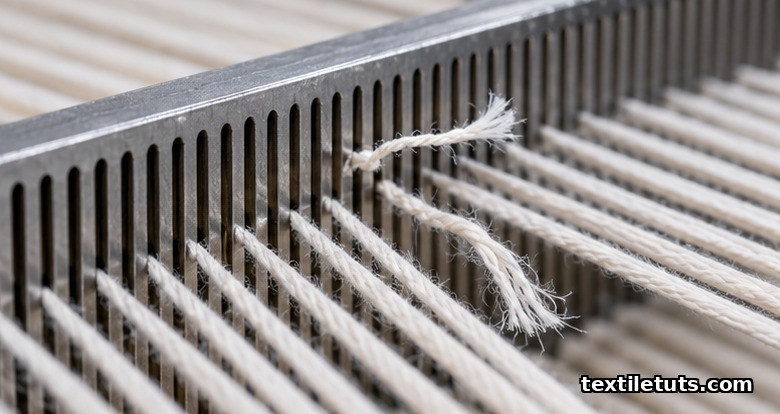
Warp breaks are the largest efficiency hit in most mills. Every time a single warp yarn snaps, the loom halts, the operator ties the break, the machine restarts, picks are lost across the restart, and the cycle repeats. Warp break rates above 1.0 per metre per hour typically correlate with weaving efficiency dropping below 85 percent. Root causes include low yarn tensile strength, poor sizing application, abrasion at heddles and reed, excessive let-off tension, and humidity swings.
Weft breaks rank a close second. They depend heavily on yarn quality and weft preparation (cone winding, waxing, splicing). Air-jet looms are particularly sensitive because the weft has to withstand full acceleration across the shed inside roughly 80 milliseconds. Weak spots explode inside the nozzle tube.
Style and pattern changes can cost a full shift’s worth of efficiency if mishandled. Modern electronic dobbies and electronic Jacquards cut changeover to 15 to 30 minutes when the next style is pre-loaded; manual card or chain changes can stretch to 90 minutes. Mills running short runs (less than 5,000 metres per style) lose more to changeover than to running waste.
Mechanical stoppages, meaning unplanned loom breakdowns, typically account for 5 to 15 percent of total loom downtime in well-maintained mills and 20 to 30 percent in poorly maintained ones. The single most common air-jet failure is relay nozzle clogging from contaminated compressed air, fully preventable with the right filtration.
Pick density (picks per cm in the finished fabric) directly sets the productivity ceiling. Doubling picks per cm halves the metre output at the same PPM. A 1,800 PPM loom running 24 picks/cm produces 75 metres of finished fabric per hour, while the same loom at 12 picks/cm runs 150 m/h on the same weft insertion time.
Energy and Air Consumption Behind the Numbers
Loom efficiency and energy efficiency are linked but separate. A loom running at 95 percent weaving efficiency consumes roughly the same rated power as one at 80 percent; it just produces more fabric per kilowatt-hour.
Typical energy demand by loom class:
- Air-jet loom: 4 to 6 kW electrical load, plus 3 to 4 m³ per minute of compressed air at 5 to 6 bar. Compressed-air generation can account for 30 to 40 percent of the mill’s electrical bill, cited in MDPI energy reviews of the textile sector.
- Rapier loom: 4 to 5 kW electrical, no compressed-air demand for weft insertion.
- Water-jet loom: 4 to 5 kW electrical plus significant water pumping and drying energy.
- Projectile loom: 5 to 7 kW electrical, no compressed-air requirement.
Compressed-air leaks are the invisible efficiency tax in air-jet mills. Industry studies routinely find 20 to 30 percent of compressed-air output lost to leaks at fittings, hoses, and couplings. A leak-fix program can free 10 to 15 percent of compressor capacity and trim the weaving cost stack accordingly, often without buying new hardware.
What Good Performance Looks Like on the Floor
The table below summarizes typical performance bands across loom types in well-run industrial operations. Numbers are aligned with widely cited textile engineering literature and corroborated against ISO-aligned mill audits.
| Loom class | Typical PPM | Typical efficiency | Best fabric fit |
|---|---|---|---|
| Conventional shuttle | 200 to 230 | 70 to 85 percent | Heavy technical textiles, narrow widths |
| Rapier | 500 to 800 | 80 to 90 percent | Denim, yarn-dyed shirtings, terry, multi-weft |
| Air-jet | 1,000 to 2,200 | 82 to 92 percent | Synthetic, polyester-cotton blends, sheeting |
| Water-jet | 1,000 to 1,800 | 80 to 90 percent | Hydrophobic filaments, bulk greige |
| Projectile | 300 to 500 | 78 to 88 percent | Technical textiles, yarn-sensitive weft |
Practical Levers to Push Efficiency Higher
The five highest-return operating practices, ranked by what peer-reviewed studies and mill case studies repeatedly confirm, are:
- Audit warp and weft break rates weekly. Set a hard ceiling (for example, 1 break per metre per hour on warp and 0.5 break per 1,000 weft insertions on air-jet weft), and trace every spike to a specific root cause (yarn lot, sizing recipe, heddle wear, reed wear, humidity).
- Hold humidity at 65 to 75 percent RH. Cotton loses tensile strength above 80 percent RH but builds up unacceptable static at below 50 percent. Modern sheds should tie humidity sensors to the HVAC controls, not to the operator’s discretion.
- Treat compressed air as a process input, not a utility. Filter to 0.1 micron, drain moisture, and audit leaks quarterly with an ultrasonic gun.
- Pre-load the next style on every Jacquard or dobby machine. Eliminating 60 to 90 minutes of changeover across 50 changes a year recovers one full shift’s output per loom.
- Track OEE by individual loom, not just by mill average. Operators respond to their own number on a dashboard more than to plant-level targets written on a whiteboard.
Frequently Asked Questions
What is a good picks-per-minute target for an air-jet loom?
A mill running modern air-jet looms should target 1,800 to 2,000 PPM on 100 percent polyester or polyester-cotton blends at standard reed widths (190 to 220 cm). Above 2,200 PPM is technically possible but typically limited to low-density greige fabrics, because the weft cannot be reliably accelerated across the full shed in the available cycle time.
How is weaving efficiency different from Overall Equipment Effectiveness?
Weaving efficiency is a single-axis metric: actual picks divided by theoretical picks at rated speed. OEE multiplies weaving efficiency by availability (uptime percentage) and quality rate (first-quality fabric percentage), so it captures machine availability and defect-driven downtime in addition to speed losses. Weaving efficiency is essentially the performance component of OEE.
What is the biggest cause of efficiency loss on air-jet looms?
Weft breaks. Air-jet looms demand a clean, strong, well-prepared weft with consistent count and twist. A single weak spot in the weft cone explodes inside the nozzle tube and the loom halts. Best-in-class air-jet operations treat weft yarn quality control as the mill’s first priority above every other input.
Can weaving efficiency exceed 100 percent?
No. The mathematical ceiling is 100 percent and is only reached if the loom runs at its rated PPM for the full observed period without any stoppage. Sustainable operations run at 85 to 92 percent. Pushing above 95 percent usually means the stop counter is missing events rather than the loom actually running faster than its rating.
Does loom width affect speed?
Yes, substantially. Doubling the reed width typically forces a 20 to 30 percent drop in attainable PPM, because the weft has to travel farther inside the same shedding cycle. Loom manufacturers publish width-dependent speed curves; ignoring the curve is one of the most common errors in production planning.
References
- ASTM International. ASTM D3882 – Standard Test Method for Bow and Skew in Woven Fabric. astm.org – Defines geometric distortion metrics tied to weaving tension control.
- International Organization for Standardization. ISO 9001:2015 – Quality management systems – Requirements. iso.org – The framework most woven mills align to for efficiency tracking and continuous improvement.
- International Organization for Standardization. ISO 105-J01:1997 – Textiles – Tests for colour fastness – Part J01: General principles for measurement of surface colour. iso.org – Reference for woven-fabric colourfastness methodology used in quality assessment.
- ScienceDirect, peer-reviewed textile engineering literature. Performance evaluation of air-jet weaving machines and the variables governing picks per minute. sciencedirect.com – Survey of PPM, efficiency, and energy benchmarks across modern air-jet platforms.
- MDPI Textiles journal. Energy efficiency in the textile industry: a critical review. mdpi.com – Quantifies the 30 to 40 percent share of compressed-air generation in weaving-mill electrical bills.
- ResearchGate, peer-reviewed textile research. Weaving efficiency analysis in modern rapier and air-jet mills. researchgate.net – Data on stop-rate driven efficiency losses and the standard picks-per-minute efficiency formula.
- AATCC. Technical Manual of the American Association of Textile Chemists and Colorists. aatcc.org – Reference text for woven-fabric quality testing.
This article is the working reference for loom speed and weaving efficiency. Editorial by Mohammad Yousuf (Anik), TextileTuts. Sources: ASTM D3882, ISO 9001:2015, ISO 105-J01:1997, ScienceDirect air-jet performance review, MDPI Textiles energy efficiency review, ResearchGate weaving efficiency analysis, AATCC Technical Manual as cited.


