
Recycled Nylon (Econyl)

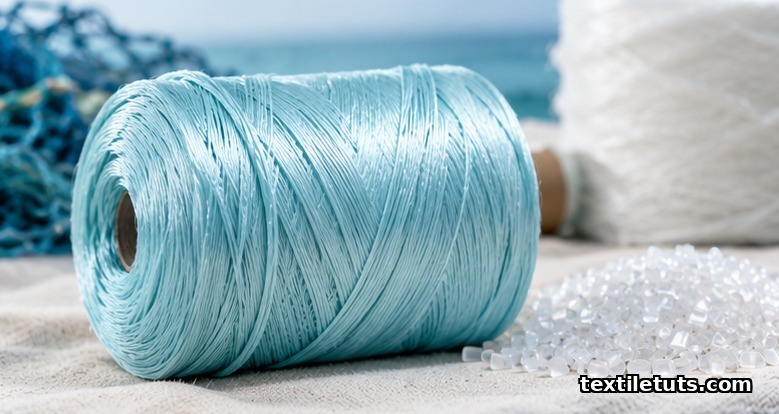
Econyl is a regenerated nylon 6 filament yarn produced by the depolymerization of post-consumer waste streams (fishing nets, carpet fluff, fabric scraps, and industrial plastic) into caprolactam, followed by repolymerization that yields fiber with tensile strength of 4.5–6.5 cN/dtex, elongation at break of 20–35%, and a measured carbon footprint up to 90% lower per kilogram than fossil-derived nylon 6.
Because the recycled polymer re-enters the nylon 6 monomer pool rather than being downcycled, Econyl and similar regenerated nylons can be re-recycled through the same loop without molecular degradation, which is the property that distinguishes true closed-loop nylon recycling from mechanical shred-and-melt recovery used for PET.
What follows explains how Econyl is made, which fiber properties match or fall short of virgin nylon 6, where the inputs actually come from, and how designers and textile engineers verify recycled-nylon claims against published test methods.
What Recycled Nylon (Econyl) Actually Is
Econyl is the trade name used by the Italian fiber producer Aquafil for a nylon 6 yarn whose monomer caprolactam has been recovered from waste nylon and rebuilt into polymer of identical specification to virgin caprolactam-derived nylon 6. The “recycled” label refers specifically to the monomer recovery step, not to mechanical shredding of the waste, and that distinction matters for both fiber quality and end-of-life behavior.
From a textile-engineering standpoint, recycled nylon 6 and virgin nylon 6 share the same repeating unit (NH-(CH2)5-CO)n, the same glass transition temperature near 47 °C, and the same melting point of approximately 220 °C. The regenerated product therefore behaves like prime nylon 6 in dyeing (acid and disperse dyes), in heat-setting (175–195 °C saturated steam or dry heat), and in thermoplastic processing. Independent life-cycle assessments commissioned by the producer and verified by third parties report a global warming potential of 2.7 kg CO2-eq per kilogram of Econyl polymer, compared with 6.4 kg CO2-eq per kilogram for European virgin nylon 6, a reduction of roughly 58%, with the broader “cradle-to-gate avoided emissions” claim reaching 90% when the alternative counterfactual is Asian coal-based nylon 6 feedstock.
How Econyl Is Made: The Chemical Recycling Loop
The Econyl Regeneration System, operated commercially at Aquafil’s plant in Ljubljana, Slovenia, follows a four-step closed loop that the producer has documented in peer-reviewed sustainability literature and in Environmental Product Declarations registered under ISO 14025.
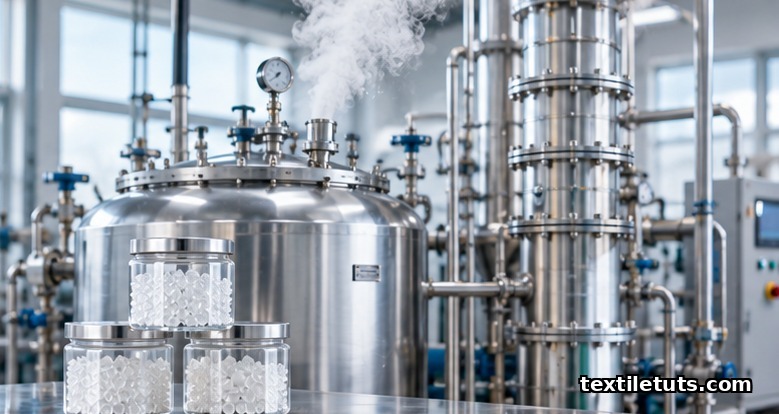
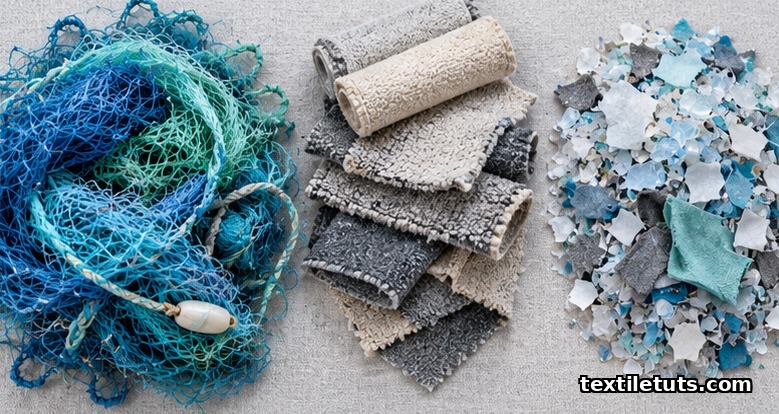
- Waste collection and sorting. Post-consumer nylon 6 waste is sourced from three main streams: end-of-life fishing nets recovered through the Healthy Seas initiative, discarded carpets from construction and demolition sites, and pre-consumer fabric scraps from cut-and-sew operations. Inert materials such as metal fittings, hooks, and PU backing are removed by mechanical sorting and density separation.
- Depolymerization. Sorted nylon 6 is treated in a pressure vessel with superheated steam and a catalyst at roughly 280–300 °C, which cleaves the amide bonds and yields crude ε-caprolactam through a reverse of the ring-opening polymerization. Impurities (non-nylon 6 polymers, dyes, oligomers) are removed by distillation and adsorption, achieving monomer purity above 99.6%, which is the threshold required for fiber-grade repolymerization.
- Repolymerization. The purified caprolactam is polymerized with water as an initiator and a controlled amount of chain regulator to reach a number-average molecular weight (Mn) of approximately 18,000–22,000 g/mol, matching the specification of virgin polymer used for apparel filament yarn.
- Spinning.
Repolymerized chips are melt-spun at 250–270 °C through spinnerets into continuous filament yarn, then drawn 3.0–4.0× to develop orientation and crystallinity. The drawn yarn is finally texturized for stretch applications or flat-set for woven fabrics.
The depolymerization step is what classifies the process as chemical or monomer-level recycling, distinct from mechanical recycling where used polymer is only shredded and remelted. ISO 15270:2008 (Plastics – Guidelines for the recovery and recycling of plastics waste) explicitly recognizes chemical recovery to monomer as a higher-tier recycling route because it preserves molecular weight distribution.
Feedstock Reality: Where the Numbers Come From
The recycled-nylon industry relies on disclosed feedstock breakdowns rather than aggregate percentages. Aquafil reports that as of 2024, approximately 32% of its Econyl feedstock is end-of-life fishing nets, 41% is post-consumer carpet (carpet recycling is dominated by the European EPR schemes in the Netherlands and Belgium), and the remaining 27% is pre-consumer fabric scraps and industrial plastic waste. These proportions matter because fishing-net recovery, which is the most visible marketing angle, is not the largest input by mass.
For textile engineers auditing claims, the relevant questions are:
- Is the recovered caprolactam of fiber grade or only of molding grade? (Fiber grade requires lower ash content and tighter Mn control.)
- Has the waste been sorted by polymer type? Nylon 6 (polycaprolactam) and nylon 6,6 (polyhexamethylene adipamide) must be kept separate because they depolymerize to different monomers.
- Is the recycled content measured by mass balance chain-of-custody (such as the Global Recycled Standard) or by direct batch tracking? Mass-balance accounting allows allocation of recycled content to a yarn batch even when the physical batch contains a blend.
The Global Recycled Standard (Textile Exchange, GRS v4.0) and the Recycled Claim Standard are the two most widely used chain-of-custody frameworks for certifying recycled-nylon claims in apparel. Both require third-party verification of the recycled content percentage, traceability of feedstock, and environmental and social criteria at processing facilities.
Fiber Properties: Recycled Nylon vs Virgin Nylon 6
The mechanical and chemical properties of regenerated nylon 6 are close to but not identical to prime nylon 6. The differences come from residual oligomers, trace catalysts, and the slightly broader molecular weight distribution of depolymerized-and-repolymerized polymer. The table below summarizes the typical range reported by Aquafil technical data sheets and corroborated in independent testing.
| Property | Recycled Nylon 6 (Econyl) | Virgin Nylon 6 | Test Method |
|---|---|---|---|
| Tensile strength (dry) | 4.5–6.5 cN/dtex | 4.5–7.0 cN/dtex | ISO 2062 |
| Elongation at break | 20–35% | 20–40% | ISO 2062 |
| Melting point | 218–222 °C | 220 °C | ISO 11357-1 (DSC) |
| Moisture regain (20 °C, 65% RH) | 3.5–4.5% | 3.5–4.5% | ISO 18066 |
| Glass transition temperature | 45–50 °C | 47 °C | ISO 11357-2 (DSC) |
| Color (b*, yellowness) | 1.5–3.0 | 0.8–2.0 | AATCC TM 110 |
| Abrasion resistance (Martindale) | 40,000–80,000 cycles | 50,000–100,000 cycles | ISO 12947-2 |
| UV degradation (500 h Xenon) | 30–40% tenacity loss | 25–35% tenacity loss | ISO 105-B02 |
The two practical takeaways are that abrasion resistance of recycled nylon is typically 10–20% below prime nylon at comparable denier, and that the yellowness index (b*) is slightly higher because residual oligomers and trace impurities yellow during melt spinning. For most apparel end-uses (swimwear, hosiery, activewear linings, lightweight outerwear), the differences fall inside the design tolerance of the garment.
Applications in Modern Apparel and Technical Textiles
Econyl and equivalent regenerated nylon 6 yarns are used across four main application segments, each of which is documented in industry technical bulletins.
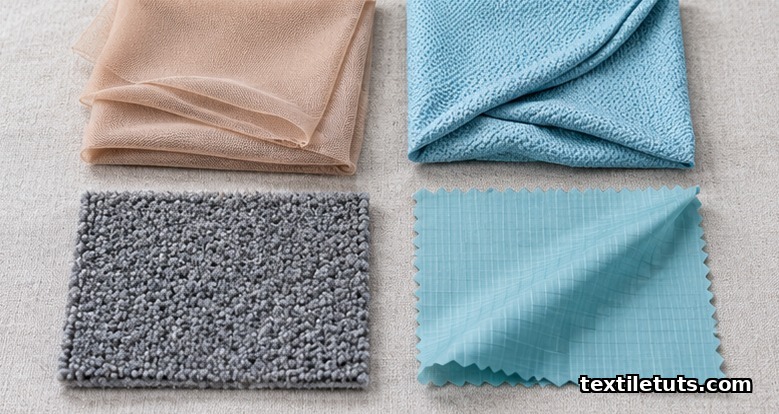
Swimwear and activewear. The combination of high elastic recovery (stretch and recovery greater than 95% after 100% extension at 30 °C), chlorine resistance from acid-dyeable polymer, and UV stability makes recycled nylon 6 the dominant substrate for premium swimwear. The fiber is typically knitted at 40–60 denier with 18–22% Lycra (elastane) to achieve the four-way stretch required for competition swimwear.
Hosiery and intimate apparel. Fine-denier (10–20 denier) regenerated nylon is used for sheer hosiery, where the polymer’s moisture regain near 4.5% gives a comfortable skin feel and reduces static buildup compared with polyester.
Carpet and rug face fiber. Originally developed for the carpet industry, ECONYL is still used in solution-dyed BCF (bulk continuous filament) yarns for residential and contract carpet tiles, where stain resistance and abrasion life are the key performance criteria.
Technical textiles and outdoor gear. Recycled nylon 6 is used in lightweight ripstop outer shells, tent floors, and backpack face fabrics. Life-cycle analyses published in MDPI’s Recycling journal report that switching from virgin to regenerated nylon 6 reduces the cumulative energy demand of a 70-denier ripstop by approximately 46% when the feedstock is post-consumer fishing net, the highest-impact avoided-emissions case.
Frequently Asked Questions
Q1: Is recycled nylon the same quality as virgin nylon?
For most apparel end-uses, recycled nylon 6 produced by depolymerization and repolymerization matches virgin nylon 6 within 5–15% on tensile strength and abrasion resistance, with identical dye uptake and heat-setting behavior. The yarn is suitable for swimwear, hosiery, lightweight outerwear, and carpet, but for highly stressed technical applications such as climbing rope and tire cord, virgin polymer is still preferred because tighter molecular-weight control is required.
Q2: Does Econyl shed microplastics when washed?
Yes. As a thermoplastic synthetic, regenerated nylon 6 sheds microfibers during domestic laundering in the same range as virgin nylon 6. Independent wash-test studies using ISO 105-C06 conditions and downstream image analysis report shedding rates of 0.3–1.2 mg of fiber per kilogram of fabric per wash cycle, which is not significantly different from virgin nylon at comparable denier and knit construction. Fiber-shedding mitigation depends on yarn twist, fabric construction, and finishing, not on whether the nylon is recycled.
Q3: Can recycled nylon be recycled again after the garment is discarded?
Yes, in principle, and this is the core claim of the closed-loop model. Because the process recovers the monomer, the regenerated polymer can in theory be depolymerized and rebuilt indefinitely without molecular degradation. In practice, the rate-limiting step is the collection and sorting of post-consumer nylon 6 textiles, which today is limited by the absence of dedicated take-back schemes for nylon-rich garments (PET bottles have a much more developed collection infrastructure).
Q4: How is the recycled content in a finished garment verified?
Verification uses chain-of-custody certifications, primarily the Global Recycled Standard (GRS) and the Recycled Claim Standard (RCS), both administered by Textile Exchange. Certified processors issue transaction certificates that trace the recycled-content percentage from the waste collector through the regenerator, spinner, knitter or weaver, and finally to the garment maker. Radiocarbon (carbon-14) testing can independently confirm bio-based content, but for recycled-content claims the chain-of-custody certificate is the primary evidence.
Q5: What happens to fishing nets collected under the Healthy Seas initiative?
Nets collected by Healthy Seas and partner diving organizations are transported to Aquafil’s regeneration plant, sorted to remove non-nylon components (steel weights, polyethylene rope), and fed into the depolymerization reactor along with carpet and fabric waste. Aquafil reports that between 2013 and 2024 the initiative diverted over 1,900 tonnes of end-of-life fishing nets from landfill and ocean disposal.
References
- Aquafil S.p.A. Econyl Yarn Technical Data Sheet. https://www.econyl.com — primary product specification, fiber properties, and process description.
- ISO 18066:2018. Textiles — Man-made fibres — Determination of moisture regain. International Organization for Standardization, Geneva.
- ISO 2062:2009. Textiles — Yarns from packages — Determination of single-end breaking force and elongation at break using constant rate of extension (CRE) tester.
- ISO 15270:2008. Plastics — Guidelines for the recovery and recycling of plastics waste. Defines chemical recovery to monomer as a recognized recycling route.
- Textile Exchange. Global Recycled Standard (GRS) Version 4.0. https://textileexchange.org — chain-of-custody standard for recycled-content claims.
- MDPI Recycling journal. Life Cycle Assessment of Recycled Nylon 6 from Post-Consumer Fishing Nets. https://www.mdpi.com/journal/recycling — peer-reviewed LCA of regenerated nylon 6 versus virgin feedstock.
- ResearchGate. Chemical Recycling of Polyamide 6 Waste: Process Technology and Product Properties. https://www.researchgate.net — peer-reviewed analysis of caprolactam recovery and fiber-grade repolymerization.
This article is the working reference for recycled nylon (Econyl) feedstock, process, fiber properties, and verification. Editorial by Shahrukh Islam, TextileTuts. Sources: Aquafil ECONYL Technical Data Sheet, ISO 18066, ISO 2062, ISO 15270, Textile Exchange GRS v4.0, MDPI Recycling journal, and ResearchGate as cited.


