
Knitting Mill Safety Standards

Knitting mills must operate under ISO 45001:2018 occupational health and safety management systems, the seven-part ISO 11111 series for textile machinery safety, and ILO Convention No. 155, with circular machines typically running at 1,200 to 1,800 RPM and noise levels reaching 85 to 100 dB(A) on the shop floor.
Beyond those headline numbers, a compliant knitting facility also has to satisfy Bangladesh Labour Act 2006 sections 79 to 89, EU Directive 2009/104/EC on work equipment if it ships to European buyers, and AATCC / ASTM test methods for any chemical auxiliaries used in pre-treatment or finishing. This guide walks through the seven hazard families a knitting mill must control, the standards that quantify each control, and the practical measures that pass an audit in Bangladesh, India, Pakistan, or Vietnam.
What Hazards Actually Define a Knitting Mill?
A knitting mill is not a generic factory. The hazard profile is shaped by needles moving at high cyclic rates, by long continuous-shift human operators, and by the volume of lint and short fibers the machines generate. The seven families that consistently show up in incident reports and ISO 45001 risk registers are mechanical, noise, dust, chemical, ergonomic, electrical, and fire. Each one is regulated by a specific clause of ISO 11111, a specific OSHA permissible exposure limit, or a specific clause of national labour law.
Mechanical hazards dominate the statistics. Circular knitting machines contain 1,800 to 3,600 needles arranged on a rotating cylinder, with sinker cams and striper mechanisms that can trap fingers and loose clothing within milliseconds. Flat knitting machines have moving carriages that traverse the needle bed at up to 1.2 m/s. ISO 11111-1:2013 and its sector-specific parts (-2 knitting, -3 nonwovens, -4 yarn processing, -5 fabric manufacturing, -6 fabric finishing, -7 storage and ancillary) require fixed guards on all moving parts, interlocked access doors, and stop motions that bring needle motion to rest within one revolution after a guard breach.
ISO 45001 and the ISO 11111 Series: The Two Backbone Standards
ISO 45001:2018 is the management-system standard. It does not prescribe specific numbers; it requires the mill to identify hazards, evaluate risks, set objectives, and review performance through the Plan-Do-Check-Act cycle. Auditors look for a documented hazard register, written safe work procedures, training records, and a functioning incident-investigation process. Mills exporting to Europe often pair ISO 45001 with ISO 14001:2015 environmental management because buyers increasingly request both certifications in the same audit cycle.
ISO 11111 is the technical standard. Part 1 covers common requirements across all textile machinery, while ISO 11111-2:2016 covers knitting machines specifically. The standard specifies guard dimensions, safety distances per ISO 13857:2008, stop times measured at the maximum operating speed, and the strength of interlocking devices tested per ISO 14119:2013. A typical circular knitting machine guard must withstand a 1,000 N static push without permanent deformation, and a finger-probe access gap must be less than 12 mm. ISO 11111-2 also requires emergency-stop devices colored red against a yellow background, with the actuator located within 600 mm of the operator’s normal working position.
Machine Guarding, Needle Guards, and Stop Times
The single most-cited nonconformity in knitting-mill audits is inadequate guarding on the cylinder and cam sections. ISO 11111-2 requires that a needle guard cover the entire needle circle during operation, with a tool to remove it without exposing the operator’s hands to the needle zone. Yarn-feed creels must have a guard preventing the operator from reaching between packages while the machine is running.
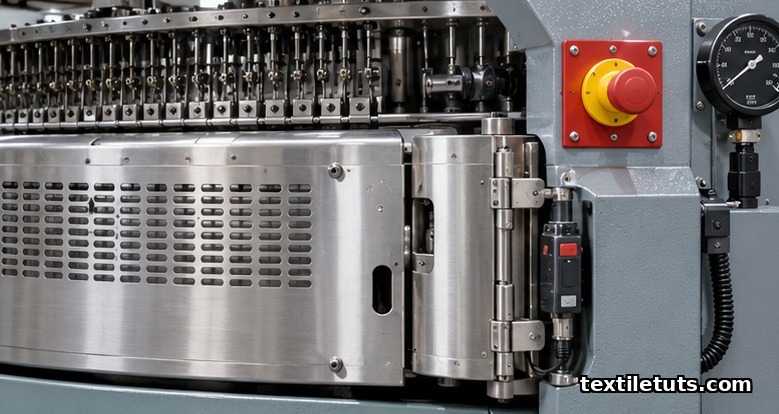
Stop times matter because of the high cyclic rates. ISO 11111-2 sets a maximum stopping time of one full needle-bed revolution at top speed. For a 30-inch circular machine running at 28 RPM, that is roughly 2.1 seconds; for a high-speed seamless machine at 60 RPM, it is about 1 second. Auditors verify this with a tachometer and a stop-watch during type-test certification. A brake that takes longer than one revolution is grounds for a major nonconformity. Belt drives, chain drives, and gear drives must also be enclosed per ISO 11111-1, with guard openings no greater than 12 mm for finger access per ISO 13857.
Noise: The Invisible Hazard Above 85 dB(A)
Noise is the hazard most often underestimated by mill owners. Multiple knitting machines running in parallel in a hall with a hard floor and metal roof can produce 85 to 100 dB(A) at the operator station, well above the NIOSH Recommended Exposure Limit of 85 dB(A) as an 8-hour time-weighted average and the OSHA Permissible Exposure Limit of 90 dB(A). Prolonged exposure above 85 dB(A) causes permanent noise-induced hearing loss, with risk doubling for every 3 dB increase per the equal-energy rule.
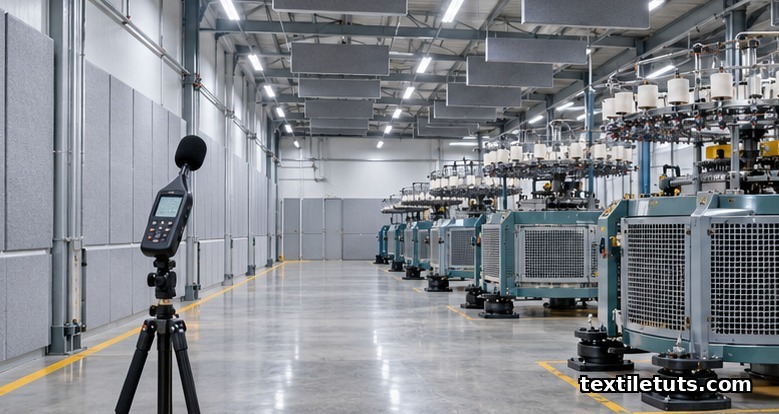
Control follows the hierarchy of controls in ISO 45001. Engineering controls come first: anti-vibration mounts on machine bases, acoustic enclosures around individual knitting heads, and resilient coupling on drive shafts. Administrative controls include rotating operators between noisy and quiet stations every two hours, posting hearing-protection zones, and audiometric testing on hire and annually thereafter. PPE (earplugs or earmuffs with a Noise Reduction Rating of at least 25 dB) is the last line. AATCC and ASTM do not set noise limits for textile mills directly, but mills audited under social-compliance schemes such as BSCI or Sedex must produce noise-mapping records and audiometric-test logs on request.
Dust, Lint, and Cotton or Synthetic Fiber Exposure
Knitting generates short fiber, yarn lint, and oil mist. In a cotton knitting mill, total dust exposures can reach 5 to 10 mg/m³ in carding-adjacent halls, dropping to 1 to 3 mg/m³ in the knitting hall itself when yarn is already prepared. OSHA’s PEL for cotton dust (raw) is 1 mg/m³ as an 8-hour TWA for yarn manufacturing, while the cotton-dust standard 29 CFR 1910.1043 sets 0.2 mg/m³ for the respirable fraction in higher-hazard operations. Synthetic knitting (acrylic, polyester, nylon) generates lower dust but produces oil mist from knitting-machine lubrication that should stay below 5 mg/m³ per the American Conference of Governmental Industrial Hygienists threshold limit value.
Local exhaust ventilation at each machine is the primary control, with ducted pickup within 300 mm of the lint-generating point. Filtration typically uses a cyclone pre-separator followed by a bag-house with an efficiency of 99.9% at 5 µm. Workers handling yarn packages should wear N95 or FFP2 respirators where local exhaust is insufficient, with fit testing per OSHA 29 CFR 1910.134. The mill must also comply with NFPA 654:2017 for combustible-dust fire prevention, which mandates dust-layer cleaning schedules and bonding-and-grounding of all metal ducting to prevent static-discharge ignition.
Ergonomic Risks: Repetition, Posture, and Standing
Knitting operators spend 8 to 12 hours per shift standing at the same station, threading yarn ends, piecing broken yarns, and doffing fabric rolls. Repetitive upper-limb motion, awkward trunk posture during piecing, and prolonged static standing drive musculoskeletal-disorder rates. ISO 11228-1:2003 sets limits for lifting and lowering, ISO 11226:2000 sets limits for static working postures, and ISO/TR 12295:2014 provides practical guidance for combining these into a job-task analysis.
Anti-fatigue mats reduce static-standing load by 20 to 50% and are the single cheapest effective intervention. Adjustable-height creels let operators keep yarn packages between waist and shoulder height, eliminating the shoulder abduction that drives rotator-cuff injury. Job rotation between knitting, mending, and inspection stations every two hours breaks the repetition cycle. Mills supplying European brands are increasingly asked for an ergonomic risk-assessment report aligned to EN ISO 12100:2010, the type-B safety-of-machinery standard that drives ergonomic considerations across all industrial equipment.
Chemical Safety: Dyes, Auxiliaries, and Lubricants
Even a “knitting-only” facility uses knitting oils (mineral or synthetic), machine-cleaning solvents, and occasionally pre-treatment chemicals if the mill runs an integrated dyeing line. The Globally Harmonized System of Classification and Labelling of Chemicals, implemented in Bangladesh under the Labour Act 2006 rules and in the EU under Regulation (EC) No 1272/2008 (CLP), requires Safety Data Sheets for every chemical on site, with worker training on hazard pictograms, signal words, and precautionary statements.
Knitting oils often contain petroleum distillates with an OSHA PEL of 500 ppm as an 8-hour TWA for the hydrocarbon fraction. Lubricant mist must be controlled by enclosure of the lubrication points and local exhaust. Hand-wash stations and emergency eyewash per ANSI Z358.1:2014 must be within 10 seconds walking distance of every chemical-handling station. Mills exporting to the EU must also meet REACH (EC No 1907/2006) restrictions on substances of very high concern, with the candidate list updated twice yearly by the European Chemicals Agency.
Fire Safety and Building Layout
Textile mills are high-fire-load facilities. Cotton stores, yarn stores, and finished-goods warehouses can present a fire load of 500 to 1,500 MJ/m², far above the 200 MJ/m² threshold that classifies an occupancy as high hazard. NFPA 13:2019 requires automatic sprinkler systems designed for a 12.5 mm/min density over the most demanding 250 m² area for Class IV commodities. Bangladesh National Building Code Part 4 mandates a similar sprinkler density for any textile building over 1,000 m².
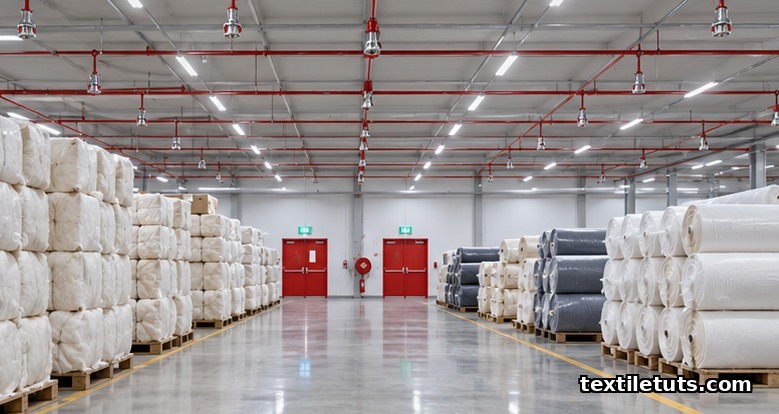
Means of egress must allow evacuation of the largest occupancy load within 2.5 minutes per NFPA 101:2018. In practice, a knitting hall of 200 operators needs at least four remote exit doors, 1.5 m wide, opening in the direction of travel. Fire alarms must be audible at 65 dB(A) above ambient noise at the operator’s ear, which in a 95 dB(A) knitting hall means strobe supplementation per ISO 7240-23:2013. Emergency lighting powered by self-contained batteries must provide 10 lux at floor level for at least 90 minutes.
Personal Protective Equipment and Worker Training
PPE for a knitting operator is straightforward: safety footwear with steel toe caps per ISO 20345:2011, cut-resistant gloves for yarn-handling, hearing protection in marked zones, and dust masks where local exhaust is insufficient. All PPE must be supplied by the employer at no cost, fitted to the individual worker, and replaced when worn or damaged per ISO 45001 Clause 7.1.
Training records are a frequent audit finding. ISO 45001 Clause 7.2 requires documented competency for every task assigned. New operators must receive at least 8 hours of safety induction covering machine-specific hazards, lockout-tagout per OSHA 29 CFR 1910.147 (or equivalent ILO-OSH 2001 guidance), emergency-stop location and use, and PPE donning. Refresher training is required annually, with additional sessions after any incident or near-miss. Records must include the trainee’s name, trainer’s name, date, duration, and topics covered, signed by both parties.
Frequently Asked Questions
Which ISO standard is mandatory for a knitting mill?
No ISO standard is legally mandatory by itself, but ISO 45001:2018 is required by most international buyers and by every social-compliance scheme in widespread use. ISO 11111-1 through ISO 11111-7 are the technical standards for machine safety and are referenced in EU Directive 2009/104/EC on work equipment, which applies to any mill shipping to the European Union.
How loud is too loud in a knitting hall?
Any 8-hour time-weighted average above 85 dB(A) triggers mandatory hearing-protection programs per NIOSH, and above 90 dB(A) triggers engineering controls per OSHA. Most knitting halls run 85 to 100 dB(A), so a documented audiometric-testing program is non-negotiable for any certified mill.
What is the most common safety audit finding in knitting mills?
Inadequate machine guarding, specifically on the cylinder and cam sections of circular machines and on the carriage of flat machines. Auditors look for guards rated to at least 1,000 N static load, gap dimensions below 12 mm, and stop times within one needle-bed revolution at top speed per ISO 11111-2:2016.
Does a knitting mill need a fire sprinkler system?
Yes if the building exceeds 1,000 m², if the fire load from stored cotton, yarn, or finished fabric exceeds 200 MJ/m², or if the local building code requires it. NFPA 13:2019 calls for a sprinkler density of 12.5 mm/min over 250 m² for Class IV commodities, which covers most knit-fabric storage arrangements.
How often must operators be retrained on safety?
Annual refresher training is the minimum per ISO 45001 Clause 7.2, with additional sessions after any incident, near-miss, or process change. New operators need at least 8 hours of induction before working unsupervised, and all training must be documented with signatures from both trainee and trainer.
References
- International Organization for Standardization. ISO 45001:2018, Occupational health and safety management systems. iso.org. The management-system backbone used in nearly every modern safety audit.
- International Organization for Standardization. ISO 11111-2:2016, Textile machinery — Safety requirements — Part 2: Weaving and knitting machines. iso.org. The technical machine-safety standard that drives guard dimensions and stop times.
- International Labour Organization. Convention No. 155, Occupational Safety and Health Convention, 1981. ilo.org. The international treaty that defines national-policy frameworks for worker safety, ratified by 56 countries.
- Occupational Safety and Health Administration. 29 CFR 1910.95, Occupational Noise Exposure. osha.gov. The US standard setting 90 dB(A) PEL and the 85 dB(A) action level that most international audits reference.
- National Fire Protection Association. NFPA 13:2019, Standard for the Installation of Sprinkler Systems. nfpa.org. Drives sprinkler-density requirements for textile-storage occupancies.
- European Committee for Standardization. EN ISO 12100:2010, Safety of machinery — General principles for design. cen.eu. The type-B standard that frames ergonomic and risk-assessment duties for textile machinery.
- Bangladesh Department of Inspection for Factories and Establishments. Bangladesh Labour Act 2006, sections 79 to 89. dife.gov.bd. The national statutory baseline for safety, health, and welfare in factories.
This article is the working reference for knitting-mill safety standards and their practical implementation. Editorial by Iftay Khairul Alam, TextileTuts. Sources: ISO 45001:2018, ISO 11111-2:2016, ILO C155, OSHA 29 CFR 1910.95, NFPA 13:2019, EN ISO 12100:2010, and Bangladesh Labour Act 2006 as cited.


