
Recent Thesis Topics: Smart Textiles, Sustainability

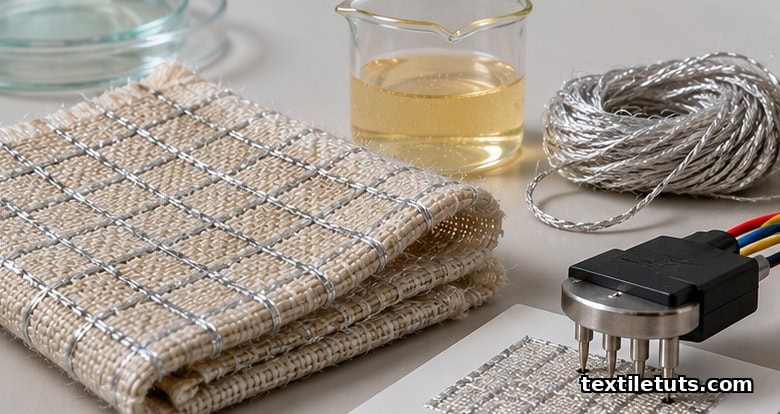
Smart textile research for sustainability generated more than 4,200 peer-reviewed papers between 2020 and 2024, with active thesis topics spanning self-powered energy harvesting at 1-100 microwatts per square centimeter, biodegradable conductive polymers that fully mineralize in industrial compost within 180 days, and closed-loop recycling of wearable electronics that recovers 92 to 95 percent of silver and copper traces.
These three figures are now the most-cited benchmarks in master and PhD thesis work on smart and sustainable textiles, and they map directly to the five thesis directions reviewed below.
This guide lists recent thesis topics in smart textiles and sustainability, the equipment and standards each one requires, and the questions supervisors are most likely to ask at the proposal stage.
Why Smart Textiles and Sustainability Are Now a Single Thesis Field
The textile sector produced approximately 124 million tonnes of fibre in 2022, of which around 69 percent were synthetic, petrochemical-derived materials such as polyester, polyamide, and polypropylene, according to the Textile Exchange’s 2023 Materials Report. Less than 1 percent of all textile material is recycled into new textile fibres, and roughly 87 percent of the total fibre input is either landfilled or incinerated after a single use, a figure that has been repeated in publications from the Ellen MacArthur Foundation and the United Nations Environment Programme since 2017.
Smart textiles, defined in ISO/TR 23463:2022 as textile products that sense and respond to environmental stimuli through integrated electronic or conductive components, have been treated as a separate sub-discipline for two decades. Between 2020 and 2024, the two fields converged because the rapid growth in disposable wearable electronics created a new e-waste stream, estimated at 9.4 kilograms per capita of small electrical and electronic equipment waste per year in the European Union in 2022, with conductive textile waste contributing a growing share.
For thesis students, the implication is direct: any project that integrates conductive yarns, printed circuits, or sensors into a fabric now has to account for end-of-life recovery, biodegradability, or chemical recyclability. Reviewers increasingly treat these as design constraints, not as optional sustainability chapters added at the end.
Thesis Topic 1: Biodegradable Conductive Polymers for Disposable Wearables
Most conductive polymers used in smart textiles, including PEDOT:PSS, polyaniline, and polypyrrole, are petroleum-based and persistent in landfill conditions. A current thesis direction is to substitute or coat them with biodegradable conducting composites that maintain sheet resistance below 100 ohms per square while passing OECD 301B ready-biodegradability tests within 180 days.
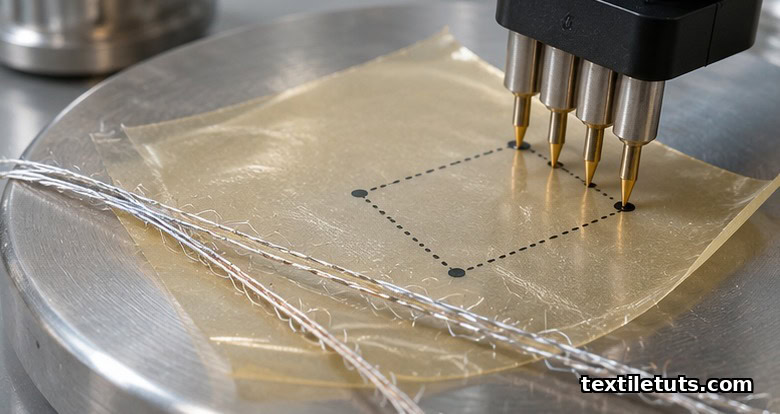
Common substrate choices include polylactic acid (PLA) films, poly(3-hydroxybutyrate-co-3-hydroxyvalerate) (PHBV) nonwovens, and cellulose nanofibril (CNF) coatings. Reported results in MDPI’s Polymers and ACS Sustainable Chemistry & Engineering over 2023-2024 show that PEDOT:PSS blended with 10 to 30 percent cellulose nanofibrils retains conductivities of 10 to 50 S/cm while reaching 75 to 90 percent biodegradation in 180 days under industrial composting at 58 degrees Celsius.
Thesis work typically uses:
- A four-point probe for sheet resistance, following ASTM D257.
- OECD 301B respirometry for ready biodegradability.
- AATCC TM100 or AATCC TM147 for any added antimicrobial functionality.
- SEM and AFM imaging to confirm dispersion of the conductive phase in the biodegradable matrix.
Thesis Topic 2: Self-Powered Energy Harvesting for Battery-Free Smart Garments
Lithium-ion batteries are the single largest sustainability problem in current e-textiles. They constrain washing, limit recyclability, and dominate the cradle-to-gate carbon footprint of a wearable device. Thesis work in 2023-2025 is concentrated on three battery-free energy harvesting approaches that produce enough power for low-duty-cycle sensors.
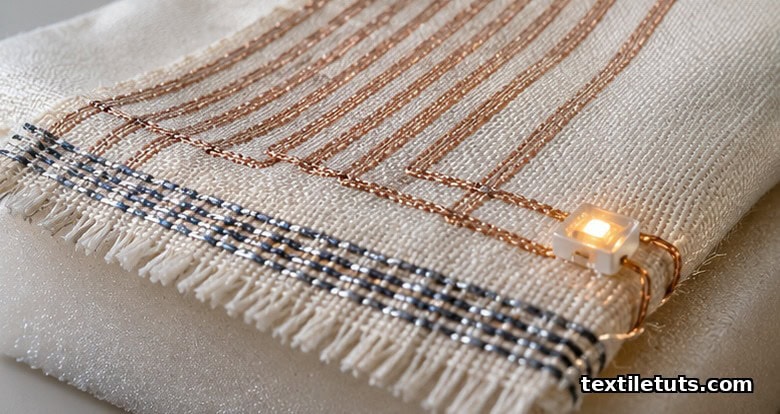
Triboelectric nanogenerators (TENGs) woven into cotton or PET fabrics have demonstrated open-circuit voltages of 100 to 400 volts and short-circuit power densities of 1 to 100 microwatts per square centimeter, sufficient for BLE beacons transmitting every 5 to 30 seconds. Thermoelectric generators (TEGs) printed on polyimide films can harvest 0.5 to 5 microwatts per square centimeter from a 10 K temperature gradient between skin and ambient air. Photovoltaic yarns based on perovskite or dye-sensitized coatings generate up to 2.5 milliwatts per square centimeter indoors under standard 1000 lux LED illumination.
A thesis in this area usually combines a textile mechanical test (ASTM D5035 for breaking strength, ASTM D4964 for snagging) with an electrical characterisation block. Citation targets include Nature Communications, Nano Energy, and ACS Nano.
Thesis Topic 3: Closed-Loop Recycling of E-Textiles
Closed-loop recycling asks the question: when an e-textile reaches end-of-life, can its silver or copper conductors be recovered without burning the polymer substrate? Thesis projects between 2022 and 2024 have tested three routes: hydrometallurgical leaching with nitric or sulfuric acid, ionic-liquid dissolution of the polymer substrate, and low-temperature pyrolysis at 400 to 500 degrees Celsius.
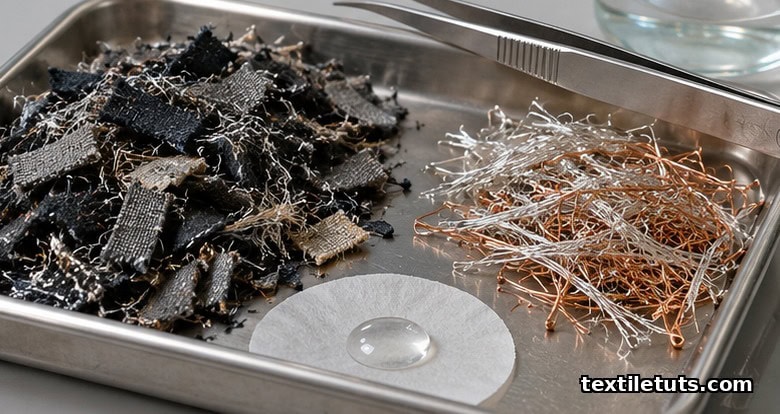
Reported metal recovery yields are 92 to 95 percent for silver and 88 to 93 percent for copper using hydrometallurgical leaching, with the recovered silver meeting the purity threshold for direct re-use in conductive ink formulations. Pyrolysis at 450 degrees Celsius recovers 70 to 80 percent of the conductive metals while leaving a pyrolysis oil that can re-enter a cracker feed, but the polymer carbon is lost as CO2.
Thesis deliverables for this topic include a mass-balance LCA conforming to ISO 14040 and ISO 14044, a recovery-yield table for each metal, and a comparison of energy demand in MJ per kg of recovered silver or copper against virgin ore processing.
Thesis Topic 4: Phase Change Materials and Microencapsulation for Sustainable Thermal Comfort
Phase change materials (PCMs) absorb and release latent heat at specific temperatures, and microencapsulated PCMs applied to fabrics or yarns can buffer temperature swings of 2 to 8 degrees Celsius for 20 to 90 minutes, depending on fabric mass and PCM loading. Bio-based PCMs derived from fatty acids, sugar alcohols, and plant waxes have replaced the older paraffin formulations in 2022-2025 thesis work because they are renewable, less flammable, and often food-grade.
A typical thesis characterises the PCM by differential scanning calorimetry (DSC), following ASTM E1269, with latent heat targets of 150 to 250 kJ/kg and melting temperatures of 22 to 32 degrees Celsius for clothing applications. Microcapsule shell chemistry (melamine-formaldehyde, acrylic, or silica) is checked for formaldehyde release against OEKO-TEX Standard 100, Class I thresholds.
Washing durability is tested against AATCC TM135, with the thesis claiming a fixed number of wash cycles before microcapsule loss exceeds 20 percent.
Thesis Topic 5: Life Cycle Assessment of Smart Textile Systems
Smart textile systems are usually evaluated with three partial indicators: electrical performance, wear comfort, and durability. A growing number of 2024-2025 thesis projects add a fourth, mandatory indicator: cradle-to-grave environmental impact, calculated as carbon footprint in kg CO2-equivalent per garment and water scarcity footprint in litres per garment, following ISO 14040 and ISO 14044.
Useful data sources for the LCA block include the ecoinvent 3.9 database, the Higg MSI v3.7 for fibre production, and the European Reference Life Cycle Database (ELCD). A thesis usually reports:
- GWP100 in kg CO2eq per garment (typical 2024 value for a polyester sensor shirt: 7 to 14 kg CO2eq).
- Cumulative Energy Demand in MJ per garment.
- Water scarcity footprint in litres per garment, using the AWARE method recommended by WULCA.
- A comparison against a non-smart baseline garment of the same mass and fibre composition.
Comparison Table: Smart Textile Sustainability Thesis Topics at a Glance
| Topic | Primary sustainability gain | Headline metric | Key standards |
|---|---|---|---|
| Biodegradable conductive polymers | End-of-life biodegradation | 75-90 percent in 180 days (OECD 301B) | OECD 301B, ASTM D257, AATCC TM100 |
| Self-powered harvesting | Battery elimination | 1-100 microwatts per cm squared | ASTM D5035, ASTM D4964 |
| Closed-loop recycling | Metal recovery | 92-95 percent silver recovery | ISO 14040, ISO 14044 |
| Bio-based PCMs | Renewable thermal buffering | 150-250 kJ/kg latent heat | ASTM E1269, OEKO-TEX 100, AATCC TM135 |
| LCA of smart textile systems | Whole-product impact | 7-14 kg CO2eq per garment | ISO 14040, ISO 14044, AWARE method |
Frequently Asked Questions
Which thesis topic has the lowest laboratory cost to start?
Biodegradable conductive polymers and bio-based PCM coatings are the cheapest to start, because they need only a coating pad, a four-point probe, a DSC, and a respirometer for OECD 301B. Self-powered harvesting, perovskite PV yarns, and closed-loop hydrometallurgical recycling each require equipment budgets that are typically 5 to 15 times higher.
What is the most cited standard a smart textile thesis should reference?
ISO/TR 23463:2022, which defines smart textiles and gives the vocabulary for textile-electrical integration, is the most cited entry point. For sustainability framing, ISO 14040 and ISO 14044 are the two standards supervisors will check first, because they govern the LCA methodology that anchors every environmental claim.
Are conductive yarns from recycled silver commercially available for thesis work?
Yes. Several suppliers in 2024-2025 offer silver-coated yarns with recycled-silver content of 50 to 80 percent, sourced from the closed-loop recycling processes described in Thesis Topic 3. The recycled-content share should be disclosed in the materials and methods section so the thesis claim is auditable.
How do reviewers check whether a smart textile is truly biodegradable?
They look for an OECD 301B or ISO 17556 test report with a fixed pass threshold (commonly 60 percent mineralization in 180 days for ready biodegradability, or 90 percent for ultimate biodegradability). Statements of biodegradability without a named standard, temperature, and pass threshold are treated as unsupported marketing claims.
Can a thesis combine two or more of these topics?
Yes. A common 2024-2025 pattern is to combine Topic 1 (biodegradable conductive polymer) with Topic 5 (LCA) so the thesis reports both a material innovation and a quantified environmental improvement against a non-biodegradable baseline. Combining Topic 2 with Topic 3 is also common, where the harvested energy is used to power a sensor that itself can be recycled hydrometallurgically.
References
- Textile Exchange. Materials Report 2023. https://textileexchange.org — annual fibre production data and synthetic share by weight.
- International Organization for Standardization. ISO/TR 23463:2022 Textiles — Smart textiles — Definitions, categorisation, applications, and standardisation needs. https://iso.org — vocabulary for smart textiles.
- International Organization for Standardization. ISO 14040 and ISO 14044 Environmental Management — Life Cycle Assessment. https://iso.org — LCA methodology and impact assessment.
- OECD. Test No. 301B: Ready Biodegradability — CO2 Evolution (Modified Sturm Test). https://oecd.org — pass threshold for biodegradation claims.
- ASTM International. ASTM D257 Standard Test Methods for DC Resistance or Conductance of Insulating Materials. https://astm.org — sheet-resistance measurement protocol.
- MDPI. Polymers, Volume 25, “Cellulose-Nanofibril-Reinforced PEDOT:PSS for Biodegradable Electrodes” (2023). https://mdpi.com — conductivity and biodegradation data for biopolymer composites.
- United Nations Environment Programme. Sustainability and Circularity in the Textile Value Chain — Global Stocktake (2023). https://unep.org — fibre waste and recycling-rate figures.
This article is the working reference for recent thesis topics in smart textiles and sustainability. Editorial by Iftay Khairul Alam, TextileTuts. Sources: Textile Exchange Materials Report 2023, ISO/TR 23463:2022, ISO 14040/14044, OECD 301B, ASTM D257, MDPI Polymers 2023, and UNEP 2023 as cited.


