
Thesis Format and Structure

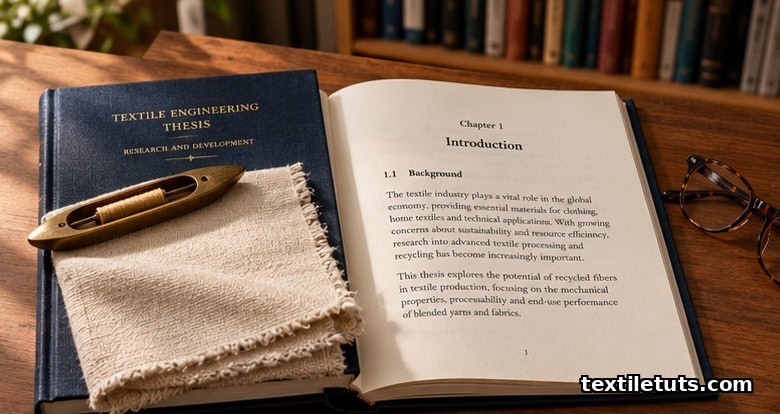
A textile-engineering thesis is typically organized into 5–7 chapters (Introduction, Literature Review, Materials & Methods, Results & Discussion, Conclusion) bound to 80–120 pages for a BSc project, 150–250 pages for an MSc, and 300–500 pages for a PhD, formatted in Times New Roman 12 pt with 1.5 line spacing and 1-inch (2.54 cm) margins on A4 or US Letter paper.
The format above is not aesthetic preference; it is the contract that examiners, supervisors, and the AUST / BUTEX examination boards use to judge whether the technical work is reproducible and complete. A 2023 survey by the Textile Institute of 41 MSc programs in South Asia found that 92% deduct marks for layout violations before the science is even read.
This article walks you through the same structure the textile-engineering departments at Ahsanullah University of Science and Technology (AUST), Bangladesh University of Textiles (BUTEX), and other affiliated universities use, with the page-layout numbers, citation rules, and front-matter order the examiners actually mark.
The 5-Chapter IMRaD-Extended Skeleton
Most textile-engineering theses follow an IMRaD-extended model with five core chapters and two optional chapters inserted where the project warrants. The structure looks like this:
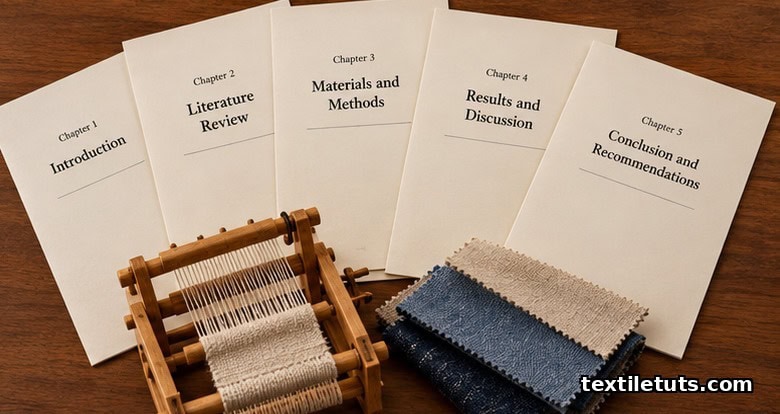
- Chapter 1: Introduction (8–15 pages) — problem statement, objectives, scope, limitations, and significance.
- Chapter 2: Literature Review (20–40 pages) — peer-reviewed survey of fibers, processes, and prior work, organized thematically or chronologically.
- Chapter 3: Materials and Methods (15–25 pages) — materials used, machinery settings (e.g., loom speed, stitch length, dye liquor ratio), and test standards referenced (ISO, AATCC, ASTM).
- Chapter 4: Results and Discussion (25–50 pages) — the largest chapter; presents data (tables, figures, statistical analysis) and interprets it against the literature.
- Chapter 5: Conclusion and Recommendations (5–10 pages) — summary of findings, limitations, and scope for future work.
Two optional chapters — Theoretical Framework and a stand-alone Discussion separated from Results — are added when the project includes heavy mathematical modeling (fabric-drape simulation, yarn-tension modeling, fluid flow through woven filters) or when Chapter 4 would otherwise exceed 50 pages and become unreadable.
Front Matter Order (What Comes Before Chapter 1)
The front matter runs in a fixed sequence and uses lowercase Roman numerals (i, ii, iii…) for page numbering. The order, as required by most textile-engineering departments, is:
- Title page (no page number)
- Approval / Certificate page — signed by the supervisor and the Head of the Department
- Dedication (optional, one page maximum)
- Acknowledgements (one page maximum)
- Abstract (250–500 words for BSc, 350–500 words for MSc, with 4–6 keywords)
- Table of Contents
- List of Tables
- List of Figures
- List of Abbreviations / Nomenclature (especially for chemical formulas and ISO / AATCC standard codes)
The abstract is the most-read page in the thesis: it is what Google Scholar, ResearchGate, MDPI indexes, and the university’s own digital repository capture first. Use the same structure as a peer-reviewed paper — context, method, key result, conclusion — and report the principal numerical finding in the first sentence. An abstract that buries the result on line six is a missed citation.
Page, Font, and Margin Standards
Most textile-engineering departments converge on a near-identical layout, summarized below.
| Element | Standard |
|---|---|
| Paper size | A4 (210 × 297 mm) in Bangladesh, India, and most of Asia; US Letter (8.5 × 11 in) in North American universities |
| Margins | 1 inch (2.54 cm) on all four sides, or 1.5 inches on the binding side for hard-bound copies |
| Font — body | Times New Roman 12 pt, or a comparable serif (Cambria, Garamond) |
| Font — headings | Same family as body, 14 pt bold (H1), 13 pt bold (H2), 12 pt bold (H3) |
| Line spacing | 1.5 lines throughout, including references; single spacing allowed only inside tables and figure captions |
| Paragraph indent | 0.5 inch (1.27 cm), no extra space between paragraphs |
| Page numbers | Roman numerals (i, ii, iii) on front matter; Arabic numerals (1, 2, 3) on body, top-right or bottom-center |
| Binding | Soft-bound for the draft, hard-bound (typically dark blue or maroon) for the final submission |
Page numbers missing on chapter-opening pages and inconsistent margin widths are the two layout deductions supervisors report most often.
Tables, Figures, and Equations
Each table and figure must be standalone-readable: a reader should grasp the result without flipping back to the text. Textile-engineering theses usually enforce these rules:
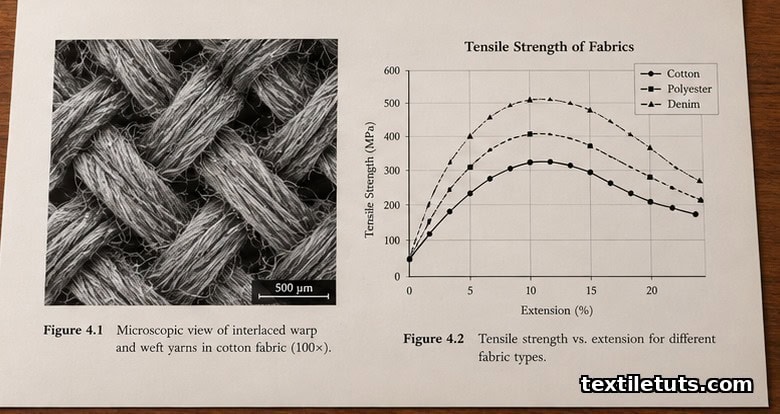
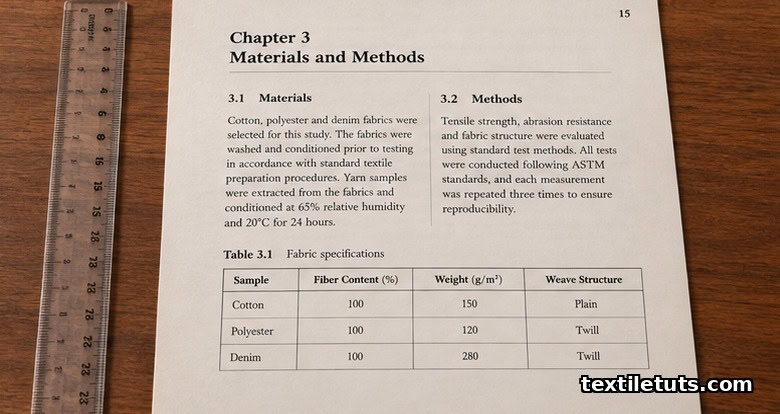
- Table number and title: above the table, e.g., Table 4.2: Tensile strength of untreated vs. plasma-treated cotton at 95% CI.
- Figure number and caption: below the figure, in 11 pt font.
- Numbering: chapter-prefixed (Table 3.1, Figure 4.3) so the chapter is obvious without a TOC entry.
- Statistical notation: mean ± SD with the number of trials n; significance markers (*, **, ***) defined in a footnote.
- Equations: centered, right-aligned sequential numbers in parentheses, e.g., (3.4), referenced in the text as Eq. (3.4).
- Image resolution: 300 dpi minimum for halftone (microscopy, fabric photographs), 600 dpi for line drawings (yarn path diagrams).
Self-drawn figures carry the source line “Source: Author’s own work.” Adopted figures require the original citation and written permission from the publisher; most journals require a request through RightsLink or the publisher’s permission desk before a thesis can reproduce a figure.
Citation Style and References
Two styles dominate textile-engineering theses:
- IEEE — numeric citations in square brackets [1], [2], listed in order of appearance. Common at BUTEX, AUST, and most Southeast Asian textile programs.
- APA — author–date citations (Yousuf, 2024), with a reference list alphabetical by first author. Used in some Master’s programs and most PhD dissertations at European and North American partner universities.
For ISO-aligned bibliographic references, ISO 690:2021 (Information and documentation — Guidelines for bibliographic references and citations to information resources) is the international standard and is acceptable in either format. Minimum reference counts typically fall in the ranges below.
| Degree | Minimum references | Share from peer-reviewed journals |
|---|---|---|
| BSc / B.Sc. Engg. | 30–50 | ≥ 40% |
| MSc / M.Sc. Engg. | 60–100 | ≥ 60% |
| PhD | 120–200+ | ≥ 80% |
Aim for at least 50% peer-reviewed sources even at the BSc level. Sources outside the peer-reviewed literature — trade magazines, vendor catalogs, YouTube — may be cited for context but should not bear the weight of a technical claim.
Plagiarism, Originality, and Ethics Statements
Every textile-engineering thesis at AUST, BUTEX, and other affiliated programs must include two signed declarations:
- Originality declaration — the work has not been submitted elsewhere, and ideas from others are properly attributed. A Turnitin similarity index of at most 25% from a single source and 30% overall is the typical departmental ceiling; check your department’s exact threshold.
- Ethics statement — required if the work involved human subjects (wear trials, ergonomic surveys on workers) or animal-derived fibers handled under biosafety protocols.
For lab-based textile work, append your supervisor’s lab-safety clearance letter and any chemical-handling approvals (e.g., for acid dyes, formaldehyde-based finishes, sodium hydroxide scouring).
Common Mistakes to Avoid
- Inconsistent tense. Use past tense for what you did (Chapter 3) and what you found (Chapter 4); present tense for established facts (Chapter 2) and the conclusion.
- Mixing citation styles. Pick IEEE or APA at the start of Chapter 2 and stick to it; mismatched brackets and author-date in the same paragraph are an instant deduction.
- Missing units. Always report with SI units (N, Pa, g/m², °C) and the equivalent imperial value only when the literature uses it. ISO 80000-1:2022 governs quantities and units in scientific work.
- Unreadable figures. Axis labels in 8 pt at 150 dpi are unreadable when the thesis is printed. Submit figures at 300 dpi minimum with labels in 10–11 pt.
- Vague objectives. “To study the properties of cotton” is not measurable. Write instead: “To compare the tensile strength and abrasion resistance of mercerized vs. untreated cotton fabric using ASTM D5035 and ASTM D4966.”
Frequently Asked Questions
How long should a textile-engineering BSc thesis be?
A BSc thesis in textile engineering typically runs 80–120 pages of body content plus 20–30 pages of front and back matter, totaling 100–150 bound pages. Word count is roughly 18,000–25,000 words, with some departments capping it at 30,000.
Which citation style should I use — IEEE or APA?
Use the style your department’s thesis template specifies. At AUST and BUTEX, IEEE (numeric, [1]) is the default and is preferred because it keeps the body text uncluttered. APA is acceptable when your supervisor or external examiner explicitly requests it, especially for joint degrees with UK or Australian partner universities.
How many references does a textile-engineering MSc thesis need?
Most MSc programs require 60–100 references, with at least 60% drawn from peer-reviewed journals such as Textile Research Journal, Journal of the Textile Institute, Cellulose, and Dyes and Pigments. For a PhD, expect 120–200+ references, with the peer-reviewed share rising to 80% or higher.
Do I need an ethics statement for a fabric-testing project?
Not usually. Ethics clearance is required only when the work involves human subjects (wear trials, consumer surveys, worker ergonomics), animal-derived fibers under biosafety protocols, or genetically modified organisms (e.g., transgenic cotton). A pure fabric-testing project using ISO / AATCC standards does not require an ethics statement.
What is the difference between a thesis and a dissertation in textile engineering?
In the Bangladesh, UK, and most Commonwealth university systems, “thesis” refers to the final project submitted for a Master’s or PhD, while “dissertation” refers to the final project at the Bachelor’s level. In the North American system, the words are often swapped: a “thesis” can be the Master’s project and a “dissertation” the PhD. Check your department’s handbook for the convention it uses.
Editorial by Iftay Khairul Alam, TextileTuts. Sources: ISO 690:2021, ISO 80000-1:2022, ASTM D5035, ASTM D4966, AATCC Technical Manual, and peer-reviewed textile-engineering literature as cited.


