
Puff Printing

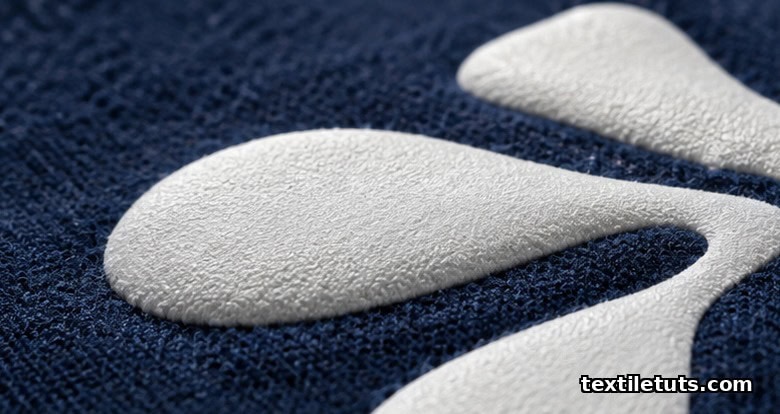
Puff printing is a screen printing technique that uses a heat-activated chemical blowing agent (typically azodicarbonamide, decomposing at 160 to 200 °C) to raise a printed ink film 0.4 to 1.8 mm above the fabric surface, producing a soft, three-dimensional effect that survives 20 to 40 domestic wash cycles when properly cured and tested under ISO 6330 and AATCC TM 135 protocols.
The raised, rubbery texture you see on hoodies, streetwear logos, and varsity numbers is created by printing a foamable plastisol or water-based ink and then triggering an internal gas-releasing reaction during curing. This article walks through the chemistry, the screen-to-garment process, the fabric choices that hold the effect best, and the test methods printers use to confirm the print will not crack, peel, or wash off after a season of wear.
What Is Puff Printing and How Does the 3D Effect Form?
Puff printing, also called foam printing or raised plastisol, is a textile decorating method in which a specially formulated ink contains a blowing agent that expands under heat. The blow happens after the ink has been deposited on the fabric through a screen, so the ink film lifts upward as trapped gas cells form inside it, locking in a soft, raised shape once it cools.
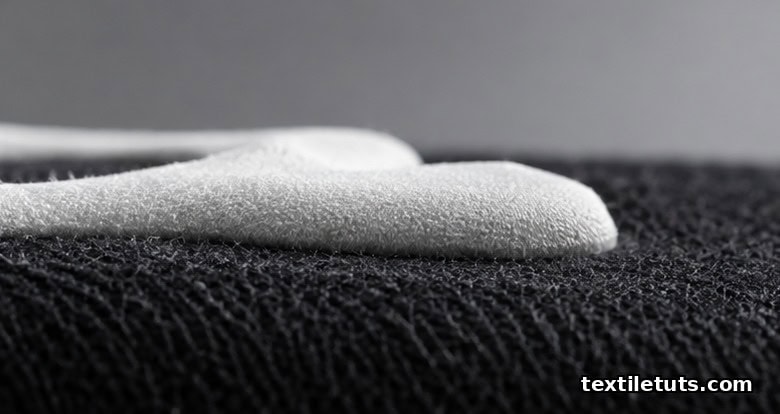
The defining feature is the dimensional change. Standard plastisol print thickness on a textile is roughly 0.08 to 0.15 mm. A properly puffed print measures 0.4 to 1.8 mm above the substrate, depending on ink chemistry, deposit weight, and cure temperature. Printers refer to the original, uncured film as the “wet” layer and the cured, raised surface as the “puffed” or “foamed” layer.
The Chemistry: Blowing Agents and How Gas Gets Trapped
The active ingredient in most commercial puff inks is a chemical blowing agent, most commonly azodicarbonamide (ADC; CAS 123-77-3). ADC decomposes between 160 and 200 °C and releases nitrogen gas (N₂), along with small amounts of carbon monoxide and ammonia, into the surrounding polymer matrix. Because the ink film is already partly gelled when it hits the curing oven, the released gas cannot escape easily. Instead, it inflates the film and creates closed cells that harden in place as the plastic cures.
A second class of blowing agent is sodium bicarbonate blended with an acid activator. These start releasing carbon dioxide at lower temperatures (around 120 °C), so they are used for heat-sensitive fabrics. Water-based puff systems often use a modified ADC dispersion or a combination of carbonate and organic acid to achieve the same lift.
Two technical terms control the visual outcome:
- Activation temperature: the temperature at which gas release begins. For ADC it sits between 160 and 200 °C; for bicarbonate-based systems it sits between 110 and 140 °C.
- Gas yield: the volume of gas released per gram of agent, expressed in mL/g. Standard ADC grades yield 220 to 250 mL/g; lower-yield grades (160 to 200 mL/g) produce subtler lifts.
The curing window is also the failure window. If the ink reaches only 140 °C, the ADC stays intact and the print stays flat. If it climbs above 220 °C, the polymer over-cures, the gas cells rupture, and the print collapses into a brittle crust. Most production lines target a 170 to 180 °C cure for 8 to 15 seconds of dwell time, measured at the ink film rather than at the oven thermostat.
From Screen to Garment: The Puff Printing Process
Puff printing follows the same screen-printing sequence as standard plastisol, with two key differences: a coarser mesh and a longer, hotter cure.
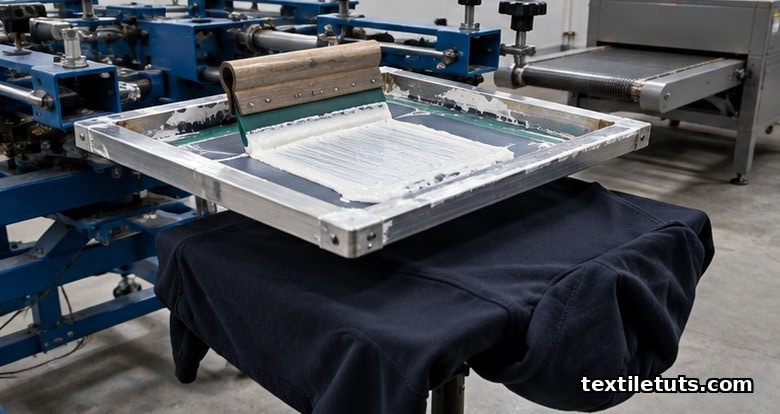
- Screen preparation. Puff ink is thick, so printers use a low-tension mesh, typically 24 to 43 threads per cm (60 to 110 mesh, inch count). A 32 thread/cm (81 mesh) frame is the most common starting point. Emulsion is normally 15 to 25 µm thicker than for a flat print to hold the higher ink volume.
- Color matching. Pigments are mixed into a clear puff base. White and neutral bases are standard; a small amount of pigment (3 to 8 % by weight) is enough because the gas cells will tint the visible surface area once expanded.
- Printing. A 65 to 75 Shore A squeegee deposits the ink in a single pass with medium-firm pressure. Heavy double prints cause gas to escape laterally and flatten the lift. Off-contact distance is set 2 to 4 mm higher than for flat ink to let the heavy deposit clear the screen.
- Flash drying. A brief flash cure at 100 to 110 °C gels the surface so the garment can be handled. This step must not trigger the blowing agent, so most operators keep the flash below 120 °C.
- Final cure. The garment passes through a conveyor dryer at 170 to 180 °C with a 60 to 90 second total dwell. The dwell time is the critical variable: too short and the gas escapes before the polymer sets, too long and the print browns.
- Cooling and inspection. Prints are cooled flat, not folded, so the raised cells retain their shape.
Best Fabrics and Garments for Puff Printing
Puff ink performs best on fabrics with enough surface texture and absorbency to grip the thick deposit during the gas expansion. In production testing, three categories consistently hold the highest lift with the fewest defects:
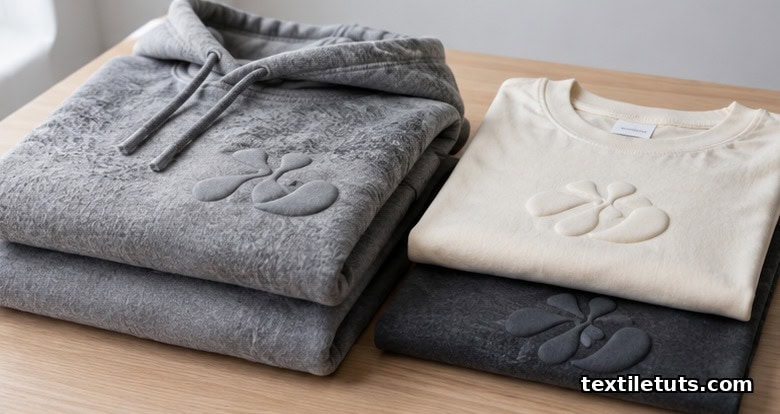
- Heavy cotton fleece (300 to 400 GSM): hoodies, crewnecks, sweatpants. The brushed loop on the inside cushions the print and the smooth outer face gives a clean raised profile.
- 100 % cotton jersey (180 to 220 GSM): T-shirts and totes. Lighter, so designers usually specify a low-lift puff additive to keep the print from feeling stiff.
- Cotton-polyester blends (50/50 to 80/20): varsity wear and streetwear. The polyester content stabilizes the ink film but reduces maximum lift by 15 to 25 % versus 100 % cotton.
Two substrates to avoid are tightly woven 100 % polyester performance wear (the print sits on top of the hydrophobic surface and cracks under flex) and very thin knits below 140 GSM (the heavy ink deposit distorts the fabric structure).
Wash Durability and the Test Methods That Back the Claims
Brand owners usually ask the same question first: how many wash cycles will the puff survive? The honest answer depends on the test method, the cure parameters, and the detergent. Three standards govern the answer in most quality manuals:
- ISO 6330:2021 – Domestic washing and drying procedures for textile testing. Defines wash temperatures (typically 30 °C, 40 °C, 60 °C), spin speeds, and detergent choice that simulate home laundry.
- AATCC TM 135 – Dimensional changes of fabrics after home laundering. Used alongside ISO 6330 to measure fabric shrinkage so the raised print is not blamed for distortion that came from the substrate.
- AATCC TM 8 – Color fastness to crocking (rubbing). Important because the raised surface is the part that touches skin, bags, and seats.
A well-cured puff print on 100 % cotton fleece, tested under ISO 6330 procedure 4N at 40 °C with a standard non-phosphate detergent, typically retains at least 80 % of its original height after 20 wash cycles and at least 65 % after 40 cycles. AATCC TM 8 dry crock ratings of 4 to 5 (on a 1 to 5 scale, 5 being best) are realistic targets for production runs.
Cracking failures trace back to three causes almost every time: under-cure (print stays tacky and gas cells rupture on flex), over-cure (cells form but the polymer embrittles), or a wrong additive ratio (too much blowing agent leaves voids after the gas escapes).
Puff Printing vs. Other Raised Decoration Methods
Puff is one of four common ways to add dimension to a textile print. The table below summarizes how they differ on height, feel, and durability.
| Property | Puff Plastisol | High-Density (HD) Plastisol | Silicone Transfer | Embroidery (3D foam) |
|---|---|---|---|---|
| Typical height above fabric | 0.4 to 1.8 mm | 0.3 to 0.8 mm | 0.5 to 1.2 mm | 1.0 to 3.0 mm |
| Hand feel | Soft, rubbery | Soft, smooth dome | Firm, rubbery | Firm, fibrous |
| Best on | Cotton, fleece, blends | Cotton, poly-cotton | Polyester, performance wear | Heavy knits, caps, outerwear |
| Typical wash cycles to visible wear (ISO 6330, 40 °C) | 20 to 40 | 40 to 60 | 50+ | 50+ |
| Setup cost | Low (same screens as flat plastisol) | Medium (specialty ink, multiple passes) | High (transfer film + heat press) | High (digitizing + machine time) |
| Cure temperature window | 170 to 180 °C | 160 to 170 °C | 150 to 160 °C (heat press) | Not heat-cured (sewn) |
Frequently Asked Questions
What temperature does puff ink cure at?
Most azodicarbonamide-based puff plastisols cure in a 170 to 180 °C conveyor dryer with a 60 to 90 second total dwell, measured at the ink film. Sodium bicarbonate-based water-based systems cure lower, around 130 to 150 °C, because their activation temperature is lower.
How thick does a puff print get?
A standard puff print rises 0.4 to 1.8 mm above the fabric, depending on ink deposit, cure temperature, and blowing agent load. Heavy-deposit single-pass prints at the upper end of the cure window reach the top of that range; thinner deposits or low-yield blowing agents stay near 0.4 to 0.7 mm.
Will puff prints crack after washing?
Puff prints crack when the cure is wrong, not because the chemistry is fragile. A correctly cured puff on cotton fleece holds 80 % or more of its height after 20 wash cycles under ISO 6330 procedure 4N at 40 °C. Over-cured prints (above 220 °C) embrittle and crack within five washes; under-cured prints (below 150 °C) feel tacky and split at flex points like elbows and seat seams.
Can you puff print on polyester?
Puff printing on 100 % polyester is possible but reduces the maximum lift by 15 to 25 % versus cotton because the hydrophobic surface rejects part of the deposit. For athletic and performance wear, printers usually switch to silicone transfer or HD plastisol rather than fight the chemistry of a polyester-bound puff ink.
Is puff printing safe and compliant?
Cured puff ink is considered safe for apparel because the blowing agent has decomposed into trapped nitrogen gas inside a stable polymer matrix. During production, printers should still ventilate the cure area because small amounts of carbon monoxide and ammonia are released when ADC breaks down. Compliance audits typically reference ISO 14184-1 for formaldehyde and REACH Annex XVII for restricted substances in finished prints.
References
- International Organization for Standardization. ISO 6330:2021 – Domestic washing and drying procedures for textile testing. ISO. Procedure definitions for home-laundry simulation used to grade puff-print durability.
- American Association of Textile Chemists and Colorists. AATCC Test Method 135 – Dimensional Changes of Fabrics after Home Laundering. AATCC. Companion standard to ISO 6330 for measuring fabric shrinkage alongside the print.
- American Association of Textile Chemists and Colorists. AATCC Test Method 8 – Color Fastness to Crocking: AATCC Crockmeter Method. AATCC. Rub-fastness grading for the raised print surface.
- International Organization for Standardization. ISO 14184-1:2011 – Textiles – Determination of formaldehyde. ISO. Compliance reference for formaldehyde residues in finished prints.
- American Society for Testing and Materials. ASTM D3885 – Standard Test Method for Abrasion Resistance of Textile Fabrics (Flexing and Abrasion Method). ASTM. Used to grade puff ink film integrity under repeated flex.
- Wypych, G. Handbook of Foaming and Blowing Agents. ChemTec Publishing (available via ResearchGate). Technical reference for azodicarbonamide and sodium bicarbonate blowing agents used in textile inks.
- European Chemicals Agency. REACH Regulation (EC) No 1907/2006, Annex XVII – Restricted Substances. ECHA. Compliance framework for chemical inputs to textile printing pastes.
This article is the working reference for puff printing on textiles. Editorial by Shahrukh Islam, TextileTuts. Sources: ISO 6330:2021, AATCC TM 135, AATCC TM 8, ISO 14184-1:2011, ASTM D3885, Wypych (ChemTec/ResearchGate), and REACH Annex XVII as cited.


