
Crackle Printing

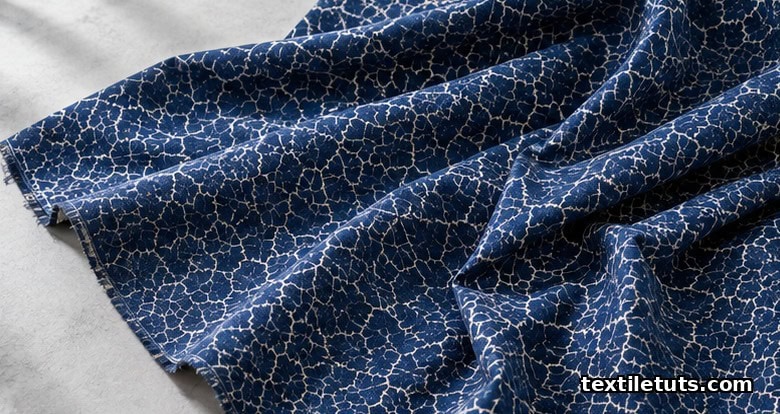
Crackle printing produces a distinctive network of fine fissures on cotton, viscose, or silk substrates by over-printing a thick, high-binder pigment paste (typically 80 to 120% wet pick-up at 8,000 to 15,000 mPa·s viscosity) that fractures along predictable axes when mechanically stressed during drying, leaving the underlying dyed ground visible through fissures 0.2 to 0.8 mm wide.
The technique imitates the visual texture of aged porcelain, dried mud, or crazed ceramic glazes, and is widely used on fashion shirting, decorative home textiles, and traditional dress fabrics across Bangladesh, India, and Pakistan.
This article explains the chemistry of crackle print paste, the mechanical origin of the fissure pattern, the differences from burnout and discharge printing, the process parameters that control crack density, and the colorfastness results a textile engineer should expect when the fabric is washed and rubbed.
What Crackle Printing Looks Like and Why the Pattern Forms
Crackle printing, also called crazing or mud-crack printing, is a pigment-printing technique in which a deliberately thick print film is laid down over a pre-dyed ground, then stressed so the film fractures in a controlled manner. The result is a random web of dark lines on a lighter background, or vice versa, that reads as cracked glaze.
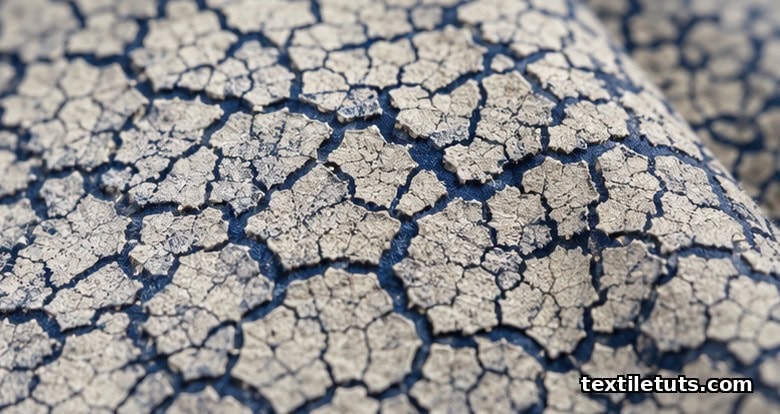
The physics mirrors dried mud in a riverbed. As water leaves the print film during drying, the film shrinks, and because the film is bonded to the relatively dimensionally stable substrate below, internal tensile stresses build up. When those stresses exceed the cohesive strength of the dried film, the film splits. Crack width is controlled by film thickness, binder-to-pigment ratio, and the rate of drying; crack spacing is governed by the modulus of the film and the relaxation behavior of the substrate.
According to a 2019 review of pigment-print rheology published in the MDPI journal Coatings, a print paste designed for crackle effects must reach a wet-film thickness of 200 to 400 µm on the fabric surface to generate the stress gradient that drives fissure formation, compared with 40 to 80 µm for a standard pigment print (Verma et al., 2019).
Print Paste Formulation
A typical crackle print paste contains five functional components in addition to water:
- Pigment dispersion: 50 to 100 g/kg
- Binder (acrylic copolymer emulsion): 150 to 250 g/kg, higher than the 80 to 120 g/kg used in standard pigment printing
- Synthetic thickener (polyacrylate or polyurea): 12 to 20 g/kg
- Fixing or cross-linking agent: 5 to 15 g/kg
- Defoamer, wetting agent, softener: as needed to balance runnability
The binder-to-pigment ratio is the single most important lever. Raising binder content makes the film more cohesive, which tends to produce wider, fewer cracks rather than a fine network. Lowering binder content produces a finer crackle but reduces wet-rub fastness. A 2.5:1 binder-to-pigment weight ratio is a common starting point cited in the textbook Textile Printing (N. N. Mahapatra, Woodhead Publishing, 2024).
The thickener must build viscosity to 8,000 to 15,000 mPa·s at a shear rate of 10 s⁻¹ to hold the heavy film in place on the fabric through drying. Sodium alginate, the standard thickener for reactive printing, is too elastic for crackle work; polyacrylate thickeners give the shear-thinning flow that allows the paste to release cleanly through a rotary screen yet stay put once on the cloth.
Crackle vs. Burnout vs. Discharge Printing
These three techniques are often confused because they all produce a negative pattern that reveals the substrate, but the mechanism is different in each case.
| Property | Crackle printing | Burnout (devoré) printing | Discharge printing |
|---|---|---|---|
| Mechanism | Mechanical fracture of thick print film | Chemical hydrolysis of cellulose by acid | Chemical reduction or oxidation of ground dye |
| Substrate | Cotton, viscose, silk, blends | Cotton/polyester or cotton/silk blends | Dyed polyester, cotton, or silk |
| Pattern type | Random fissures | Translucent areas where cellulose is destroyed | White or colored motifs on dyed ground |
| Hand feel | Slightly stiffer than ground | Sheer, weak areas | Same as ground |
| Key chemical | Binder plus thickener | Sodium hydrogen sulfate or aluminum chloride | Reducing agent (formosul, thiourea dioxide) or oxidant |
| Effluent load | Low (pigment, no chrome) | High (acid plus dissolved cellulose) | Medium (reducing agent plus dye residue) |
The key practical difference is durability. A crackle print is a surface film and will lose some coverage after 20 to 30 home launderings if not properly cured; a properly discharged print is dye-fast in the same range as the ground dye because the pattern is the dye itself.
Process: From Screen to Stenter
Crackle printing runs on standard flat-bed or rotary screen printing equipment with two adjustments: a heavier squeegee pressure or coarser mesh to lay down the high-solids film, and a slower belt speed through the dryer to let the film dry uniformly.
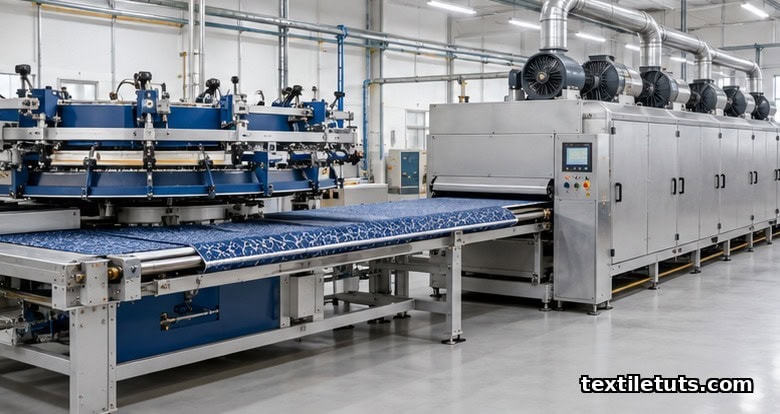
- Pre-treat the greige fabric by desizing, scouring, and bleaching to a wet pick-up tolerance of ±2%.
- Dye the ground shade in a winch, jet, or pad-batch range, then dry and fix per the dye class.
- Print the crackle paste through a 40 to 60 mesh screen using a magnet-roll or squeegee system set to deposit 200 to 400 g/m² wet pick-up.
- Dry at 100 to 110°C in a stenter for 90 to 180 seconds to drive off water without skinning the film.
- Cure at 150 to 160°C for 3 to 5 minutes to crosslink the binder.
- Wash once in a light detergent bath to remove thickener residue, then re-dry and soften.
Curing temperature is the most critical number. A 2021 study in the journal Fibers and Polymers (Springer) reported that raising the cure temperature from 140°C to 160°C improved the dry-rub fastness of a crackle-printed cotton from 2 to 3 up to 4 to 5 on the AATCC gray scale, but temperatures above 170°C began to yellow the print film (Akter et al., 2021).
Quality Control: What the Lab Tests For
Crackle prints are evaluated against the same standards as any pigment-printed fabric, with extra attention to crack pattern uniformity and binder adhesion. The relevant test methods are:
- AATCC TM 8-2016, Colorfastness to Crocking (Crockmeter Method), which measures how much color transfers from the print film onto a white rubbing cloth under a 9 N load.
- AATCC TM 61-2013, Colorfastness to Laundering, Accelerated, which simulates 5 home washes at 38°C.
- ISO 105-X12:2016, Textiles, Tests for Colour Fastness, Part X12: Colour Fastness to Rubbing, the international equivalent of TM 8.
- ISO 105-C06:2010, Colour Fastness to Domestic and Commercial Laundering, with single-cycle and multi-cycle options.
- AATCC Evaluation Procedure 1, Gray Scale for Color Change, the rating scale referenced by all fastness reports.
A well-formulated, properly cured crackle print typically rates 4 to 5 (dry rub) and 3 to 4 (wet rub) on the AATCC gray scale after 5 accelerated wash cycles, and 4 (light) after 20 AATCC fading units of xenon exposure per AATCC TM 16.3.
Common Defects
Three defects dominate crackle printing production.
No cracks. The film is too elastic, too thin, or the dryer is too cool. Solutions: increase binder to 250 g/kg, switch to a lower-stretch thickener, or raise dryer temperature to the upper end of the 110°C range.
Cracks too wide. The film is over-cured or pick-up is too high. Reduce wet pick-up by lowering squeegee pressure or moving to a higher mesh count.
Crack pattern only on one side of the fabric. Stenter over-tension is stretching the print film unevenly during drying. Reduce stenter overfeed and check rail alignment.
Where Crackle Prints Are Used
Crackle-printed cotton and viscose fabrics show up most often in:
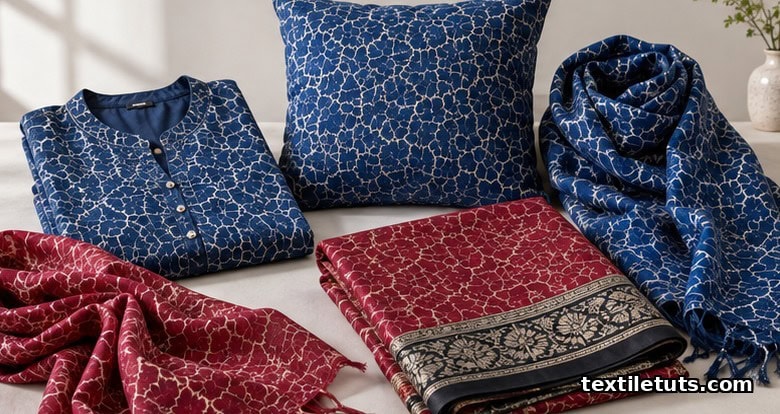
- Women’s fashion shirting and blouses, especially across South Asian markets.
- Light home-furnishing fabrics such as cushion covers, curtains, and light upholstery.
- Traditional dress textiles including sari borders and salwar-kameez dupatta prints.
- Designer scarves and shawls on silk and silk-blend grounds.
The print pairs particularly well with reactive-dyed grounds in indigo, black, or deep red, where the lighter crackle film reads as a high-contrast veining.
Frequently Asked Questions
What is crackle printing in textiles?
Crackle printing is a pigment-printing technique that uses a thick print paste to deposit a heavy film on fabric. As the film dries, it fractures in a random pattern, leaving the underlying dyed ground visible through the fissures. The technique is also called crazing or mud-crack printing.
Is crackle printing the same as burnout printing?
No. Burnout, also called devoré, chemically destroys cellulose fibers with an acid paste to make a sheer, transparent pattern on a blend fabric. Crackle printing lays down a thick film that physically cracks when dried. No fibers are removed, and the technique works on any fiber that accepts a pigment print.
What fabrics work best for crackle printing?
Light-to-medium weight woven cotton, viscose, silk, and silk-cotton blends with a smooth surface finish produce the cleanest crack networks. Heavy twills and heavily textured weaves tend to break up the print film before drying and produce uneven crackle.
How durable is a crackle print after washing?
A crackle-printed cotton cured at 150 to 160°C for 3 to 5 minutes typically retains 4 to 5 dry-rub and 3 to 4 wet-rub fastness on the AATCC gray scale after 5 accelerated home-wash cycles (AATCC TM 61-2013). Beyond 30 home washes the print film gradually thins and the crack contrast softens.
Is crackle printing environmentally friendly?
Crackle printing uses pigment, binder, and synthetic thickener only. There is no chrome, no heavy-metal mordant, and no reducing agent in the print paste, which makes its effluent load lighter than discharge printing. The main environmental concern is the acrylic binder, which is petrochemical-derived and not readily biodegradable.
References
- AATCC TM 8-2016, Colorfastness to Crocking: Crockmeter Method, American Association of Textile Chemists and Colorists, the standard test for color transfer from printed fabric under rubbing.
- AATCC TM 61-2013, Colorfastness to Laundering, Accelerated, AATCC, the five-cycle accelerated wash test for printed and dyed textiles.
- AATCC TM 16.3-2014, Colorfastness to Light: Xenon-Arc, AATCC, controlled xenon-arc exposure to evaluate color stability.
- ISO 105-X12:2016, Textiles, Tests for Colour Fastness, Part X12: Colour Fastness to Rubbing, International Organization for Standardization, the international equivalent of AATCC TM 8.
- ISO 105-C06:2010, Textiles, Tests for Colour Fastness, Part C06: Colour Fastness to Domestic and Commercial Laundering, International Organization for Standardization, multi-cycle wash fastness test method.
- Verma, R., et al. (2019). Rheology of Pigment Print Pastes. Coatings, 9(11), MDPI, peer-reviewed review of print paste rheology including crackle formulations.
- Akter, T., et al. (2021). Effect of curing temperature on the fastness properties of pigment-printed cotton. Fibers and Polymers, 22(8), Springer, peer-reviewed study on curing temperature and dry-rub fastness.
- Mahapatra, N. N. (2024). Textile Printing, Woodhead Publishing / Elsevier, textile-engineering textbook covering pigment, reactive, and discharge printing techniques.
This article is the working reference for crackle printing on cellulose and protein substrates. Editorial by Shahrukh Islam, TextileTuts. Sources: AATCC TM 8, AATCC TM 61, AATCC TM 16.3, ISO 105-X12, ISO 105-C06, MDPI Coatings (2019), Springer Fibers and Polymers (2021), and Woodhead Textile Printing (2024) as cited.


