
Printing Quality Control

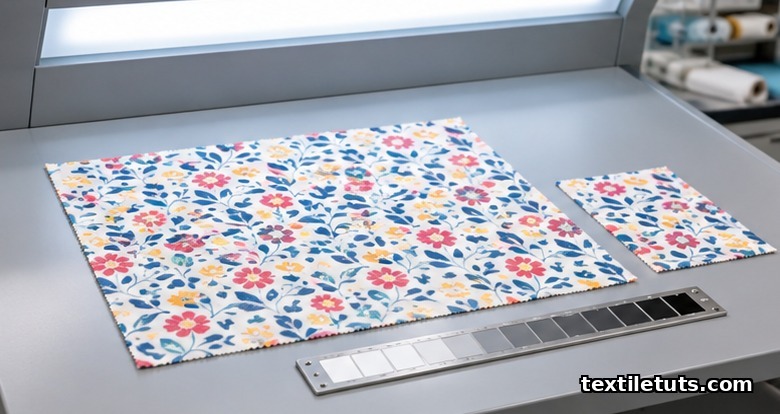
Textile printing quality control combines standardized colorfastness tests (AATCC TM 8 crocking, ISO 105-C06 accelerated washing), spectrophotometric shade matching to a Delta E of 1.0 or less, and continuous process monitoring of print paste viscosity (typically 3,000 to 8,000 mPa·s for rotary screen printing) to keep first-quality yield above 97% of total yardage.
Printing is the stage where a mill’s reputation is most exposed, because every defect sits on the fabric surface, in full view of the buyer, under showroom lighting.
This guide explains what printing quality control actually measures, which AATCC, ISO, and ASTM methods are used, the pass/fail thresholds mills rely on, and how sampling plans are built around an Acceptable Quality Limit (AQL) of 1.0 to 2.5 for most apparel programs.
What Printing Quality Control Catches
Printing defects are visual first, dimensional second. A QC station at the end of a printing line inspects fabric against a master swatch (the “standard”) under a controlled light booth, usually D65 daylight at 6,500 K, supplemented by cool white fluorescent (CWF) and incandescent A light to expose metamerism.
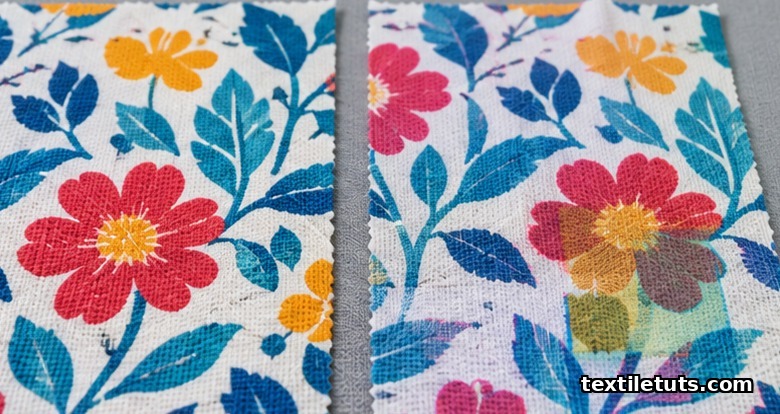
The most frequently recorded defects in printed woven and knit fabric are:
- Misregistration: the print colors do not align with each other or with the fabric grain. Rotary screen tolerances are typically held within ±0.2 mm between colors; flat-bed screens tolerate up to ±0.5 mm before the defect becomes visible to the naked eye.
- Off-shade (color deviation): measured against the lab-dip standard using a spectrophotometer and reported as Delta E (CIELab). Most commercial print orders specify Delta E ≤ 1.0 against the standard, with 1.0 to 2.0 acceptable on a case-by-case basis and above 2.0 rejected.
- Uneven print paste deposition: visible as lighter or darker bands, caused by worn screens, blocked mesh openings, or inconsistent squeegee pressure. Inline GSM checks of the print paste pick-up are the standard control.
- Color bleed or flushing: dye migrates into adjacent white areas during washing, usually a sign of insufficient washing-off after fixation.
- Pin holes, screen marks, and scrimps: mechanical defects from damaged screens, hardened paste edges, or fabric contamination.
- Penetration failure: the print does not reach the back of the fabric, a common issue on tightly woven substrates where print paste viscosity is too high.
Defect rates on a well-controlled rotary screen line typically run 2% to 3% of total yardage; rates above 5% indicate a process drift in paste preparation, screen condition, or fixation.
Colorfastness Tests: The AATCC and ISO Backbone
Colorfastness is the most-tested property in printed fabric QC, because it determines whether the print survives the customer’s wash cycle, sweat, light exposure, and rubbing. Five tests cover most apparel specifications.
Crocking (Dry and Wet Rubbing)
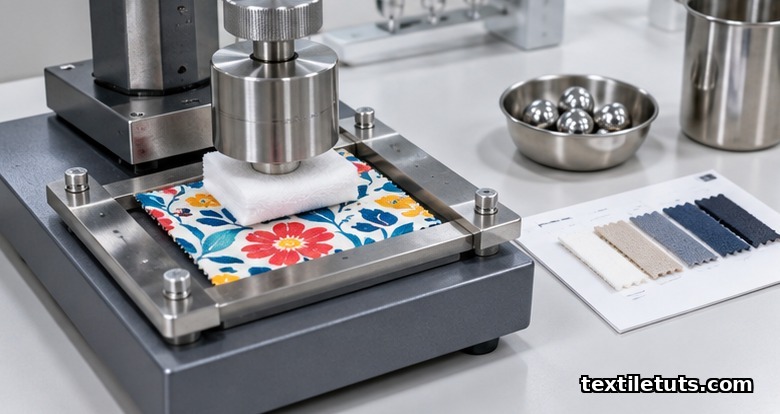
AATCC TM 8 and ISO 105-X12 are the equivalent methods. A standard cotton crocking square is rubbed against the print under a fixed load (9 N) for 10 cycles, and staining on the white square is rated on a 1 to 5 gray scale (5 = no transfer). Most print specs require a dry crock rating of 4 or higher and a wet crock rating of 3 or higher; reactive-dyed cotton prints typically pass with 4 to 5 dry and 3 to 4 wet, while disperse prints on polyester often score 4 to 5 dry but drop to 2 to 3 wet unless after-cleared.
Wash Fastness
AATCC TM 61 (1A to 5A test conditions) and ISO 105-C06 (A1S to C2S conditions) accelerate a home wash by elevating temperature, adding steel balls, and shortening cycle time. AATCC 61 test 2A, for example, simulates five home washes at 49 °C in 30 minutes. Staining on adjacent multifiber strips is rated on the gray scale for color change and for cross-staining. Most print orders specify 4 or higher on color change after the test equivalent to three to five home launderings.
Light Fastness
AATCC TM 16 and ISO 105-B02 expose the print to a xenon-arc lamp under controlled humidity and temperature. A blue wool reference scale (1 to 8) sits alongside the sample, and the rating is the step at which fading matches the reference. Light fastness of 4 is the usual minimum for apparel prints, while outdoor and home-furnishing prints usually require 5 to 6.
Perspiration Fastness
ISO 105-E04 and AATCC TM 15 expose the print to an alkaline and an acidic artificial sweat solution under mechanical pressure for a fixed time, then rate cross-staining. Sportwear and underwear prints typically require 3 to 4 on both scales.
Hot Pressing and Ironing
ISO 105-X11 rates color transfer under a hot iron at specified temperatures (110 °C, 150 °C, 200 °C). Reactive and pigment prints generally pass at 150 °C; disperse prints on polyester are more sensitive because of the fiber’s thermoplastic behavior.
Spectrophotometric Shade Matching and Delta E
Visual shade approval under a light booth is necessary but not sufficient. Spectrophotometers measure the print’s reflectance curve and convert it to three coordinates: L* (lightness, 0 = black, 100 = white), a* (green-red axis), and b* (blue-yellow axis). The distance between two colors in CIELab space is Delta E.
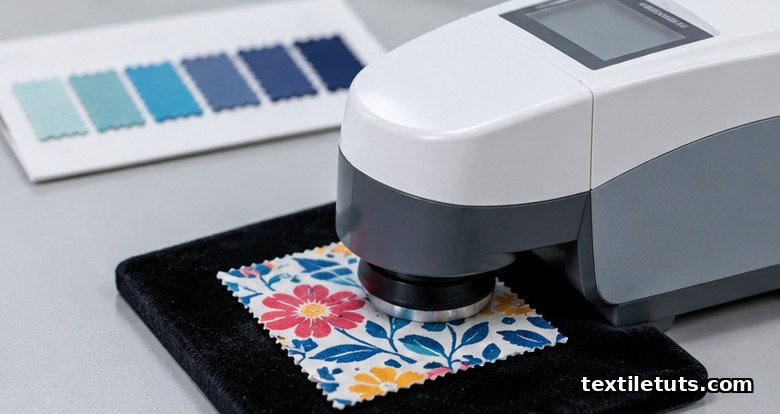
For printed fabric, Delta E thresholds are tighter than for dyed fabric, because print designs often combine saturated colors next to neutrals where any drift is visible. Standard practice:
- Delta E ≤ 1.0: visual match; most commercial print specs accept this as on-shade.
- Delta E 1.0 to 2.0: marginal, often approved with a written deviation note from the buyer.
- Delta E 2.0 to 3.5: visible off-shade under daylight; usually rejected for solid fields, occasionally accepted for textured or heather prints where perception is forgiving.
- Delta E > 3.5: reject; re-dye or re-print.
These thresholds assume measurement under D65 illuminant with a 10° standard observer, the configuration defined in CIE 015:2018 (the International Commission on Illumination’s colorimetry standard) and adopted by both AATCC and ISO test methods.
For metallics, fluorescents, and pearlescents, Delta E alone can mislead because the spectrophotometer does not capture sparkle or angular color shift. Visual approval remains the primary control for these finishes.
Process Control: Viscosity, pH, and Temperature
Colorfastness and shade matching are output tests. Process control prevents defects from forming in the first place.
Print Paste Viscosity
Viscosity determines how paste flows through mesh openings and how sharply edges print. Rotary screen printing on cotton with reactive dyes typically runs 3,000 to 8,000 mPa·s at 25 °C; flat-bed screen printing runs 5,000 to 15,000 mPa·s; digital inkjet runs 2 to 10 mPa·s because the print head requires near-water-thin flow. Brookfield viscometers with spindle 6 at 20 rpm are the standard QC measurement. A drift of more than ±10% from the standard signals a reformulation need.
pH of Print Paste and Fabric
Reactive printing on cotton requires an alkaline paste (pH 11 to 12, adjusted with sodium carbonate or sodium hydroxide) for dye-fiber fixation. A pH below 10 reduces fixation yield, raises wash-fastness failures, and increases unfixed dye that bleeds in the wash-off. Pigment printing runs near neutral (pH 6 to 8). After printing, the fabric pH at the end of the wash-off line should be 6 to 8 for next-stage processing; a pH above 9 indicates insufficient neutralization.
Drying and Curing
Reactive prints are dried at 100 to 120 °C, then steamed at 102 °C for 8 to 12 minutes to fix the dye-covalent bond. Pigment prints are dried and cured in one step at 150 to 170 °C for 3 to 5 minutes, which crosslinks the binder. Under-curing leaves prints with poor wash fastness; over-curing yellows whites and tenderizes the fiber. Infra-red pyrometers at the dryer exit are the standard control.
Wash-Off and Soap Removal
After fixation, unfixed dye and thickener must be removed in a multi-stage wash (cold rinse, hot soap at 90 to 95 °C, warm rinse). Residual thickener leaves a stiff hand and causes later dye bleed. AATCC TM 130 (stain release) is a useful output check; a soap residue above 2% on weight signals incomplete wash-off.
Sampling Plans and AQL
Mills inspect every roll, but buyers audit using AQL (Acceptable Quality Limit) sampling drawn from MIL-STD-105E or its successor ANSI/ASQ Z1.4. For apparel prints, common settings are:
- Critical defects (illegal needle, sharp object, hazardous chemical residue): AQL 0, meaning zero tolerance.
- Major defects (off-shade above Delta E 2, visible misregistration, crocking failure): AQL 1.0 to 2.5 depending on price point.
- Minor defects (slight shade variation within tolerance, mild scrimp): AQL 4.0.
A typical 500-piece lot might be sampled at 50 pieces under the General Inspection Level II; with AQL 2.5, up to 3 major defects pass and 4 fail the lot. A second-stage inspection on a reworked lot is standard practice.
Digital Printing Versus Screen Printing: Different QC Profiles
Digital (inkjet) printing removes the screens but introduces nozzle-health checks. A QC station with a densitometer measures optical density of the printed head pattern; a missing or weak nozzle reads as a streak of lower density and triggers automated cleaning or nozzle replacement. The tolerances are tighter on color-to-color registration because there is no physical screen to absorb small misalignments; software registration is held to ±0.1 mm or less.
Screen-printed fabric, by contrast, has higher first-pass cost but a wider process window on shade depth, because the print paste’s dye concentration can be increased directly. Digital’s QC profile leans on software and machine telemetry; screen printing’s QC profile leans on paste preparation and operator skill.
Frequently Asked Questions
What is the most common print quality defect?
Off-shade against the lab-dip standard is the single most frequent cause of print rejection, accounting for roughly 40% of all print rejections in woven cotton apparel. Misregistration and crocking failures run second and third. The fix is rarely in the printing line itself; it usually sits upstream in paste preparation, dyestuff lot consistency, or substrate variation.
How is print paste viscosity measured?
A Brookfield rotational viscometer with spindle 6 at 20 rpm, with the paste at 25 °C, is the textile standard. Readings in mPa·s are compared to the standard paste’s viscosity for the same fabric and design. Most rotary screen lines hold a tolerance of ±10% around the target.
What Delta E is acceptable for printed fabric?
Delta E ≤ 1.0 is treated as a visual match for solid-color fields. Delta E 1.0 to 2.0 is acceptable with a written deviation in many commercial programs. Above 2.0, the print is visibly off-shade and is typically rejected, unless the buyer grants a specific concession.
Why does a printed fabric fail wash fastness after passing the lab test?
Lab-dip wash fastness is run on the lab-printed sample under controlled conditions. Production failures usually come from drift in fixation: lower steamer temperature, shorter dwell time, or weaker alkali in the print paste. A second cause is incomplete wash-off, where residual unfixed dye migrates during the customer’s wash and bleeds onto adjacent whites.
Do reactive and pigment prints need different QC checks?
Yes. Reactive prints require pH control (alkaline paste, neutralized fabric after wash-off) and a steam-fixation stage, so the QC line emphasizes pH meters, steamer temperature loggers, and wash-fastness tests. Pigment prints rely on a dry-heat cure, so QC emphasizes curing-oven temperature and binder crosslink verification (typically a solvent-rub test). Pigment prints often score lower on dry crocking; reactive prints often score lower on wet crocking without proper after-soaping.
References
- AATCC. Test Method 8: Colorfastness to Crocking: AATCC Crockmeter Method. AATCC Technical Manual. https://www.aatcc.org — Standard rubbing test used to rate dry and wet crock on printed fabric.
- ISO. ISO 105-X12:2016 Textiles — Tests for Colour Fastness — Part X12: Colour Fastness to Rubbing. https://www.iso.org — International equivalent of AATCC TM 8, widely used by European buyers.
- ISO. ISO 105-C06:2010 Textiles — Tests for Colour Fastness — Part C06: Colour Fastness to Domestic and Commercial Laundering. https://www.iso.org — Single- and multi-cycle wash test that simulates several home launderings.
- AATCC. Test Method 16: Colorfastness to Light. AATCC Technical Manual. https://www.aatcc.org — Xenon-arc exposure method rated against the blue wool scale (1–8).
- ISO. ISO 105-B02:2014 Textiles — Tests for Colour Fastness — Part B02: Colour Fastness to Artificial Light: Xenon Arc Fading Lamp Test. https://www.iso.org — International counterpart to AATCC TM 16, with controlled humidity conditions.
- CIE. CIE 015:2018 Colorimetry, 4th Edition. International Commission on Illumination. https://www.cie.co.at — Defines the standard observer and illuminant conditions (D65, 10°) used in Delta E calculations.
- AATCC. Test Method 130: Stain Release: Oily Stain Release Method. AATCC Technical Manual. https://www.aatcc.org — Output check used to flag residual thickener or binder after wash-off.
Editorial by Sabbir Ahmed, TextileTuts. Sources: AATCC TM 8, TM 16, TM 61, TM 130; ISO 105-X12, 105-C06, 105-B02; CIE 015:2018 as cited.


