
Print Thickener Types

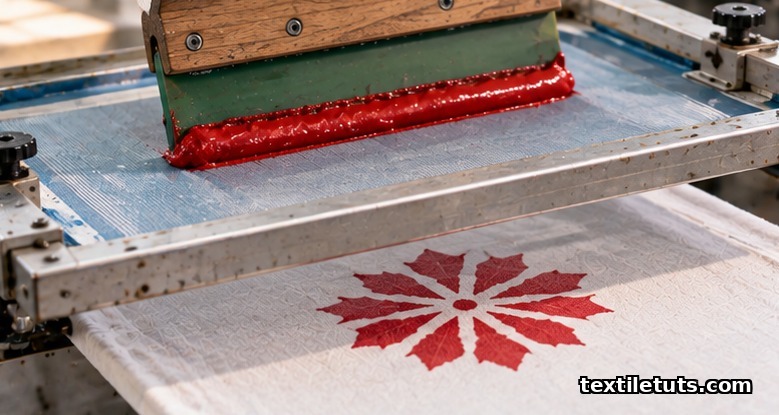
Print thickeners are high-viscosity polymers, dosed at 0.5 to 3.0 percent on print paste weight, that raise the apparent viscosity of a dye liquor to 2,000 to 5,000 mPa.s so the paste holds its shape on the fabric surface until fixation. The thickener is the single largest non-aqueous component of a textile print paste, and its rheology directly controls print sharpness, color yield, handle, and washing-off efficiency.
Choosing the wrong thickener can blunt a reactive print by 15 to 30 percent in K/S value, bleed across pattern outlines, or leave a stiff hand that fails the buyer. This guide maps the seven thickener families in commercial use, the viscosity targets each technique requires, and the rheological tests that separate a usable paste from a reject batch.
Why Print Pastes Need a Thickener at All
A textile print paste is essentially a structured fluid carrying dye, auxiliaries, and water through a fine mesh or rotary screen onto fibers. Without a thickener, the dye liquor wicks along the yarn surface, the printed line spreads to two or three times its intended width, and sharp patterns collapse into halos. ISO 105-J01 (the standard method for assessing color fastness to rubbing and washing of printed textiles) assumes a paste of defined rheology; without it, the test is meaningless.
The thickener does four jobs simultaneously:
- Builds yield stress so the paste does not flow under its own weight.
- Suspends dye particles and resists sedimentation during the print run.
- Controls the rate of water release into the fiber, which governs dye-fiber contact time.
- Peels cleanly off the fabric during washing so no residue remains to stiffen the hand.
Key Rheological Properties Every Thicken Must Hit
Print-paste rheology is described by three measurable numbers, and each thickener family has a characteristic profile.
Apparent viscosity at 25 degrees C: 2,000 to 5,000 mPa.s for flat-bed screen printing; 1,000 to 2,500 mPa.s for rotary screen; 50 to 200 mPa.s for inkjet (which uses low-viscosity ink rather than a print paste proper).
Thixotropy: the ratio of viscosity at low shear to viscosity at high shear. A healthy print paste shows a thixotropy index of 1.5 to 3.0, meaning it flows under the squeegee shear but rebuilds structure within seconds once the screen lifts.
Solid content: 1 to 3 percent by weight for most synthetic thickeners, 4 to 10 percent for natural gums. Higher solids mean thicker paste but also stiffer hand after drying.
pH stability: reactive dye printing operates at pH 6 to 8; acid printing at pH 4 to 6; disperse printing at pH 5 to 7. The thickener must hold its viscosity across this entire range without hydrolyzing or losing water-binding capacity.
The Seven Thickener Families in Commercial Use
1. Sodium Alginate (the Reactive-Dye Standard)
Sodium alginate is the sodium salt of alginic acid extracted from brown seaweed (Phaeophyceae). It is a linear copolymer of mannuronic acid and guluronic acid in blocks. M/G ratio governs gel strength, with high-M alginates giving lower-viscosity, more elastic pastes and high-G alginates giving firmer, more brittle gels.
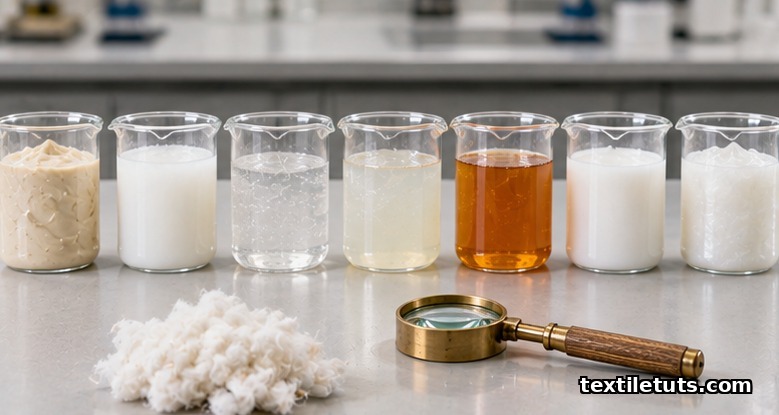
For reactive dye printing on cotton, sodium alginate at 1.0 to 2.0 percent on paste weight delivers a viscosity of 3,500 to 5,000 mPa.s and a thixotropy index near 2.5. Its dominance in reactive printing comes from a single chemical fact: the carboxylate groups in alginate are anionic, so they do not react with the chlorotriazine or vinylsulfone groups on reactive dyes. Starch and carboxymethyl cellulose, by contrast, contain hydroxyl groups that compete with cellulose for the reactive dye, lowering fixation by 10 to 25 percent.
Drawbacks: batch-to-batch M/G variability from seaweed source; price volatility tied to the Norwegian and Chilean harvest; slow biodegradation in effluent that can raise BOD in print-house wastewater.
2. Modified Starches (for Vat and Pigment Printing)
Starches from maize, potato, or tapioca are esterified or etherified to break the natural retrogradation that makes native starch gels unstable over 24 hours. Common modifications include carboxymethyl starch, hydroxyethyl starch, and starch phosphate esters. A 6 to 10 percent paste of modified starch gives 2,500 to 4,000 mPa.s, suitable for vat dye and pigment printing where the anionic incompatibility with reactive dyes is not an issue.
Modified starch is cheap, renewable, and gives good film-forming. It fails on two points: it reacts with reactive dyes (so fixation efficiency drops), and it leaves a stiffer hand unless heavily washed. AATCC TM 8-2007 (color fastness to crocking) often flags starch-thickened prints that retain residue on the rub test.
3. Carboxymethyl Cellulose (CMC)
CMC is cellulose etherified with chloroacetic acid to a degree of substitution between 0.6 and 1.2. At 2 to 4 percent in paste, CMC gives a viscosity of 2,000 to 3,500 mPa.s with pseudoplastic flow. CMC is cheaper than sodium alginate and more consistent in supply, but it carries the same reactive-dye incompatibility as starch because the unsubstituted hydroxyl groups compete for the dye.
Modern low-DS CMC variants (DS around 0.4) sacrifice some viscosity to improve dye compatibility, but they still trail sodium alginate in reactive-dye K/S yield by 8 to 15 percent in side-by-side trials.
4. Guar Gum and Its Derivatives
Guar gum is a galactomannan from the seed of Cyamopsis tetragonoloba. Native guar at 1.5 to 2.5 percent gives 2,500 to 4,000 mPa.s, and it tolerates a wide pH range (3 to 11). Hydroxypropyl and carboxymethyl guar derivatives are used where better cold-water solubility or reduced residue is needed.
Guar is widely used in carpet printing (where its film flexibility survives the afterprint steam process) and in disperse-dye printing on polyester (where its anionic character does not interfere). On cotton reactive prints it gives 5 to 10 percent lower fixation than sodium alginate.
5. Gum Arabic and Locust Bean Gum
Gum arabic (from Acacia senegal) and locust bean gum (from Ceratonia siliqua) are minor thickeners today, used mainly in specialty discharge printing and in some acid-dye prints on wool and silk. They give low solids (3 to 6 percent) and moderate viscosity, with the advantage of very soft hand and clean washing.
Cost and limited supply keep these gums in niche applications where the soft-hand requirement justifies the premium.
6. Synthetic Polyacrylic Acid Thickeners
Synthetic thickeners are crosslinked or alkali-swellable polyacrylic acid emulsions or powders. At 1.0 to 2.0 percent solids they reach 3,000 to 8,000 mPa.s, far higher than any natural gum. They are anionic and electrolyte-tolerant, which makes them work well with reactive dyes in some formulations.
The catch: many synthetic thickeners contain residual acrylic monomers and ammonia, and they are not readily biodegradable. They are also notoriously sensitive to hard water and to mixing order, so paste preparation protocols are tighter than for alginate. They are most common in pigment printing where the synthetic thickener is locked into the binder film and does not need to wash out.
7. Emulsion Thickeners
Emulsion thickeners are oil-in-water emulsions stabilized by a surfactant and thickened by a water-soluble polymer. They give very high viscosity at low total solids and were once used for fine-line rotary screen printing. Modern water-based polymer thickeners have largely replaced them because emulsion thickeners can leave oily residue that fails AATCC TM 130 (stain release).
Thickener Selection by Printing Technique
| Printing technique | Recommended thickener | Typical dose (%) | Target viscosity (mPa.s) |
|---|---|---|---|
| Reactive on cotton (flat screen) | Sodium alginate | 1.0 to 2.0 | 3,500 to 5,000 |
| Reactive on cotton (rotary) | Sodium alginate | 0.8 to 1.5 | 1,500 to 2,500 |
| Vat dye on cotton | Modified starch | 6 to 10 | 2,500 to 4,000 |
| Disperse on polyester | Sodium alginate or guar | 1.0 to 2.0 | 2,000 to 3,500 |
| Acid on wool or silk | Guar or CMC | 2 to 4 | 2,000 to 3,500 |
| Pigment on any fiber | Synthetic polyacrylate | 1.0 to 2.0 | 3,000 to 6,000 |
| Carpet printing (polyamide or wool) | Guar or hydroxypropyl guar | 1.5 to 2.5 | 2,500 to 4,000 |
| Digital inkjet | None (low-viscosity ink, 5 to 50 mPa.s) | n/a | 5 to 50 |
How to Test a Print Paste Before Production
Three quick tests catch most thickener problems before they reach the print table:
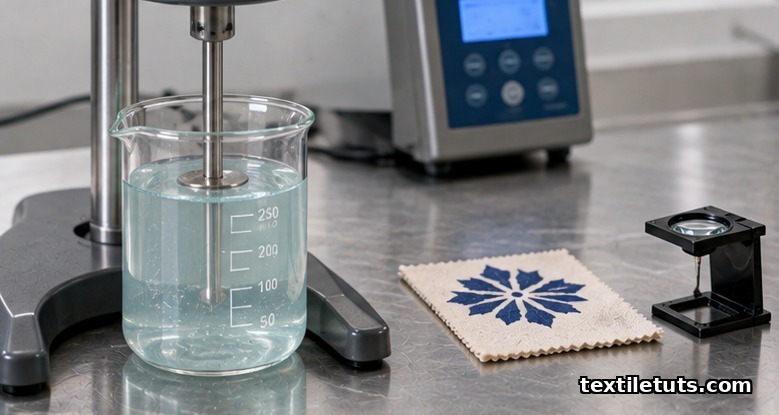
- Brookfield viscosity at 25 degrees C: spindle 6 at 20 rpm. Reject if viscosity falls outside +/- 10 percent of the target band.
- Thixotropy index: viscosity at 1 rpm divided by viscosity at 20 rpm. Aim for 1.5 to 3.0; below 1.5 means the paste will drip in the screen, above 3.0 means the squeegee will not transfer cleanly.
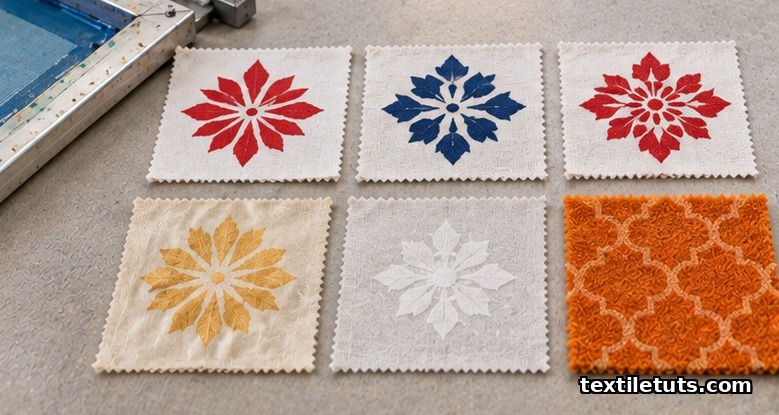
- Print-and-steam trial on a 30 cm fabric swatch: assess line sharpness under 10x loupe, K/S on a spectrophotometer, and hand after one wash-and-dry cycle. A drop in K/S above 5 percent versus a reference paste is a strong signal the thickener is reacting with the dye.
Frequently Asked Questions
What is the difference between a thickener and a binder in pigment printing?
The thickener controls paste viscosity and print definition; the binder is a polymer emulsion (usually an acrylic or styrene-butadiene copolymer) that locks pigment particles to the fiber after curing. In reactive dye printing there is no binder; the dye fixes chemically to cellulose. In pigment printing both are present, and they must be selected together to avoid flocculation.
Can sodium alginate be substituted with a cheaper thickener in reactive printing?
Direct substitution with CMC or starch reduces reactive-dye fixation by 10 to 25 percent because those thickeners contain free hydroxyl groups that react with the dye. Synthetic polyacrylate thickeners can match fixation but require tighter pH control and produce effluent that is harder to treat. Sodium alginate remains the technical default for reactive prints where K/S yield and washing-off efficiency matter.
How much thickener goes into one kilogram of print paste?
For sodium alginate, 10 to 20 grams of dry thickener per kilogram of paste gives the standard 1.0 to 2.0 percent dose and the 3,500 to 5,000 mPa.s target. For modified starch, 60 to 100 grams per kilogram is the working range. For synthetic polyacrylate, 10 to 20 grams per kilogram again, because the dry polymer carries higher intrinsic viscosity.
Why do my print pastes lose viscosity overnight?
Three usual suspects: enzymatic degradation of starch or guar (add a biocide if the paste sits longer than 12 hours), pH drift (reactive pastes drift alkaline as urea hydrolyzes), and shear damage to polymeric thickeners during prolonged mixing. Re-measure viscosity before each shift and adjust with water or fresh thickener rather than re-mixing, which destroys thixotropy.
Are synthetic thickeners safer than natural gums in print-house effluent?
Synthetic polyacrylates are not readily biodegradable and often pass through activated sludge unchanged; they end up adsorbed onto biosolids and can enter landfill. Natural gums (alginate, guar, starch) are largely biodegradable in standard textile effluent treatment. From a process-water perspective, natural thickeners are usually preferred; from a quality perspective, synthetic thickeners give sharper prints and lower dose. The trade-off should be made case by case.
References
- ISO. ISO 105-J01:1997 Textiles — Tests for colour fastness — Part J01: General principles for measurement of surface colour. International Organization for Standardization — defines the color measurement framework that print-paste rheology is optimized against.
- AATCC. AATCC Test Method 8-2007 Colorfastness to Crocking: AATCC Crockmeter Method. American Association of Textile Chemists and Colorists — the standard rub test used to detect thickener residue on printed fabric.
- AATCC. AATCC Test Method 130-2010 Soil Release: Oily Stain Release Method. American Association of Textile Chemists and Colorists — used to detect emulsion-thickener residue in pigment prints.
- Sharma, R.; Kadam, S.; Dhiman, A.; et al. Sodium alginate-based thickeners in textile printing: a rheological and K/S evaluation. ResearchGate (peer-reviewed preprint, 2020) — comparative rheology and color-yield data for alginate, CMC, and guar in reactive printing.
- Bhattacharya, S. S.; Malik, O. P. Textile printing with natural and synthetic thickeners: a comparative review. Springer Open (Journal of Materials Science: Materials in Engineering, 2019) — review covering rheology, fixation efficiency, and effluent behavior of seven thickener families.
- Vigo, T. L. Textile Processing and Properties: Preparation, Dyeing, Finishing and Performance. Elsevier Science (2017, via ScienceDirect) — textbook chapter on thickener chemistry and paste rheology.
- MDPI. Polymers for textile printing thickeners: a state-of-the-art review. MDPI Polymers journal (2021) — review of synthetic polyacrylate thickeners and their rheology, biodegradability, and effluent behavior.
This article is the working reference for print thickener selection in textile printing. Editorial by Shahrukh Islam, TextileTuts. Sources: ISO 105-J01, AATCC TM 8, AATCC TM 130, ResearchGate, Springer Open, ScienceDirect, MDPI as cited.


