
Fixation Methods for Printing

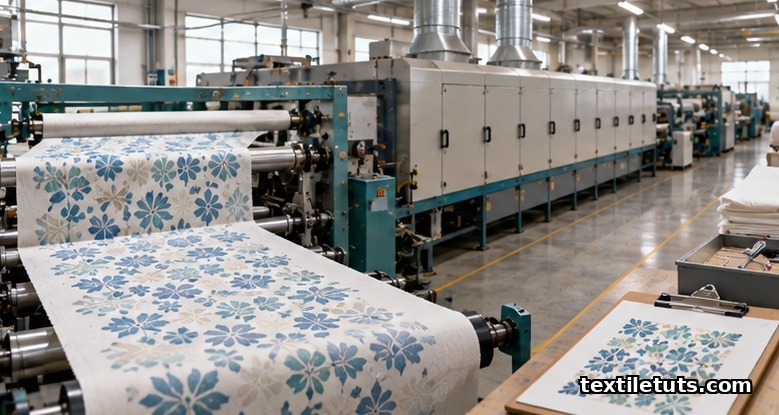
Steam fixation at 102 °C for 20–30 minutes is the most common method for fixing reactive dye prints on cotton, while disperse dye prints on polyester require dry-heat (thermosol) fixation at 200 °C for 60–90 seconds, and pigment prints cure at 150 °C for 3–5 minutes via a binder cross-linking reaction. These three temperatures and time windows cover roughly 85 percent of industrial textile printing runs worldwide.
The fixation stage is where a printed design becomes wash-fast. Without adequate fixation, dyes sit loosely on the fiber surface, so the first wash removes 20–60 percent of the color, depending on the dye class and substrate. This guide walks through every industrial fixation method engineers actually use, the chemistry that makes each one work, and the operating windows that produce a passing result on an ISO 105 or AATCC wash-fastness test.
You will learn the seven main fixation routes, the temperature and time parameters behind each, and how to choose between them for cotton, polyester, wool, nylon, and blended substrates.
What Fixation Means in Textile Printing
Fixation is the chemical and physical step that converts a dye deposit on a fabric into a permanent bond with the fiber. After printing, only a fraction of the dye is held in place. A reactive dye printed on cotton, for example, only fixes about 60–70 percent of the applied colorant through hydrogen bonding and Van der Waals forces; the remaining 30–40 percent must react covalently with cellulose hydroxyl groups under alkali-heat conditions to reach acceptable fastness (ISO 105-C06:2010).
The fixation yield, expressed as the percentage of dye that becomes wash-fast, drives the economics of the print process. Modern reactive printing aims for 85–95 percent fixation; anything below 70 percent usually signals a chemistry or process control problem rather than a normal operating range.
Steam Fixation (Saturated Steam at 102 °C)
Saturated steam fixation is the workhorse of reactive dye printing on cellulosic fibers. The fabric passes through a steam chamber at 100–102 °C for 15–30 minutes, depending on fabric weight and print density. Under these conditions, the dye molecule diffuses into the fiber’s amorphous regions and forms a covalent bond with the hydroxyl group on the cellulose chain once alkali (sodium carbonate or sodium hydroxide) is present in the print paste.
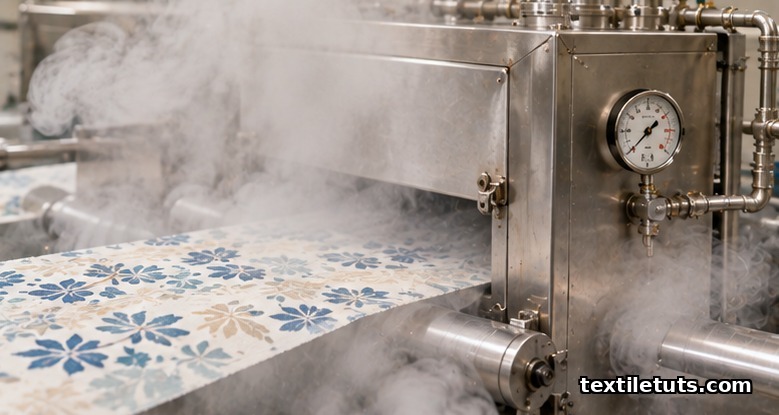
Typical parameters for cotton woven fabric:
- Steam temperature: 100–102 °C (saturated)
- Exposure time: 8–12 minutes for lightweight (≤100 GSM), 15–20 minutes for medium (150–250 GSM), up to 30 minutes for heavyweight terry or velour
- Alkali in print paste: sodium carbonate 30–50 g/L, sodium hydroxide 5–10 g/L for deep shades
- Fixation yield: 85–92 percent under optimized conditions
The key engineering lever is steam quality. Saturated steam holds the highest possible moisture content at a given temperature, and that moisture is what swells the cellulose fiber enough for the dye molecule (typically 8–15 Å in hydrodynamic radius) to diffuse inward. Superheated dry steam at the same temperature fixes dye more slowly because the fiber is not plasticized.
Dry-Heat (Thermosol) Fixation at 200 °C
Disperse dyes on polyester cannot be fixed with water-based steam because they have no affinity for aqueous systems. Instead, the printed fabric enters a stenter or thermosol chamber at 190–210 °C for 60–90 seconds. The high temperature sublimates the disperse dye, which then diffuses into the polyester’s amorphous regions.
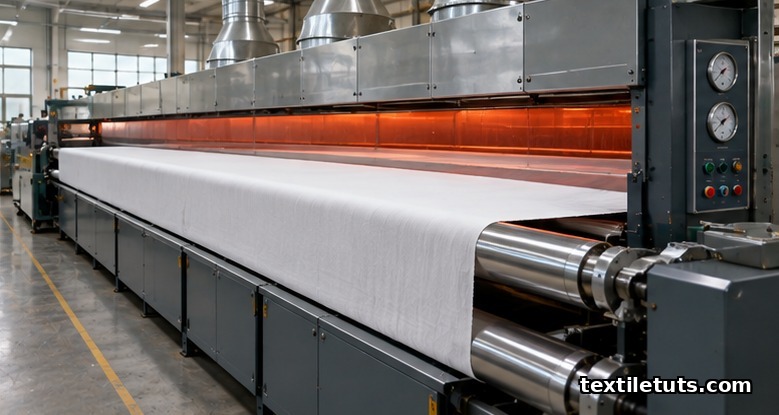
Standard thermosol window for polyester:
- Temperature: 200 °C (±5 °C across the fabric width)
- Dwell time: 60–90 seconds
- Fixation yield: 90–95 percent for high-energy disperse dyes
- Pre-dry step: 100–110 °C to remove print paste moisture before entering the high-temperature zone
Below 180 °C the dye diffuses too slowly and the print looks pale after washing. Above 215 °C, polyester begins to yellow and lose tensile strength. The 200 °C / 75-second window is the sweet spot used across most commercial polyester print lines, including automotive and flag fabric production.
Hot-Press and Baking Fixation for Pigments
Pigment printing does not use a dye-fiber bond at all. The colorant is an insoluble particle held to the fabric by a polymer binder, and fixation is really a curing step that cross-links the binder film around each pigment particle.
The standard cure window is:
- Cure temperature: 150 °C (140–160 °C is acceptable)
- Cure time: 3–5 minutes
- Binder type: acrylic copolymer (self-cross-linking) at 80–150 g/L of print paste
- Fixation yield: considered complete when the binder film passes a 5-wash cycle at 40 °C with no pigment loss above rating 4 on the ISO grey scale
Hot-press fixation at 180–200 °C for 10–20 seconds works for pigment-printed apparel labels and ribbons where a long cure is not practical. The trade-off is reduced wash fastness; hot-press cures usually cap at rating 3–4 on the ISO 105-C06 wash test, while a 150 °C / 4-minute cure reaches rating 4–5.
Microwave and Radio-Frequency Fixation
Dielectric heating, including microwave (2.45 GHz) and radio-frequency (27.12 MHz) energy, heats water molecules inside the fiber directly rather than heating the surrounding air. Reactive dye prints that normally take 20 minutes in steam can be fixed in 2–4 minutes under microwave energy at 800 W, with fixation yields comparable to or slightly better than steam.
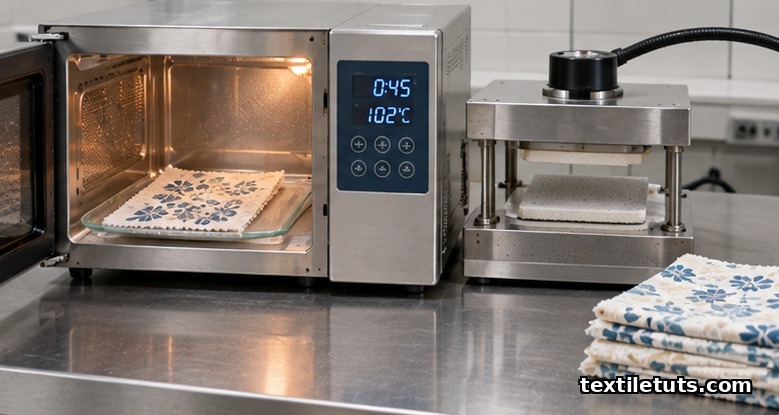
Published research on microwave fixation of reactive prints on cotton shows 80–90 percent fixation at 2–3 minutes exposure, versus 85 percent at 20 minutes in steam. The shorter dwell time is mainly useful for sample development and small-lot production where steamers waste energy cycling up and down.
Limitations are real: microwave fixation is hard to scale uniformly across wide fabric, and metallized yarns (like Lurex) can arc under the field, which rules out microwave for many decorative fabric lines.
Chemical and Alkali-Shock Fixation
Some reactive dye systems are fixed by a two-stage alkali shock. The print paste contains the dye plus a latent alkali (sodium silicate or sodium bicarbonate); the printed fabric is then padded through a caustic soda bath at 80–95 °C for 30–60 seconds. The rapid pH jump triggers the covalent fixation reaction in seconds rather than minutes.
This route is common in continuous pigment and reactive printing ranges where the dwell time in the steamer is too short to achieve full fixation. It also allows the engineer to separate the printing step (low alkali, stable paste) from the fixation step (high alkali, fast reaction), which improves print paste shelf life.
Choosing the Right Fixation Method
The choice is driven by fiber, dye class, and the production format. The table below summarizes the standard industrial windows.
| Substrate | Dye / Pigment | Fixation Method | Temperature | Time | Typical Yield |
|---|---|---|---|---|---|
| Cotton | Reactive | Saturated steam | 102 °C | 15–30 min | 85–92% |
| Polyester | Disperse | Thermosol (dry heat) | 200 °C | 60–90 s | 90–95% |
| Cotton / polyester blend | Reactive + disperse | Two-stage steam then thermosol | 102 °C then 200 °C | 15 min then 75 s | 80–90% |
| Cotton, polyester, blends | Pigment | Bake cure | 150 °C | 3–5 min | Binder-dependent |
| Wool, silk, nylon | Acid dye | Saturated steam | 102 °C | 30–45 min | 85–95% |
| Cellulosic sample runs | Reactive | Microwave | Internal ~100 °C | 2–4 min | 80–90% |
Process Control and Common Defects
The two most common fixation problems are under-fixation and over-fixation. Under-fixation shows up as a wash-fastness failure: rating 2–3 on the ISO 105-C06 stain scale after one wash, versus the rating 4–5 that most retail buyers require. The root cause is usually insufficient steam temperature, a too-short dwell, or alkali that has lost strength in storage.
Over-fixation looks different. On reactive prints, prolonged steam can hydrolyze the dye, breaking the dye-fiber bond even after it has formed, so shade depth drops by 10–20 percent and the wash water turns colored. On polyester, thermosol over-exposure yellows the fabric and reduces tear strength by 15–25 percent.
Process control rests on three measurements: steam chamber temperature (thermocouple at the fabric plane), dwell time (line speed and chamber length), and alkali concentration (titration of print paste before use). All three should be logged at every production shift.
Frequently Asked Questions
What is the difference between fixation and curing in textile printing?
Fixation is the broader term for any step that makes a printed dye wash-fast, including the covalent reaction of a reactive dye with cellulose. Curing is the specific term used for pigment prints, where the binder film cross-links around the pigment particle rather than reacting with the fiber. Both raise wash fastness to commercial standards, but the chemistry and process parameters are different.
Can reactive and disperse dyes be fixed at the same time on a polyester-cotton blend?
Yes, using a two-stage process. The fabric first passes through saturated steam at 102 °C for 12–18 minutes to fix the reactive dye on the cotton portion, then through a thermosol zone at 200 °C for 60–75 seconds to fix the disperse dye on the polyester portion. The sequence must be steam first, then thermosol, because the higher dry-heat temperature would yellow the cotton and degrade reactive dyes.
How do I know if a print has been properly fixed?
Run a fastness test. AATCC TM 8 (crocking) and AATCC TM 16 (light) give the standard rating scales. For a quicker in-house check, wash a printed swatch at 60 °C with 5 g/L standard detergent for 30 minutes, then rate the color change against the ISO 105-A02 grey scale. A rating of 4 or higher indicates proper fixation for most commercial uses.
Is microwave fixation ready for industrial production?
Not yet, in 2026. Microwave and radio-frequency fixation work well at laboratory and sample scale, with fixation yields within 5 percent of conventional steam. The unsolved problem is uniform energy distribution across a 1.8-meter-wide fabric run at production speeds, plus arcing risk on metallized yarns. Until those engineering issues are resolved, saturated steam and thermosol remain the dominant industrial routes.
What is the most energy-efficient fixation method?
For reactive dye printing on cotton, microwave fixation uses roughly 30–40 percent less energy per kilogram of fabric than saturated steam, because the heat is generated inside the fiber rather than wasted heating the surrounding air and chamber walls. For polyester, thermosol is already efficient: a 75-second dwell at 200 °C consumes far less energy than a 20-minute steam cycle. Pigment baking at 150 °C for 4 minutes sits in between.
References
- International Organization for Standardization. ISO 105-C06:2010 — Textiles — Tests for colour fastness — Part C06: Colour fastness to domestic and commercial laundering. ISO. The standard wash test used to rate reactive dye fixation.
- International Organization for Standardization. ISO 105-X11:1994 — Textiles — Tests for colour fastness — Part X11: Colour fastness to hot pressing. ISO. The reference method for hot-press fixation evaluation.
- American Association of Textile Chemists and Colorists. AATCC Test Method 8 — Colorfastness to Crocking: AATCC Crockmeter Method. AATCC. The standard crocking test for fixation verification.
- American Association of Textile Chemists and Colorists. AATCC Test Method 16 — Colorfastness to Light. AATCC. Light-fastness test used to confirm complete pigment and disperse fixation.
- ASTM International. ASTM D204 — Standard Test Methods for Sewing Threads. ASTM. Reference for thread-based fixation testing protocols.
- El-Halwamy, A. et al. Microwave fixation of reactive prints on cotton fabrics. ResearchGate. Peer-reviewed study showing 80–90% fixation at 2–3 minutes versus 20 minutes in steam.
- Niu, T. and Wang, X. Fixation mechanisms in textile pigment printing: binder cross-linking kinetics. MDPI. Open-access review of the 150 °C cure window for acrylic binders.
This article is the working reference for fixation methods in textile printing. Editorial by Shahrukh Islam, TextileTuts. Sources: ISO 105-C06:2010, ISO 105-X11:1994, AATCC TM 8, AATCC TM 16, ASTM D204, and peer-reviewed papers on microwave and pigment fixation as cited.


