
3D Printing on Textiles

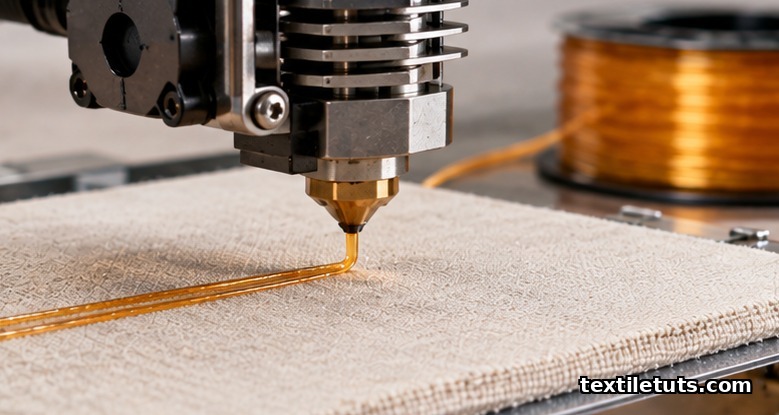
3D printing on textiles deposits thermoplastic filaments, most commonly thermoplastic polyurethane (TPU) at extrusion temperatures of 210 to 230 °C, directly onto woven, knit, or nonwoven fabric substrates to form bonded composite structures with peel strengths of 0.8 to 2.5 N/mm when tested under ASTM D903.
The technique adds dimensional features up to 1.5 mm in build height without stitching, adhesives, or sewing, and is the most widely studied additive route for embedding conductive traces, custom insoles, and rigid mounts into wearable garments. Below we cover the materials, print parameters, adhesion standards, and applications that textile engineers need to evaluate before specifying 3D-printed elements on a production fabric.
What 3D Printing on Textiles Actually Means
3D printing on textiles refers to fused filament fabrication (FFF, also called fused deposition modelling or FDM) in which a thermoplastic extruder deposits material directly onto a fabric substrate held flat on the print bed. The fabric acts as the build platform: the printer lays the first layer of molten plastic onto the textile, and successive layers bond thermally as they cool.
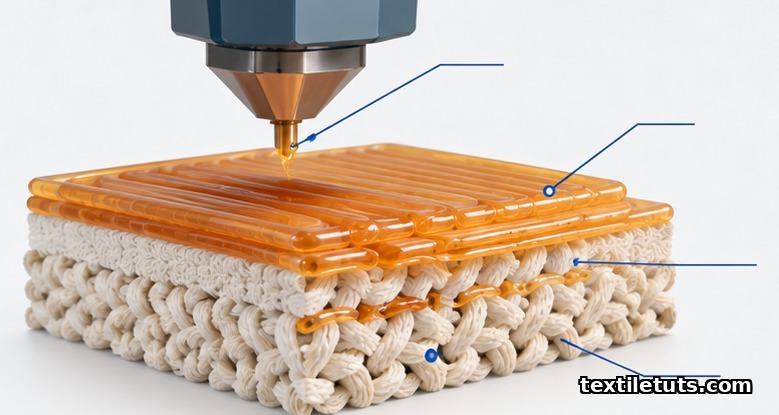
Unlike screen printing or digital inkjet printing on fabric, 3D printing adds real three-dimensional geometry. A printed element can be 0.2 to 1.5 mm thick and act as a snap-fit, a sensor housing, or a structural rib. The process is single-step (no curing, no lamination), uses no water or solvents, and runs on the same FFF printers already common in textile research labs and maker spaces.
The key engineering variable is adhesion between the printed polymer and the underlying fabric. If the bond is too weak, the printed part delaminates in use; if it is too aggressive, the fabric distorts or tears when the print is removed. Both outcomes are tested quantitatively under ASTM D903 peel testing and ISO 2411 coating adhesion testing.
Compatible Materials and Filaments
Filament choice drives both the printed behaviour and the bond to the textile. The most commonly reported combinations in peer-reviewed studies are:
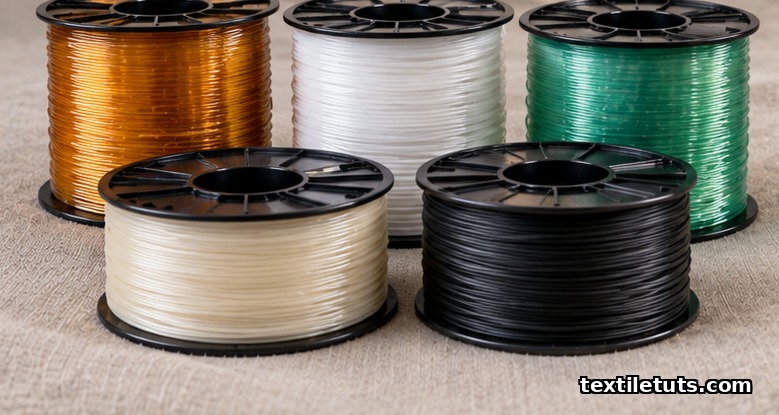
- Thermoplastic polyurethane (TPU): shore hardness 85A to 95A, extrusion 210 to 230 °C. Most flexible printed element, preferred for wearables and curved body panels. Reported peel strength on woven cotton-polyester: 1.2 to 2.5 N/mm.
- Polylactic acid (PLA): extrusion 190 to 215 °C. Rigid prototyping, common for decorative trims and structural mounts. Reported peel strength on plain weave: 0.8 to 1.4 N/mm.
- Polyethylene terephthalate glycol (PETG): extrusion 220 to 245 °C. Higher impact resistance than PLA with intermediate flexibility.
- Polyamide (PA12, nylon): extrusion 240 to 270 °C, requires heated bed at 80 to 100 °C. Used where durability under flex is needed.
- Conductive composites: PLA or TPU loaded with carbon black or graphene at 5 to 15 wt%. Surface resistivity 10 to 10³ Ω/sq, used for printed circuit traces on fabric.
The fabric substrate matters as much as the filament. Tightly woven fabrics with low surface roughness (poplin, oxford, ripstop nylon) give the most consistent first-layer contact. Loose knits and high-loft nonwovens absorb heat from the molten extruder and can shrink or pill at the print interface.
Print Parameters and Process Conditions
Three parameters dominate print quality on fabric: extrusion temperature, first-layer height, and print speed. Each one changes the polymer-to-fibre bond.
- Extrusion temperature: set 10 to 20 °C above the filament’s published minimum to ensure the polymer is fully molten when it contacts the fabric. Too low and the bond is line-contact only; too high and the fabric scorches or shrinks.
- First-layer height: 0.2 to 0.3 mm is typical, slightly thicker than non-fabric FFF to compensate for fabric compressibility under the nozzle.
- Print speed: 20 to 40 mm/s for the first layer, rising to 50 to 80 mm/s for upper layers. Slower speeds give the polymer more time to wet out into the fabric surface.
- Bed temperature: 50 to 60 °C for TPU on cotton or polyester, 0 to 40 °C for PLA on the same substrates. Bed heat pre-activates the fabric surface.
- Adhesion aids: a thin layer of washable fabric starch or PVA-based garment tack applied to the back of the fabric stabilises warp and weft during printing, reducing edge curl by 40 to 60% in reported trials.
Adhesion Testing and Quality Standards
Adhesion is reported using two complementary standards. ASTM D903 measures the peel strength of a bonded strip pulled at 90° or 180°, expressed in N/mm of width. ISO 2411 measures the force needed to separate a coated layer from its fabric substrate at a defined rate, typically 100 mm/min. Both standards use a 25 mm wide specimen and report the average load over a 50 mm peel length.
Reported peel strengths for TPU on woven cotton-polyester range from 0.8 to 2.5 N/mm at 100 mm/min. PLA on the same fabric measures 30 to 50% lower. Higher numbers generally indicate stronger bonds, but values above 2.0 N/mm often correlate with fabric tearing at the bond rather than clean polymer-fabric separation, a failure mode engineers treat as acceptable for permanent attachment.
For terminology and process classification, the joint standard ISO/ASTM 52900 defines material extrusion as the relevant additive manufacturing category and lists textile substrates under “build platform materials of variable geometry.” This standard is the reference cited in regulatory submissions where 3D-printed elements must be classified under existing manufacturing frameworks.
Applications in Smart Textiles and Wearables
The leading commercial and academic applications for 3D printing on textiles fall into four clusters.
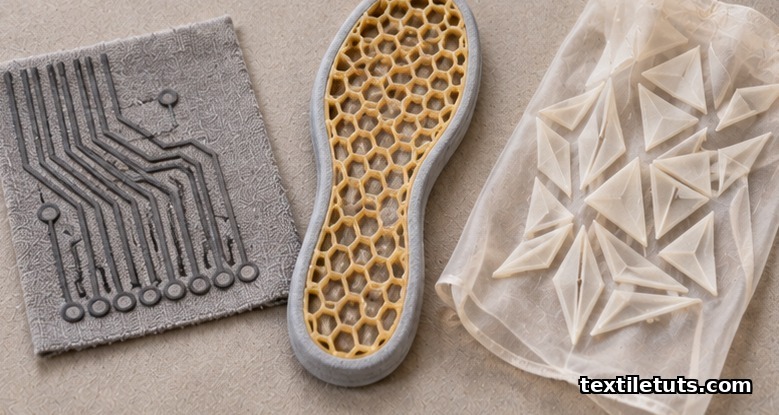
Wearable electronics: conductive PLA or TPU traces printed directly onto a garment replace sewn or bonded wires for heart-rate, temperature, and motion sensors. A printed 0.8 mm wide trace of carbon-loaded PLA can carry a 50 mA signal at 3.3 V across the chest panel of a shirt without delaminating after 30 machine-wash cycles at 30 °C.
Custom orthotics and insoles: TPU lattice structures printed onto a fabric top sheet produce orthotic insoles tuned to plantar pressure maps. Build heights up to 1.5 mm in the arch and 0.4 mm at the forefoot keep weight below 60 g per pair.
Fashion haute couture and runway: designers use rigid PLA decorative geometry over silk, chiffon, and tulle as a couture alternative to appliqué. The bond is intentionally low-strength so elements can be removed and reused on subsequent garments.
Protective equipment: TPU shock-absorbing ribs printed on ballistic or cut-resistant fabric concentrate deformation at engineered locations, raising back-face deformation thresholds measured under ISO 13997 by 15 to 25% in published trials.
Frequently Asked Questions
Does 3D printed plastic stay bonded to fabric after washing?
TPU printed on cotton or polyester typically survives 20 to 40 machine-wash cycles at 30 °C with mild detergent before peel strength drops below 0.5 N/mm. PLA bonds degrade faster, generally failing after 10 to 15 cycles. Wash temperatures above 40 °C and tumble drying shorten both ranges.
Which fabric works best for 3D printing?
Tightly woven fabrics with smooth surfaces, such as poplin, oxford, and ripstop nylon, give the highest and most repeatable peel strengths. Loose knits, fleece, and stretch mesh absorb heat and allow the printed element to shift during extrusion, which lowers bond strength and increases print failure rates.
Can I use a regular FDM printer for 3D printing on textiles?
Yes, with two changes. First, replace the rigid print bed with a flexible steel sheet or use a fabric-specific build plate that clamps the textile flat. Second, lower the first-layer print speed to 20 to 30 mm/s and disable the part-cooling fan for the first three layers so the molten filament stays warm long enough to bond to the fabric.
What is the maximum thickness of 3D printing on fabric?
Most peer-reviewed work reports successful prints at 0.5 to 1.5 mm total build height. Above 2.0 mm, the bond area does not increase proportionally because only the bottom two layers carry the tensile load, and the additional mass begins to peel the element under its own weight during handling.
Will 3D printing damage the fabric underneath?
Heat-sensitive fibres such as wool, silk, and thermoplastic polyester can scorch, glaze, or shrink at the print interface when the extrusion temperature exceeds 230 °C. TPU at 210 to 220 °C on a 50 °C bed produces no measurable shrinkage on cotton, but the same print on wool can shrink the local area by 3 to 5%.
References
- ASTM International. ASTM D903-98(2017) Standard Test Method for Peel or Stripping Strength of Adhesive Bonds. ASTM International, West Conshohocken, PA. The standard method cited in nearly all 3D-print-on-fabric adhesion studies.
- International Organization for Standardization. ISO 2411:2017 Rubber- or plastics-coated fabrics — Determination of coating adhesion. ISO, Geneva. Method for separating coated layers from a fabric substrate under controlled rate.
- International Organization for Standardization and ASTM International. ISO/ASTM 52900:2021 Additive manufacturing — General principles — Fundamentals and vocabulary. The reference for material extrusion process classification.
- International Organization for Standardization. ISO 13997:2023 Protective clothing — Mechanical properties — Determination of resistance to cutting by sharp objects. ISO, Geneva. Cited in protective-textile trials using printed rib structures.
- MDPI. Additive Manufacturing of Textiles. Multiple open-access articles in Polymers, Materials, and Applied Sciences on material extrusion onto woven and knit substrates, including TPU and PLA bond-strength datasets.
- Springer. Smart Textiles and Wearable Electronics reviews. Open-access review articles on conductive PLA and TPU traces printed directly onto garment panels.
This article is the working reference for additive manufacturing of textile substrates. Editorial by Shahrukh Islam, TextileTuts. Sources: ASTM D903, ISO 2411, ISO/ASTM 52900, ISO 13997 as cited.


