
Princess Seams

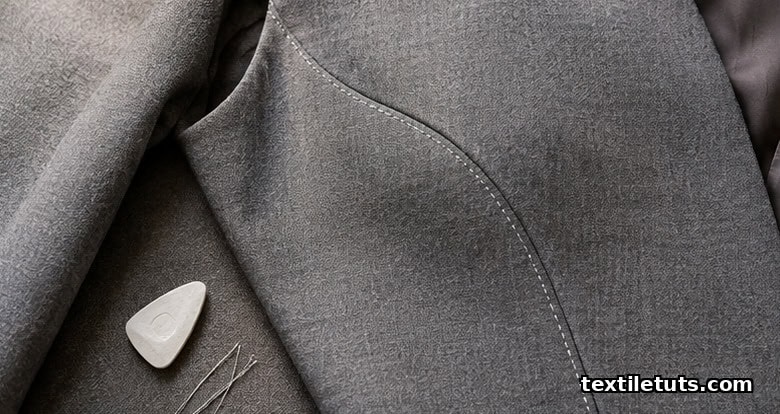
A princess seam is a vertical, curved seam that runs from the shoulder or armhole through the bust apex to the hem, absorbing the shaping normally done by darts and producing a smooth torso line without a horizontal break at the waist. On a fitted bodice the seam is sewn with a standard 1.5 cm (5/8 in) seam allowance at 8 to 10 stitches per inch (about 3 to 4 stitches per cm) using a 301 lockstitch, the construction that ASTM D6193-16 designates as a Type SSa superimposed seam and that ISO 4916:1991 classifies as a Type 1 seam.
This guide covers where the princess line comes from, how single and double princess constructions differ, the seam engineering that lets a curved line hold shape, the fitting problems a princess seam exposes, and how the construction changes across woven, knit, and sheer fabrics.
Where the Princess Line Comes From
The princess line emerged in mid-Victorian dressmaking, between roughly 1860 and 1875, as an alternative to corseted waist suppression. Early references describe it as a close-fitting garment whose shaping came from vertical panels rather than from gathering, pleating, or a fitted waistband. The style is generally attributed to Charles Frederick Worth, the English-born couturier working in Paris, and to designers in his circle who supplied gowns to European royal houses.
The name “Princess” is widely explained as a reference to Alexandra, Princess of Wales (later Queen Alexandra), whose wardrobe in the 1870s popularized the uncluttered, body-skimming silhouette. The cut subsequently became a standard patternmaking option in women’s tailoring and has remained in continuous use for more than 150 years because it solves a specific fitting problem: shaping a torso without a horizontal break at the waist.
How Princess Seams Shape the Body
A princess seam replaces multiple darts with one vertical seam that rotates around the body’s high-bust, full-bust, and waist points. In a standard bodice block, the darts that a princess seam absorbs are:
- The front waist dart, typically 2.5 to 4 cm deep at the waistline
- The side bust dart, when present, about 1 to 2 cm at the side seam
- Optionally, the shoulder dart, transferred into the same seam line
Because the seam curves through all three of these shaping points, the resulting bodice has no horizontal interruption at the waist. This is the property that makes princess lines the standard construction choice for bridal bodices, tailored jackets, sheath dresses, and any garment where a smooth torso line is required.
Single Princess vs. Double Princess Seams
Patternmakers distinguish between two constructions:
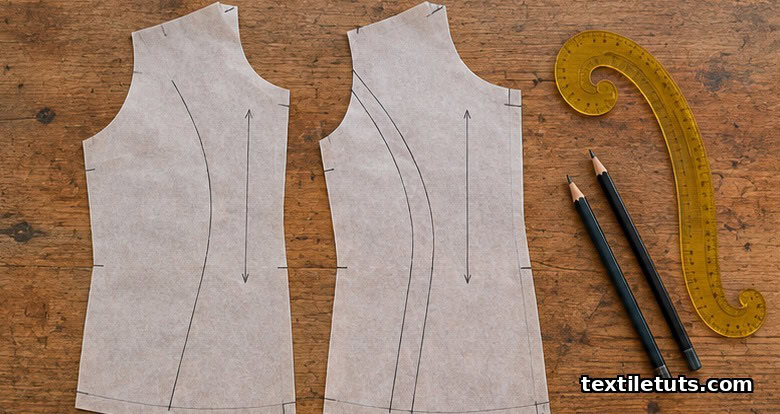
Single princess seam: one curved seam on each side of the garment, running from the shoulder (or armhole) through the bust apex to the hem. Used in bodices, sheath dresses, and coats where the side panel is a single piece.
Double princess seam: two curved seams on each side, creating a center-front panel, a side-front panel, and a side-back panel. The construction divides the torso shaping across more panels, which improves fit on figures with a pronounced difference between the high bust and the full bust, and is the construction used in most fitted blazers and tailored jackets.
| Property | Single Princess | Double Princess |
|---|---|---|
| Seams per side | 1 | 2 |
| Panels in front | 2 | 3 |
| Best for | Sheath dresses, bridal bodices, blouses | Tailored jackets, blazers, coats |
| Full-bust adjustment range | Moderate (FBA up to about 5 cm) | Large (FBA up to about 10 cm or more) |
| Construction time vs. dart bodice | +15 to 25% | +25 to 40% |
Seam Engineering and Stitch Selection
Because a princess seam must curve around the bust without puckering, the stitch selection and seam engineering matter as much as the pattern draft. The relevant textile standards treat this as a sewn-seam performance problem, not just a decorative question.
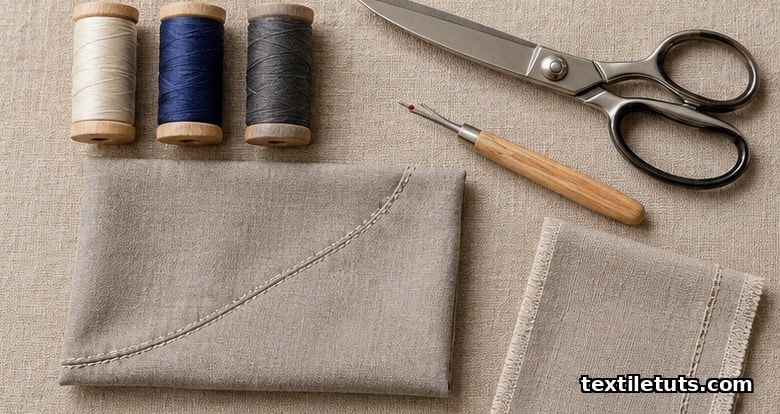
ASTM D1683/D1683M-22, Standard Test Method for Failure in Sewn Seams of Woven Fabrics, defines how seam strength is measured under tensile load and is the standard reference for setting stitch density on shaped seams. For a curved princess seam in a medium-weight woven (150 to 250 GSM), the practical stitch range is 8 to 10 stitches per inch (3 to 4 per cm); a longer stitch of 6 to 7 SPI (about 2.4 to 2.8 per cm) is reserved for very lightweight fabrics where stitch perforation can weaken the curved allowance. ISO 13935-1:2014, Textiles, Seam tensile properties of fabrics and made-up textile articles, provides the matching tensile-strength method used to qualify a stitch and seam combination for a given fabric weight.
ISO 4916:1991, Textiles, Seam types, Classification and terminology, classifies seam geometry by the number of components and the type of stitch used. A curved princess seam is a Type 1 seam (superimposed seam) stitched with a 301 lockstitch, the standard stitch for garment panels that will be stressed during wear. ASTM D6193-16, Standard Practice for Stitches and Seams, uses the same 301 lockstitch designation and lists the curved superimposed seam as a Type SSa seam in its nomenclature.
For the seam finish, a princess seam is usually pressed open and, on fabrics that fray, finished with a clean finish or a Hong Kong bias binding. AATCC TM 88B-2018, Smoothness of Seams in Fabrics after Repeated Home Laundering, is the standard appearance-retention method referenced in bridal and formalwear QC protocols because seam impressions on the right side of a bodice are a visible defect; the standard test geometry uses a sewn seam pressed open as the specimen.
Common Fitting Problems and How to Diagnose Them
Princess seams show fitting errors more clearly than darts do, because the seam line itself is on the outside of the garment and any tension or drag becomes visible.
- Diagonal pulls toward the bust apex: the seam is too tight across the bust; the fix is a full bust adjustment (FBA) of 1 to 2 cm at the apex, with corresponding length added at the hem.
- Horizontal pulling at the waist: the waist suppression is too aggressive; let the waist out by 0.5 to 1.5 cm on both the center-front and side-front panels.
- Puckering along the curve: usually a stitch-density issue (too many stitches per inch on a curved allowance) or a thread-tension imbalance. Re-stitch at 8 to 10 SPI with balanced upper and lower thread tension.
- Seam impression on the right side: the seam allowance is too bulky for the fabric; grade the allowance so the two layers are different widths, or trim one layer to 0.5 cm before pressing.
A standard fitting protocol, taught in most accredited patternmaking courses, is to baste the princess seam with a long stitch of 4 to 5 SPI first, fit the garment on the body, mark any adjustments with tracing paper or a washable pen, and only then set the final stitch at the production stitch length.
Princess Seams Across Fabric Families
The fabric changes the seam, but not the principle.
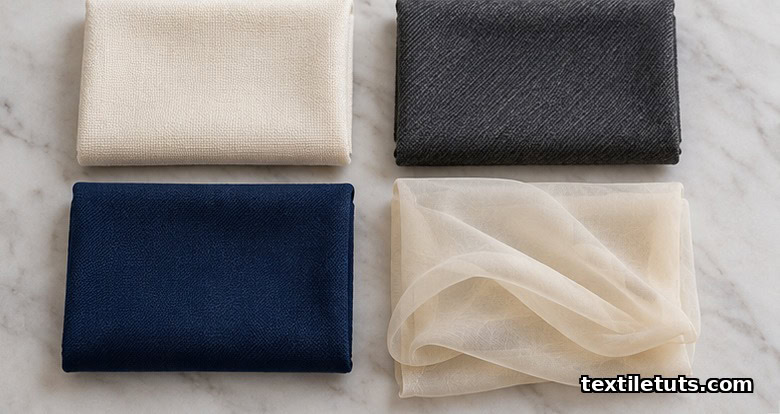
Woven cotton, linen, and shirting (80 to 150 GSM): standard 1.5 cm seam allowance, 8 to 10 SPI, 301 lockstitch, pressed open. A Hong Kong finish is optional on medium-weight wovens; on shirting, a clean finish or pinking is usually sufficient.
Wool and wool-blend suitings (200 to 350 GSM): princess seams in tailored jackets are typically pad-stitched along the seam line on the canvas before the seam is closed, to keep the roll line smooth. Seam allowance is reduced to 1 cm (3/8 in) on the canvas layer and held at 1.5 cm on the outer layer.
Knits (single jersey, interlock, ponte): the 301 lockstitch is replaced with a 401 chainstitch or a narrow 504 four-thread overlock, because lockstitch on knit stretches less than the fabric and will break under body movement. Seam allowance is typically 0.75 to 1 cm, and the stitch length is 2 to 2.5 mm (about 8 to 10 SPI).
Sheer fabrics (silk chiffon, organza, georgette): the princess seam is sewn as a French seam (Type 1, then Type 5 in ISO 4916) to enclose the raw edge and prevent fraying. Stitch length increases slightly to about 3 mm (10 to 12 SPI) to avoid perforation on the sheer.
Frequently Asked Questions
What is the difference between a princess seam and a dart?
A dart is a folded wedge of fabric, stitched and pressed to one side, that shapes a flat panel to a curved body. A princess seam is a sewn seam that combines the shaping of two or three darts into a single curved line. The princess seam lies on the outside of the garment and is a visible construction line, while a dart is hidden inside a panel.
Do princess seams make a bodice more difficult to sew?
Yes, by a measurable margin. Industry time studies put a princess-seam bodice at roughly 1.15 to 1.40 times the construction time of an equivalent darted bodice, depending on whether the seam is single or double and whether it is topstitched. The added time is in the matching, basting, and pressing of the curved seam, not in the stitching itself.
Can a princess seam be added to an existing darted pattern?
Yes. The standard patternmaking procedure is to draw the princess seam line from the shoulder or armhole through the bust apex to the waist, slash the bodice along that line, close the waist dart and any shoulder or side bust dart, and true the new seam line. The procedure is the same one used to convert a sloper to a princess block, and it works on most darted bodice patterns.
What stitch is best for a princess seam on a knit fabric?
A 401 chainstitch or a 504 four-thread overlock, set at 2 to 2.5 mm stitch length (8 to 10 stitches per inch). A 301 lockstitch on a knit will restrict the fabric’s stretch and break under body movement. If the seam is to lie flat on the outside, finish the overlock edge with a single-needle coverstitch or a topstitch-and-trim operation.
Are princess seams only used in women’s clothing?
No. Men’s tailoring has used the equivalent construction, a curved seam from the shoulder through the chest to the hem, in fitted waistcoats, dress uniforms, and historical military coats for at least as long as it has been used in women’s dress. The term “princess seam” is, however, gendered in modern retail pattern catalogs and is most often associated with women’s fitted garments.
References
- ASTM International. ASTM D1683/D1683M-22, Standard Test Method for Failure in Sewn Seams of Woven Fabrics. https://www.astm.org/d1683_d1683m-22.html — seam strength testing protocol cited for stitch density on curved allowances.
- ASTM International. ASTM D6193-16, Standard Practice for Stitches and Seams. https://www.astm.org/d6193-16.html — classification of stitch and seam types including superimposed seam geometry.
- International Organization for Standardization. ISO 4916:1991, Textiles — Seam types — Classification and terminology. https://www.iso.org/standard/11323.html — reference for the seam type classification (Type 1, Type 5) used throughout the article.
- International Organization for Standardization. ISO 13935-1:2014, Textiles — Seam tensile properties of fabrics and made-up textile articles. https://www.iso.org/standard/56827.html — seam tensile strength test referenced in the curved-seam engineering discussion.
- American Association of Textile Chemists and Colorists. AATCC TM 88B-2018, Smoothness of Seams in Fabrics after Repeated Home Laundering. https://www.aatcc.org — seam appearance retention method cited for bridal and formalwear QC.
- Encyclopaedia Britannica. Princess dress (clothing). https://www.britannica.com — encyclopedic reference for the 19th-century origin of the Princess line and its attribution to mid-Victorian couturiers.
This article is the working reference for princess seams in woven and knit garments. Editorial by Kazi Sifat Muntasir, TextileTuts. Sources: ASTM D1683, ASTM D6193, ISO 4916, ISO 13935, AATCC TM 88B, Encyclopaedia Britannica as cited.


