
Bias Cut Construction

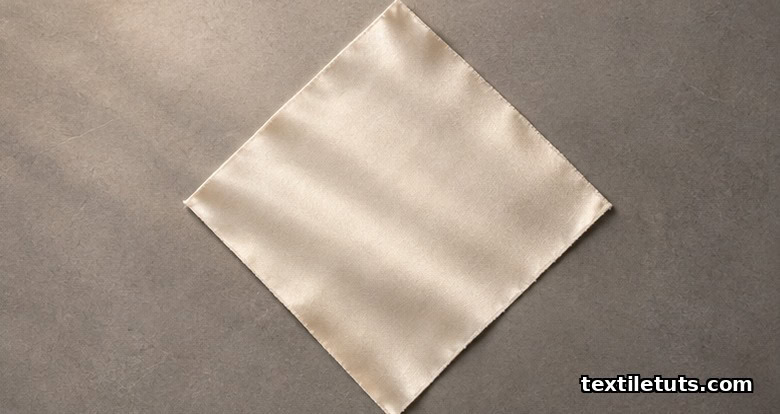
Bias-cut fabric is cut at 45° to the warp and weft yarns, which gives a typical woven textile roughly 20-30% mechanical stretch along the bias direction compared with under 2% stretch on the straight grain. This stretch, caused by yarn crimp interchange rather than fiber elasticity, is the reason bias-cut garments drape fluidly against the body and contour curves without darts. Understanding how grain angle, fabric weight, and seam handling interact is what separates a bias-cut dress that flows from one that sags out of shape after one wear.
This guide covers the grain mathematics behind bias cutting, how much stretch a maker can expect from common apparel fabrics at 45°, the cutting and sewing techniques that prevent distortion, and the finishing steps that keep a bias hem where it was sewn.
What Bias Cut Construction Means
Every piece of woven fabric has two reference yarns: the warp (lengthwise, on the loom) and the weft (crosswise, inserted by the shuttle or projectile). The straight grain runs parallel to the warp; the cross grain runs parallel to the weft. The bias is any line that sits between these two grains, and the most common bias for garment work is exactly 45° from the warp because that angle is symmetrical with respect to both yarn systems.
When a pattern piece is laid on the fabric at 45°, the warp and weft yarns pass under the seam at equal angles. Because the yarns are no longer aligned with the seam, small forces along the seam line pull on the yarn crimp rather than the yarn itself. Yarn crimp is the waviness baked into a yarn by the weaving process, typically 5-12% in a balanced plain weave (ISO 7211-3:1984 for yarn crimp measurement), and that stored waviness is what allows the bias to stretch without permanently deforming the fibers.
The Grain Mathematics: 45°, 22.5°, and True Bias
Designers talk about bias in three practical grades:
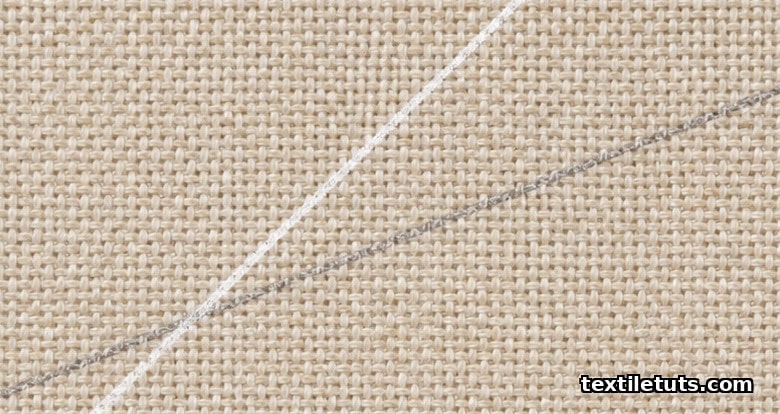
- True bias (45°): the maximum stretch direction in a balanced weave. A square cut at 45° will hang with no visible grainline.
- Half bias or partial bias (22.5° from warp or weft): about 60-70% of the stretch of true bias with a less dramatic drape. Used in sleeve caps and curved hems where some structure is desired.
- Off-grain (anything more than 10° off the warp): considered a defect in pattern matching but is sometimes deliberately used to soften the silhouette.
Stretch grows quickly as the cut angle moves away from the warp. At 15° off grain, a lightweight cotton voile shows about 8% stretch; at 30° off, around 15%; at 45°, between 20% and 30% depending on yarn count and weave density. The relationship is roughly proportional to the sine of twice the angle, which is why 45° is the peak: sin(2 × 45°) = 1.0.
Stretch, Recovery, and Why Bias Drapes Differently
Bias stretch is mechanical, not elastic, so it behaves differently from the stretch of a knit. AATCC TM135 dimensional-change test data on woven cottons shows that after one stretch-and-release cycle on the bias, residual elongation of 2-4% remains; the yarn crimp has partly rearranged. Wools recover better because of fiber-scale structure; polyesters recover worst because the thermoplastic yarns hold the stretched crimp once set.
Drape is a separate property, measured under ASTM D1388 (cantilever test for bending length) and Cusick drape coefficient methods. A fabric cut on the true bias typically shows a 30-50% lower bending length in the bias direction than in the warp direction, which is the physical reason bias-cut skirts cling to the hips and flare from the knees rather than standing out.
Cutting and Sewing Techniques That Prevent Distortion
Because bias stretches easily, the standard pin-and-rotate cutting method used for straight-grain pattern pieces will distort a bias piece. The working sequence used in industry sample rooms is:
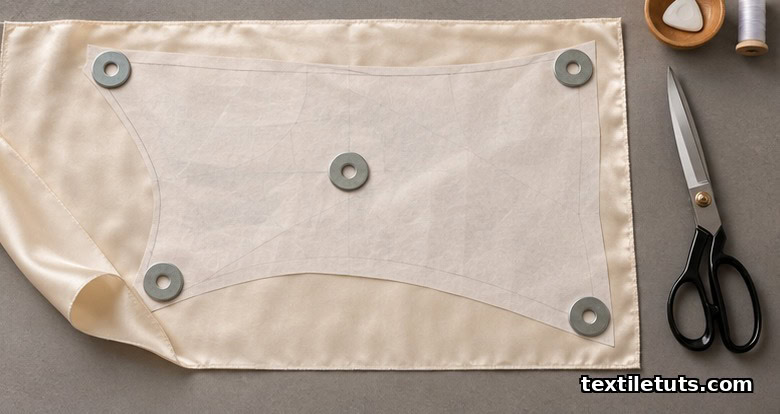
- Lay the fabric flat on a table, wrong side up, smoothing from the center outward.
- Weight the pattern piece with metal washers or pattern weights instead of pins through the body of the piece. Pins through the bias stretch the fabric locally and leave a permanent ridge.
- Pin only at the corners and along straight edges that will be cut on true bias.
- Cut with long, smooth shears strokes; do not lift the fabric as you cut.
- Mark notches with tailor’s tacks or a single clip rather than chalk, because chalk lines smear on a stretched surface.
Seam allowances on bias garments are usually increased to 1.0-1.5 cm (around 3/8 to 5/8 inch) to give room for trimming after the seam relaxes, and stay-stitching is sewn within the seam allowance immediately after each seam is assembled to stabilize the bias against further stretch during handling.
Common Fabrics and How They Behave on the Bias
| Fabric | Typical 45° bias stretch | Drape behavior | Suitability for true bias |
|---|---|---|---|
| Silk charmeuse | 20-28% | Liquid, clings | High (eveningwear, slip dresses) |
| Cotton lawn | 12-18% | Soft, slight structure | Moderate (blouses, summer skirts) |
| Wool gabardine | 10-15% | Smooth, fluid body | Moderate (tailored dresses, trousers) |
| Polyester crepe | 15-22% | Grainy drape, good recovery | High (workwear bias cuts) |
| Linen | 6-10% | Crisp, holds shape | Low (bias wrinkles rather than drapes) |
| Rayon/viscose challis | 22-30% | Very fluid, heavy | High, but recovers poorly without hang |
Knits are a separate case: a true knit jersey already has 50-100% mechanical stretch along the wales, so the term “bias” in knit design usually means a deliberate diagonal layout that controls stretch direction rather than adds stretch.
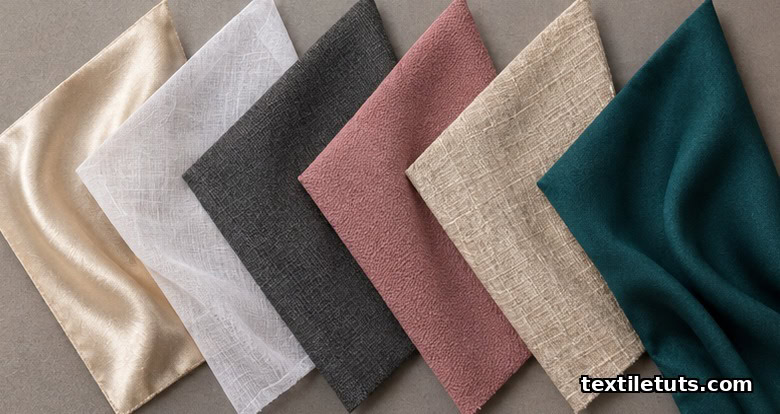
Hemming and Finishing Bias Garments
Bias-cut hems should always be left to hang overnight, ideally on a dress form or hanger with the hem pinned but unstitched. The fabric will drop 2-5 cm depending on weight and length as the bias relaxes, and the final hem is taken up to the new level. Skipping this step produces a hem that rides up on one side after the first wearing.
Three finishing methods work on the bias:
- Folded hem (1.5-2 cm, double turned): the standard for silk, cotton lawn, and rayon. Stitch from the right side with a long basting first to check the level, then machine-finish.
- Bias-bound hem: uses a separate bias strip to wrap the raw edge. Adds weight, which can be desirable in chiffon for a slight flare.
- Rolled hem by hand: the only realistic choice for sheer or very fluid fabrics where machine stitches would pucker the edge.
Pressing bias seams requires care. Steam and a hot iron will permanently stretch the bias if the iron is dragged; the safer method is press-and-hold with steam, no lateral movement, followed by a cool press to set the seam. A pressing cloth between the iron and the fabric prevents shine on satins and crepe-back satins.
Frequently Asked Questions
Why do designers cut on the bias at all if the fabric stretches out of shape?
Bias is used for the drape and body-skimming fit it creates, not for permanent stretch. When cut and sewn correctly, with hang time before hemming and stay-stitching on every seam, the residual stretch settles and the garment holds its shape as well as a straight-grain equivalent. The “stretching out of shape” failure happens when a maker skips the hang time or uses a fabric with poor recovery, such as loose-weave rayon.
How much extra fabric does a bias layout require compared with a straight-grain layout?
For most garments, a bias layout needs 10-20% more fabric because pattern pieces cannot be nested as tightly when they sit on the diagonal. A dress that takes 2.5 m on the straight grain typically takes 3.0 m on the true bias. Smaller repeat prints and one-way designs push this closer to 25%.
Can I cut bias pieces from fabric that has already been pre-washed?
Yes, and for most projects this is the safer choice. Pre-washing stabilizes shrinkage before the cut, so the bias piece behaves predictably. The exception is silk charmeuse and similar fabrics where pre-washing can change the hand; in those cases, dry-cleaning through several construction steps and only pre-washing the lining is the industry practice.
What stitch length works best on bias seams?
A short straight stitch of 1.8-2.0 mm length gives the best seam security without perforating the bias too aggressively. Lengthening to 2.5 mm or more risks the seam popping under the constant tension a bias seam carries. For very fluid fabrics, a narrow zigzag (0.5 mm width, 2.0 mm length) substitutes for the straight stitch and provides similar security with a small amount of give.
Does the bias behave the same way in all woven fabrics?
No. The bias stretch numbers in the table above assume a balanced plain or twill weave of standard yarn count. Fabrics with very high yarn crimp (some heavy linens, textured crepes) stretch more than 30% on the bias; fabrics with very low crimp (tightly woven taffeta, ripstop nylon) stretch closer to 8-10%. Always cut a 10 cm square on the bias and stretch it gently before laying out the pattern if the fabric is unfamiliar.
References
- ASTM D1388-18. Standard Test Method for Stiffness of Fabrics. ASTM International, West Conshohocken, PA.
- ASTM D2594-04(2020). Standard Test Method for Stretch Properties of Knitted Fabrics Having Low Power. ASTM International.
- AATCC TM135-2018. Dimensional Changes of Fabrics After Home Laundering. American Association of Textile Chemists and Colorists.
- ISO 7211-3:1984. Textiles — Woven Fabrics — Construction — Methods of Analysis, Part 3: Determination of Crimp of Yarn in Fabric. International Organization for Standardization.
- Hu, J. (2008). Fabric Testing (Woodhead Publishing Series in Textiles). Woodhead Publishing, Cambridge.
- Stylios, G. K., & Wan, T. R. (2012). The concept of fabric drape and its applications. ResearchGate publication 234812456.
This article is the working reference for bias-cut garment construction. Editorial by Kazi Sifat Muntasir, TextileTuts. Sources cited: ASTM D1388, ASTM D2594, AATCC TM135, ISO 7211-3, Hu (Woodhead 2008), and Stylios & Wan (2012).


