
Pretreatment Quality Control

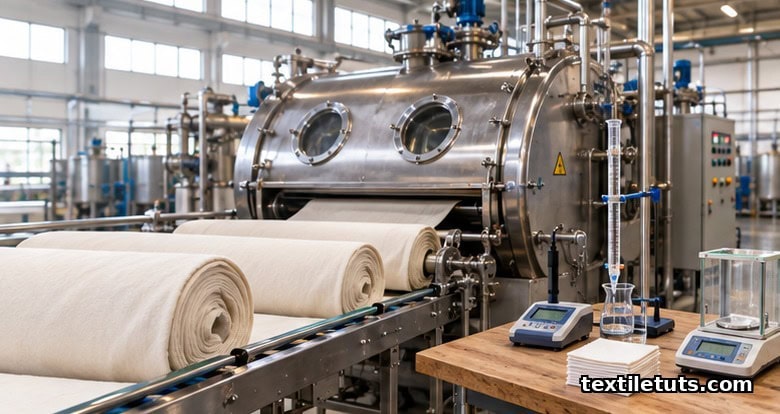
Pretreatment quality control rejects any cotton fabric that carries more than 1.0% residual sizing, registers a pH outside the 6.0–7.5 range on the aqueous extract, or scores below a 5-second drop absorbency on AATCC Test Method 79, because these three checkpoints together catch roughly 80% of downstream dyeing and printing defects before the dyehouse ever sees the cloth.
For a woven cotton mill running at 30,000 m per day, pretreatment is the gate between a grey loom-state fabric and the reactive-dye range; every kilogram of impurity left on the fibre translates directly into shade variation, dye wastage, and rejected lots.
This article walks through the four pretreatment stages (desizing, scouring, bleaching, mercerizing) with the specific process parameters a quality team needs to verify, the standard test methods that quantify each property, and the defect classes that almost always trace back to a missed QC checkpoint.
What Pretreatment QC Actually Covers
Pretreatment quality control is the systematic measurement of chemical, physical, and surface properties of grey fabric after each wet-processing stage, against written acceptance criteria, before that fabric is released to the dyehouse. It spans four stage-gates: desizing, scouring, bleaching, and (for mercerized cotton) mercerizing. Each gate has three things to verify: the chemistry did what it was supposed to do, the chemistry did not damage the fibre, and the fabric is in a state the next stage can rely on.
The cost of skipping any gate is rarely visible in pretreatment itself; it shows up as a 3–5% first-quality loss in the dyehouse or a 30-second shade mismatch on a customer-approved lab-dip. Mills that operate without written QC limits at the bleaching stage typically discover the problem only when the dyehouse starts rejecting lots, by which point tens of thousands of metres of fabric have been processed.
Stage 1: Desizing QC
Desizing removes the warp sizing (starch, PVA, CMC, or acrylic) that was applied during weaving to protect the yarn from abrasion. The QC goal is residual size less than 1.0% on the fabric weight, because anything above that will block dye molecules from reaching the fibre and produce unlevel or pale dyeing.
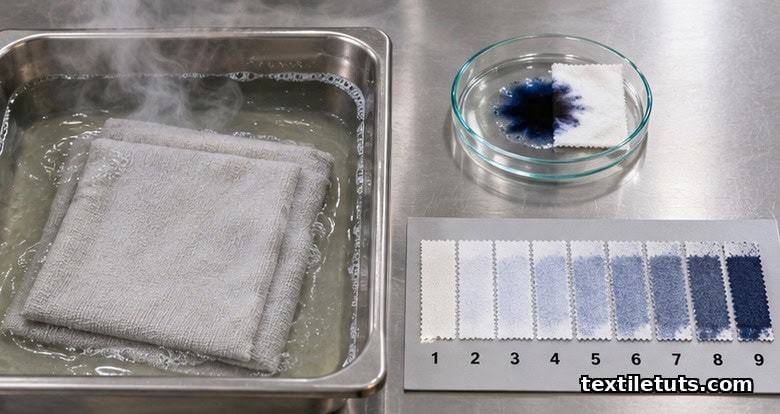
The standard test is AATCC Test Method 97 (Extractable Matter in Textiles), which determines how much non-fibrous material remains by solvent extraction; for size-only testing, the TEGEWA rating (a 1–9 visual scale using an iodine-starch indicator) gives a fast shop-floor read in under five minutes. A TEGEWA of 1 corresponds to less than 0.4% residual size, which is the release criterion most export mills use.
Process parameters that the QC team should be spot-checking: enzyme desizing runs at 50–70 °C for 30–60 minutes at pH 5.5–7.0; oxidative desizing with hydrogen peroxide and a persulphate activator runs at 80–95 °C and must be fully rinsed before the next stage, or the carry-over will consume the scouring alkali.
Stage 2: Scouring QC
Scouring removes the natural impurities of cotton: waxes (0.4–1.0%), pectins (0.4–1.2%), proteins (1.0–1.5%), and mineral salts. The QC release criterion is a weight loss of 4.0–8.0% for knitted cotton and 6.0–10.0% for woven cotton, measured by conditioning the fabric to constant weight under ISO 139 standard atmosphere (20 °C, 65% RH) before and after the bath.
Absorbency is the second key check. AATCC Test Method 79 (Absorbency of Bleached Textiles) uses a drop of water placed on the fabric surface; a properly scoured fabric absorbs the drop in 1–5 seconds. Anything above 10 seconds means the waxes are still in place and the scouring bath did not reach its time-temperature target.
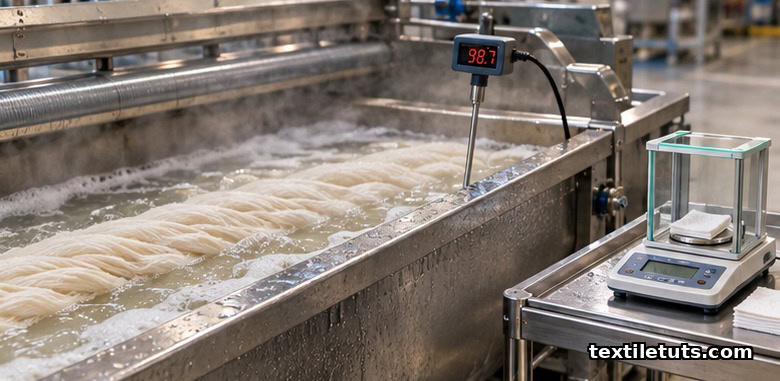
The bath itself runs at 80–100 °C with 2.0–4.0% sodium hydroxide on weight of fabric, plus a wetting agent and sequestrant; pH must hold at 12.0–13.5 throughout, and the liquor ratio (typically 1:6 to 1:10 for jet machines) is verified by direct metering because a wrong LR will swing effective concentration by 20–40%.
Stage 3: Bleaching QC
Bleaching decolorises the natural pigments and any residual lignin fragments left after scouring. Hydrogen peroxide bleaching (the standard for export cotton) runs at 80–95 °C with 2.0–4.0% H2O2 (35%), NaOH to maintain pH 10.5–11.0, and a stabiliser (typically sodium silicate at 0.5–1.0% on weight of fabric, or a biological alternative).
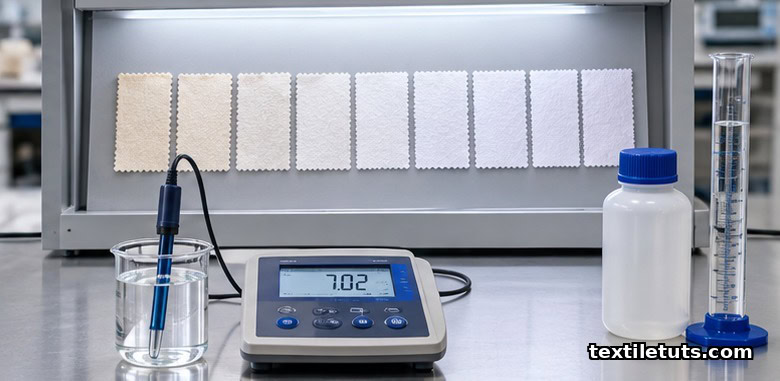
The release criterion is whiteness. AATCC Test Method 110 (Whiteness of Textiles) reports a Berger or Stensby whiteness index; export-oriented mills target a Berger whiteness of 75–85 for full-white and 65–75 for optical-white-with-fluorescent-brightener. The fabric pH on the aqueous extract, measured by ISO 3071 (pH of Aqueous Extracts of Textiles), must come out at 6.0–7.5: any residual alkali above pH 8.0 will hydrolyse reactive dyes during the next stage and shift the shade.
Two failure modes account for most bleaching rejects: residual H2O2 above 0.05% (which kills reactive dyes by oxidation, traced to insufficient rinsing or a missed peroxide-neutralising step with catalase or sodium hydrosulphite) and pinholes (small holes from localised over-bleaching when iron or copper contamination catalyses radical formation; iron above 50 ppm in the bath is the usual cause).
Stage 4: Mercerizing QC
Mercerizing treats cotton with 22–26% w/w sodium hydroxide at 15–25 °C for 30–60 seconds under tension. The QC release criterion is the barium activity number (AATCC Test Method 89), which must read above 140 for fully mercerized cotton; below 110, the luster and dye-uptake gains the mill is paying for are essentially zero.
Dimensional change is the second check: properly mercerized cotton shrinks 2–4% less in subsequent washing than unmercerized cotton, measurable by AATCC Test Method 135 (Dimensional Changes of Fabrics after Home Laundering). The fabric pH leaving the mercerizing range must again be neutralised to 6.0–7.5 by ISO 3071, because the residual alkali carries forward just as it does after bleaching.
Process Parameters Across the Four Stages
| Stage | Key chemical | Concentration (% on weight) | Temperature (°C) | pH | Release test | Pass criterion |
|---|---|---|---|---|---|---|
| Desizing (enzymatic) | Amylase enzyme | 0.5–2.0 | 50–70 | 5.5–7.0 | AATCC 97 / TEGEWA | Residual size <1.0%; TEGEWA 1 |
| Scouring | NaOH + wetting agent | 2.0–4.0 | 80–100 | 12.0–13.5 | AATCC 79; weight loss | Drop test ≤5 s; 4–10% loss |
| Bleaching | H2O2 35% | 2.0–4.0 | 80–95 | 10.5–11.0 | AATCC 110; ISO 3071 | Berger ≥75; pH 6.0–7.5 |
| Mercerizing | NaOH (conc.) | 22–26 (°Bé 30–35) | 15–25 | n/a (concentrated) | AATCC 89; AATCC 135 | Barium no. >140 |
In-Process and Lab Testing: What Runs Where
Two QC layers run in parallel. In-process tests are run by the production team at the machine every 30–60 minutes on a sample drawn from the bath, and answer: is the bath still doing its job? Lab tests are run by the quality lab on fabric samples taken at the end of each lot, and answer: is this lot fit to release?
In-process: temperature (calibrated thermometer or PT-100 probe), pH (buffered electrode, calibrated at pH 4, 7, and 10), and liquor concentration (by titration for NaOH and H2O2, or by refractive index for surfactants). Lab: AATCC Test Method 79 absorbency, AATCC Test Method 110 whiteness, ISO 3071 pH, AATCC Test Method 97 extractable matter, AATCC Test Method 135 dimensional change, and ASTM D629 (Quantitative Analysis of Textiles) for any blend-fibre verification. Sampling follows ISO 5089 (Sampling of Textile Fibres, Yarns, and Fabrics), typically one metre of fabric cut across the full width for every 1,000 m of production.
Common Defects That Trace Back to Pretreatment
Uneven or patchy dyeing almost always traces to under-scoured fabric; the wax and pectin residues block dye sites selectively, and the pattern on the finished fabric matches the scouring bath’s flow pattern. Weakened or tendered fabric (lower tear and tensile strength, measured by ASTM D5035) points to over-bleaching: either too much peroxide, too long a run time, or metal-catalysed radical attack. Yellowing in storage or during finishing points to residual alkali; the fabric left the bleaching range above pH 8.0 and slowly oxidised back to a cream shade. Stiff hand and poor drape on mercerized cotton mean the barium number never reached 140 and the cotton never fully converted from cellulose I to cellulose II.
Documenting the QC Trail
Every lot leaving each pretreatment stage carries a process card with bath number, time-temperature recording chart, pH log, in-process test results, and lab test results. The card is the legal proof that the fabric was processed correctly and is the document a buyer’s lab inspector will ask for if a finished-garment claim comes back. Mills exporting to the EU under OEKO-TEX Standard 100 must additionally retain these records for at least five years.
Frequently Asked Questions
What residual size percentage is acceptable after desizing?
For woven cotton going to reactive or vat dyeing, residual size must be below 1.0% on weight of fabric, equivalent to a TEGEWA rating of 1. Anything above 2.0% will produce visible unlevel dyeing on medium and dark shades, and above 4.0% the fabric should be re-desized rather than released.
Why does pH control matter so much after bleaching?
Reactive dyes form a covalent bond with cellulose under alkaline conditions. If residual alkali on the fabric exceeds pH 8.0 entering the dye bath, the dye hydrolyses in the liquor instead of fixing to the fibre, wasting 10–30% of the dye and producing weaker, faster-fading shades. ISO 3071 sets the release window at 6.0–7.5.
How is absorbency measured on pretreated fabric?
AATCC Test Method 79 places a single drop of distilled water from a fixed height onto a flat fabric sample and times how long it takes to be fully absorbed. A properly scoured and bleached cotton absorbs in 1–5 seconds; a scoured-only sample runs 5–10 seconds; an under-scoured sample takes more than 10 seconds and fails the release check.
What causes pinholes after bleaching?
Pinholes are localised over-bleaching from metal-catalysed decomposition of hydrogen peroxide. Iron above 50 ppm in the bath, copper contamination from piping, or rust particles falling into the bath all accelerate radical formation and burn small holes through the fabric. The fix is sequestrant dosing (EDTA or DTPA at 0.5–1.0 g/L) plus stainless-steel or fibre-reinforced plastic piping throughout the bleach range.
How often should pretreatment QC samples be drawn?
In-process samples (pH, temperature, liquor concentration) every 30–60 minutes per machine; lab samples for absorbency, whiteness, and pH on the fabric at least once per lot, where a lot is typically 1,000–3,000 m of fabric. For export orders, OEKO-TEX audits will check that the lot-level sampling rate matches the mill’s documented QC plan.
References
- AATCC. Test Method 79: Absorbency of Bleached Textiles. AATCC Technical Manual, Research Triangle Park, NC: American Association of Textile Chemists and Colorists.
- AATCC. Test Method 97: Extractable Matter in Textiles. AATCC Technical Manual, Research Triangle Park, NC: American Association of Textile Chemists and Colorists.
- AATCC. Test Method 110: Whiteness of Textiles. AATCC Technical Manual, Research Triangle Park, NC: American Association of Textile Chemists and Colorists.
- ISO. ISO 3071:2020, Textiles — Determination of pH of Aqueous Extract. Geneva: International Organization for Standardization.
- ASTM. ASTM D629-15, Standard Test Methods for Quantitative Analysis of Textiles. West Conshohocken, PA: ASTM International.
- AATCC. Test Method 135: Dimensional Changes of Fabrics after Home Laundering. AATCC Technical Manual, Research Triangle Park, NC: American Association of Textile Chemists and Colorists.
- ISO. ISO 139:2005, Textiles — Standard Atmospheres for Conditioning and Testing. Geneva: International Organization for Standardization.
This article is the working reference for pretreatment quality control in woven and knitted cotton. Editorial by Shahrukh Islam, TextileTuts. Sources: AATCC Test Methods 79, 97, 110, 135; ISO 3071 and ISO 139; ASTM D629, as cited.


