
Combined Pretreatment Processes

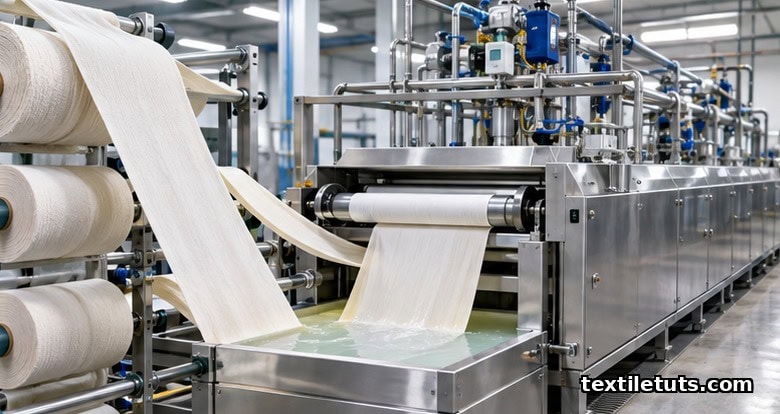
Combined (one-bath) pretreatment replaces the conventional three-step desizing, scouring, and bleaching sequence with an integrated scouring-bleaching bath that runs at 90 to 98 °C, cuts water use by 40 to 60 %, and shortens total cycle time by 30 to 50 % on 100 % cotton woven and knit fabrics. The economic logic is straightforward: each wet step after the padder carries its own rinse, its own steam bill, and its own effluent load, so collapsing two or three steps into a single hot bath directly shrinks a plant’s utility footprint.
For a dyeing-floor engineer, the practical question is whether the shorter process still hits the absorbency, residual-size, and whiteness targets that downstream reactive, vat, and disperse dyeing demand. This article walks through the chemistry of the three combined-process families, the temperature-time profiles that work on cotton and cotton-polyester blends, and the AATCC and ISO lab tests that confirm a fabric is truly ready for the dye bath.
Why Pretreatment Steps Get Combined
Cotton arrives from the loom or knitting machine coated with three things the dye bath cannot tolerate: a sizing film (PVA, starch, CMC, or acrylic from the warp), a thin layer of natural non-cellulosics (waxes, pectins, proteins, motes), and a creamy-yellow pigment from flavonoid chromophores. Conventional pretreatment removes them in three sequential hot baths: amylase desizing at 60 to 80 °C, alkali scouring with sodium hydroxide at 90 to 100 °C, and oxidative bleaching with hydrogen peroxide at 90 to 95 °C, each followed by a hot rinse.
The combined approach is not new; one-bath scouring-bleaching recipes appeared in the technical literature in the 1980s, but only became commercially standard after the 2010s as peroxide stabilizers and surfactant packages matured enough to keep cellulose intact during the shortened high-pH soak. The economic driver behind adoption is well-documented: peer-reviewed studies on cotton knit lines report a 35 to 50 % drop in water use and a comparable reduction in thermal energy when a one-bath scouring-bleaching sequence replaces the conventional three-bath sequence with hydrogen peroxide as the bleach.
The Three Families of Combined Pretreatment
Three process families dominate industrial practice. They differ in how thoroughly they consolidate the conventional steps and in what they demand of the fabric.
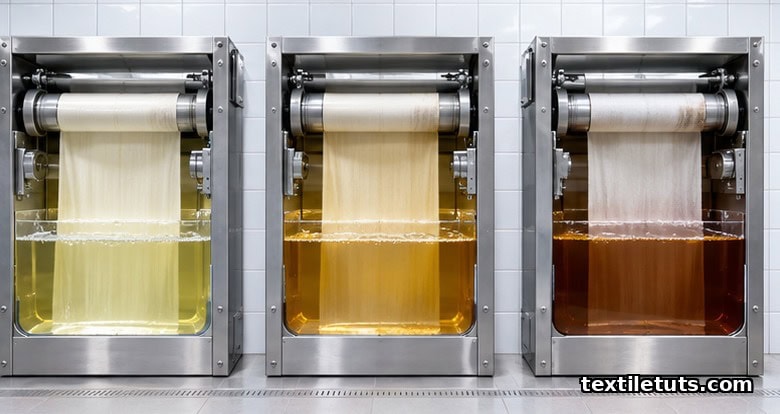
Desizing-scouring (D-S): amylase enzymes, sodium hydroxide at 1.0 to 2.5 % on weight of fabric, a non-ionic wetting agent, and a chelating agent run together at 70 to 90 °C for 30 to 60 minutes. This is the lowest-risk combined process because it skips bleaching, preserves fiber strength, and is widely used on cotton-polyester blends where the polyester component would otherwise yellow under peroxide. Residual size is checked by the AATCC Test Method 79 drop test or by solvent extraction per ASTM D2257.
Scouring-bleaching (S-B): sodium hydroxide at 1.5 to 3.5 %, hydrogen peroxide at 2.0 to 5.0 % of a 35 % H2O2 stock, sodium silicate or an organic stabilizer, and a wetting agent run in a single bath at 90 to 98 °C for 45 to 90 minutes. This is the most common industrial one-bath process for 100 % cotton woven shirting and sheeting. Whiteness is typically measured on a spectrophotometer against a magnesium-oxide reference using Berger whiteness (ISO 2470 family).
Desizing-scouring-bleaching (D-S-B): a single bath that tries to run all three stages at once. It is the most aggressive, requires the tightest control of pH (10.8 to 11.2), temperature (95 to 98 °C), and stabilizer loading, and is most common on continuous pad-steam ranges where dwell time is fixed at 20 to 45 minutes rather than 60 to 90 minutes in a jet machine.
Process Variables That Decide Whether the Bath Works
Five variables separate a successful combined bath from a costly re-do:
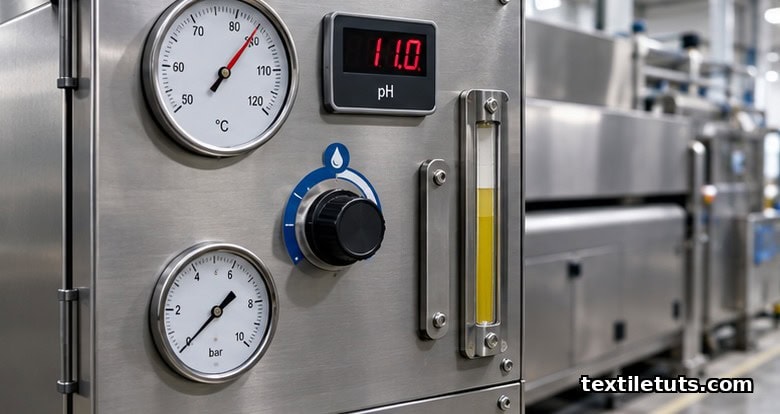
1. Temperature. Hydrogen peroxide decomposes rapidly above 100 °C, and cotton scouring falls off sharply below 85 °C because waxes and pectins only saponify at near-boiling temperatures. The workable window for a one-bath process is 90 to 98 °C; below 90 °C the bath loses scouring efficiency, and above 98 °C peroxide decomposition outruns the bleach effect and wastes chemical.
2. Stabilizer system. Without a stabilizer, hydrogen peroxide decomposes to oxygen and water instead of bleaching, and the exothermic decomposition damages cellulose. Sodium silicate at 5 to 10 g/L was the original choice; modern lines substitute magnesium sulfate plus an organic phosphonate, or a sodium gluconate-based stabilizer that does not deposit silica scale on rollers.
3. Wetting agent. A non-ionic surfactant at 0.5 to 2.0 g/L pulls the alkaline bath into the fiber lumen and replaces the hydrophobic wax film with a water-wet surface. Cationic wetting agents are avoided in a peroxide bath because they accelerate peroxide decomposition.
4. Sequestering agent. Calcium, magnesium, and especially iron ions in the process water catalyze peroxide decomposition and cause pinhole damage on the fabric. EDTA (ethylenediaminetetraacetic acid) or DTPA (diethylenetriaminepentaacetic acid) at 0.5 to 1.0 g/L chelates these metals before they enter the bath.
5. Mechanical action. A jet dyeing machine provides softer mechanical action than a winch and suits knit fabrics; a continuous pad-steam range with low-tension rollers suits woven fabrics where length stability matters. Too little agitation leaves unscoured patches; too much raises pilling on knits.
How Cotton and Cotton-Polyester Behave Differently
On 100 % cotton, a one-bath scouring-bleaching recipe typically delivers a Berger whiteness of 65 to 75 and a drop-test absorbency under 3 seconds (AATCC TM 79), which is the standard reactive-dyeing precondition. Residual size falls below 1 % by solvent-extractable method.
On a 65/35 cotton-polyester blend, the same recipe underperforms because polyester absorbs little alkali and contributes its own yellow tint from oligomers and delustrant. Mills usually add an optical brightener (0.1 to 0.3 % owf, typically a stilbene disulfonate) to the combined bath, or run the blend through an additional reduction clear with sodium hydrosulfite after dyeing.
Lab Tests That Verify a Combined Bath Did the Job
Three tests, all standards-traceable, are used in the plant lab after a combined pretreatment:
- AATCC TM 79 (Absorbency): the time for a drop of water to wet the fabric, in seconds. A well-prepared fabric scores under 3 s; a poorly scoured fabric takes 30 s or more.
- AATCC TM 97 (Extractable Matter): quantifies residual wax, pectin, and oil as a percentage of fabric mass; well-scoured cotton drops below 0.5 %.
- ISO 2470 (Whiteness): measures reflectance at 457 nm and reports Berger whiteness on a 0 to 100 scale; a typical target for white shirting is 75 to 80.
Residual size, when relevant, is confirmed by solvent extraction and weighing per ASTM D2257 (Standard Test Method for Extractable Matter in Textiles), or by the qualitative iodine-staining protocol widely used for shop-floor screening.
Conventional vs Combined Pretreatment at a Glance
| Parameter | Conventional 3-step | Combined S-B | Combined D-S-B |
|---|---|---|---|
| Number of wet baths | 3 (desize, scour, bleach) | 2 (scour + bleach) | 1 |
| Water use (L/kg fabric) | 80 to 110 | 45 to 70 | 30 to 50 |
| Cycle time (min) | 180 to 240 | 100 to 150 | 60 to 90 |
| Process temperature (°C) | 60 / 95 / 95 | 90 to 98 | 95 to 98 |
| Hydrogen peroxide (%) | 2 to 3 | 3 to 5 | 4 to 6 |
| Sodium hydroxide (%) | 1.5 to 2.5 (scour only) | 1.5 to 3.5 | 2.0 to 4.0 |
| Berger whiteness | 72 to 80 | 65 to 75 | 62 to 72 |
| Drop-test absorbency (s) | ≤ 3 | ≤ 3 | ≤ 5 |
| Best fit | Critical-whiteness orders | Reactive-dyed cotton | Continuous pad-steam woven |
Common Defects When the Bath Runs Off-Spec
Three predictable failure modes show up in the lab when a combined bath drifts:
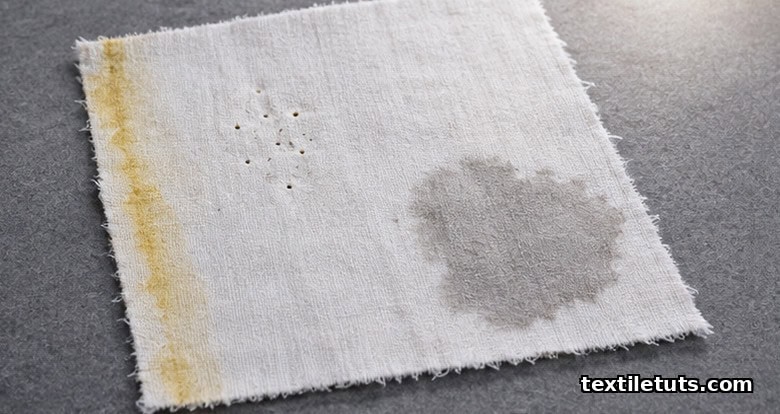
Peroxide yellowing. If the bath cools below 80 °C before the peroxide is fully consumed, residual peroxide oxidizes phenolic groups in the cotton and the fabric yellows during drying. A hot rinse at 85 to 90 °C after the bath clears the residual peroxide.
Pinholes. Iron contamination above 0.5 ppm in the process water catalyzes localized peroxide decomposition. Pinholes appear within minutes. A bath-side iron test with 1,10-phenanthroline catches the contamination before the fabric is loaded.
Uneven absorbency. If the wetting agent is short-dosed or if the bath pH drops below 10.5, the fabric shows wicking patches. Raising surfactant to 1.5 g/L and pH to 11.0 typically clears the issue on the next run.
Environmental Footprint
A combined scouring-bleaching bath reduces effluent volume by 40 to 60 % and lowers total dissolved solids by a comparable margin because the rinses after scouring and bleaching are merged. Chemical oxygen demand (COD) per kilogram of fabric falls by 25 to 35 %, mostly because the intermediate rinse between scouring and bleaching is eliminated. For a mill running 20 tons of cotton knit per day, this is the difference between roughly 1,600 m³ and 800 m³ of effluent per day.
Frequently Asked Questions
What is combined pretreatment in textile processing?
Combined pretreatment integrates two or three of the conventional preparatory steps (desizing, scouring, and bleaching) into a single bath to reduce water, energy, and process time. The most common industrial variants are desizing-scouring on cotton-polyester blends and scouring-bleaching on 100 % cotton woven and knit fabrics.
Which combined process works best for cotton knit fabrics?
Scouring-bleaching (S-B) is the standard one-bath recipe for cotton knits, run at 90 to 98 °C for 45 to 90 minutes with sodium hydroxide, hydrogen peroxide, a peroxide stabilizer (sodium silicate or magnesium-organic), a non-ionic wetting agent, and a chelating agent. Jet machines are preferred over winches because the gentler mechanical action reduces pilling.
Can a combined bath damage cotton fiber strength?
It can if the bath runs above 100 °C, if peroxide stabilizer loading is too low, or if iron contamination from process water is not chelated. Within the 90 to 98 °C window with proper stabilizer and EDTA at 0.5 to 1.0 g/L, the loss in cellulose degree of polymerization is comparable to a conventional three-step sequence, generally below 5 %.
How do you know the combined bath did its job?
Three plant-lab tests confirm it: AATCC TM 79 (drop-test absorbency, target under 3 s), AATCC TM 97 (extractable matter, target below 0.5 %), and ISO 2470 whiteness (Berger, target 65 to 80 depending on the shade). Residual size, when relevant, is checked by solvent extraction per ASTM D2257 or by qualitative iodine staining.
Is combined pretreatment cheaper than the conventional three-step process?
It is cheaper to run per kilogram of fabric because it uses less water, less steam, less rinse liquor, and fewer rinse cycles, typically saving 30 to 50 % on cycle time and 40 to 60 % on water. It is not always cheaper per unit of whiteness: critical-whiteness orders (white shirting above Berger 80) usually still require the conventional three-step sequence or an extra bleach pass.
References
- American Association of Textile Chemists and Colorists. AATCC Test Method 79: Absorbency of Textiles. AATCC, Research Triangle Park, NC, 2014. https://www.aatcc.org/testing/test-methods/ The drop test method and timing used to score pretreated fabric for downstream dye readiness.
- American Association of Textile Chemists and Colorists. AATCC Test Method 97: Extractable Matter. AATCC, Research Triangle Park, NC. https://www.aatcc.org/testing/test-methods/ The standard method for residual wax, pectin, and oil measurement on cotton.
- ASTM International. ASTM D2257-20: Standard Test Method for Extractable Matter in Textiles. ASTM International, West Conshohocken, PA, 2020. https://www.astm.org/d2257-20.html The solvent-extraction reference for residual-size and finish quantification.
- International Organization for Standardization. ISO 2470-1:2016 Paper, Board and Pulps — Measurement of Diffuse Blue Reflectance Factor (ISO Brightness). ISO, Geneva, 2016. https://www.iso.org/standard/55901.html The Berger whiteness reference method adopted by textile QC labs.
- Karmakar, S. R. Chemical Technology in the Pretreatment Processes of Textiles. Elsevier Science, Amsterdam, 1999. A standard textile-engineering reference covering combined scouring-bleaching recipes, stabilizer chemistry, and process calculations on cotton and blends.
- Choudhury, A. K. Roy. Textile Preparation and Dyeing. Science Publishers, Enfield, NH, 2011. A detailed industrial reference on combined desizing-scouring-bleaching sequences for woven and knit cotton, including jet and pad-steam profiles.
Editorial by Shahrukh Islam, TextileTuts. Sources: AATCC TM 79, AATCC TM 97, ASTM D2257, ISO 2470-1, and Karmakar (1999) and Choudhury (2011) as cited.


